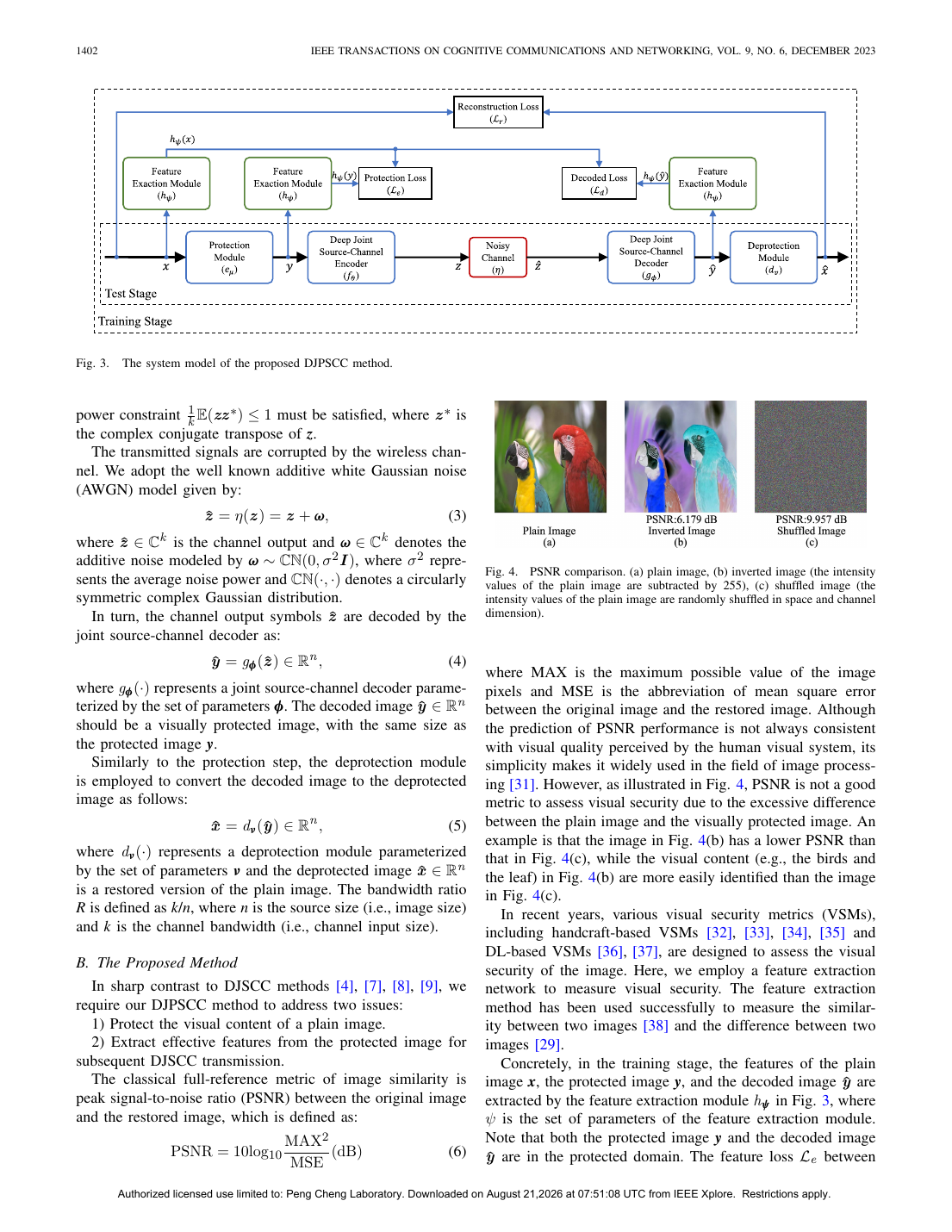
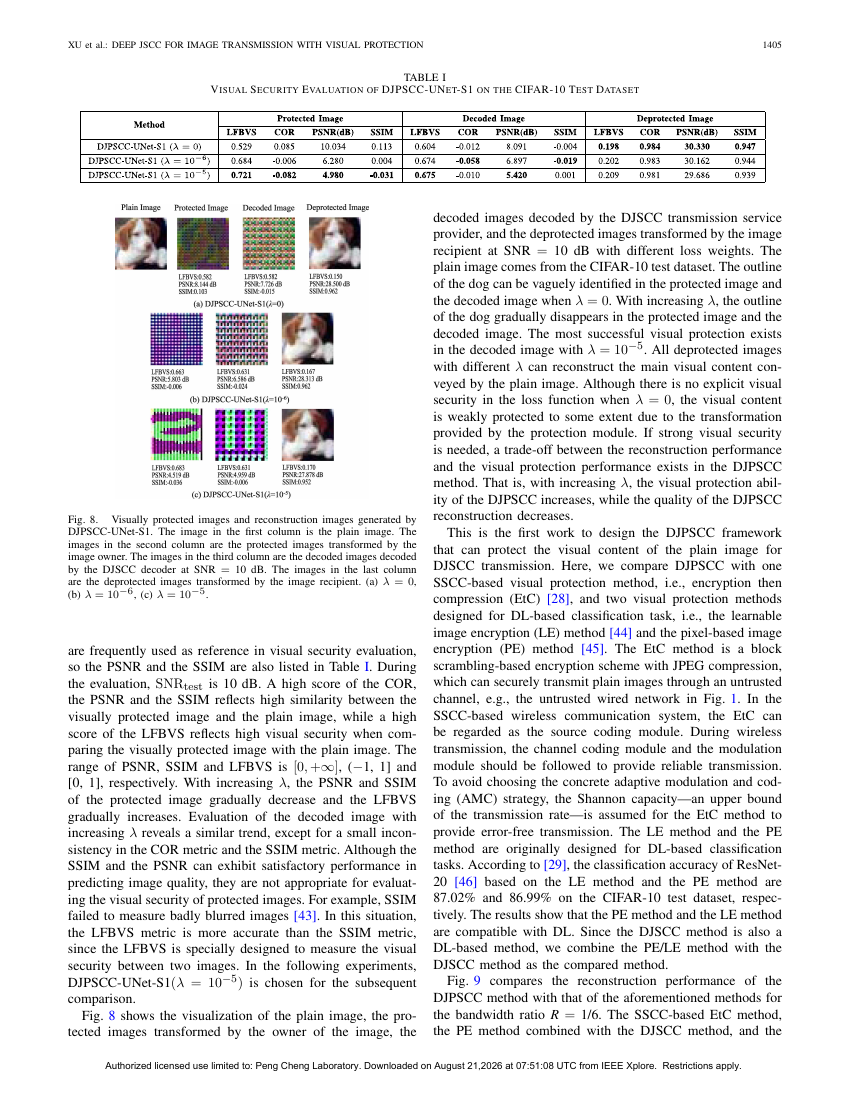
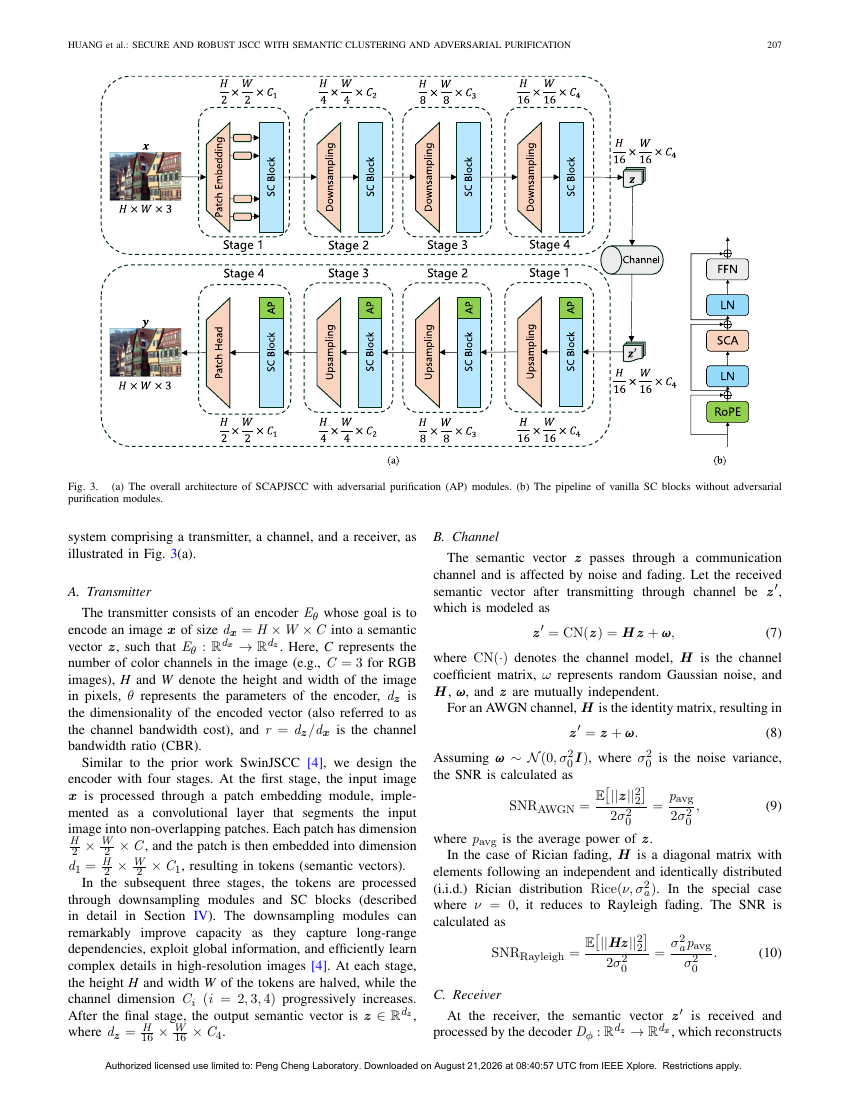
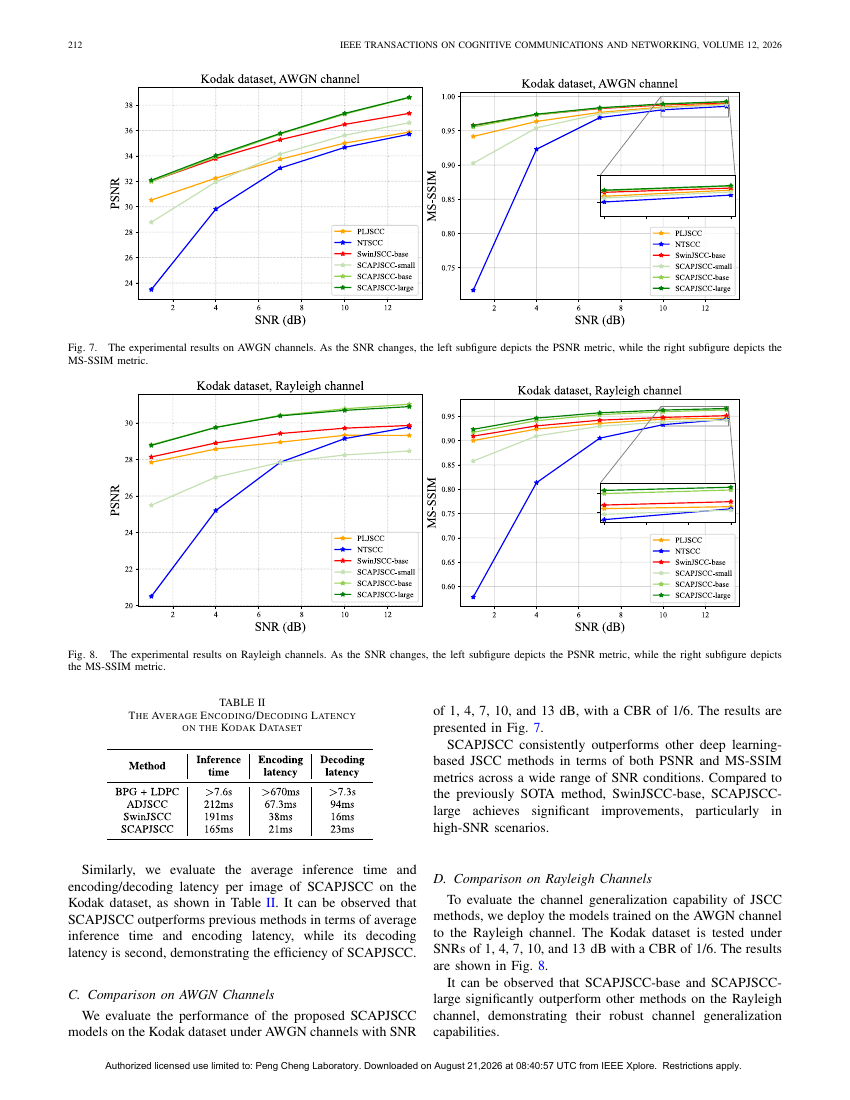
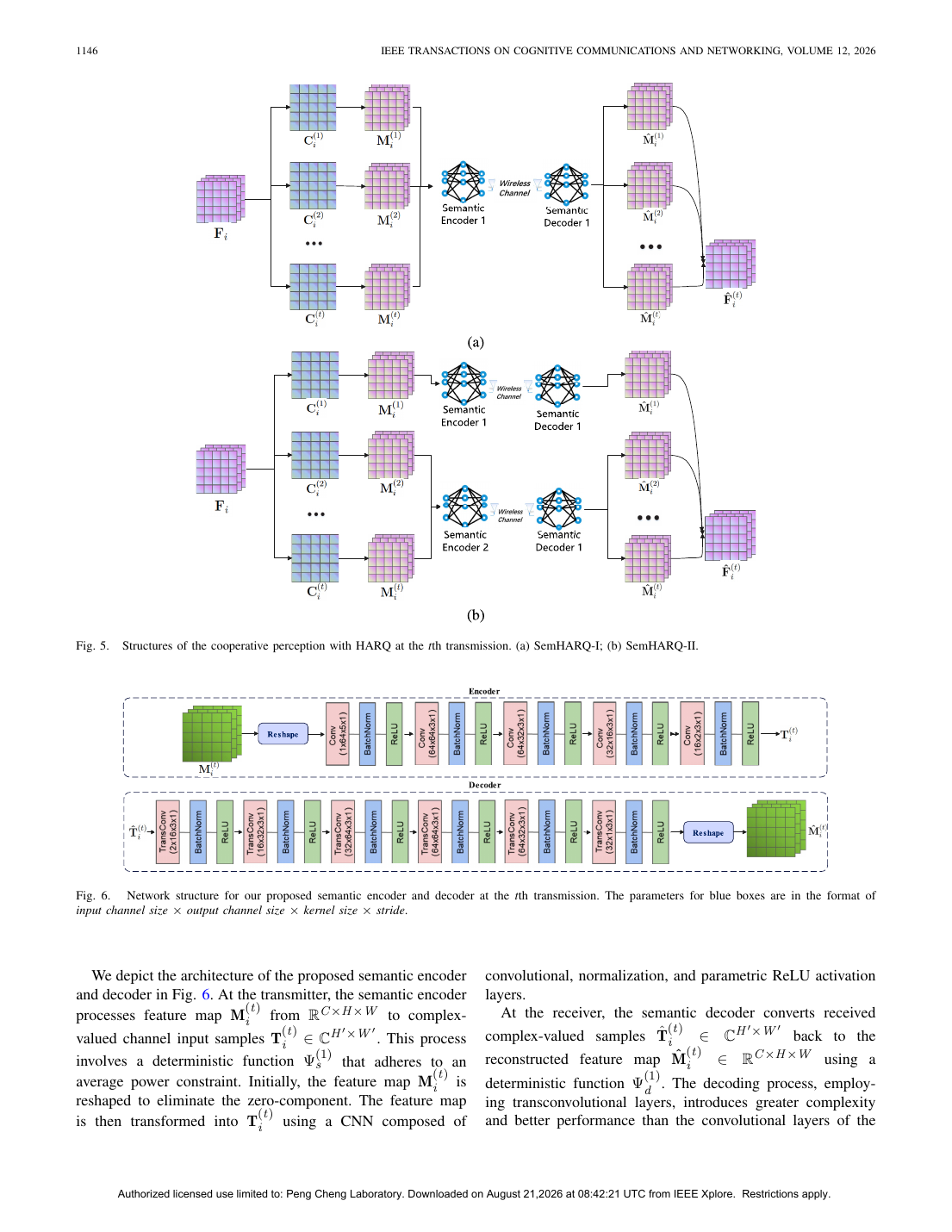
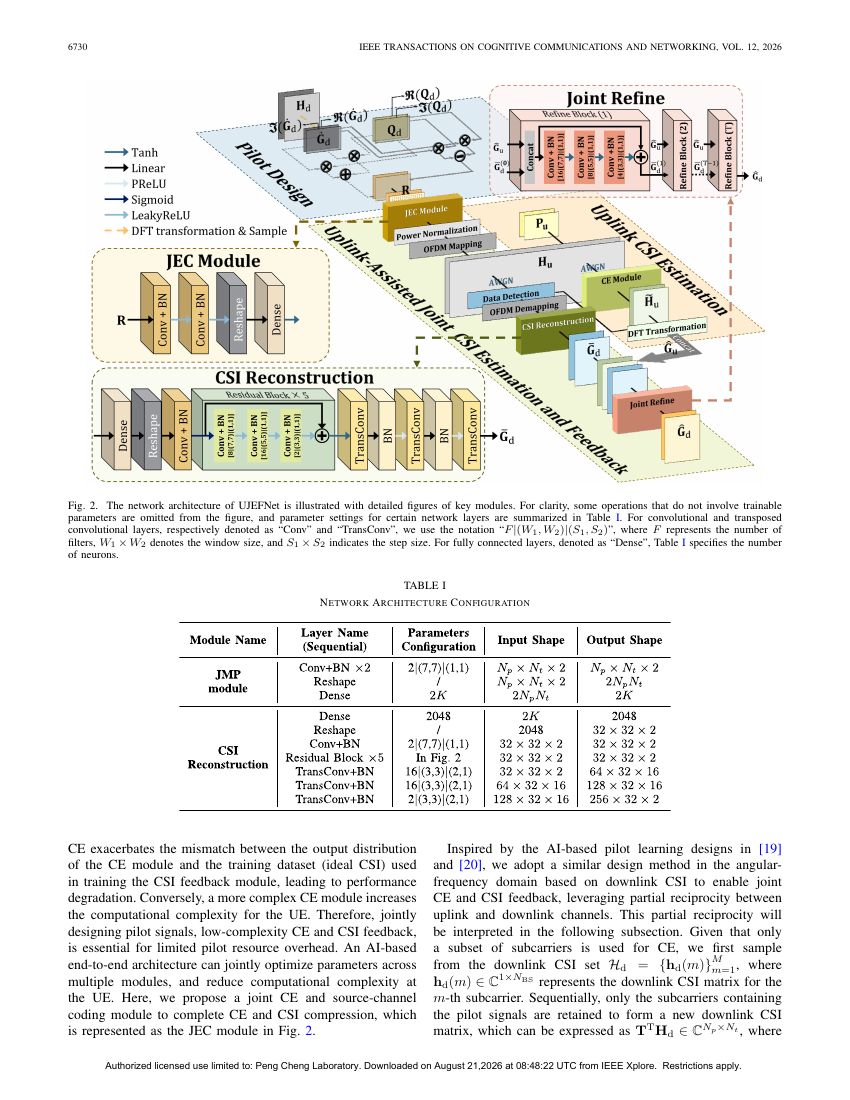
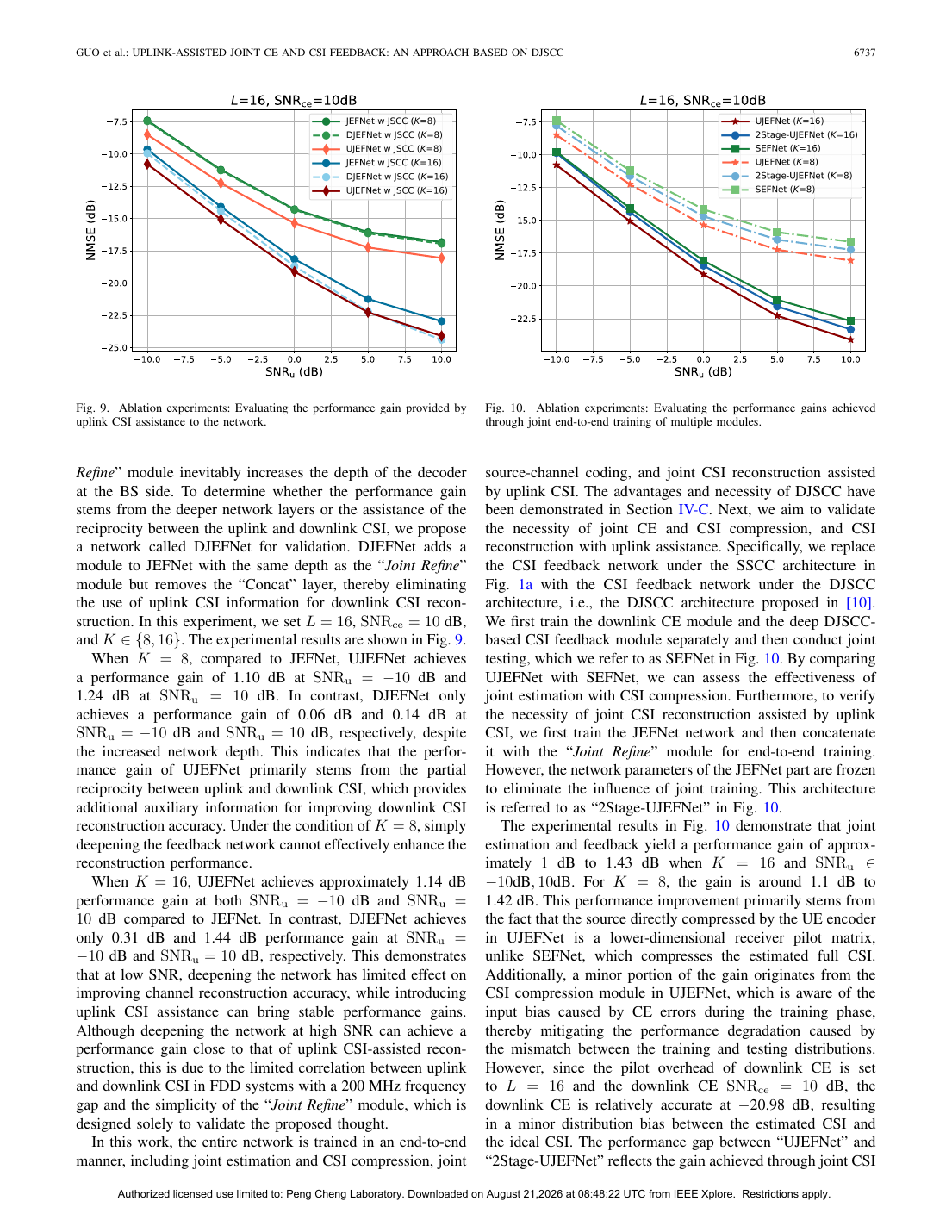
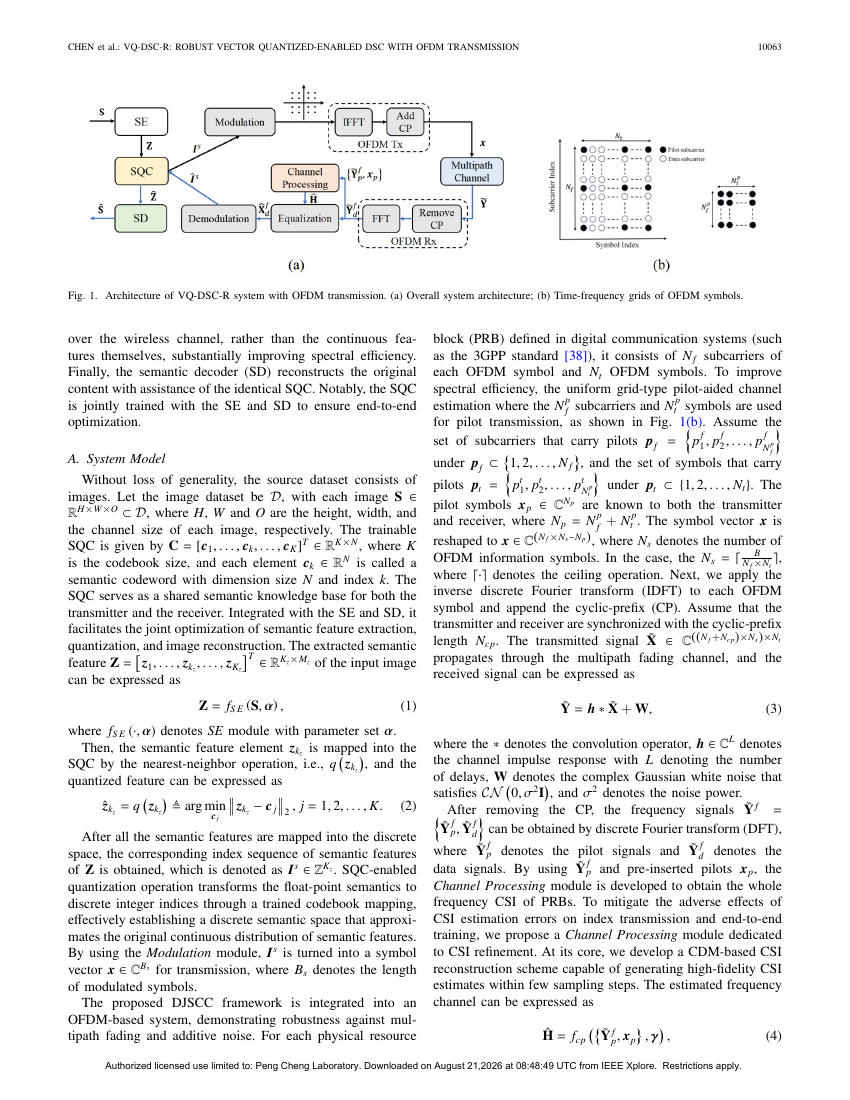
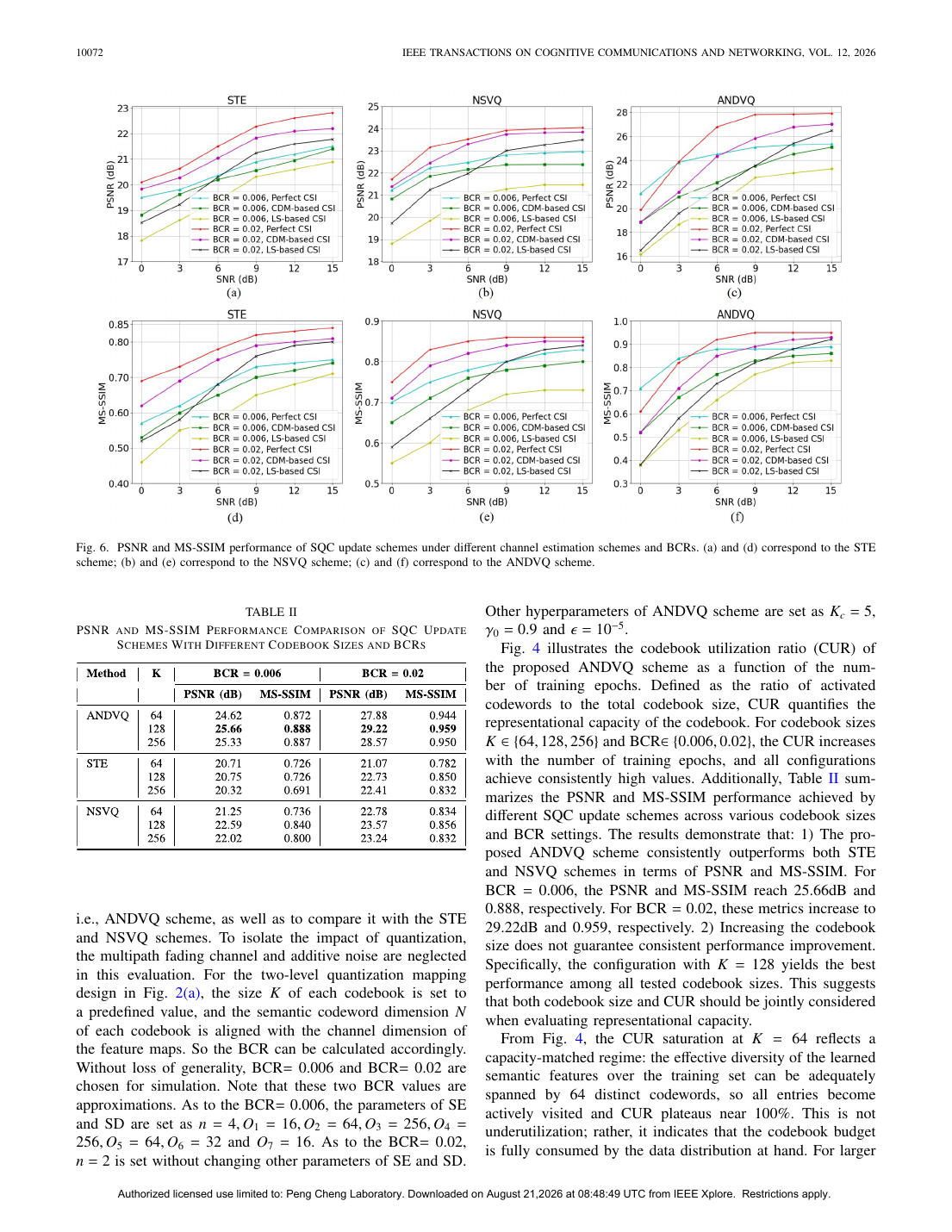
架构/方法图|来源:《Deep Joint Source-Channel Coding for Image Transmission With Visual Protection》,原 PDF p.4,Fig. 3 The system model of the proposed DJPSCC method。 核对论文关键实验结果图/表|来源:《Deep Joint Source-Channel Coding for Image Transmission With Visual Protection》,原 PDF p.7,Fig. 9 compares the reconstruction performance of the comparison. DJPSCC method with that of the aforementioned methods for 核对论文
核心纳入2023通用语义通信系统
Joint Source-Channel Coding for a Multivariate Gaussian Over a Gaussian MAC Using Variational Domain Adaptation
局限:没有完整离散接口,无法直接回答 bit/index/token 跳变问题。 未显式注入离散误码/丢包,鲁棒性结论不应外推到真实数字链路。 未报告统一可复核的 payload bit 数/CBR,跨论文带宽比较受限。
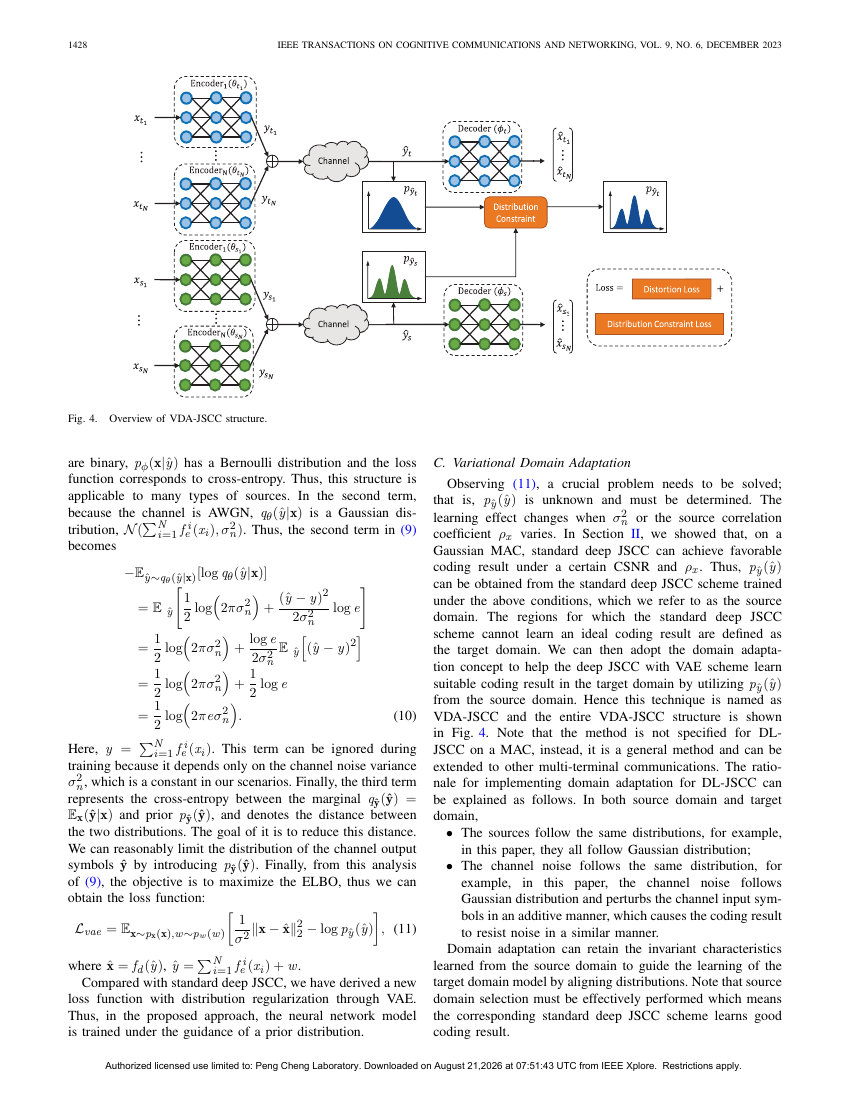
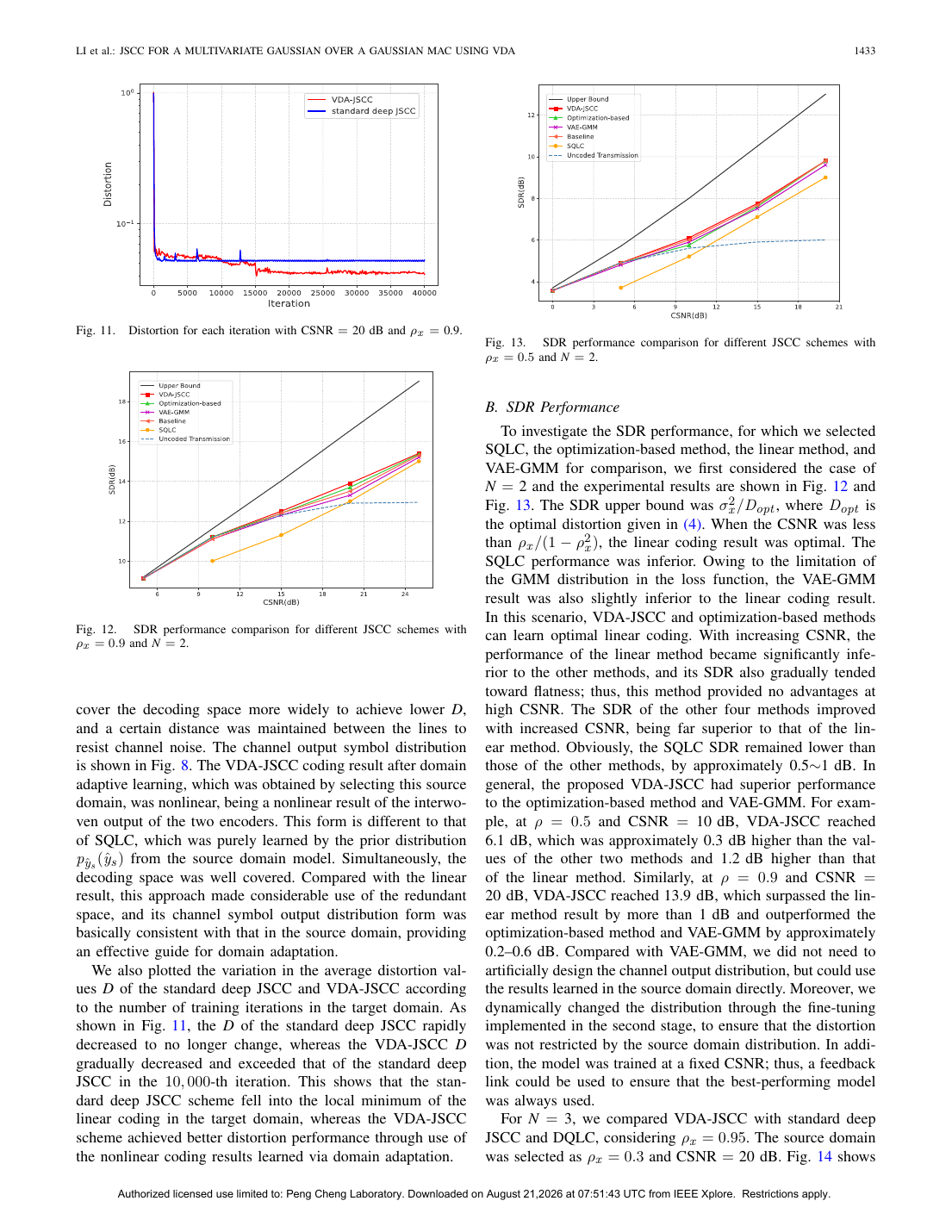
架构/方法图|来源:《Joint Source-Channel Coding for a Multivariate Gaussian Over a Gaussian MAC Using Variational Domain Adaptation》,原 PDF p.5,Fig. 4 Overview of VDA-JSCC structure。 核对论文关键实验结果图/表|来源:《Joint Source-Channel Coding for a Multivariate Gaussian Over a Gaussian MAC Using Variational Domain Adaptation》,原 PDF p.10,Fig. 13 SDR performance comparison for different JSCC schemes with ρx = 0.5 and N = 2。 核对论文
核心纳入2023任务导向推理
Neuromorphic Wireless Cognition: Event-Driven Semantic Communications for Remote Inference
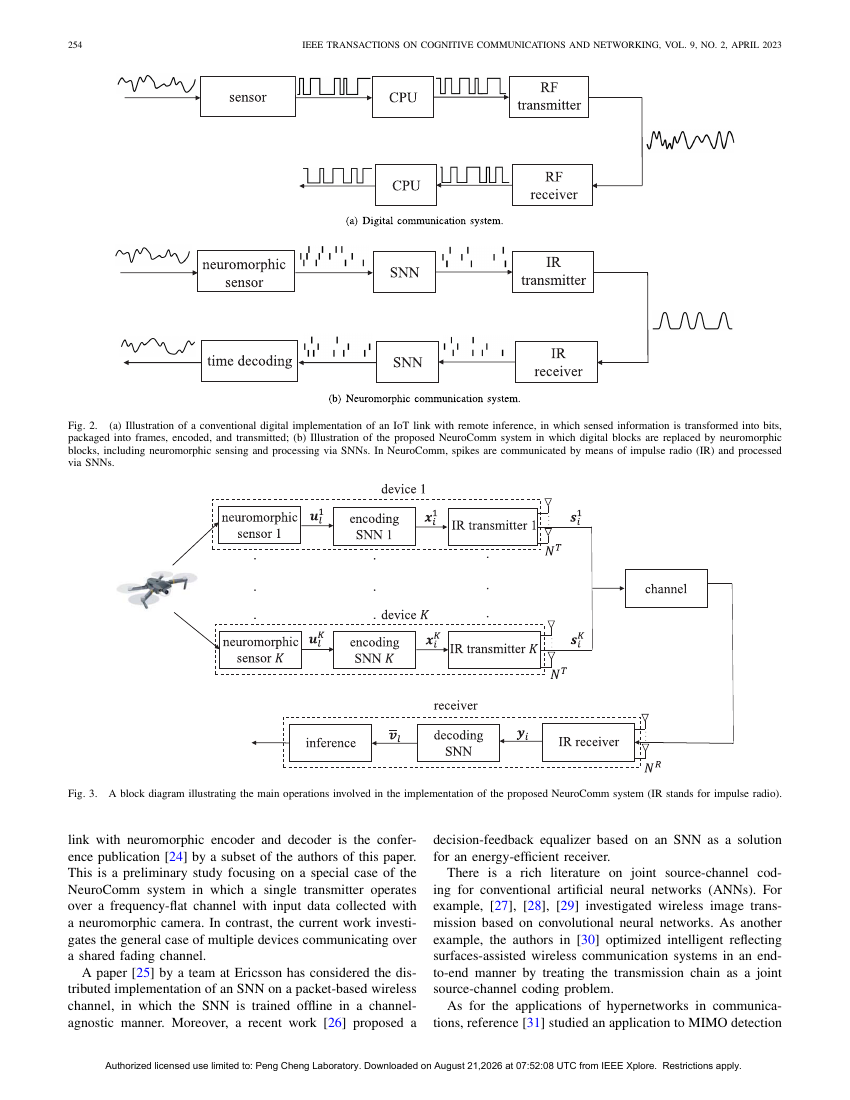
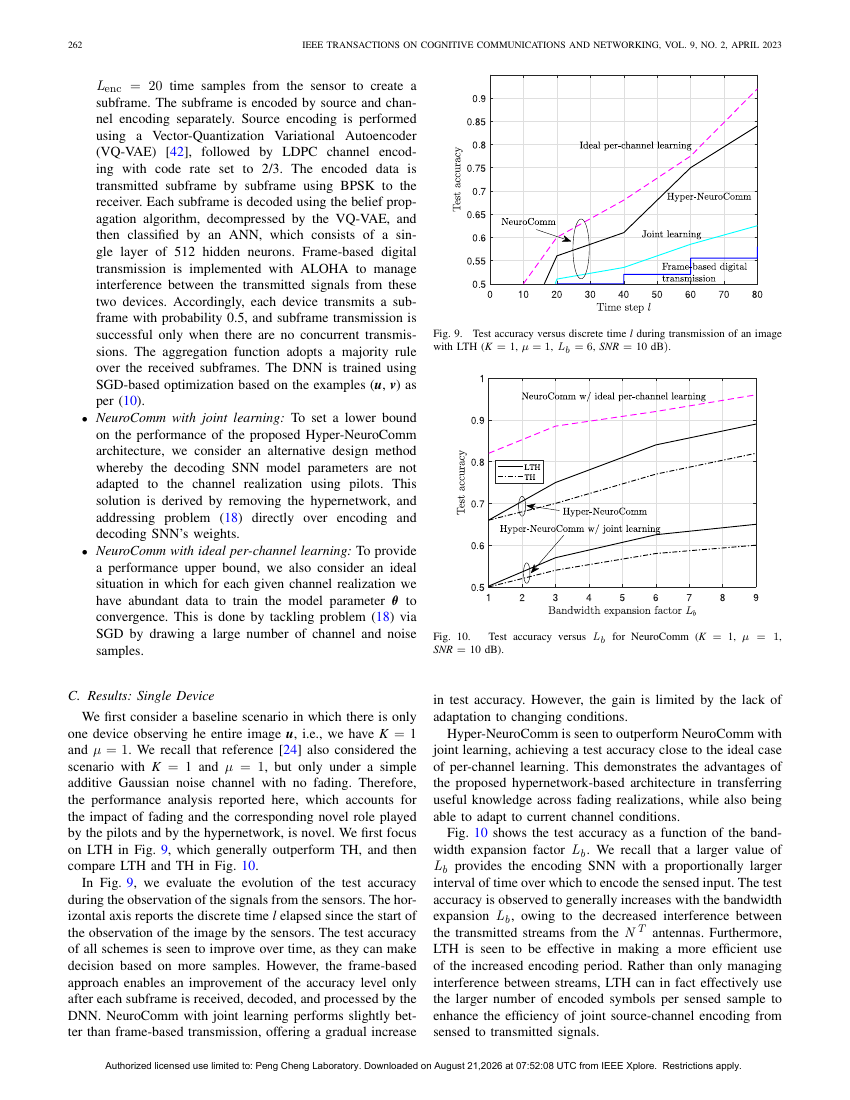
架构/方法图|来源:《Neuromorphic Wireless Cognition: Event-Driven Semantic Communications for Remote Inference》,原 PDF p.3,Fig. 3 A block diagram illustrating the main operations involved in the implementation of the proposed NeuroComm system (IR stands for impulse radio)。 核对论文关键实验结果图/表|来源:《Neuromorphic Wireless Cognition: Event-Driven Semantic Communications for Remote Inference》,原 PDF p.11,Fig. 10 Test accuracy versus Lb for NeuroComm (K = 1, μ = 1, samples. SNR = 10 dB)。 核对论文
核心纳入2023语义信息度量与理论
Non-Orthogonal Multiple Access Enhanced Multi-User Semantic Communication
数据集为MNIST、Europarl;实验小节中明确出现的比较对象包括DeepJSCC、JPEG、LDPC、Turbo、QAM、NOMASC、JSCC、Huffman;指标包括PSNR、SSIM、MSE、mAP、accuracy、MACs、BLEU、PER;信道/链路条件包括AWGN、Rayleigh、NOMA、channel estimation、fading channel。 PDF p.10
仿真结果表明,该系统在非正交多用户信号传输中具有良好的性能,尤其是在中低信噪比时,性能优于其他方法。 PDF p.1
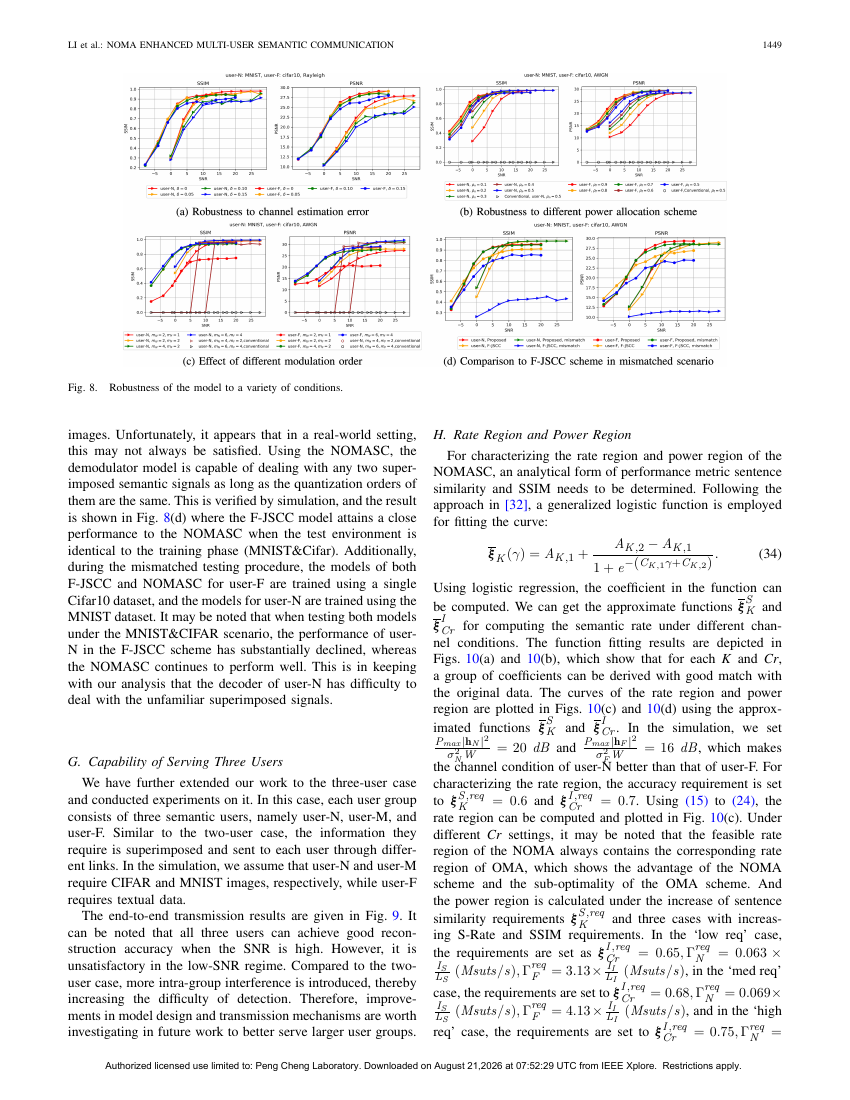
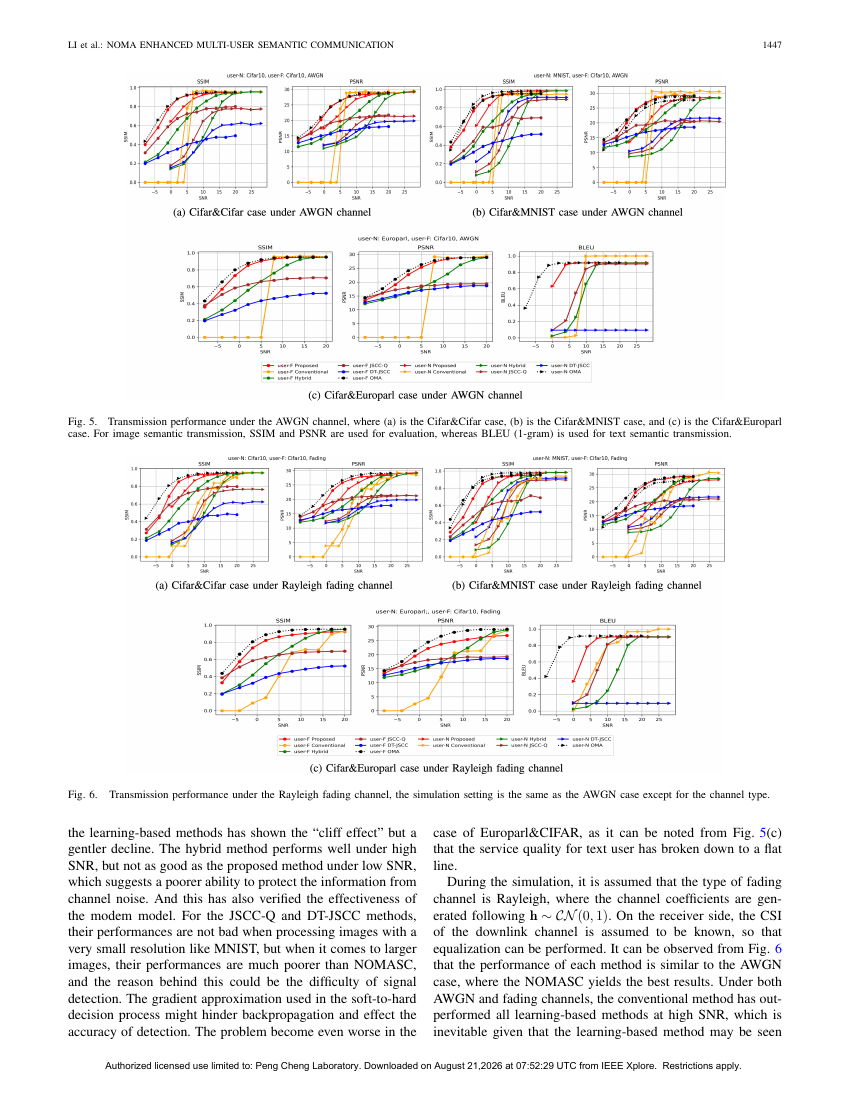
架构/方法图|来源:《Non-Orthogonal Multiple Access Enhanced Multi-User Semantic Communication》,原 PDF p.12,Fig. 8 Robustness of the model to a variety of conditions。 核对论文关键实验结果图/表|来源:《Non-Orthogonal Multiple Access Enhanced Multi-User Semantic Communication》,原 PDF p.10,Fig. 6 Transmission performance under the Rayleigh fading channel, the simulation setting is the same as the AWGN case except for the channel type。 核对论文
核心纳入2023通用语义通信系统
Semantics-Native Communication via Contextual Reasoning
现有进展:最近,机器学习(ML)通过恢复比特的语义在提高通信效率方面显示出其有效性。 PDF p.1
仍然存在的问题:然而,现有的SC研究通常假设每个听者的解码过程只是其发言者的编码过程的镜像。 PDF p.1
为什么已有方法解决不了:分离压缩与信道编码优化的是中间 bit 可靠性,未必等价于本文关心的语义/任务质量;反过来,只做端到端网络而不交代带宽、功率和信道作用点也无法形成公平通信比较。 PDF p.1
为什么这个问题重要:语义质量必须在真实的带宽、功率和时延预算下成立,否则模型收益不能转化为通信系统收益。 PDF p.1
本文提出什么:为此,受语言学和信息论的启发,我们提出了一种新的随机语义本机通信(SNC)模型,扬声器映射到语义概念,然后到符号的实体感兴趣的(例如,抽象的想法,物理现象和对象),从而在语义表示(SR)。 PDF p.1
方案为何可能有效:受人类交流的启发,我们考虑了一个点对点的SNC场景,其中扬声器有一个意图,指的是一个实体,提取其语义概念,并将这些概念映射到符号,通过传统的香农通信信道传达给目标听众。 PDF p.1
作者希望证明什么:仿真结果证实,基于上下文推理的SNC通过在上下文推理前量化实体-概念-符号映射,可以显著减少比特长度,并对不完美的Agent状态提供鲁棒的解决方案。 PDF p.1
方法与端到端信息流
为此,受语言学和信息论的启发,我们提出了一种新的随机语义-本机通信(SNC)模型,其中说话者映射感兴趣的实体将抽象概念、物理现象和物体等抽象概念转化为语义概念,再转化为符号,从而形成语义表征(SR)。我们考虑点对点SNC场景,其中说话者具有指代实体的意图,提取其语义概念,并将这些概念映射成通过传统香农通信信道传达给目标收听者的符号。 PDF p.1
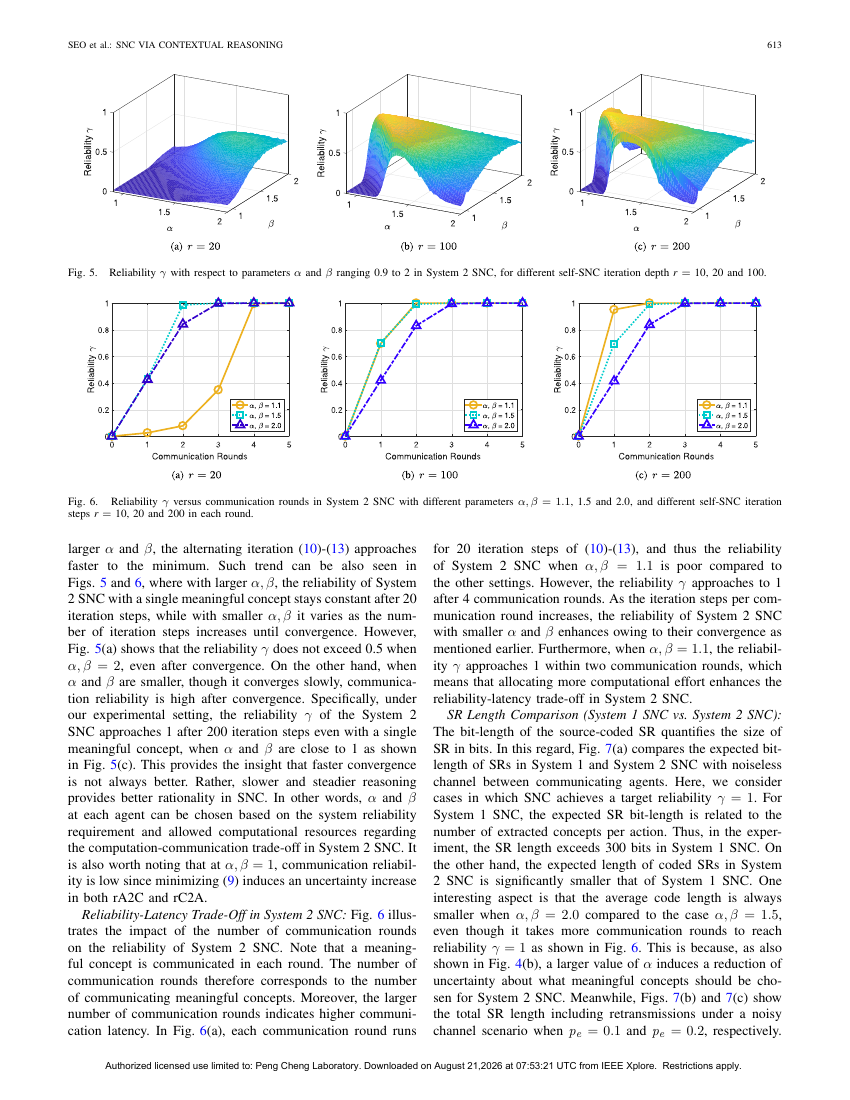
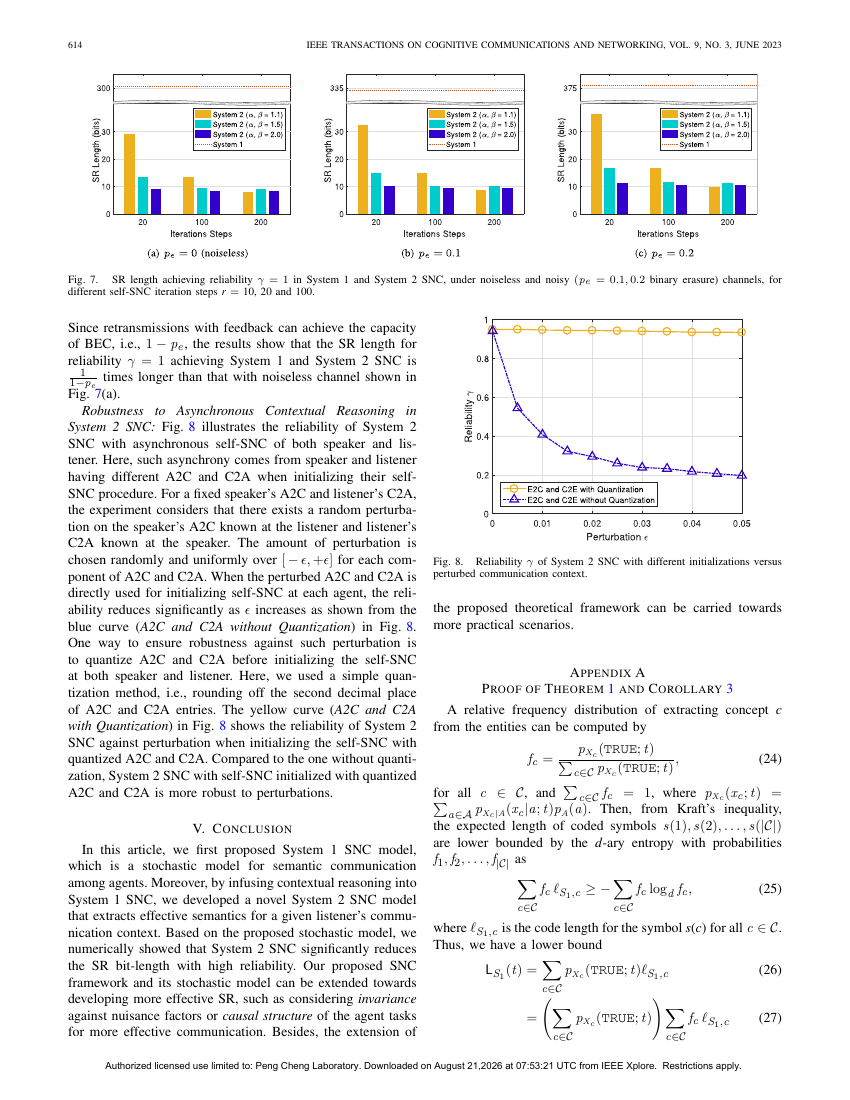
架构/方法图|来源:《Semantics-Native Communication via Contextual Reasoning》,原 PDF p.10,Fig. 5 Reliability γ with respect to parameters α and β ranging 0.9 to 2 in System 2 SNC, for different self-SNC iteration depth r = 10, 20 and 100。 核对论文关键实验结果图/表|来源:《Semantics-Native Communication via Contextual Reasoning》,原 PDF p.11,Fig. 7 SR length achieving reliability γ = 1 in System 1 and System 2 SNC, under noiseless and noisy (pe = 0.1, 0.2 binary erasure) channels, for different self-SNC iteration steps r = 10, 20 and 100。 核对论文
核心纳入2024任务导向推理
Adaptable Semantic Compression and Resource Allocation for Task-Oriented Communications
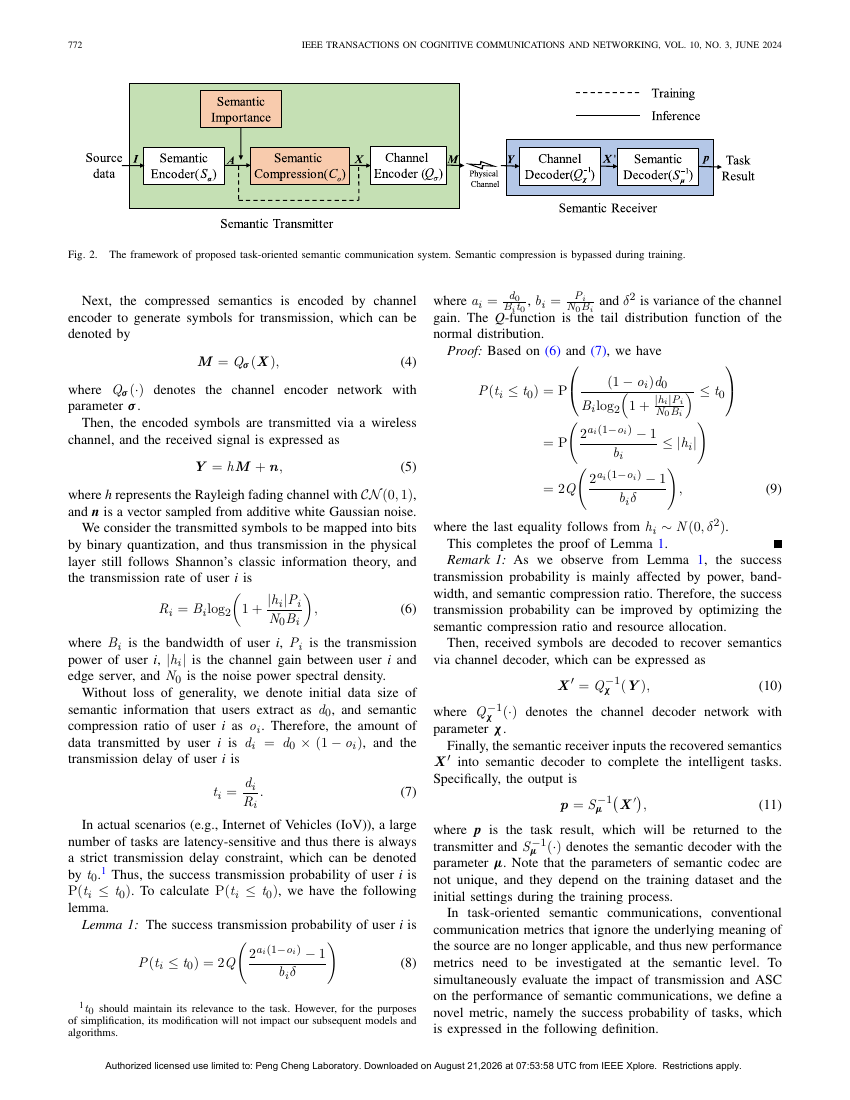
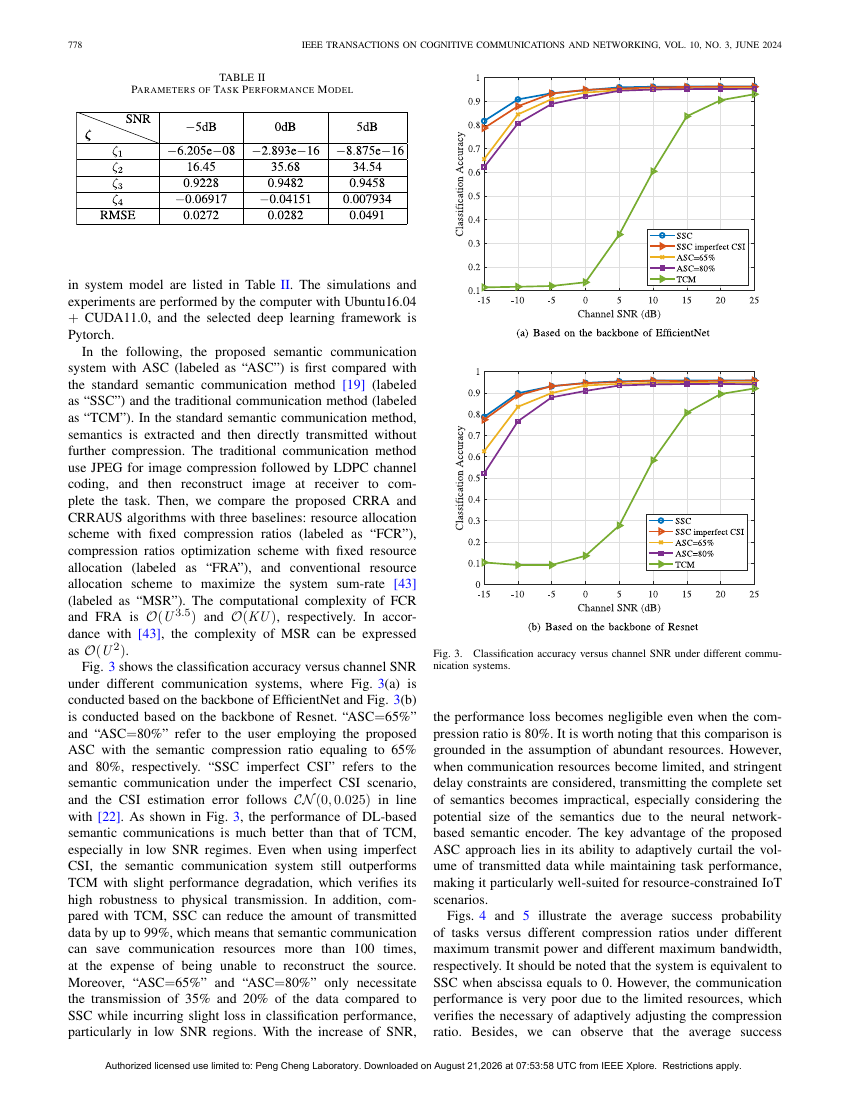
架构/方法图|来源:《Adaptable Semantic Compression and Resource Allocation for Task-Oriented Communications》,原 PDF p.4,Fig. 2 The framework of proposed task-oriented semantic communication system. Semantic compression is bypassed during training。 核对论文关键实验结果图/表|来源:《Adaptable Semantic Compression and Resource Allocation for Task-Oriented Communications》,原 PDF p.10,Fig. 3 Classification accuracy versus channel SNR under different commu- 核对论文
相关但非核心2024语义感知资源分配与网络优化
Adaptive Compression Offloading and Resource Allocation for Edge Vision Computing
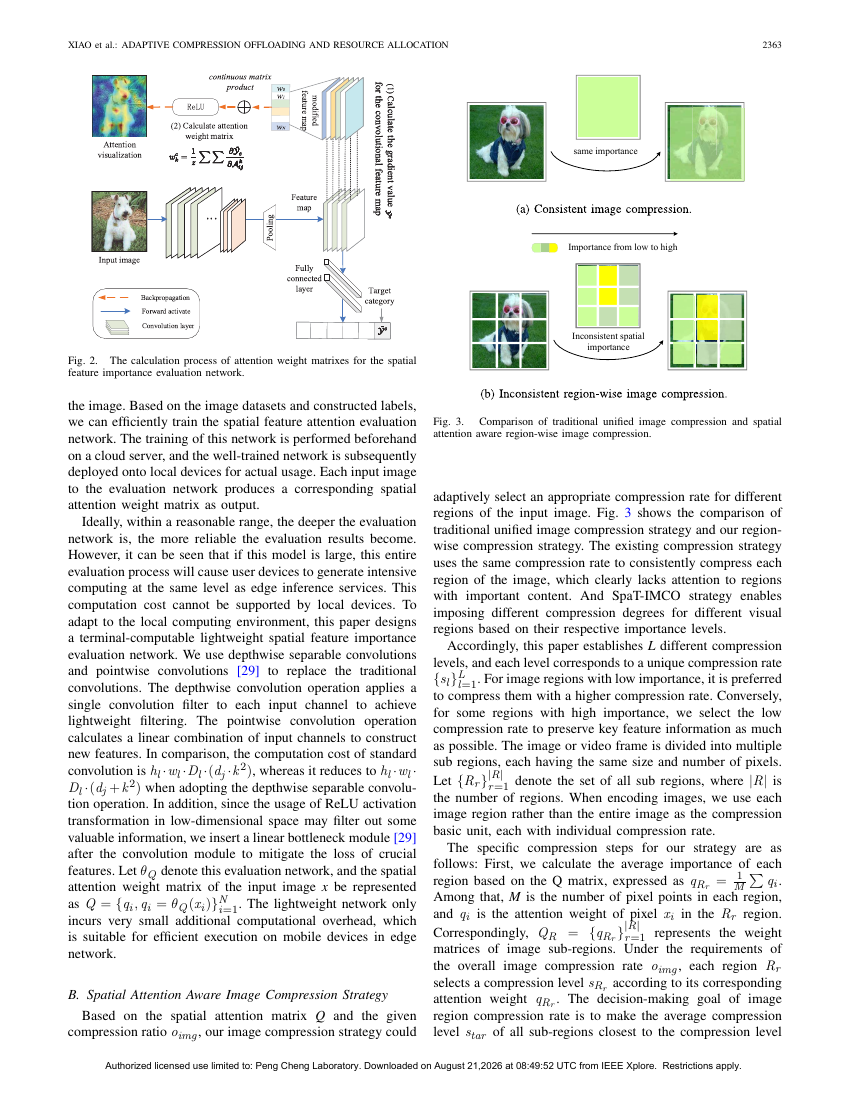
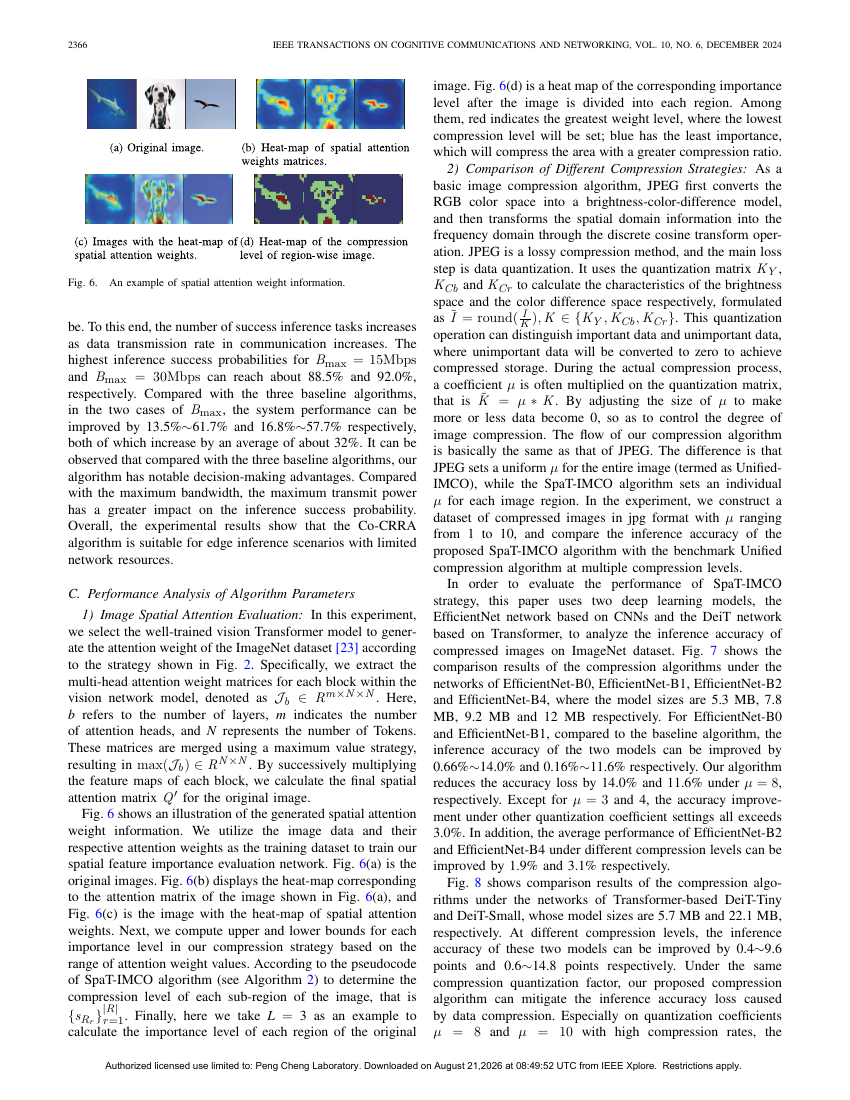
架构/方法图|来源:《Adaptive Compression Offloading and Resource Allocation for Edge Vision Computing》,原 PDF p.7,Fig. 2 The calculation process of attention weight matrixes for the spatial feature importance evaluation network。 核对论文关键实验结果图/表|来源:《Adaptive Compression Offloading and Resource Allocation for Edge Vision Computing》,原 PDF p.10,Fig. 7 shows the to the strategy shown in 核对论文
核心纳入2024任务导向推理
Adaptive Modulation and Retransmission Scheme for Semantic Communication Systems
一句话主旨:Adaptive Modulation and Retransmission Scheme for Semantic Communication Systems 面向任务导向推理,把问题放在“数字语义编码与物理层接口”层处理;本调研把主接口判断为“显式数字语义表示:bit、离散 token 或码本 index”。
Motivation|Introduction 怎样导出本文方案
现有进展:尽管上述语义通信系统在特定信道条件下表现出了优异的性能,但仍需要越来越深入的研究来进一步提高时变信道上无线传输的频谱效率。 PDF p.1
仍然存在的问题:然而,在面向任务的语义通信系统中,由于神经网络的纠错能力,不完美的传输仍然可以导致语义任务的良好推理性能。 PDF p.1
为什么已有方法解决不了:连续 latent 或独立设计的传统链路没有回答语义特征怎样量化、映射为有限符号,以及 bit/index 出错后为何不会跳到完全不同的语义。仅改进信源网络无法补上这一接口。 PDF p.1
为什么这个问题重要:边缘设备常需要及时决策而不是完整副本;只发送任务充分信息可以降低时延与带宽,但前提是关键证据确实能穿过信道。 PDF p.1
本文提出什么:针对这一问题,本文提出了一种新的自适应调制和重传方案,以在保证语义任务性能的同时最大化频谱效率。 PDF p.1
方案为何可能有效:具体来说,我们首先引入语义通信系统中的鲁棒性验证问题来分析神经网络推理的鲁棒性。 PDF p.1
作者希望证明什么:这是因为附加的纠错编码可以在编码系统中比在未编码系统中实现低得多的BER。 PDF p.11
方法与端到端信息流
在本文中,我们提出了新的自适应调制和重传方案,以最大限度地提高频谱效率,同时保证语义任务的性能。具体来说,我们首先引入语义通信系统的鲁棒性验证问题,分析神经网络推理的鲁棒性。 PDF p.1
输入输入是任务导向推理所需的源数据与下游任务所需特征。
发送端发送端采用 Adaptive Modulation and Retransmission Scheme for Semantic Communication Systems:在本文中,我们提出了新的自适应调制和重传方案,以最大限度地提高频谱效率,同时保证语义任务的性能。具体来说,我们首先引入语义通信系统的鲁棒性验证问题,分析神经网络推理的鲁棒性。
这里量化数K的选择遵循保证可接受的计算复杂度和存储容量的原则,同时量化损失可以忽略不计。 独立判断:Adaptive Modulation and Retransmission Scheme for Semantic Communication Systems 的主传输单位应归为“显式数字语义表示:bit、离散 token 或码本 index”。只有论文明确给出量化和映射时,才能把 token/index 数换算成总 bit;连续 channel symbol 只能按 channel uses/CBR 比较。 PDF p.3
论文未同时报告输入尺寸、encoder 输出尺寸、量化精度/码本大小和帧级开销,因此不能从全文唯一重建总 bit 数。页面保留论文实际使用的 CBR、bpp、token 数或信道使用次数;缺失项不作臆测。 PDF p.2PDF p.9
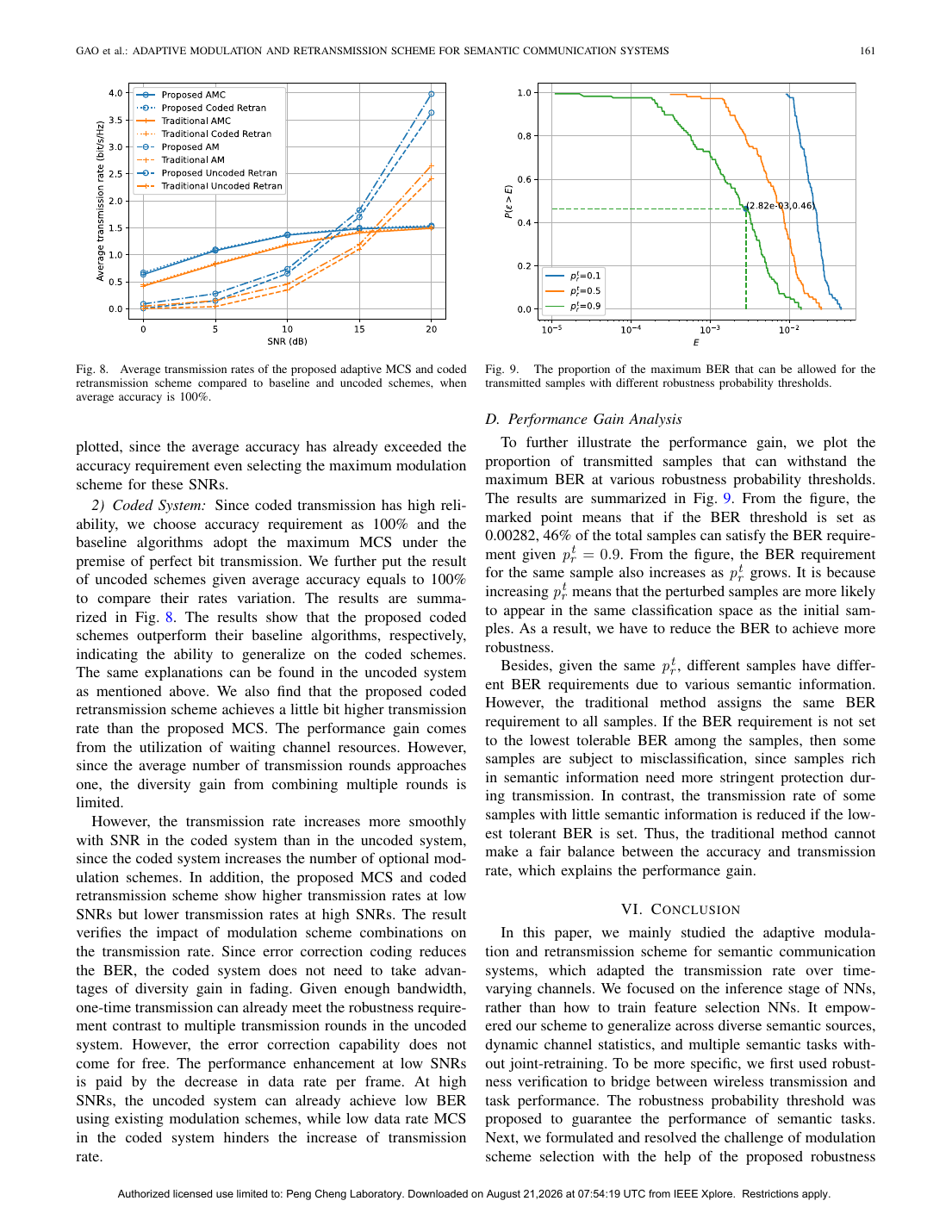
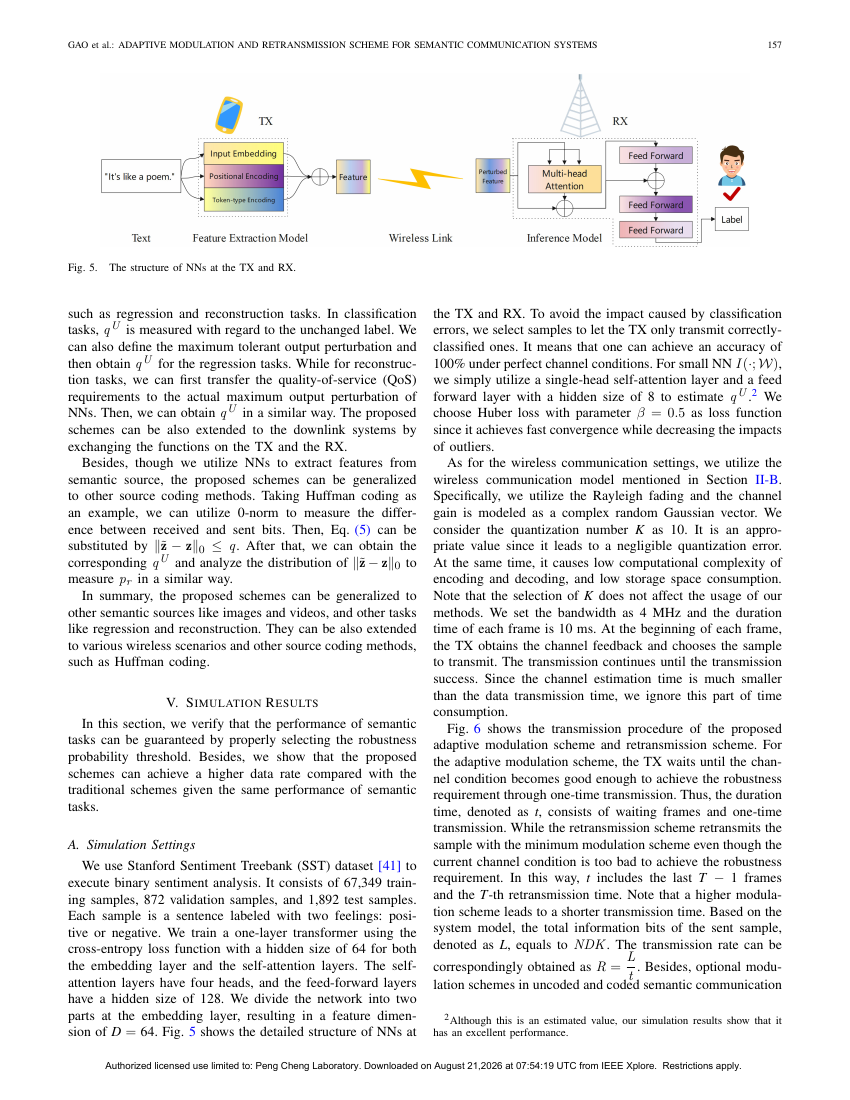
架构/方法图|来源:《Adaptive Modulation and Retransmission Scheme for Semantic Communication Systems》,原 PDF p.12,Fig. 8 Average transmission rates of the proposed adaptive MCS and coded 核对论文关键实验结果图/表|来源:《Adaptive Modulation and Retransmission Scheme for Semantic Communication Systems》,原 PDF p.8,Fig. 5 shows the detailed structure of NNs at has an excellent performance。 核对论文
核心纳入2024图像传输、压缩或生成
DeepMA: End-to-End Deep Multiple Access for Wireless Image Transmission in Semantic Communication
数据集为Kodak、ImageNet、CIFAR10、CIFAR100;实验小节中明确出现的比较对象包括JPEG、JPEG2000、BPG、LDPC、DeepMA、ADJSCC、JSCC、OFDM;指标包括PSNR、MSE、recall、PER;信道/链路条件包括AWGN、Rayleigh、wireless channel、OFDM、fading channel。 PDF p.10
实验结果表明,DeepMA能够实现高效、灵活和隐私保护的信道复用过程,与传统的多址接入方案相比,该方案具有相当的带宽效率。 PDF p.1
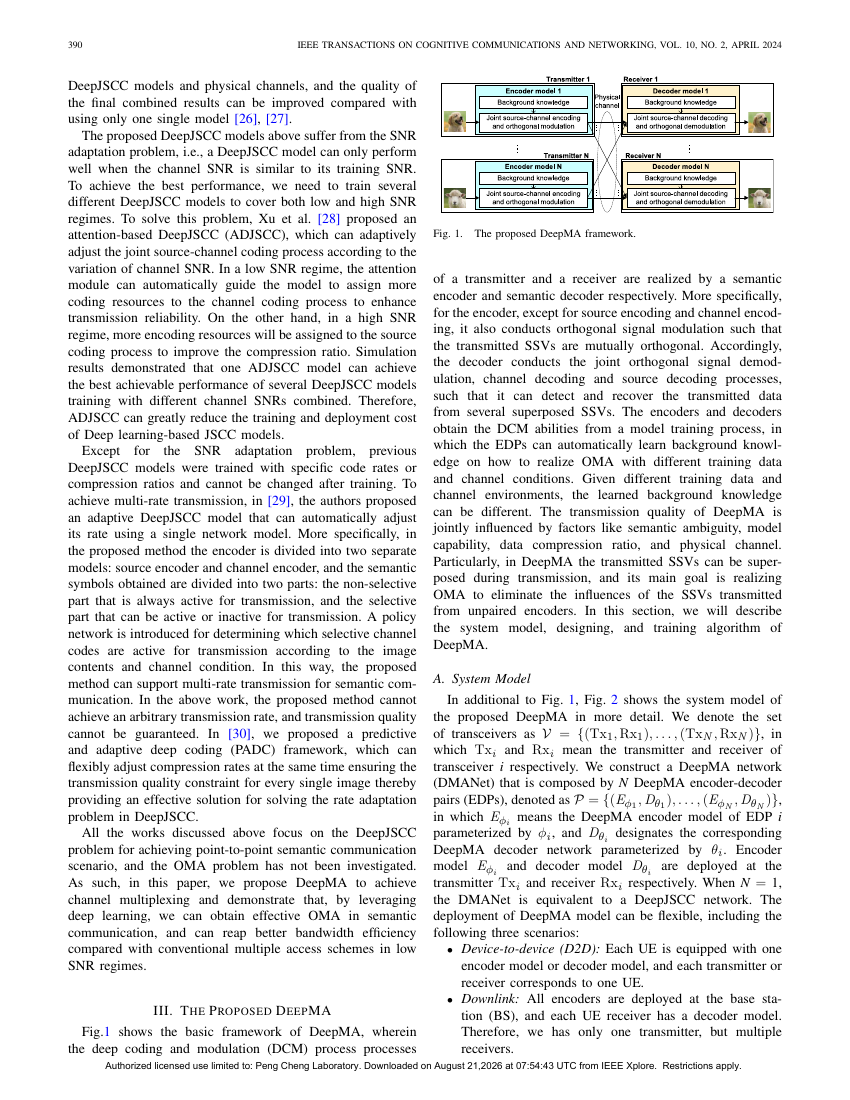
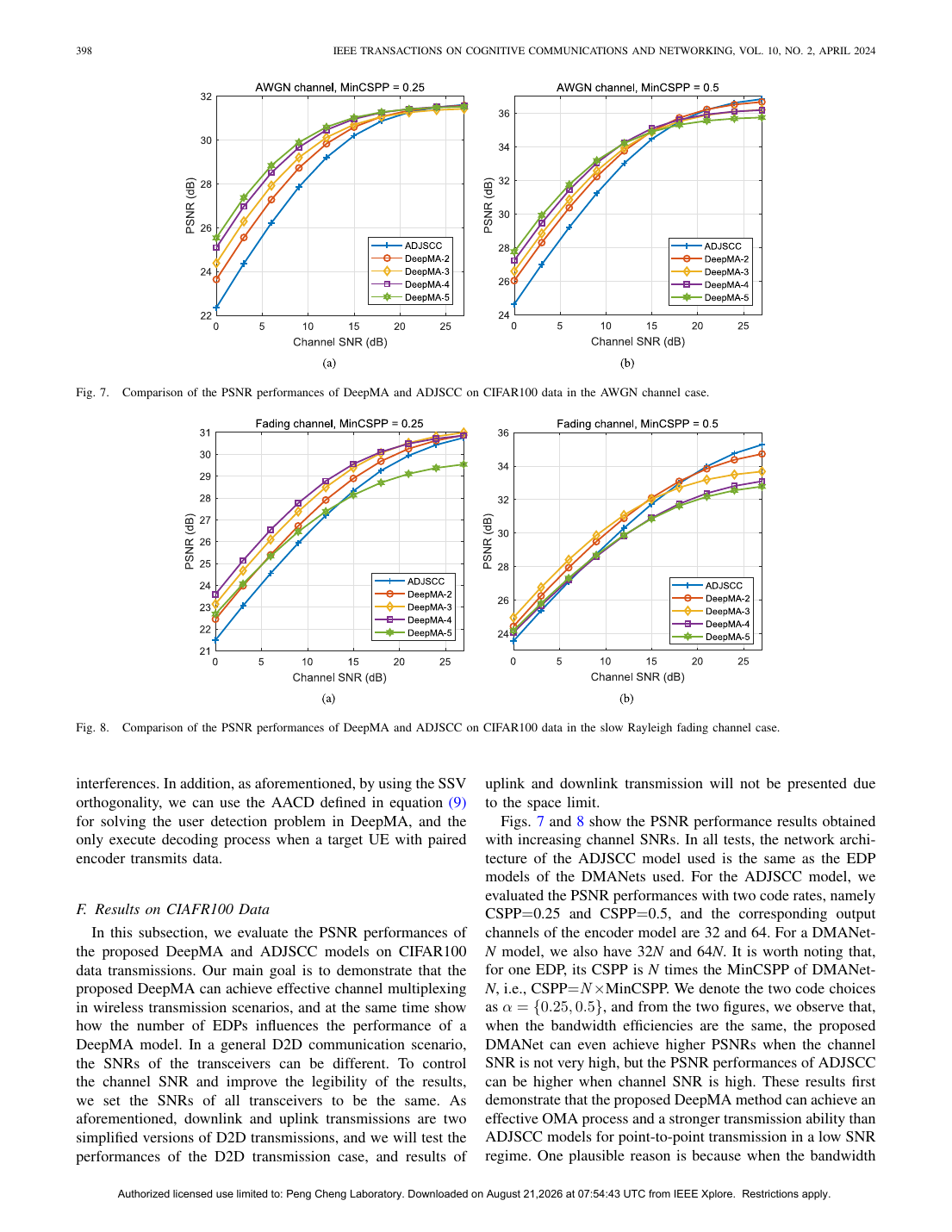
架构/方法图|来源:《DeepMA: End-to-End Deep Multiple Access for Wireless Image Transmission in Semantic Communication》,原 PDF p.4,Fig. 1 shows the basic framework of DeepMA, wherein Therefore, we has only one transmitter, but multiple the deep coding and modulation (DCM) process processes receivers。 核对论文关键实验结果图/表|来源:《DeepMA: End-to-End Deep Multiple Access for Wireless Image Transmission in Semantic Communication》,原 PDF p.12,Fig. 7 Comparison of the PSNR performances of DeepMA and ADJSCC on CIFAR100 data in the AWGN channel case。 核对论文
核心纳入2024任务导向推理
Feature Importance-Aware Task-Oriented Semantic Transmission and Optimization
局限:没有完整离散接口,无法直接回答 bit/index/token 跳变问题。 未显式注入离散误码/丢包,鲁棒性结论不应外推到真实数字链路。 未报告统一可复核的 payload bit 数/CBR,跨论文带宽比较受限。
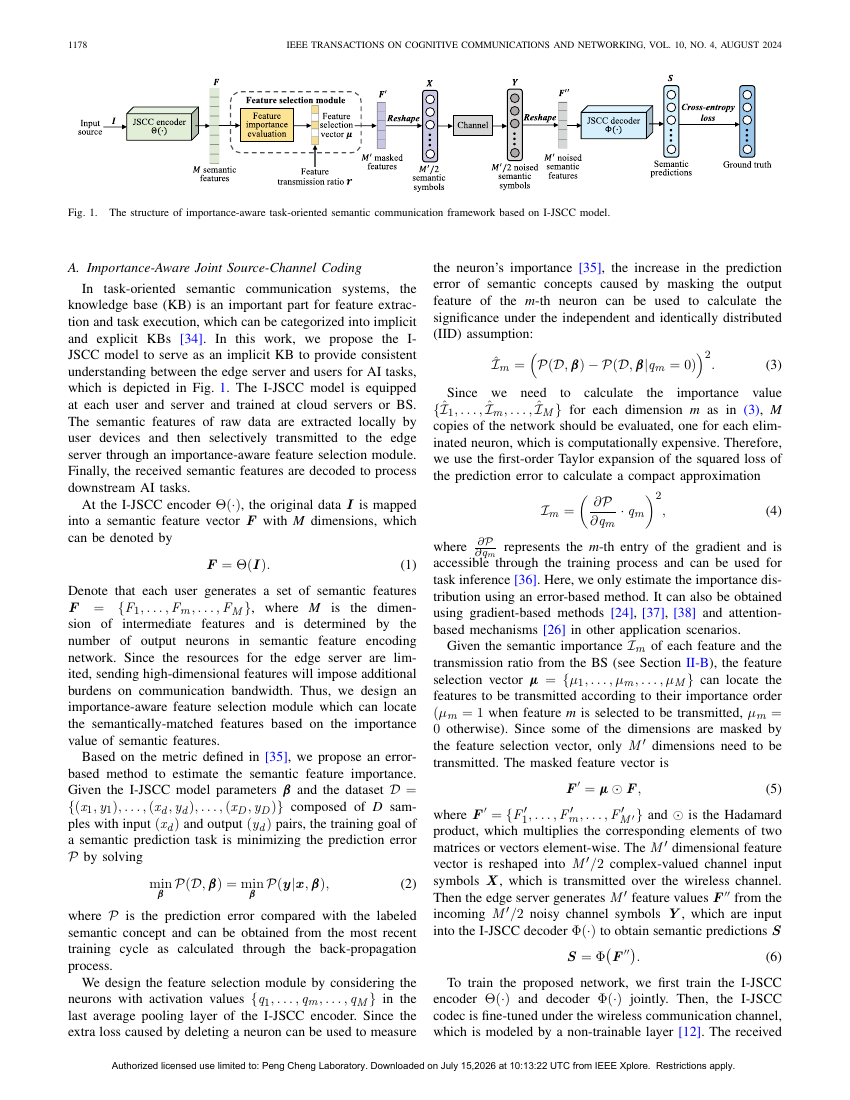
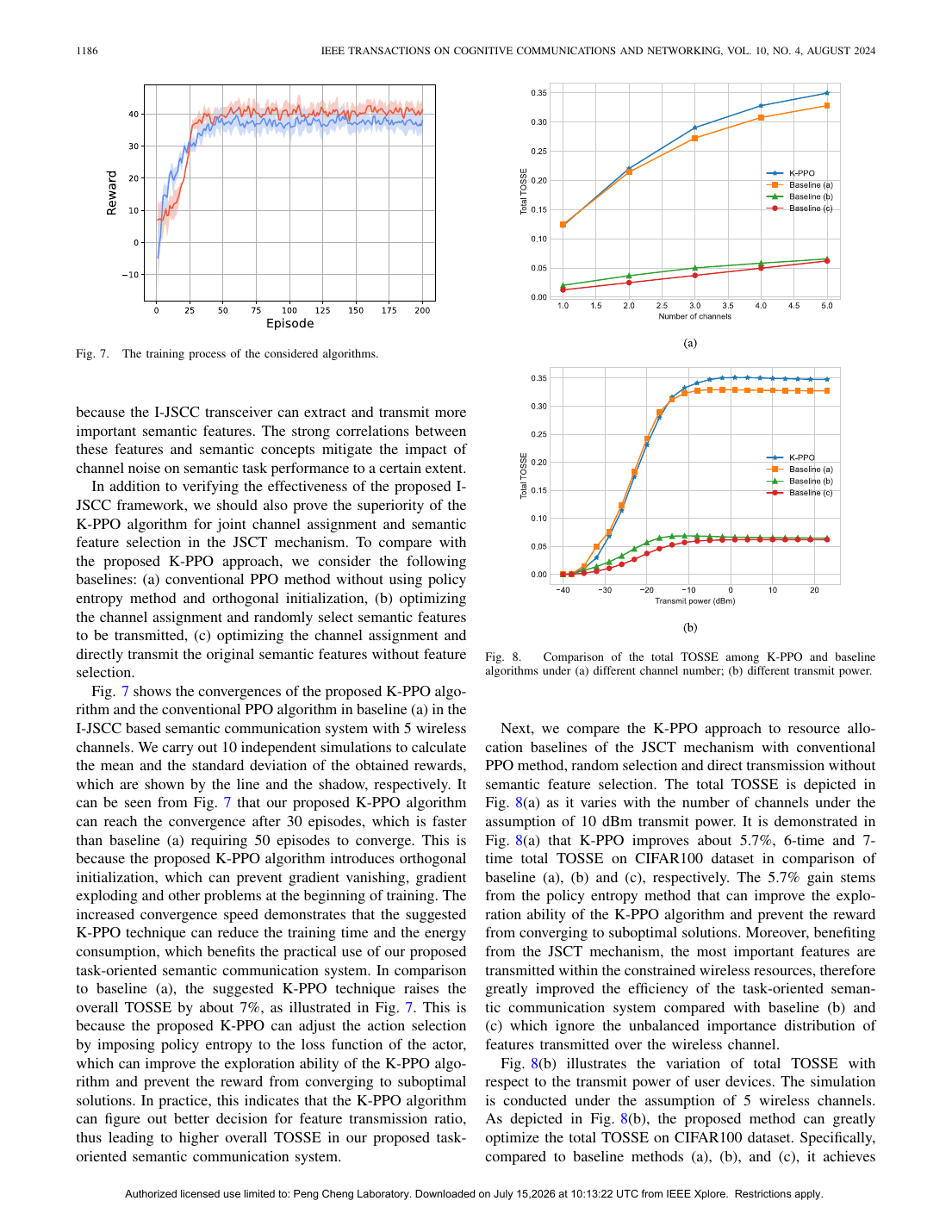
架构/方法图|来源:《Feature Importance-Aware Task-Oriented Semantic Transmission and Optimization》,原 PDF p.4,Fig. 1 The structure of importance-aware task-oriented semantic communication framework based on I-JSCC model。 核对论文关键实验结果图/表|来源:《Feature Importance-Aware Task-Oriented Semantic Transmission and Optimization》,原 PDF p.12,Fig. 8 Comparison of the total TOSSE among K-PPO and baseline selection. algorithms under (a) different channel number; (b) different transmit power。 核对论文
核心纳入2024语义信息度量与理论
How to Evaluate Semantic Communications for Images With ViTScore Metric?
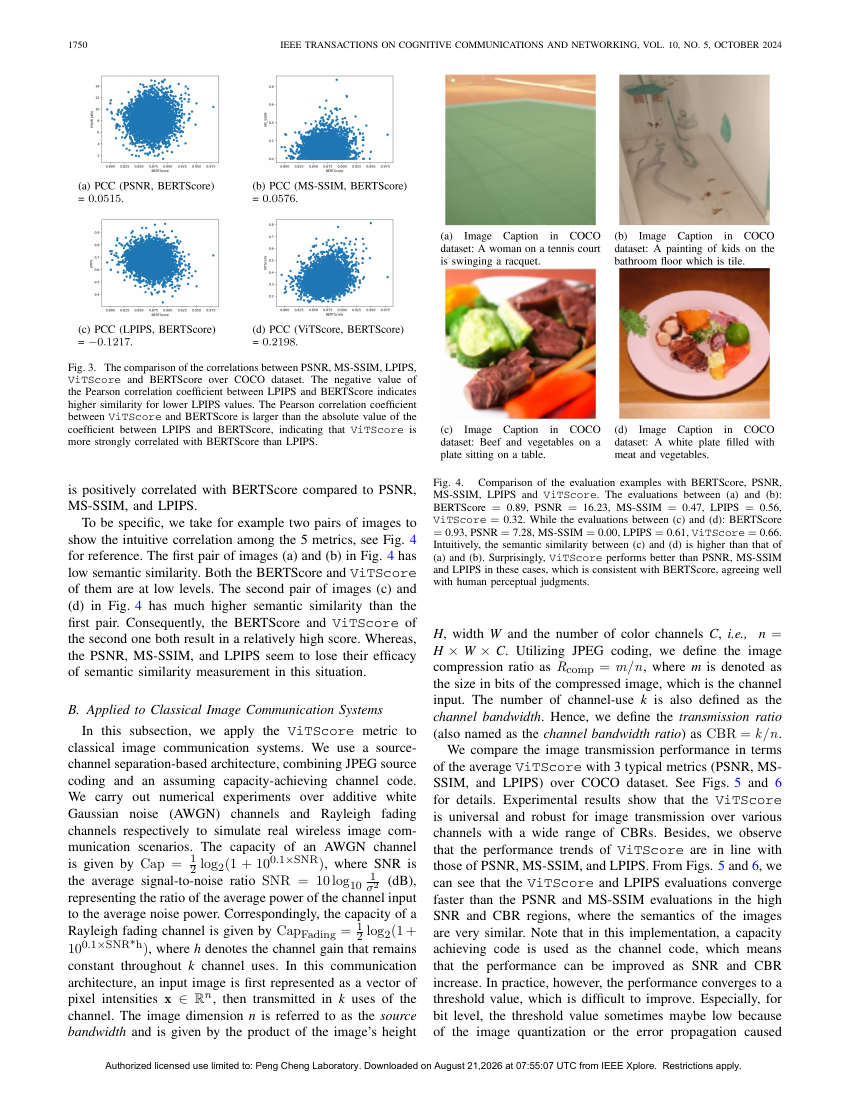
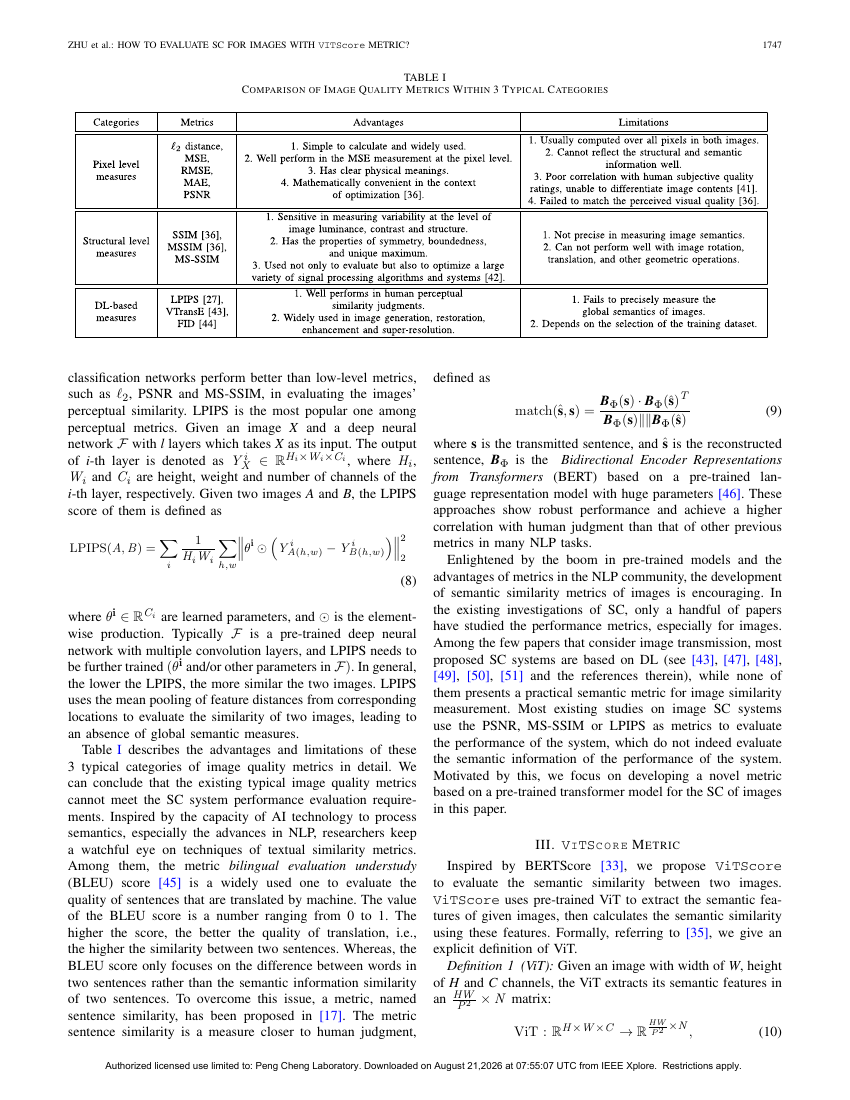
架构/方法图|来源:《How to Evaluate Semantic Communications for Images With ViTScore Metric?》,原 PDF p.7,Fig. 4 Intuitively, the semantic similarity between (c) and (d) is higher than that of for reference. The first pair of images (a) and (b) in 核对论文关键实验结果图/表|来源:《How to Evaluate Semantic Communications for Images With ViTScore Metric?》,原 PDF p.4,该页包含论文的关键实验结果图或表。 核对论文
核心纳入2024文本传输或语言任务
LaMoSC: Large Language Model-Driven Semantic Communication System for Visual Transmission
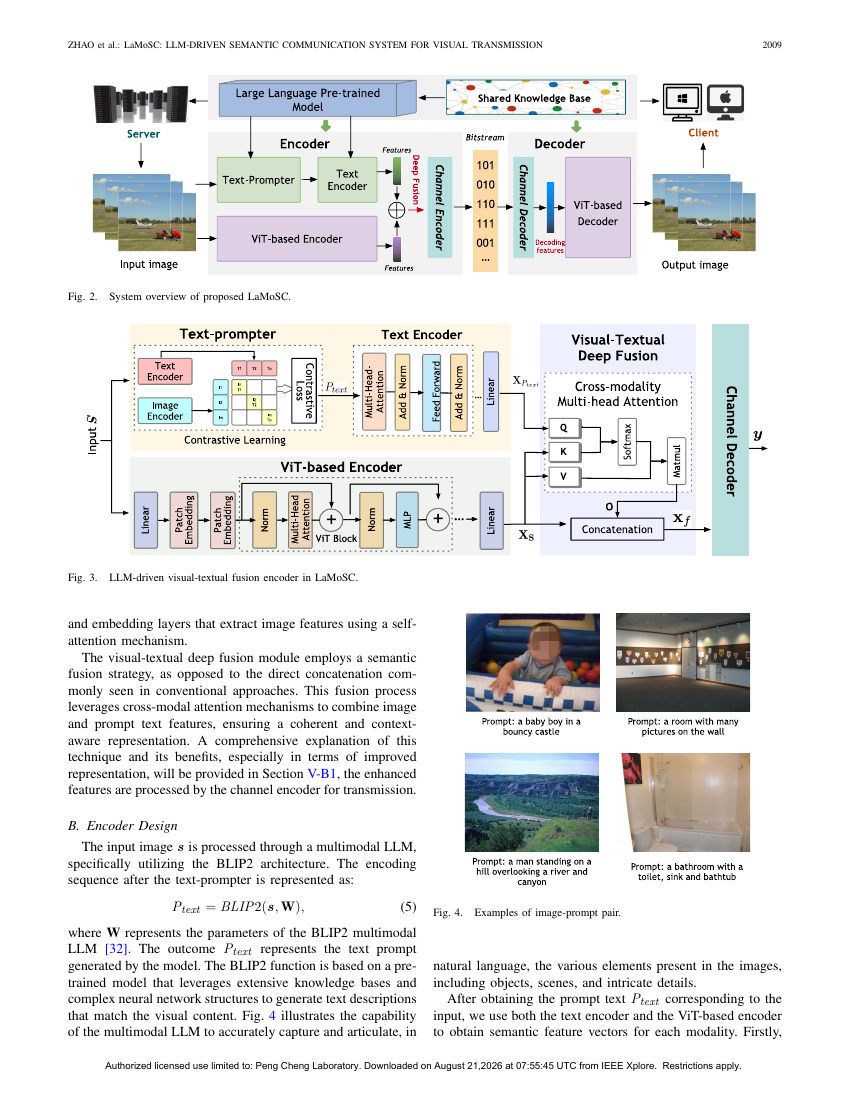
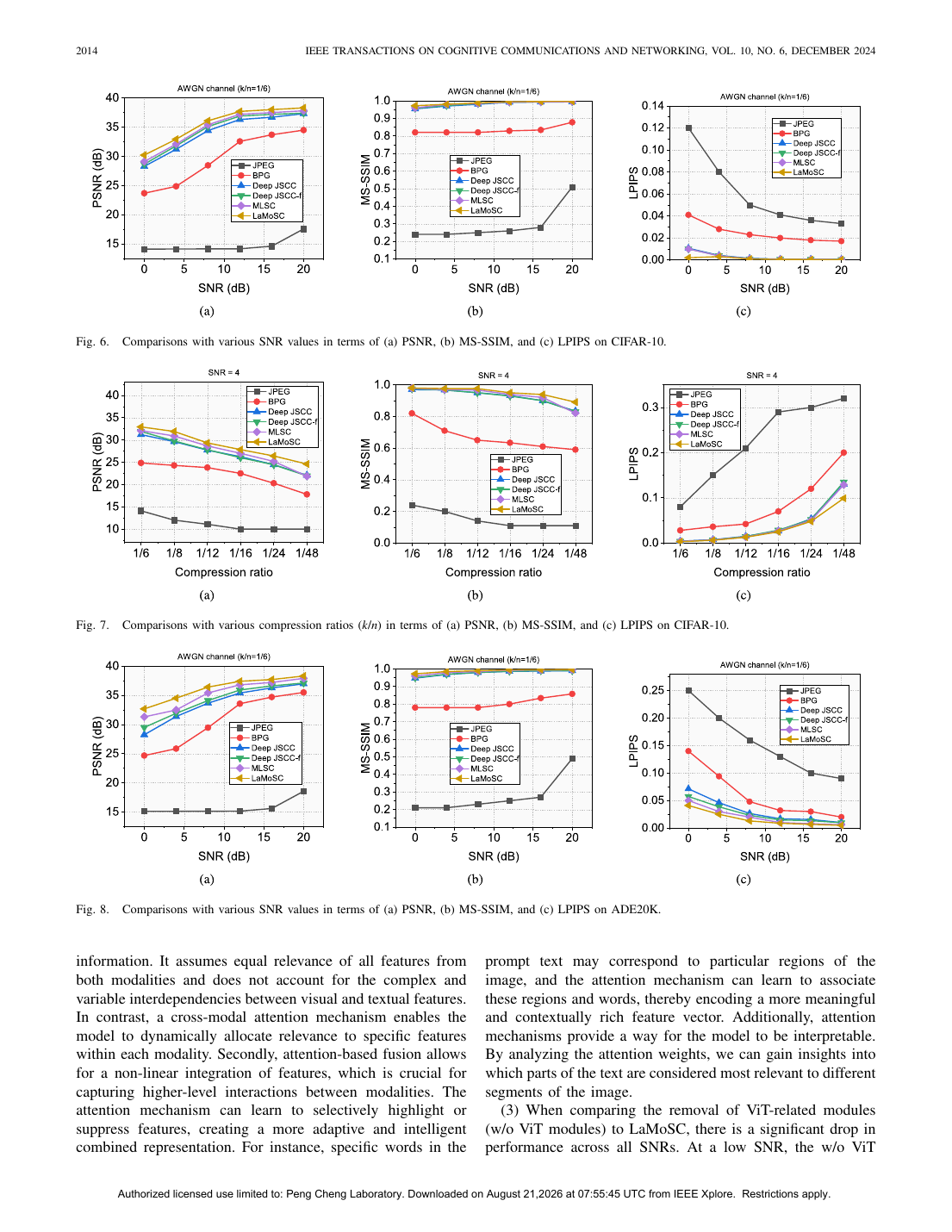
数据集为ImageNet、CIFAR-10、ADE20K;实验小节中明确出现的比较对象包括DeepJSCC、JPEG、BPG、ViT、JSCC、BERT、BLIP;指标包括PSNR、SSIM、MS-SSIM、LPIPS、MSE、mAP、accuracy、latency、semantic similarity。 PDF p.9
LaMoSC在低SNR条件下(如4 dB)的性能分别优于Deep-JSCC和多级语义感知通信系统(MLSC)5.5%和2.6%。 PDF p.1
架构/方法图|来源:《LaMoSC: Large Language Model-Driven Semantic Communication System for Visual Transmission》,原 PDF p.5,Fig. 2 System overview of proposed LaMoSC。 核对论文关键实验结果图/表|来源:《LaMoSC: Large Language Model-Driven Semantic Communication System for Visual Transmission》,原 PDF p.10,Fig. 6 Comparisons with various SNR values in terms of (a) PSNR, (b) MS-SSIM, and (c) LPIPS on CIFAR-10。 核对论文
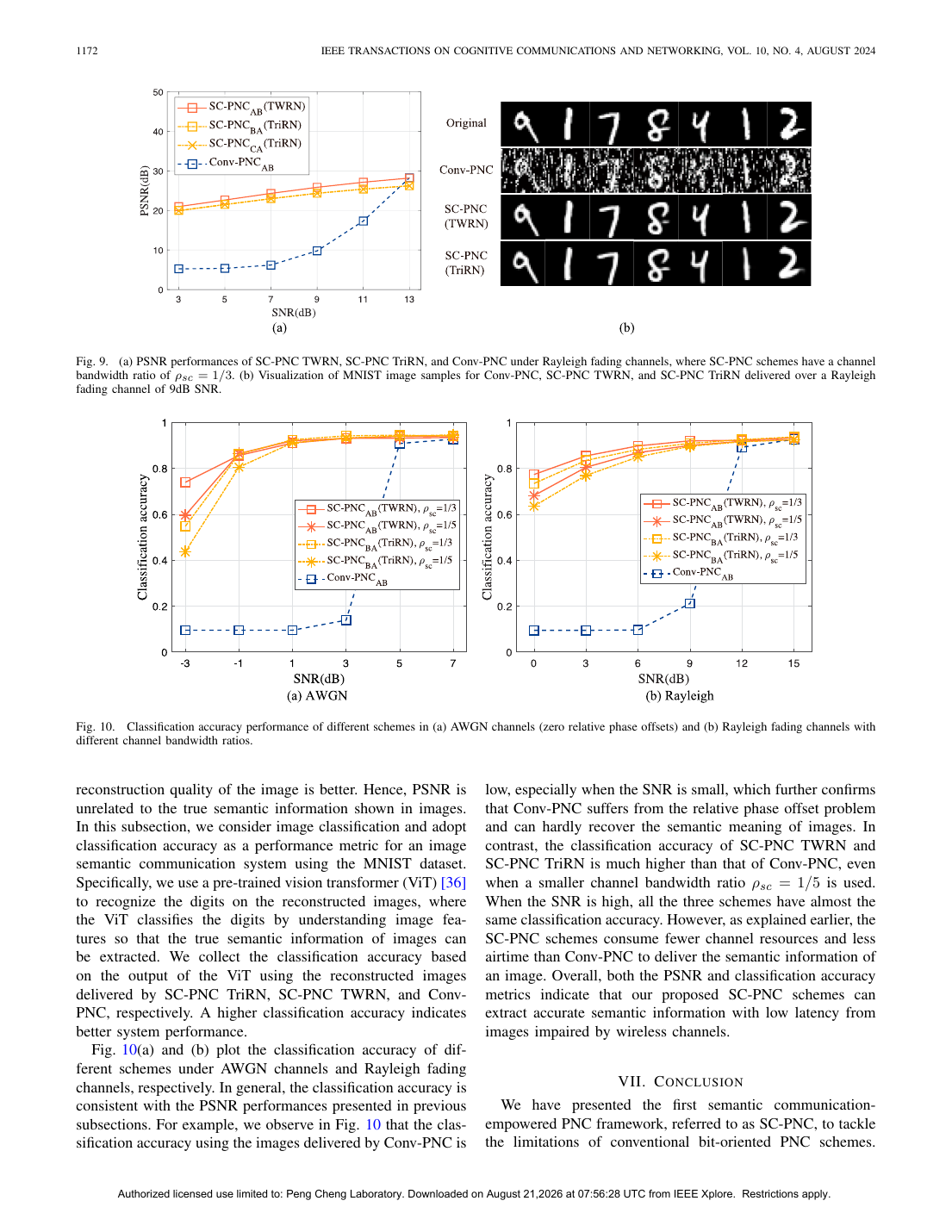
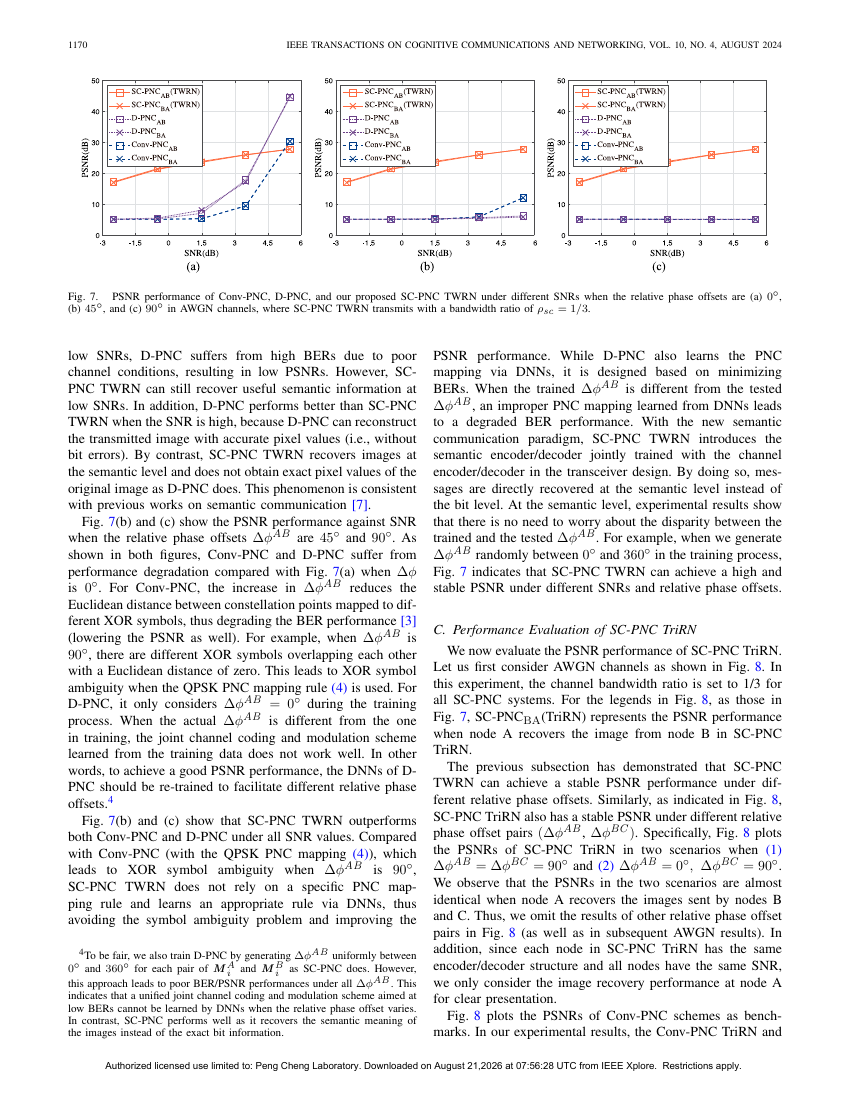
架构/方法图|来源:《SC-PNC: Semantic Communication-Empowered Physical-Layer Network Coding》,原 PDF p.13,Fig. 10 Classification accuracy performance of different schemes in (a) AWGN channels (zero relative phase offsets) and (b) Rayleigh fading channels with different channel bandwidth ratios。 核对论文关键实验结果图/表|来源:《SC-PNC: Semantic Communication-Empowered Physical-Layer Network Coding》,原 PDF p.11,Fig. 7 PSNR performance of Conv-PNC, D-PNC, and our proposed SC-PNC TWRN under different SNRs when the relative phase offsets are (a) 0◦ , (b) 45◦ , and (c) 90◦ in AWGN channels, where SC-PNC TWRN transmits with a bandwidth ratio of ρsc = 1/3。 核对论文
核心纳入2024图像传输、压缩或生成
SCAN: Semantic Communication With Adaptive Channel Feedback
传输过程被建模为信道层,并且接收到的符号可以表示为m i = H(zi ; Hi,ni),其中ni表示AWGN的噪声样本。 本调研据此归为“类别 0:信道作用点不足,或由外部传统链路抽象承担”。 PDF p.6
语义 decoder 实际面对的是:由论文系统模型定义的语义 feature、任务状态或传统译码后数据。 PDF p.6
是否真正处理离散变量出错:未形成可复核的 bit/index/token 错误闭环。
实验设置与主要结论
数据集/场景CIFAR10
BaselineDeepSC、ADJSCC、JSCC、OFDM
评价指标PSNR、MSE、mAP、accuracy、latency、NMSE、BER
信道与工作点AWGN、MIMO、OFDM、fading channel、SNR = 6dB、SNR from -16 dB
数据集为CIFAR10;实验小节中明确出现的比较对象包括DeepSC、ADJSCC、JSCC、OFDM;指标包括PSNR、MSE、mAP、accuracy、latency、NMSE、BER;信道/链路条件包括AWGN、MIMO、OFDM、fading channel;正文可定位的代表性工作点有SNR = 6dB、SNR from -16 dB。 PDF p.3
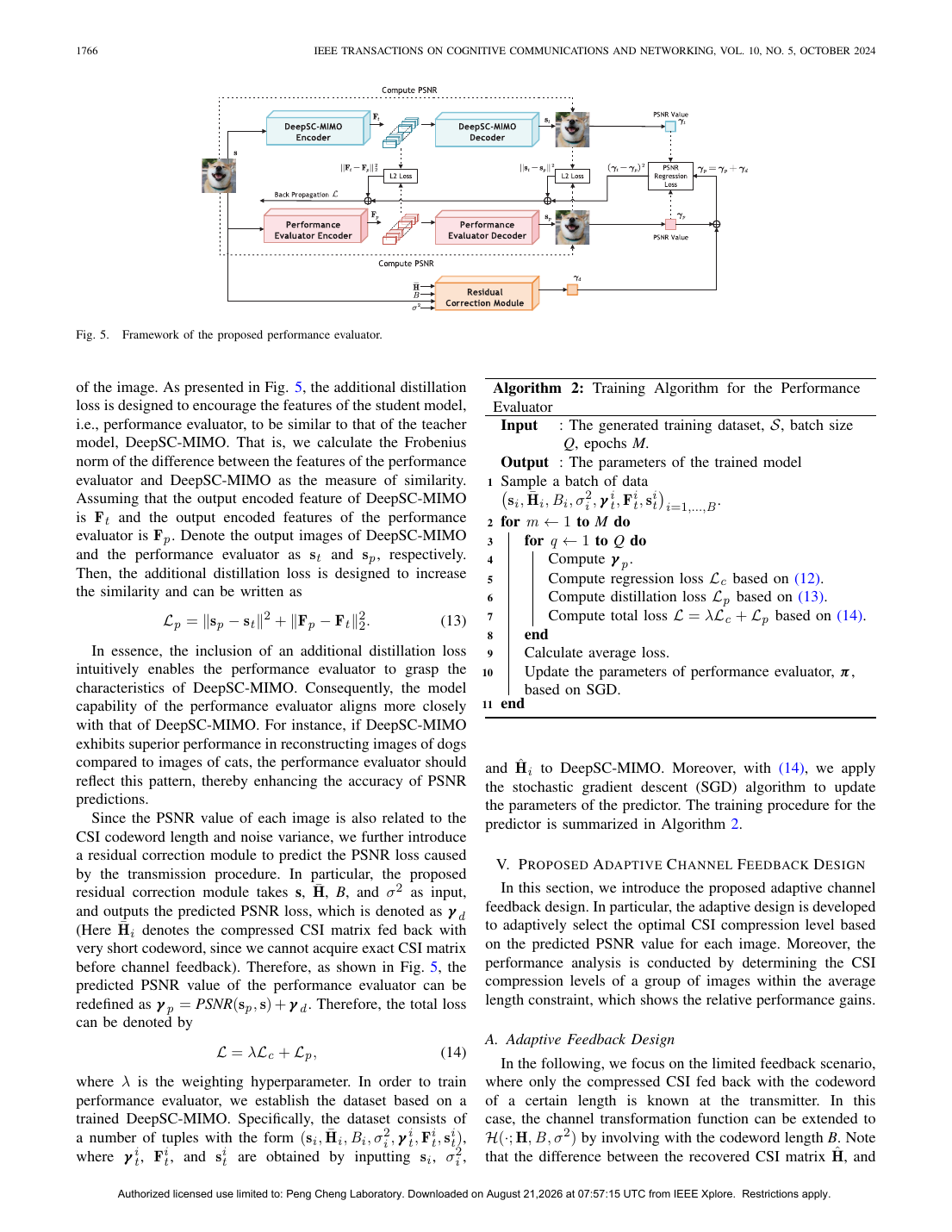
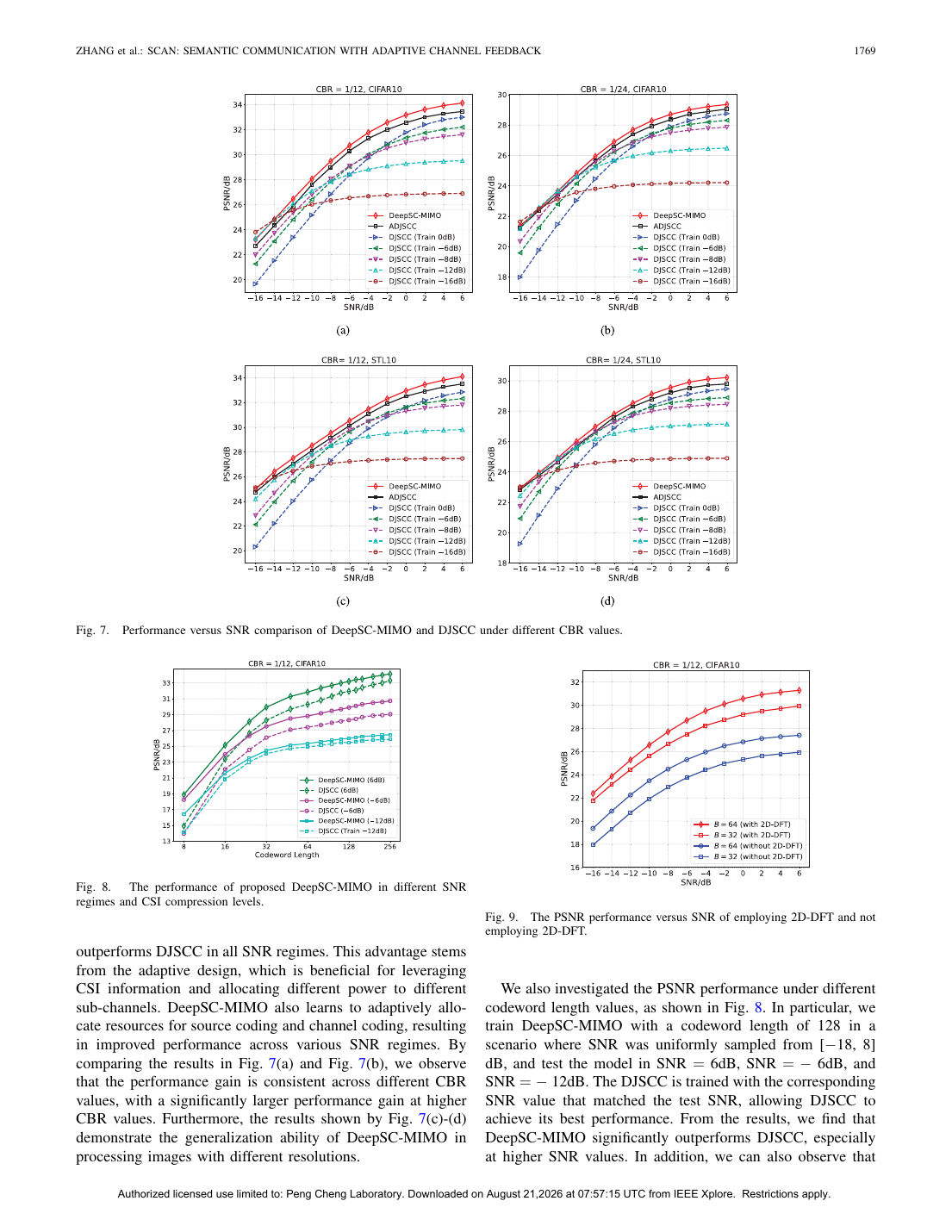
架构/方法图|来源:《SCAN: Semantic Communication With Adaptive Channel Feedback》,原 PDF p.8,Fig. 5 Framework of the proposed performance evaluator。 核对论文关键实验结果图/表|来源:《SCAN: Semantic Communication With Adaptive Channel Feedback》,原 PDF p.11,Fig. 7 Performance versus SNR comparison of DeepSC-MIMO and DJSCC under different CBR values。 核对论文
核心纳入2024语音/音频传输或识别
Speech Semantic Communication Based on Swin Transformer
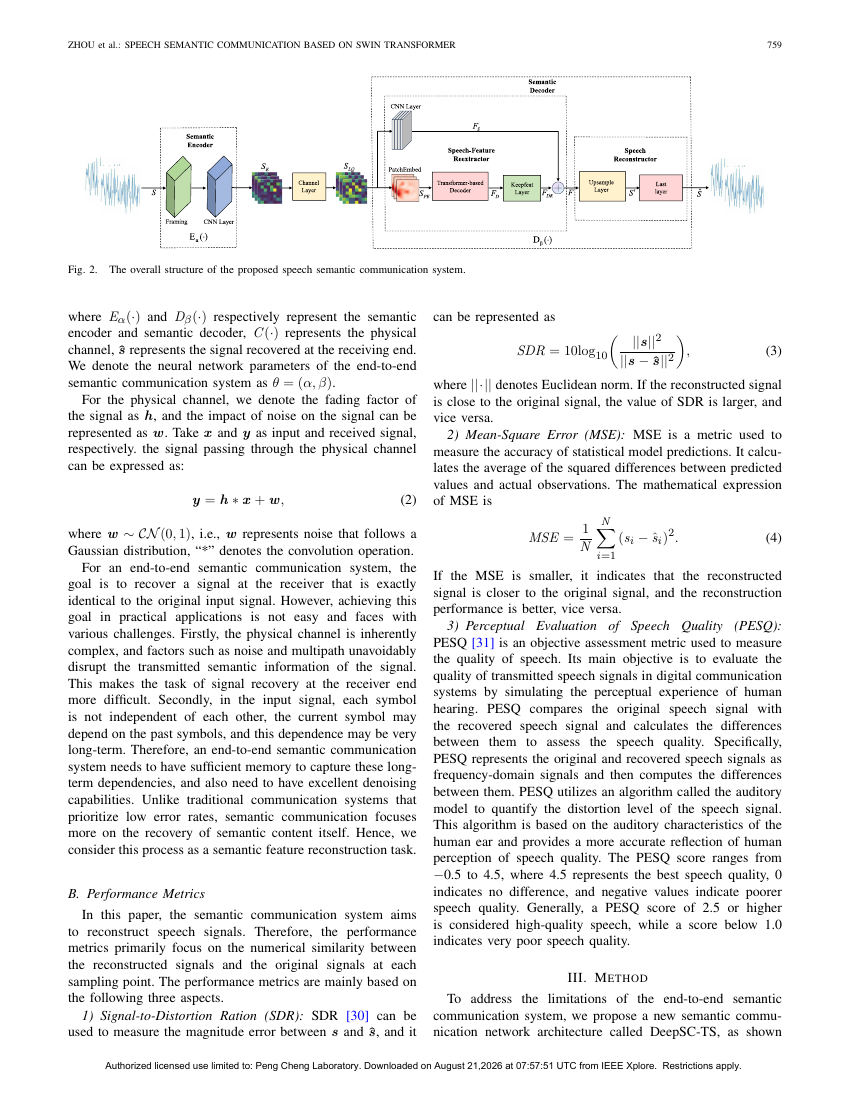
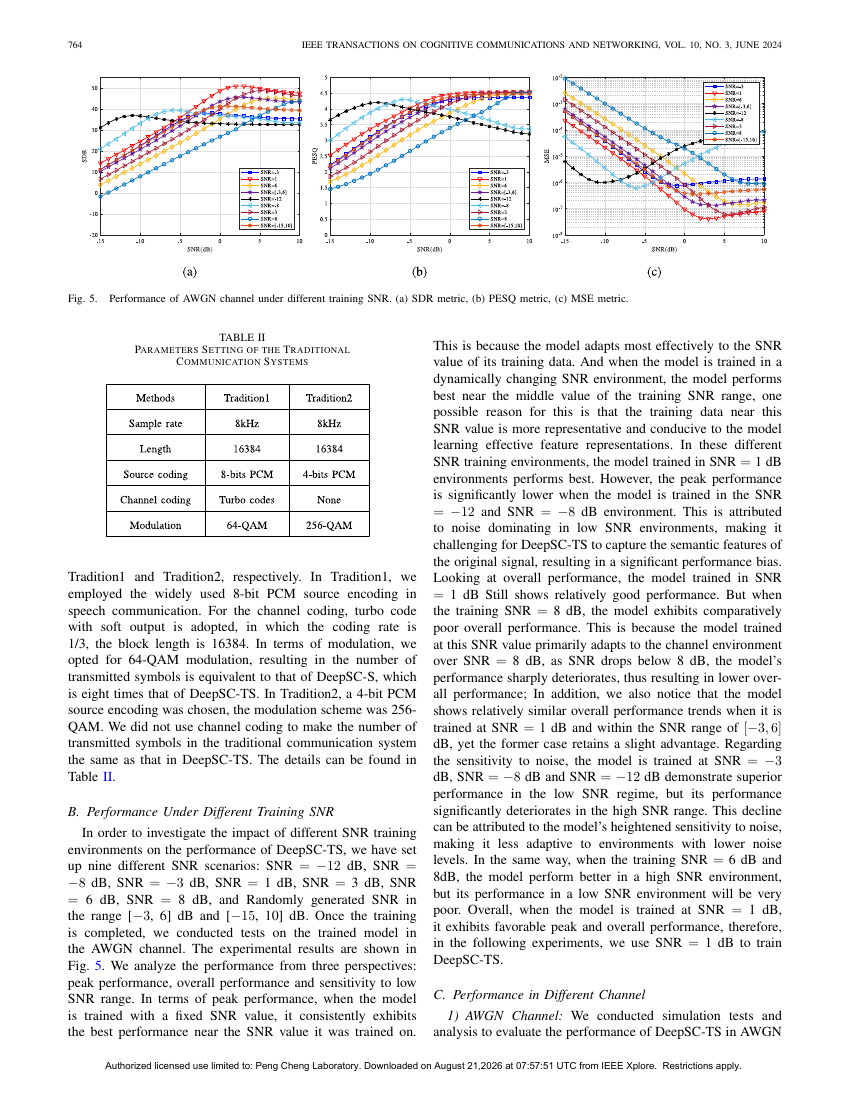
架构/方法图|来源:《Speech Semantic Communication Based on Swin Transformer》,原 PDF p.4,Fig. 2 The overall structure of the proposed speech semantic communication system。 核对论文关键实验结果图/表|来源:《Speech Semantic Communication Based on Swin Transformer》,原 PDF p.9,Fig. 5 Performance of AWGN channel under different training SNR. (a) SDR metric, (b) PESQ metric, (c) MSE metric。 核对论文
核心纳入2025语义感知资源分配与网络优化
A Physical Layer Security Framework for IRS-Assisted Integrated Sensing and Semantic Communication Systems
现有进展:在本文中,我们提出了一个物理层安全(PLS)框架的智能反射面(IRS)辅助集成传感和语义通信(ISASC)系统,多天线双功能语义基站(BS)服务于多个语义通信用户(SCU)和监视潜在的恶意传感目标(MST)在窃听者(EVE)的存在。 PDF p.1
仍然存在的问题:但是,集成这些技术会带来重大的安全挑战。 PDF p.1
为什么已有方法解决不了:只优化合法接收端的重建或任务 loss,并不会自动消除 latent 泄露、窃听或操纵风险;缺少的是把攻击者与保护目标放进同一系统模型。 PDF p.1
为什么这个问题重要:功率、带宽、算力和时延是共享资源;若调度器不知道语义效用,它可能增加吞吐量却没有改善任何用户真正关心的任务。 PDF p.1
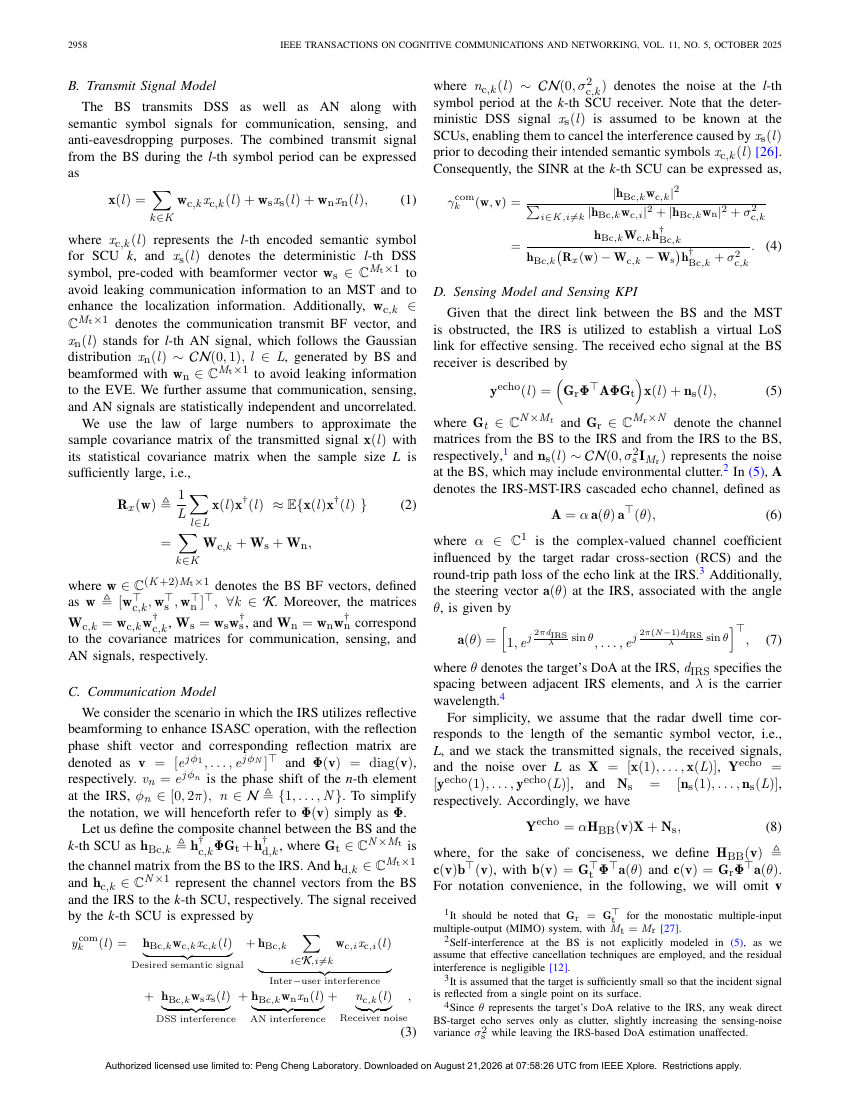
本文提出什么:在本文中,我们提出了一个物理层安全(PLS)框架的智能反射面(IRS)辅助集成传感和语义通信(ISASC)系统,多天线双功能语义基站(BS)服务于多个语义通信用户(SCU)和监视潜在的恶意传感目标(MST)在窃听者(EVE)的存在。 PDF p.1
方案为何可能有效:·提出了一个安全感知的IASC系统,该系统通过将AN和DSS结合作为PLS技术,来降低EVE和MST的安全风险。 PDF p.2
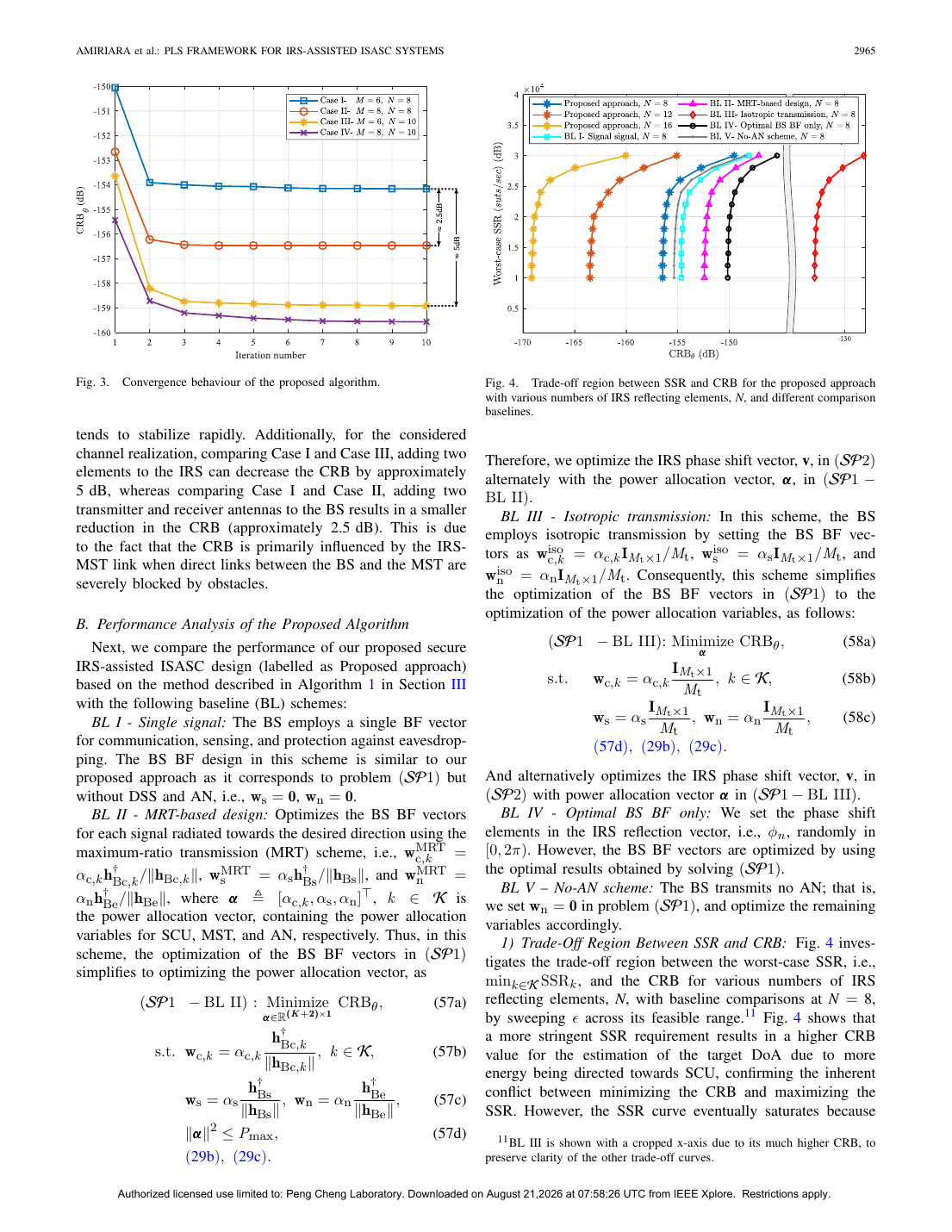
作者希望证明什么:具体地说,与通常采用的最大比传输(MRT)方法相比,所提出的方法将感知精度提高了5 dB。 PDF p.1
方法与端到端信息流
该文提出了一种智能反射面(IRS)辅助的集成感知和语义通信(IASC)系统的物理层安全(PLS)框架,其中多天线双功能语义基站(BS)服务于多个语义通信用户(SCU),并在存在窃听者(EVE)的情况下监控潜在的恶意感知目标(MST),本文的主要贡献可以概括为:·提出了一个安全感知的IASC系统,该系统通过将AN和DSS结合作为PLS技术来降低来自EVE和MST威胁的安全风险。 PDF p.1PDF p.2
局限:没有完整离散接口,无法直接回答 bit/index/token 跳变问题。 未显式注入离散误码/丢包,鲁棒性结论不应外推到真实数字链路。 未报告统一可复核的 payload bit 数/CBR,跨论文带宽比较受限。
架构/方法图|来源:《A Physical Layer Security Framework for IRS-Assisted Integrated Sensing and Semantic Communication Systems》,原 PDF p.11,Fig. 3 Convergence behaviour of the proposed algorithm。 核对论文关键实验结果图/表|来源:《A Physical Layer Security Framework for IRS-Assisted Integrated Sensing and Semantic Communication Systems》,原 PDF p.4,该页包含论文的关键实验结果图或表。 核对论文
核心纳入2025语义信息度量与理论
A Theory for Semantic Channel Coding With Many-to-One Source
一句话主旨:A Theory for Semantic Channel Coding With Many-to-One Source 面向语义信息度量与理论,把问题放在“语义信息理论与性能度量”层处理;本调研把主接口判断为“上层理论/资源变量;论文不单独定义可发送语义格式”。
Motivation|Introduction 怎样导出本文方案
现有进展:语义通信作为6G的潜在关键技术之一,目前仍处于起步阶段,存在许多问题,如语义熵定义、语义信道编码理论等。 PDF p.1
仍然存在的问题:为解决该问题,我们研究了语义信息测度和语义信道编码定理。 PDF p.1
为什么已有方法解决不了:不同论文各自报告准确率或重建指标,不能替代统一、可计算且与通信资源相联系的定义或可达界;缺失的是比较坐标而不是更深的网络。 PDF p.1
为什么这个问题重要:没有定义清楚的语义目标和资源坐标,就无法判断收益来自通信机制还是更换了数据集、模型或评价指标。 PDF p.1
本文提出什么:具体地说,我们提出了一个语义熵定义,即在知识库中随机变量符号语义解释的不确定性,在给定的条件下,它可以转化为已有的语义熵定义。 PDF p.1
方案为何可能有效:具体地说,我们提出了一个语义熵定义,即在知识库中随机变量符号语义解释的不确定性,在给定的条件下,它可以转化为已有的语义熵定义。 PDF p.1
作者希望证明什么:最后,数值仿真验证了语义熵和语义信道编码定理的有效性。 PDF p.1
方法与端到端信息流
具体地说,我们提出了一个语义熵定义,即在知识库中随机变量符号语义解释的不确定性,在给定的条件下,它可以转化为现有的语义熵定义。在Shannon信息熵的帮助下,我们提出了一个更一般的语义熵的定义,并证明了一个典型的语义信道编码定理语义通信。 PDF p.1PDF p.2
输入输入是语义信息度量与理论所需的抽象信源—任务—信道模型。
发送端发送端采用 A Theory for Semantic Channel Coding With Many-to-One Source:具体地说,我们提出了一个语义熵定义,即在知识库中随机变量符号语义解释的不确定性,在给定的条件下,它可以转化为现有的语义熵定义。在Shannon信息熵的帮助下,我们提出了一个更一般的语义熵的定义,并证明了一个典型的语义信道编码定理语义通信。
实际发送实际发送对象是系统模型定义的语义速率、任务效用或信道资源变量。
信道信道作用方式按“类别 5:沿用底层链路或抽象速率—效用模型”解释。
接收端接收端从系统公式假设的接收端输出或语义质量曲线开始,再执行语义解码、任务推理或生成。
输出最终输出为界、度量或优化原则。
它在通信系统中的位置:定义语义信息、失真、价值或可达边界,为系统比较提供共同坐标。
数字化方案与真实传输开销
是否属于严格数字语义通信:否/不适用:主接口为连续 JSCC 或上层模型
表示判断:上层理论/资源变量;论文不单独定义可发送语义格式
全文没有给出可复核的 VQ/codebook/index-to-bit 接口。根据系统模型,本调研将传输表示判断为“上层理论/资源变量;论文不单独定义可发送语义格式”;不能把网络 latent 的每个浮点维度直接当成固定 bit。 独立判断:A Theory for Semantic Channel Coding With Many-to-One Source 的主传输单位应归为“上层理论/资源变量;论文不单独定义可发送语义格式”。只有论文明确给出量化和映射时,才能把 token/index 数换算成总 bit;连续 channel symbol 只能按 channel uses/CBR 比较。 PDF p.2
论文优化的是功率、带宽、时隙、用户调度或语义效用等上层资源变量,并未定义一条可逐 bit 复现的语义 codec。因而这里只报告系统约束和效用曲线,不能从优化变量反推 token/index 总 bit 数。 PDF p.2PDF p.6
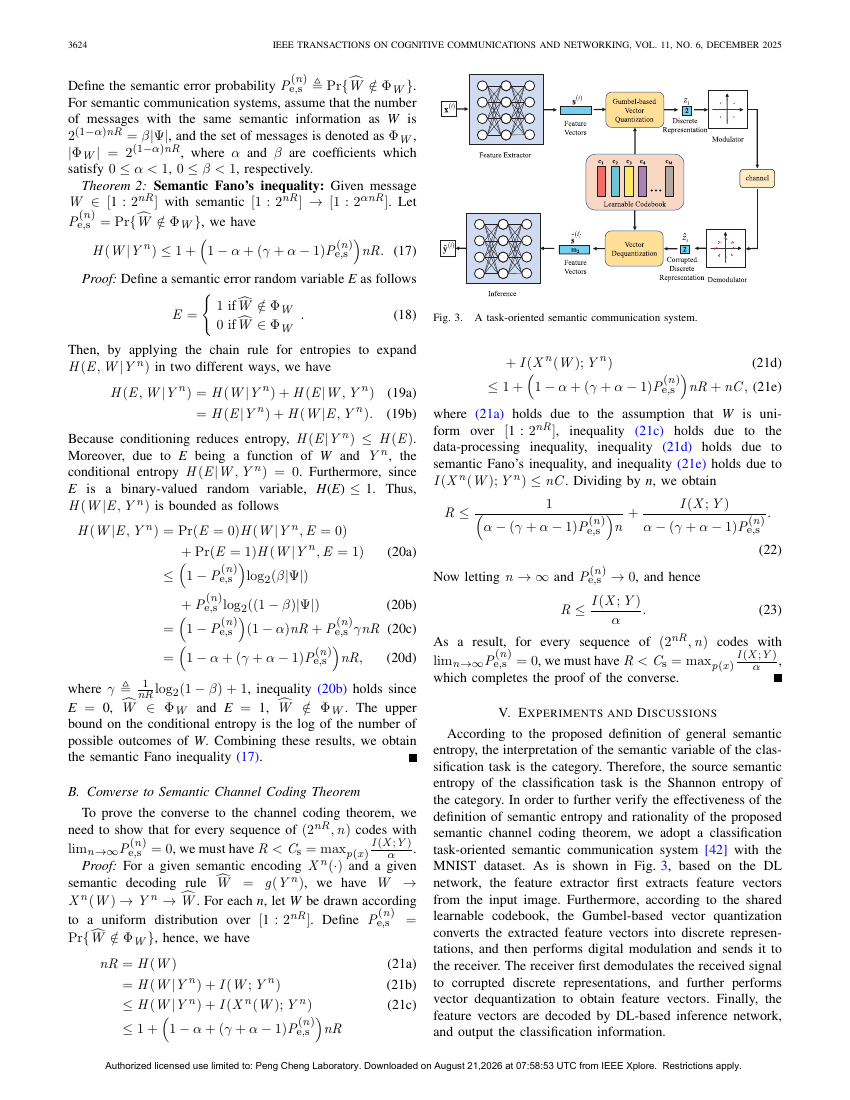
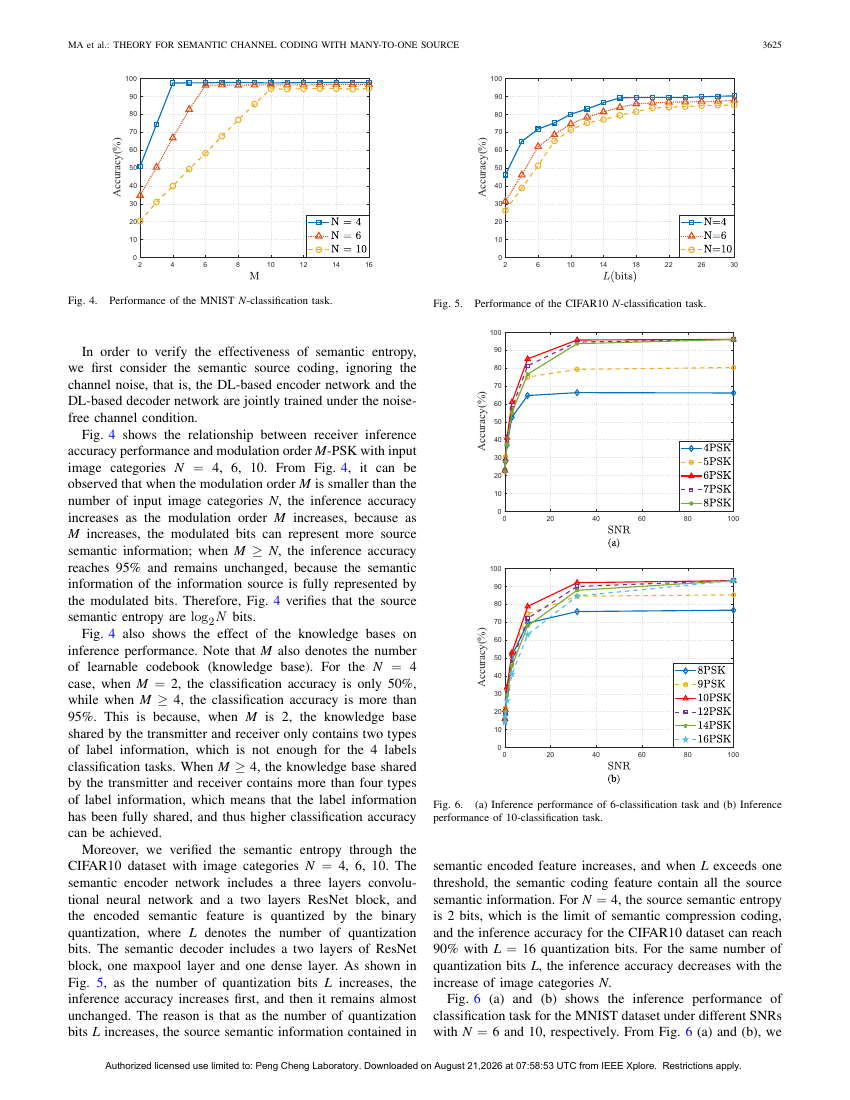
架构/方法图|来源:《A Theory for Semantic Channel Coding With Many-to-One Source》,原 PDF p.7,Fig. 3 A task-oriented semantic communication system。 核对论文关键实验结果图/表|来源:《A Theory for Semantic Channel Coding With Many-to-One Source》,原 PDF p.8,Fig. 4 Performance of the MNIST N-classification task。 核对论文
核心纳入2025语音/音频传输或识别
Adversarial Attacks Against Shared Knowledge Interpretation in Semantic Communications
局限:没有完整离散接口,无法直接回答 bit/index/token 跳变问题。 未显式注入离散误码/丢包,鲁棒性结论不应外推到真实数字链路。 未报告统一可复核的 payload bit 数/CBR,跨论文带宽比较受限。
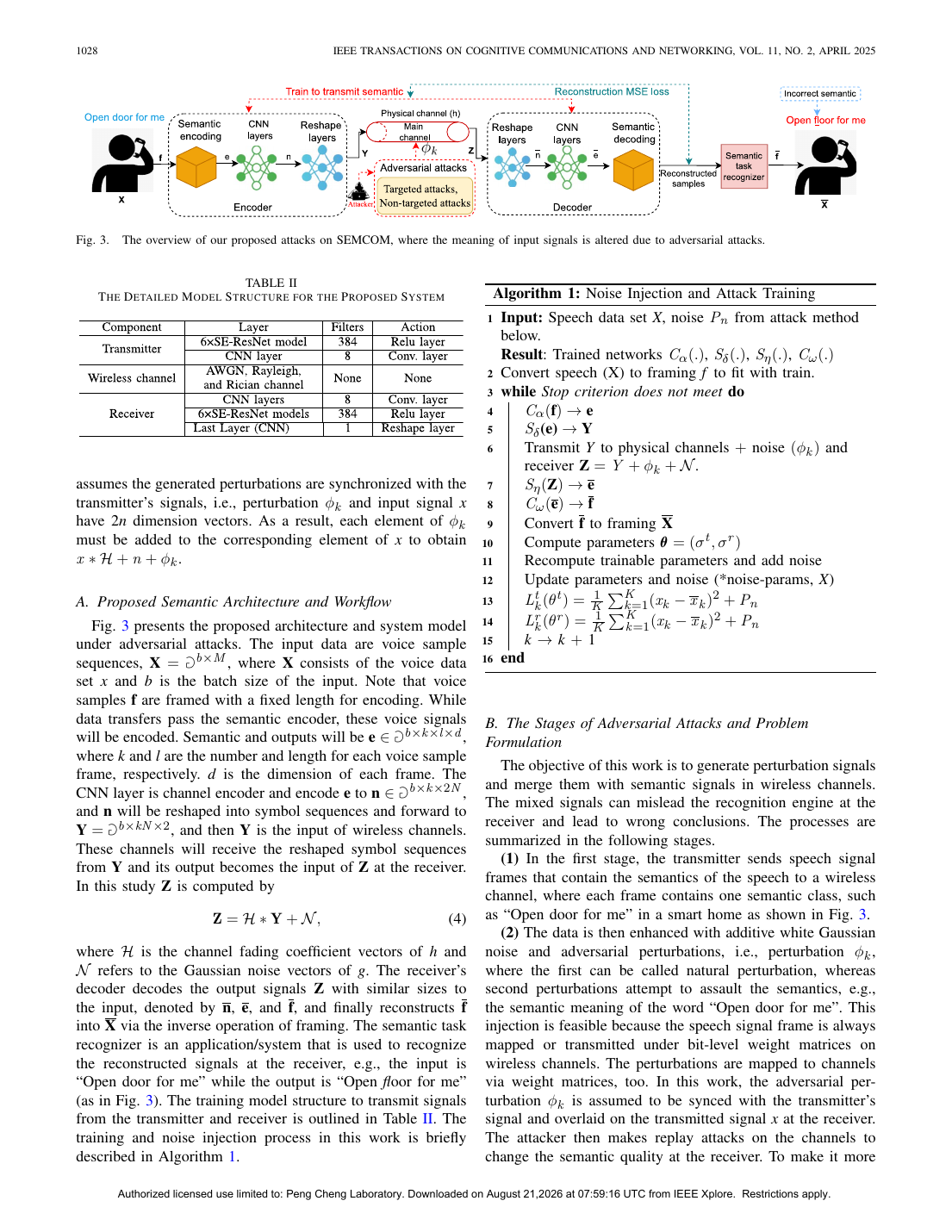
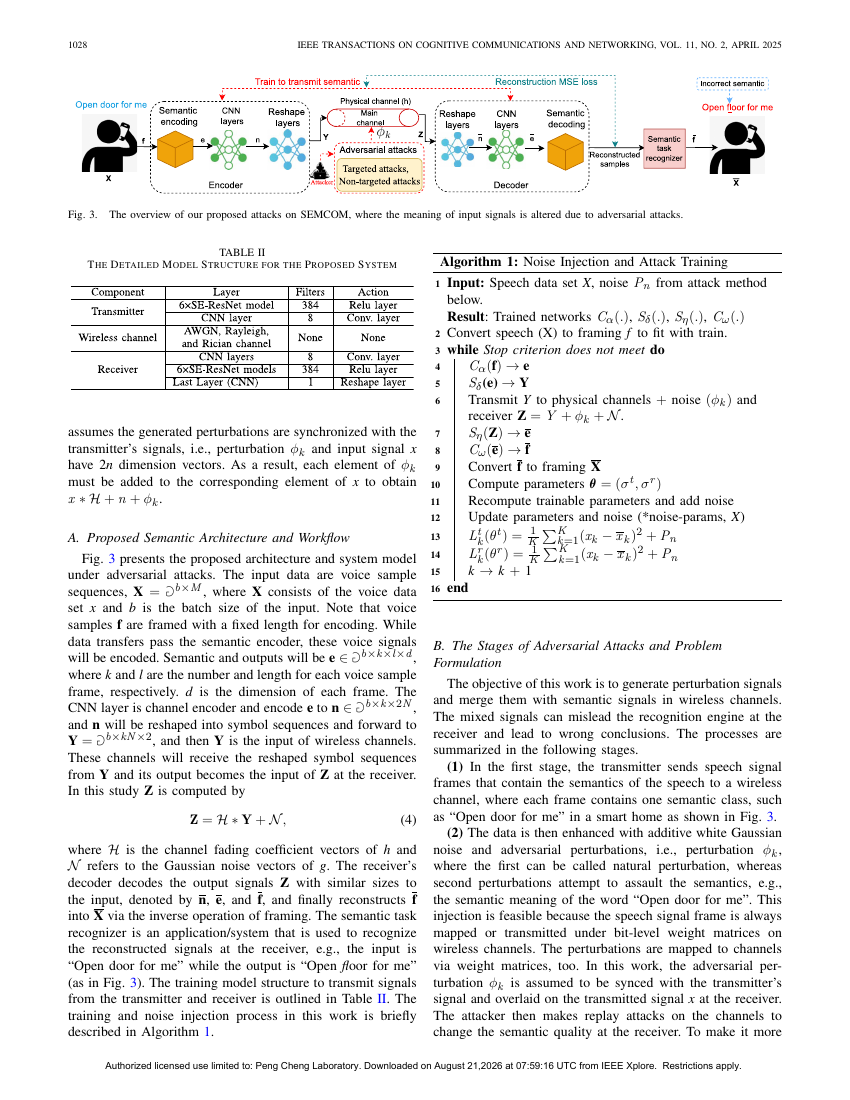
架构/方法图|来源:《Adversarial Attacks Against Shared Knowledge Interpretation in Semantic Communications》,原 PDF p.5,Fig. 3 The overview of our proposed attacks on SEMCOM, where the meaning of input signals is altered due to adversarial attacks。 核对论文关键实验结果图/表|来源:《Adversarial Attacks Against Shared Knowledge Interpretation in Semantic Communications》,原 PDF p.5,Fig. 3 The overview of our proposed attacks on SEMCOM, where the meaning of input signals is altered due to adversarial attacks。 核对论文
核心纳入2025任务导向推理
Conceptual Learning and Causal Reasoning for Semantic Communication
一句话主旨:Conceptual Learning and Causal Reasoning for Semantic Communication 面向任务导向推理,把问题放在“任务导向联合信源信道设计”层处理;本调研把主接口判断为“语义 feature/latent;量化到 bitstream 的接口未完整报告”。
Motivation|Introduction 怎样导出本文方案
现有进展:语义通信是一种向以意义为导向的交流的范式转变,这在很大程度上是由人工智能技术实现的。 PDF p.1
仍然存在的问题:然而,以自动化的方式学习这些概念空间是一个主要的挑战。 PDF p.1
为什么已有方法解决不了:像素级重建是比下游决策更强、也更昂贵的目标;但只压缩 feature 又可能丢掉决定任务的少量证据,因此需要把任务 loss 与通信瓶颈联合设计。 PDF p.1
为什么这个问题重要:边缘设备常需要及时决策而不是完整副本;只发送任务充分信息可以降低时延与带宽,但前提是关键证据确实能穿过信道。 PDF p.1
本文提出什么:为解决这些问题,本文提出了概念空间语义通信的两个主要创新。 PDF p.1
方案为何可能有效:概念空间提供可解释的低维语义变量,因果图把这些变量与任务目标连接起来,使接收端能够利用结构知识补偿信道造成的语义偏移。 PDF p.2
作者希望证明什么:仿真结果表明,该方法与传统通信技术相比,分类精度提高了40%,与传统方法相比,分类率降低了99%。 PDF p.1
方法与端到端信息流
发送端以 VAE 学习可解释的概念空间,并显式建模概念维度与任务变量之间的因果关系;接收端在受损语义变量上执行因果推理,恢复任务相关概念而非逐样本复刻。 PDF p.1PDF p.2
输入输入是任务导向推理所需的源数据与下游任务所需特征。
发送端发送端采用 Conceptual Learning and Causal Reasoning for Semantic Communication:发送端以 VAE 学习可解释的概念空间,并显式建模概念维度与任务变量之间的因果关系;接收端在受损语义变量上执行因果推理,恢复任务相关概念而非逐样本复刻。
实际发送实际发送对象是语义 feature 或未完整规定 bit 映射的 latent。
信道信道作用方式按“类别 0:信道作用点不足,或由外部传统链路抽象承担”解释。
接收端接收端从论文假设已经恢复的语义特征开始,再执行语义解码、任务推理或生成。
输出最终输出为分类、分割、检索或其他任务决策。
它在通信系统中的位置:只传下游任务需要的信息,并以任务质量而不是逐 bit 正确作为最终目标。
数字化方案与真实传输开销
是否属于严格数字语义通信:否/不适用:主接口为连续 JSCC 或上层模型
表示判断:语义 feature/latent;量化到 bitstream 的接口未完整报告
全文没有给出可复核的 VQ/codebook/index-to-bit 接口。根据系统模型,本调研将传输表示判断为“语义 feature/latent;量化到 bitstream 的接口未完整报告”;不能把网络 latent 的每个浮点维度直接当成固定 bit。 独立判断:Conceptual Learning and Causal Reasoning for Semantic Communication 的主传输单位应归为“语义 feature/latent;量化到 bitstream 的接口未完整报告”。只有论文明确给出量化和映射时,才能把 token/index 数换算成总 bit;连续 channel symbol 只能按 channel uses/CBR 比较。 PDF p.2
论文未同时报告输入尺寸、encoder 输出尺寸、量化精度/码本大小和帧级开销,因此不能从全文唯一重建总 bit 数。页面保留论文实际使用的 CBR、bpp、token 数或信道使用次数;缺失项不作臆测。 PDF p.2PDF p.9
实验小节中明确出现的比较对象包括QAM、VAE、BERT;指标包括mAP、accuracy、semantic similarity、classification accuracy、PER;信道/链路条件包括AWGN、Rayleigh、fading channel;正文可定位的代表性工作点有SNR of -20dB。 PDF p.9
仿真结果表明,该方法与传统通信技术相比,分类精度提高了40%,与传统方法相比,分类率降低了99%。 PDF p.1
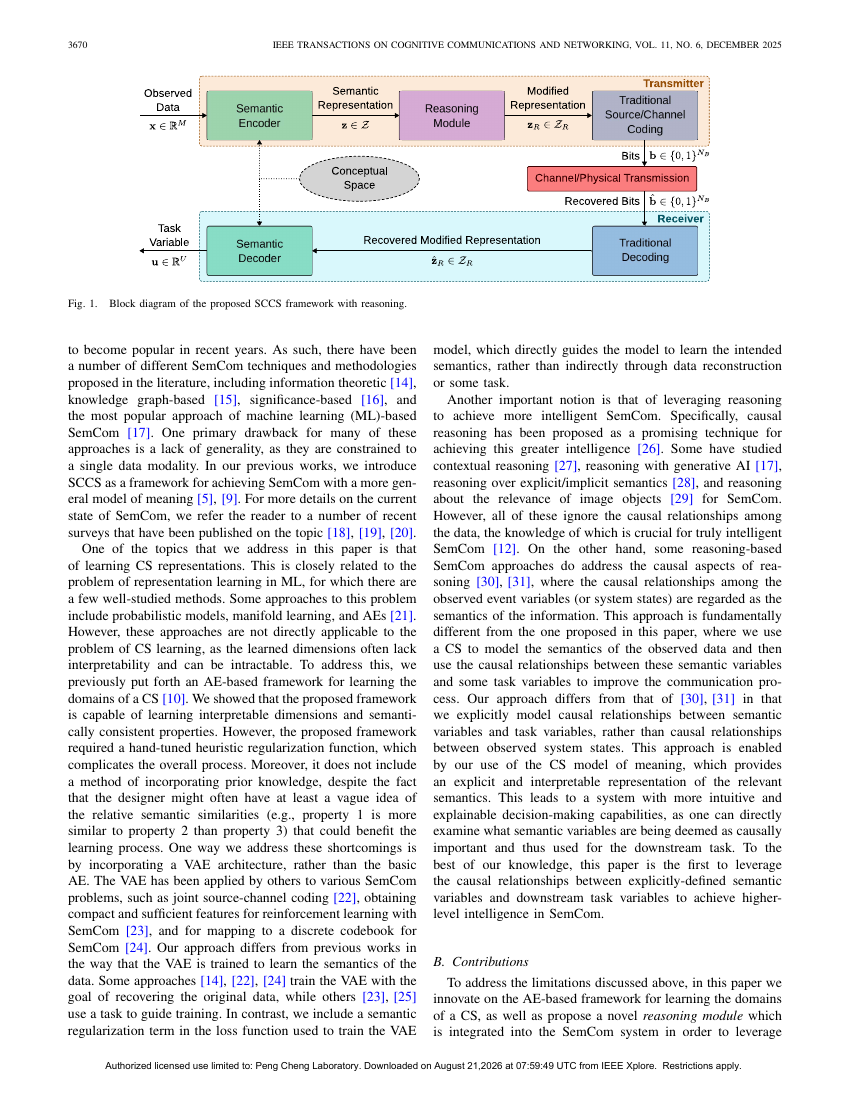
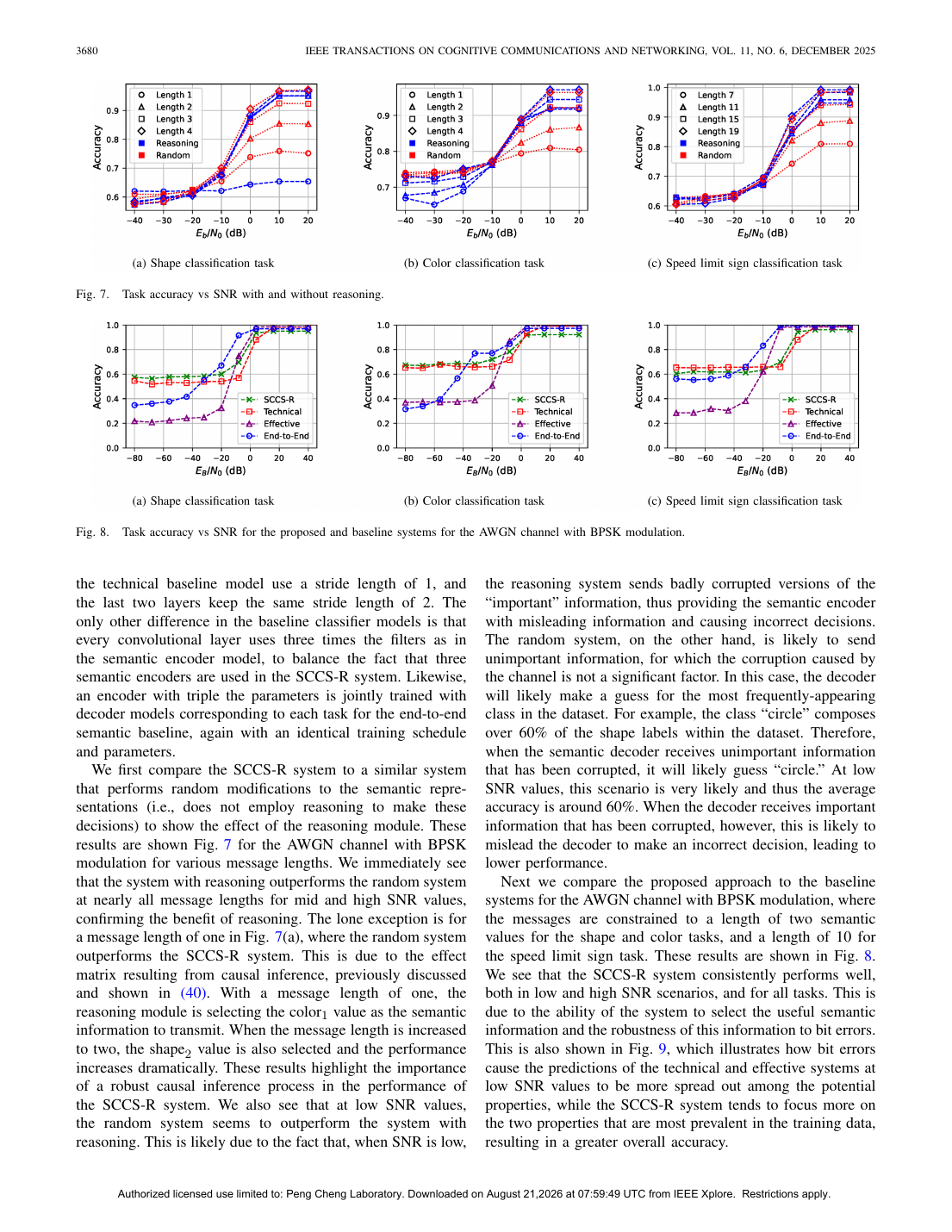
架构/方法图|来源:《Conceptual Learning and Causal Reasoning for Semantic Communication》,原 PDF p.2,Fig. 1 Block diagram of the proposed SCCS framework with reasoning。 核对论文关键实验结果图/表|来源:《Conceptual Learning and Causal Reasoning for Semantic Communication》,原 PDF p.12,Fig. 7 Task accuracy vs SNR with and without reasoning。 核对论文
核心纳入2025图像传输、压缩或生成
Content Adaptive Distributed Joint Source-Channel Coding for Image Transmission With Hyperprior
信道与工作点AWGN、SNR = 5 dB、SNR of 28.12 dB、SNR = 10 dB、compression ratio of 0.065
数据集为KITTI;实验小节中明确出现的比较对象包括JPEG、JPEG2000、BPG、ViT、JSCC;指标包括PSNR、SSIM、MS-SSIM、MSE、mAP、FLOPs、PER;信道/链路条件包括AWGN;正文可定位的代表性工作点有SNR = 5 dB、SNR of 28.12 dB、SNR = 10 dB、compression ratio of 0.065。 PDF p.8
实验结果表明,与现有的分布式JSCC算法相比,本文提出的多层信息融合模块和熵掩模模块能够有效地提高重建质量约1.0dB PSNR。 PDF p.1
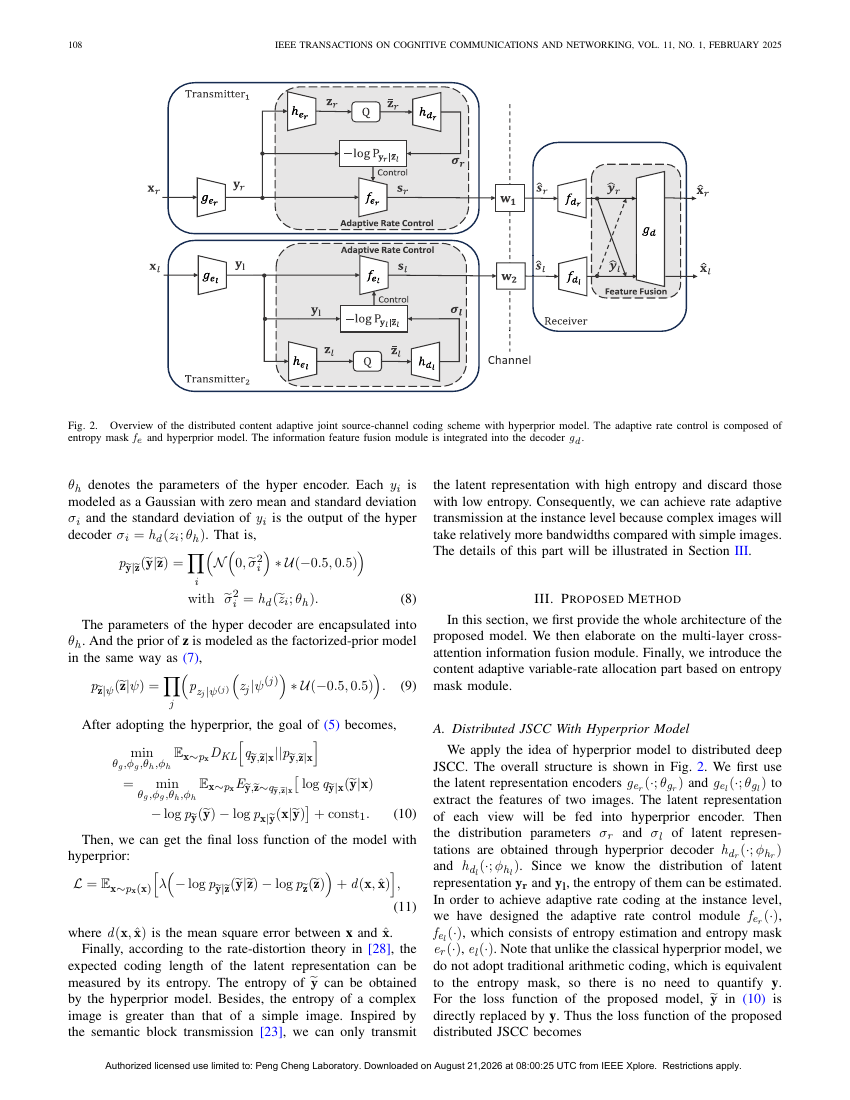
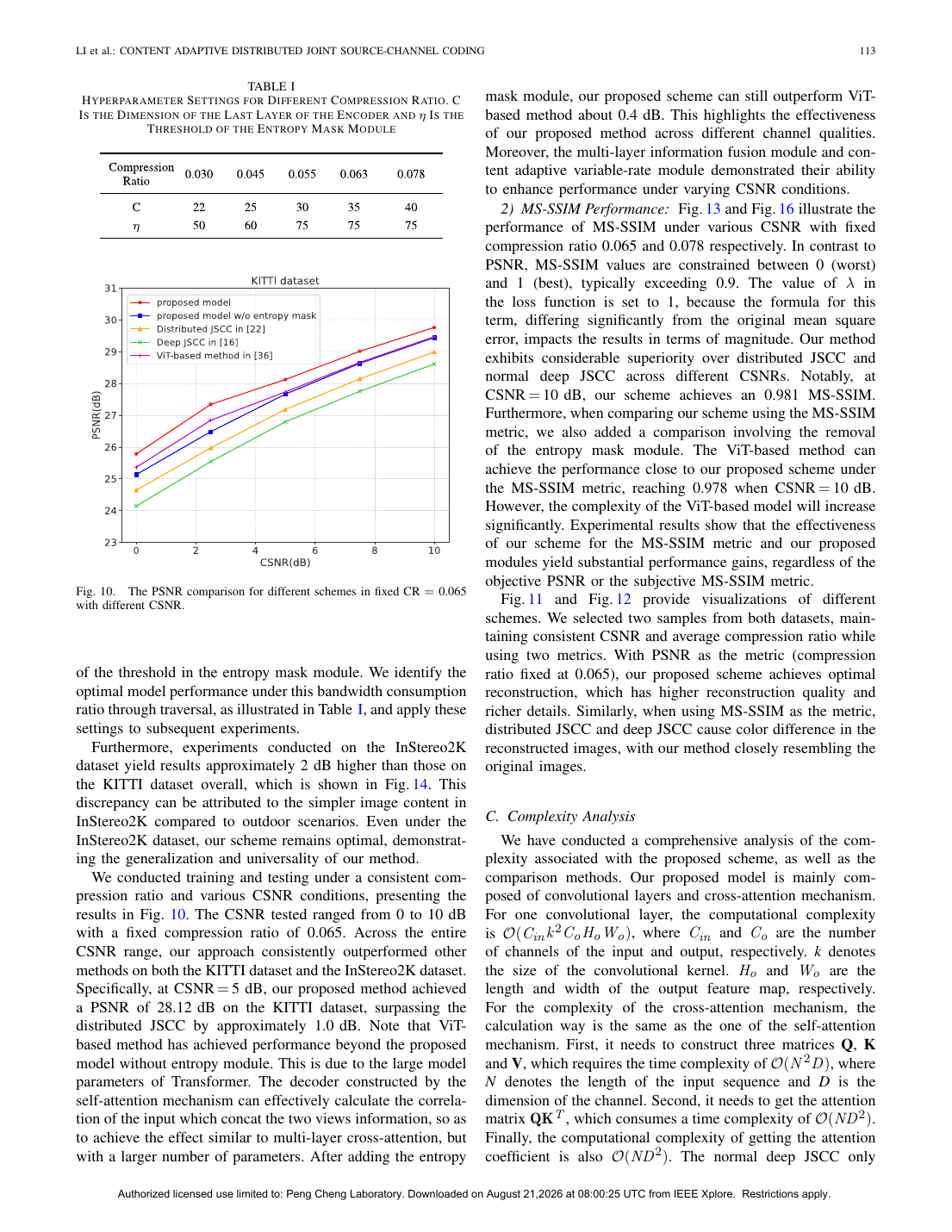
架构/方法图|来源:《Content Adaptive Distributed Joint Source-Channel Coding for Image Transmission With Hyperprior》,原 PDF p.4,Fig. 2 Overview of the distributed content adaptive joint source-channel coding scheme with hyperprior model. The adaptive rate control is composed of entropy mask fe and hyperprior model. The information feature fusion module is integrated into the decoder gd 。 核对论文关键实验结果图/表|来源:《Content Adaptive Distributed Joint Source-Channel Coding for Image Transmission With Hyperprior》,原 PDF p.9,Fig. 10 The PSNR comparison for different schemes in fixed CR = 0.065 with different CSNR。 核对论文
核心纳入2025图像传输、压缩或生成
Deep Reinforced Feature Compression and Channel Equalization for Semantic Communications
实验小节中明确出现的比较对象包括DeepJSCC、JPEG、LDPC、Turbo、QAM、VAE、SwinJSCC、JSCC;指标包括PSNR、accuracy、FLOPs、classification accuracy、PER;信道/链路条件包括AWGN、Rayleigh、Rician、fading channel。 PDF p.9
仿真结果表明,在衰落信道条件下,与现有方法相比,所提出的SC系统可分别降低约40%的计算复杂度和提高约20%的平均性能。 PDF p.1
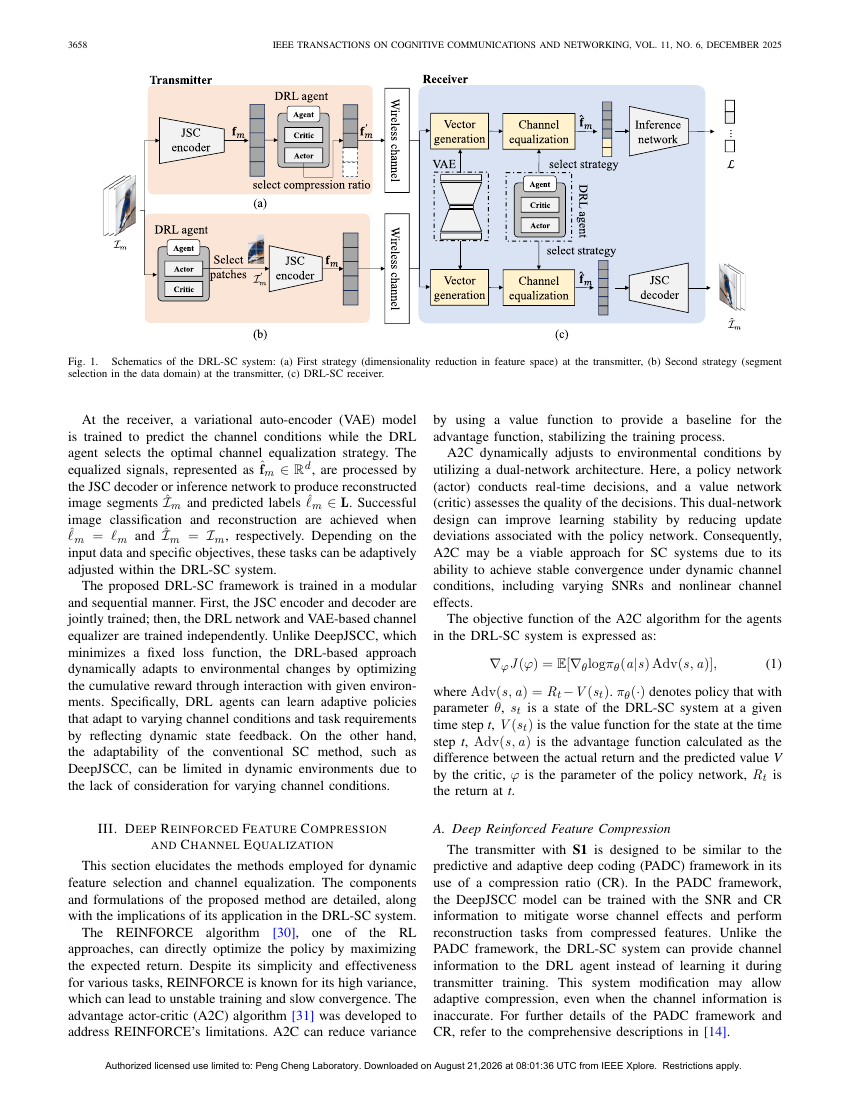
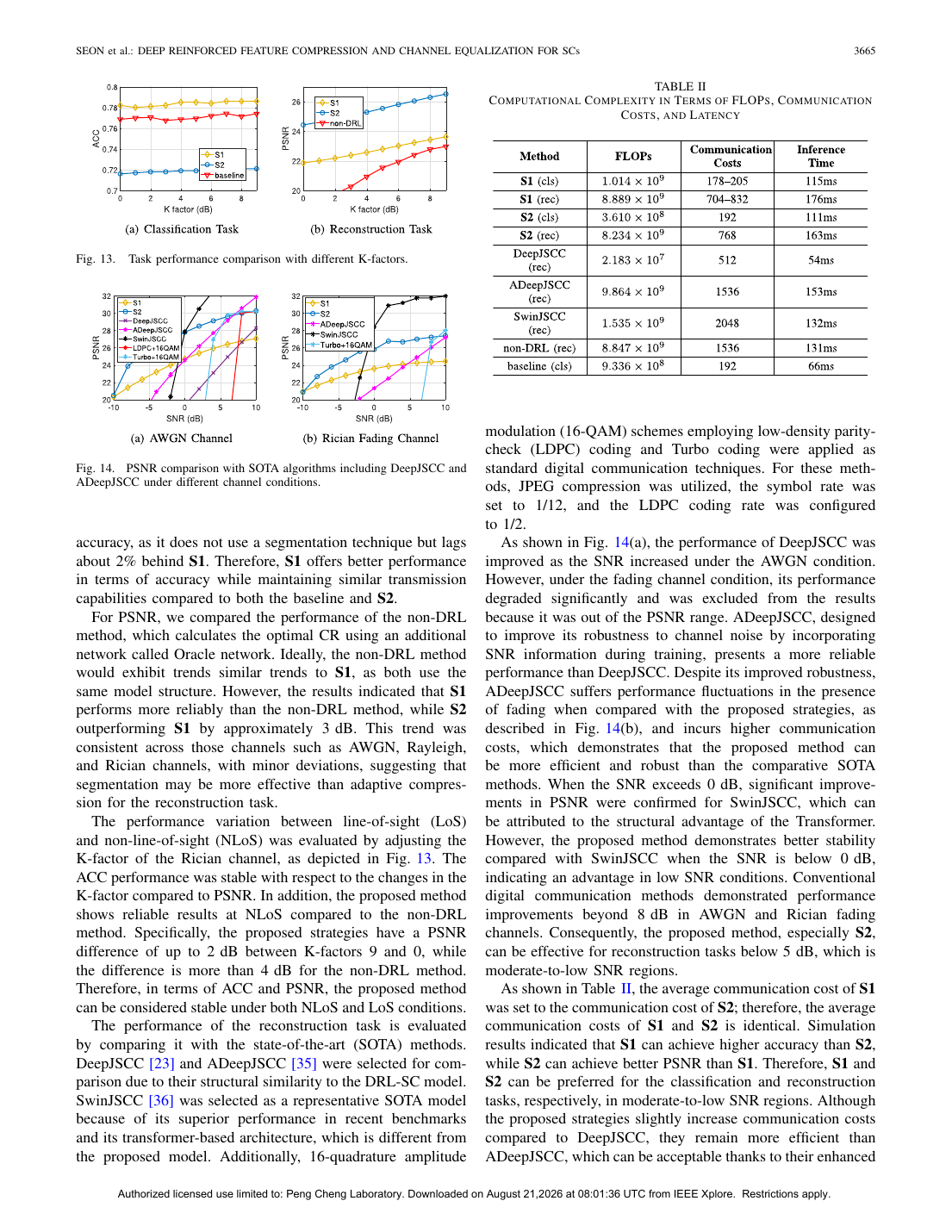
架构/方法图|来源:《Deep Reinforced Feature Compression and Channel Equalization for Semantic Communications》,原 PDF p.4,Fig. 1 Schematics of the DRL-SC system: (a) First strategy (dimensionality reduction in feature space) at the transmitter, (b) Second strategy (segment selection in the data domain) at the transmitter, (c) DRL-SC receiver。 核对论文关键实验结果图/表|来源:《Deep Reinforced Feature Compression and Channel Equalization for Semantic Communications》,原 PDF p.11,Fig. 13 Task performance comparison with different K-factors。 核对论文
核心纳入2025图像传输、压缩或生成
Digital Semantic Communication System With a Learnable Channel Estimator for OFDM Transmission
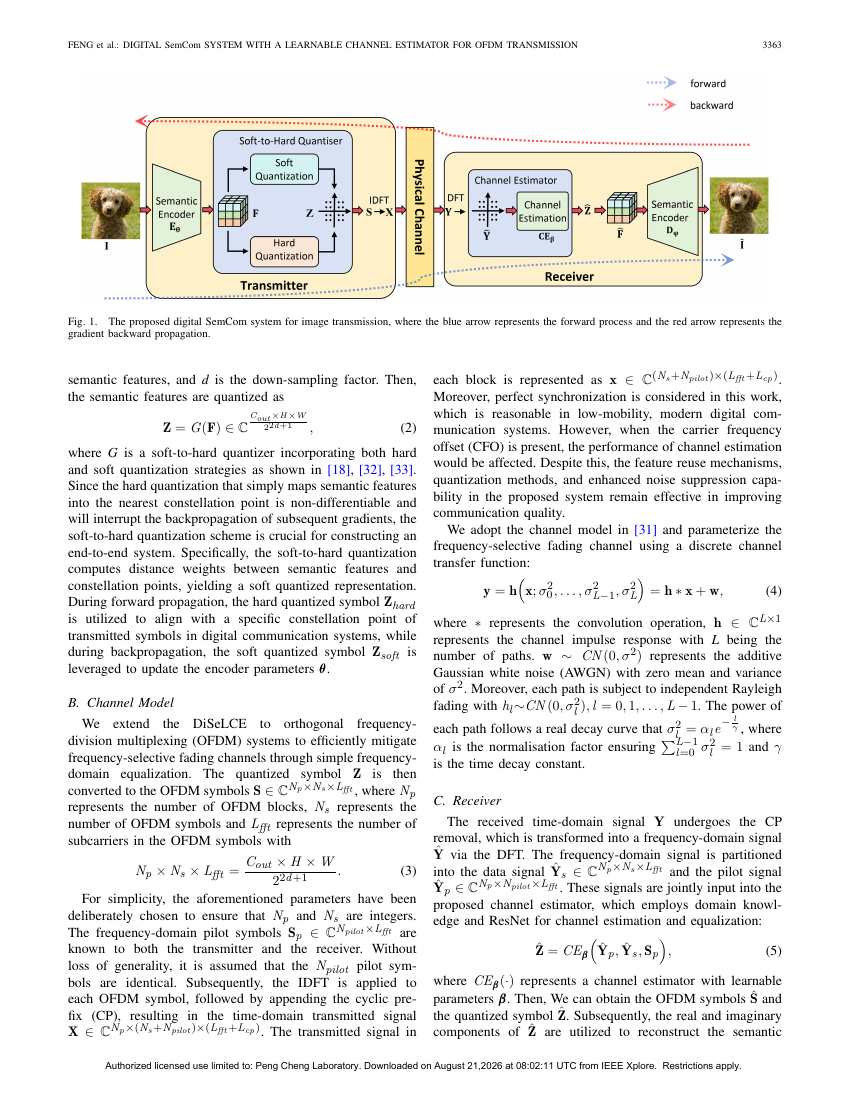
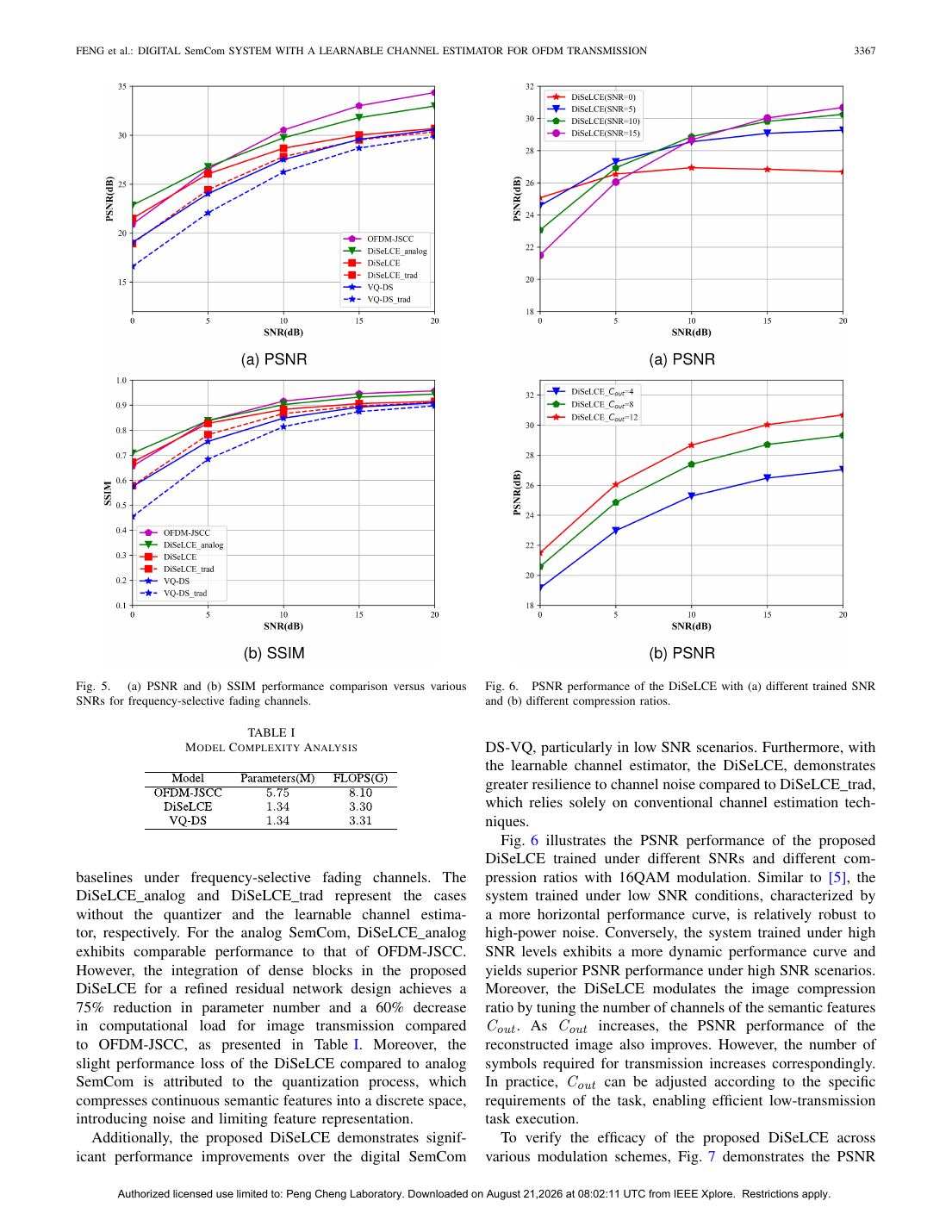
架构/方法图|来源:《Digital Semantic Communication System With a Learnable Channel Estimator for OFDM Transmission》,原 PDF p.3,Fig. 1 The proposed digital SemCom system for image transmission, where the blue arrow represents the forward process and the red arrow represents the gradient backward propagation。 核对论文关键实验结果图/表|来源:《Digital Semantic Communication System With a Learnable Channel Estimator for OFDM Transmission》,原 PDF p.7,Fig. 5 (a) PSNR and (b) SSIM performance comparison versus various 核对论文
核心纳入2025图像传输、压缩或生成
Digital-SC: Digital Semantic Communication With Adaptive Network Split and Learned Non-Linear Quantization
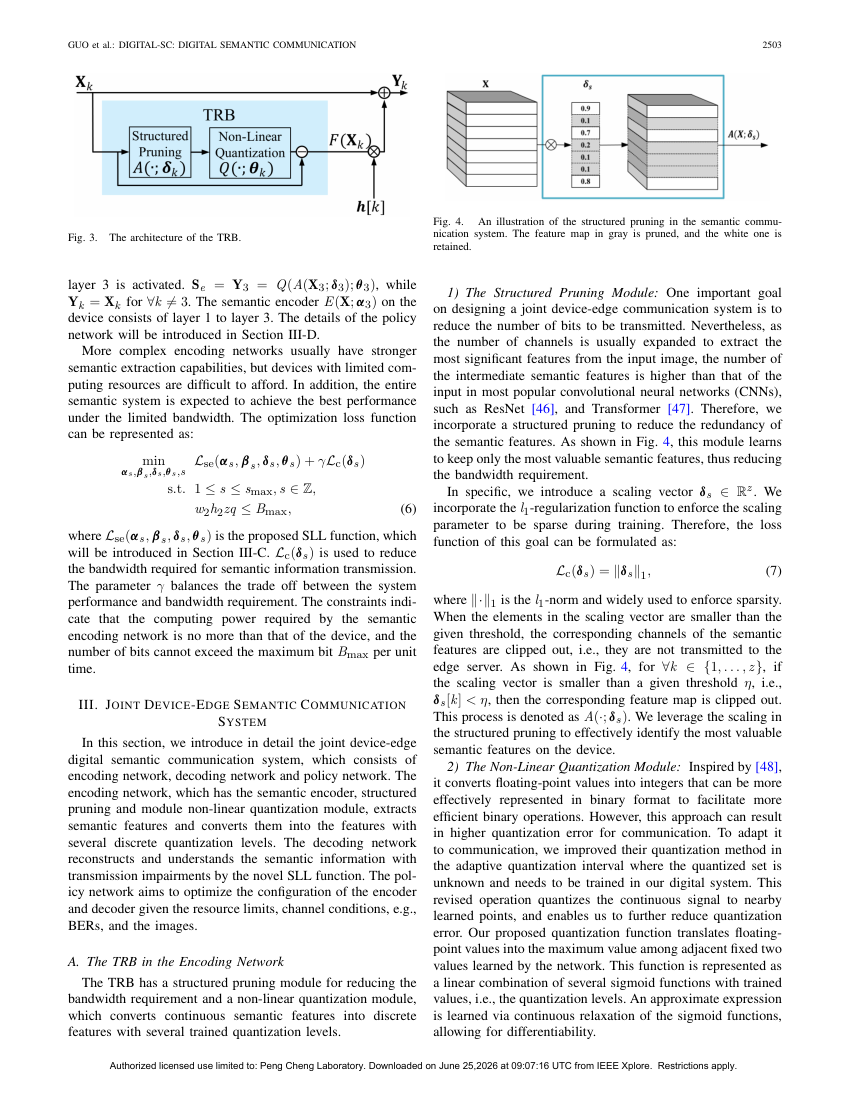
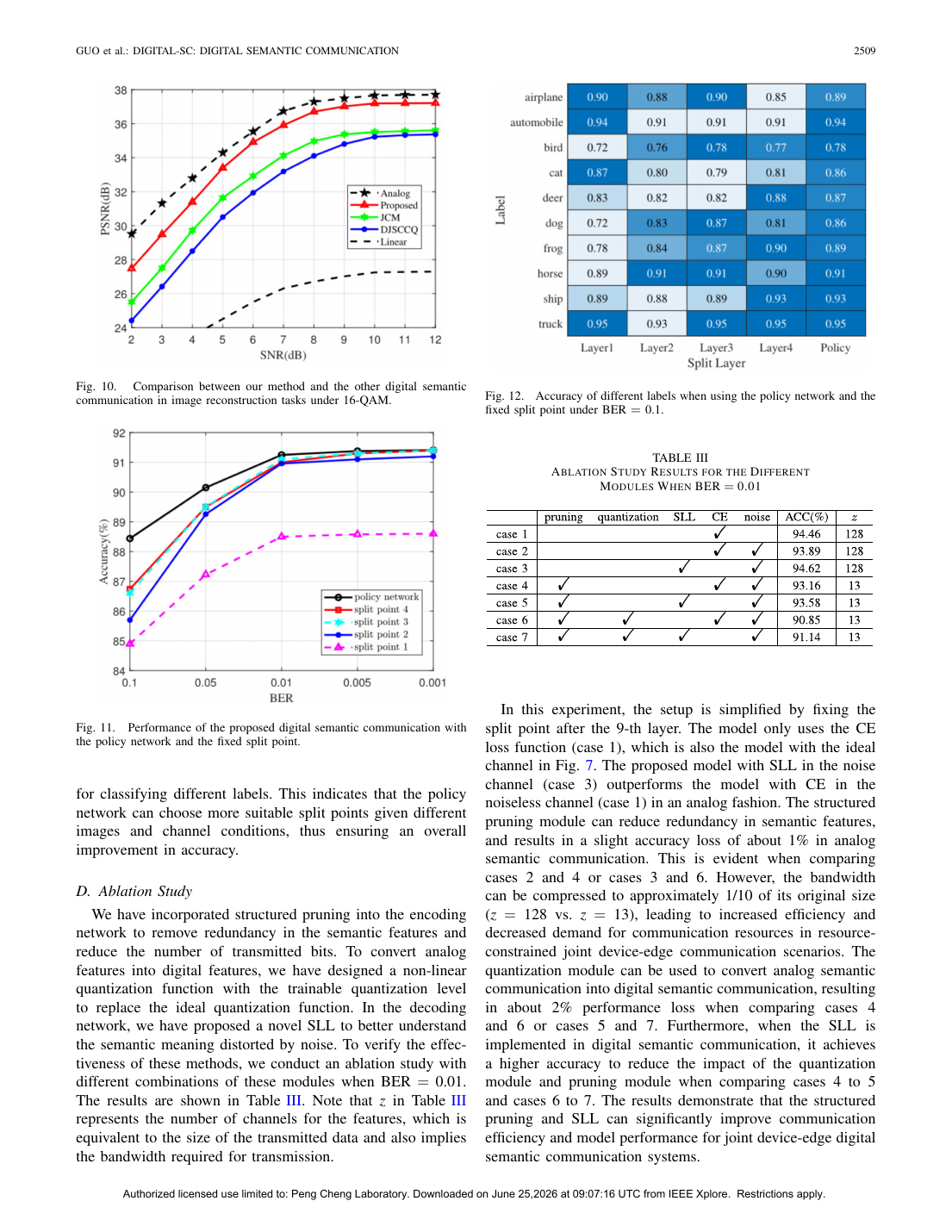
架构/方法图|来源:《Digital-SC: Digital Semantic Communication With Adaptive Network Split and Learned Non-Linear Quantization》,原 PDF p.5,Fig. 3 The architecture of the TRB. nication system. The feature map in gray is pruned, and the white one is retained。 核对论文关键实验结果图/表|来源:《Digital-SC: Digital Semantic Communication With Adaptive Network Split and Learned Non-Linear Quantization》,原 PDF p.11,Fig. 10 Comparison between our method and the other digital semantic communication in image reconstruction tasks under 16-QAM。 核对论文
核心纳入2025语音/音频传输或识别
EESC-S: An Emotion-Enhanced Semantic Communication Framework for Speech Transmission
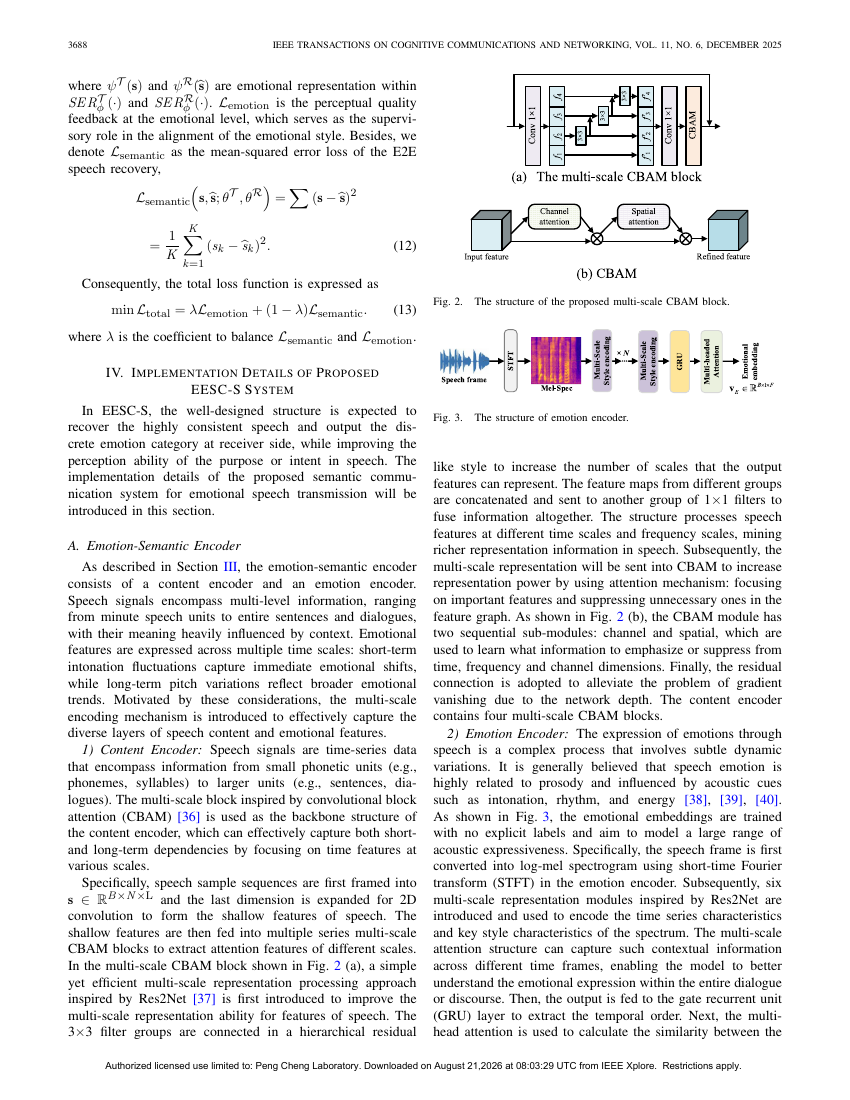
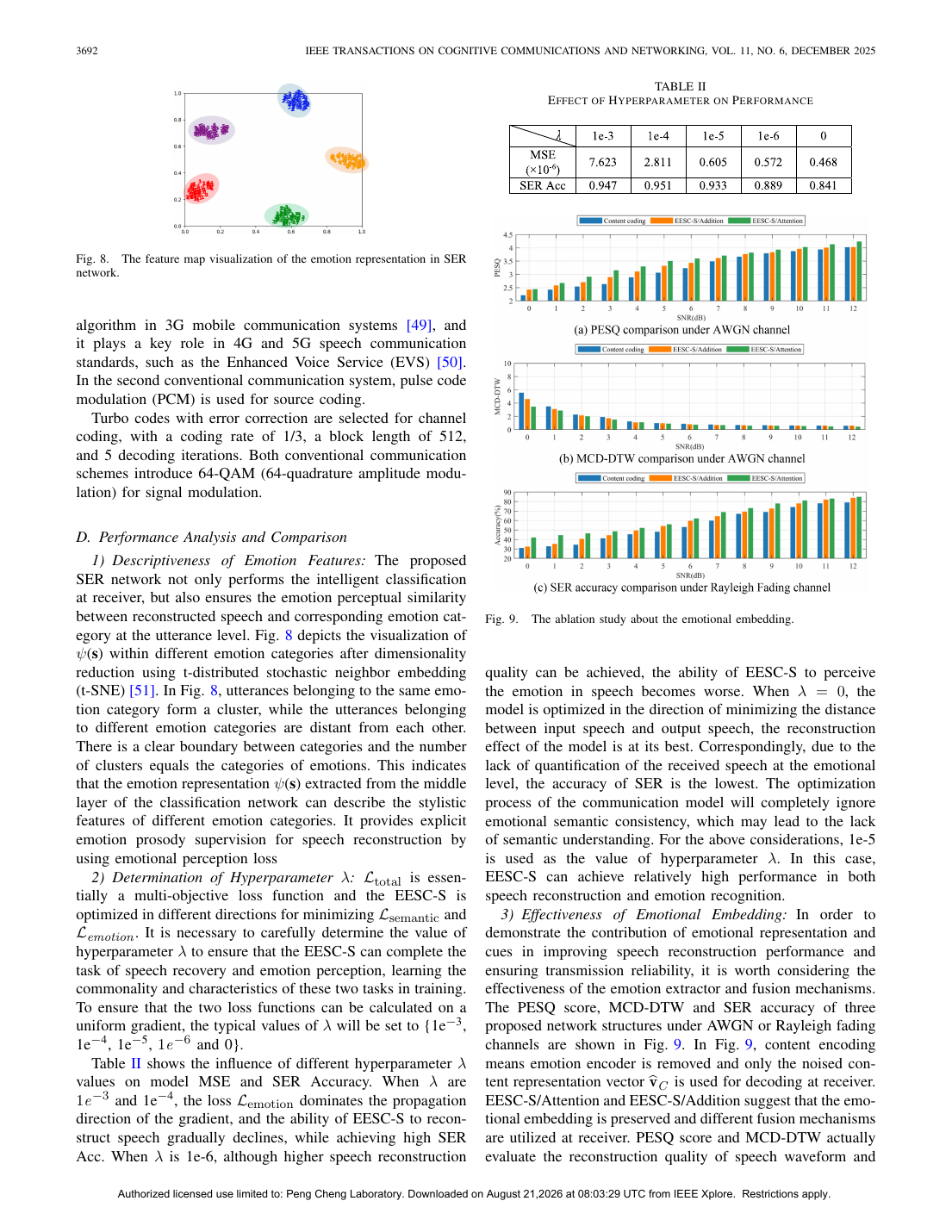
架构/方法图|来源:《EESC-S: An Emotion-Enhanced Semantic Communication Framework for Speech Transmission》,原 PDF p.5,Fig. 2 The structure of the proposed multi-scale CBAM block. min Ltotal = λLemotion + (1 - λ)Lsemantic . (13) where λ is the coefficient to balance Lsemantic and Lemotion 。 核对论文关键实验结果图/表|来源:《EESC-S: An Emotion-Enhanced Semantic Communication Framework for Speech Transmission》,原 PDF p.9,Fig. 8 The feature map visualization of the emotion representation in SER network。 核对论文
核心纳入2025通用语义通信系统
Fluid Antenna-Enabled Near-Field Integrated Sensing, Computing, and Semantic Communication for Emerging Applications
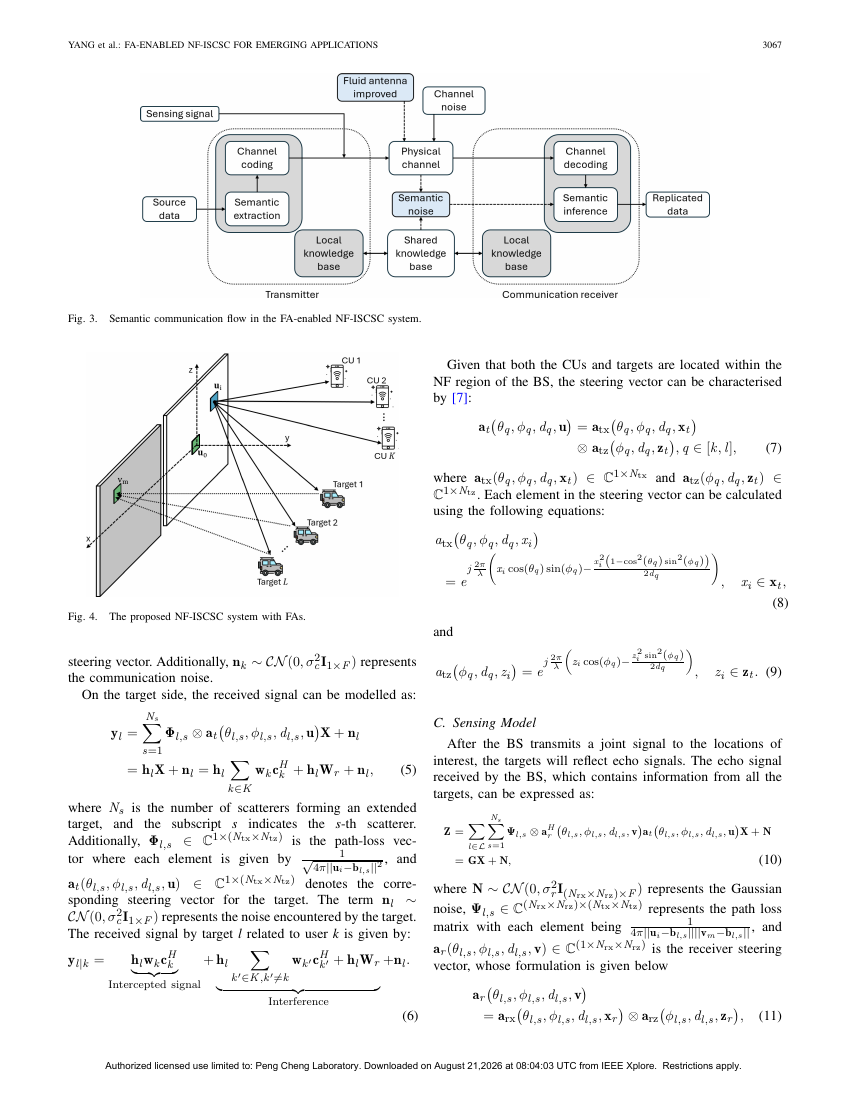
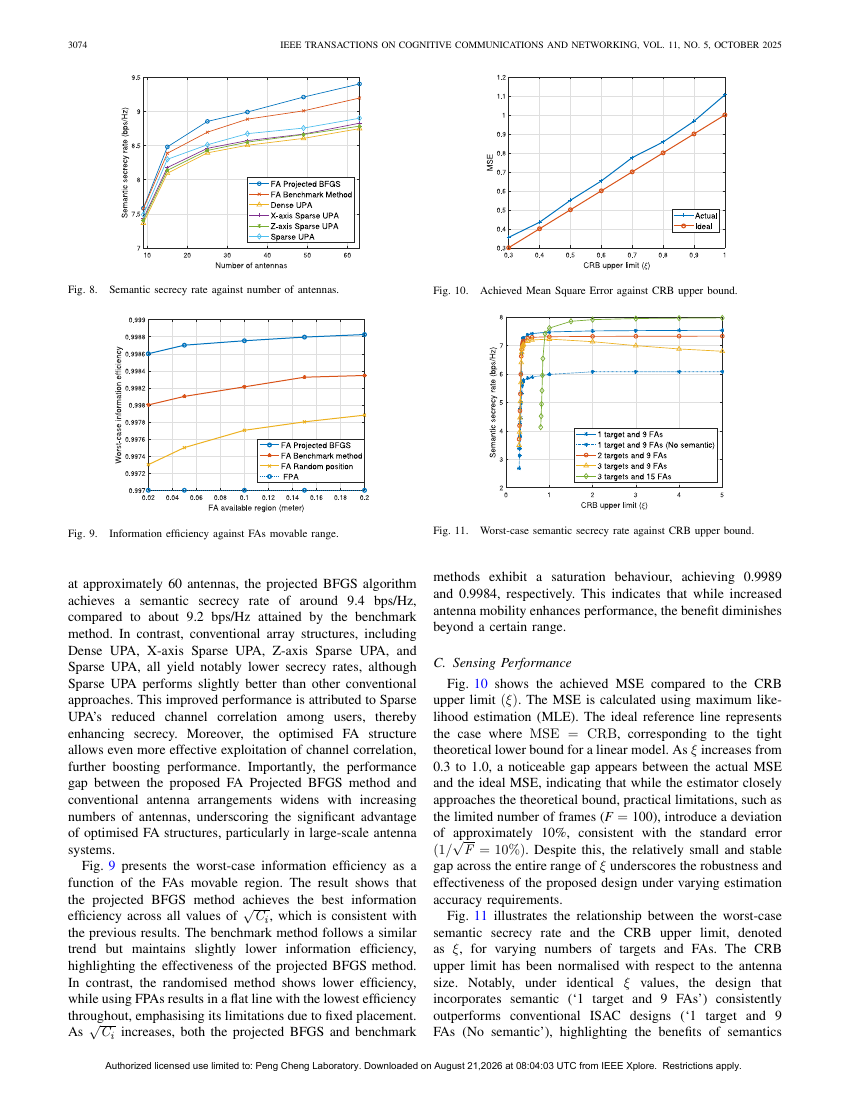
架构/方法图|来源:《Fluid Antenna-Enabled Near-Field Integrated Sensing, Computing, and Semantic Communication for Emerging Applications》,原 PDF p.6,Fig. 3 Semantic communication flow in the FA-enabled NF-ISCSC system。 核对论文关键实验结果图/表|来源:《Fluid Antenna-Enabled Near-Field Integrated Sensing, Computing, and Semantic Communication for Emerging Applications》,原 PDF p.13,Fig. 8 Semantic secrecy rate against number of antennas。 核对论文
核心纳入2025任务导向推理
GAI-Enhanced Robust Semantic Communication With Asymmetric Architecture
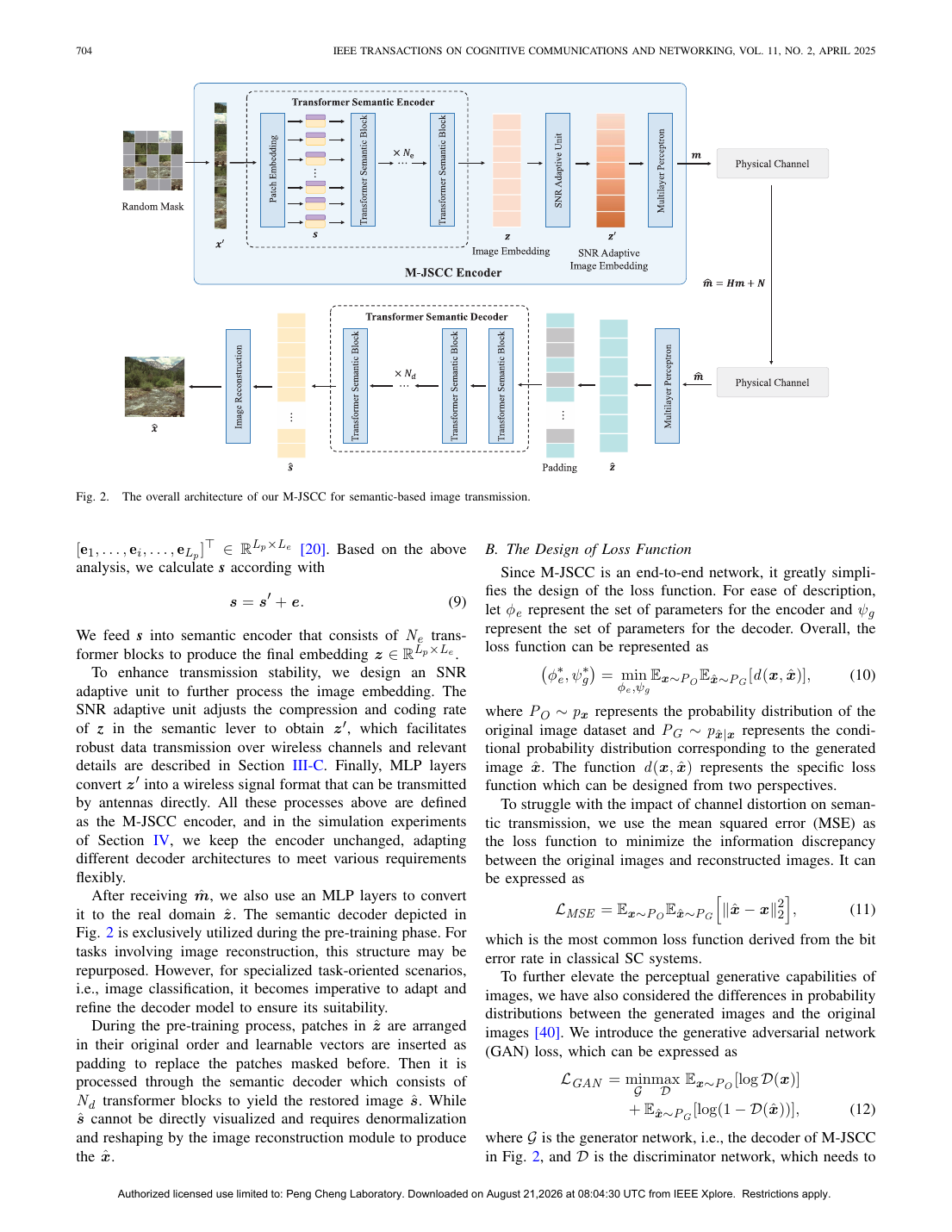
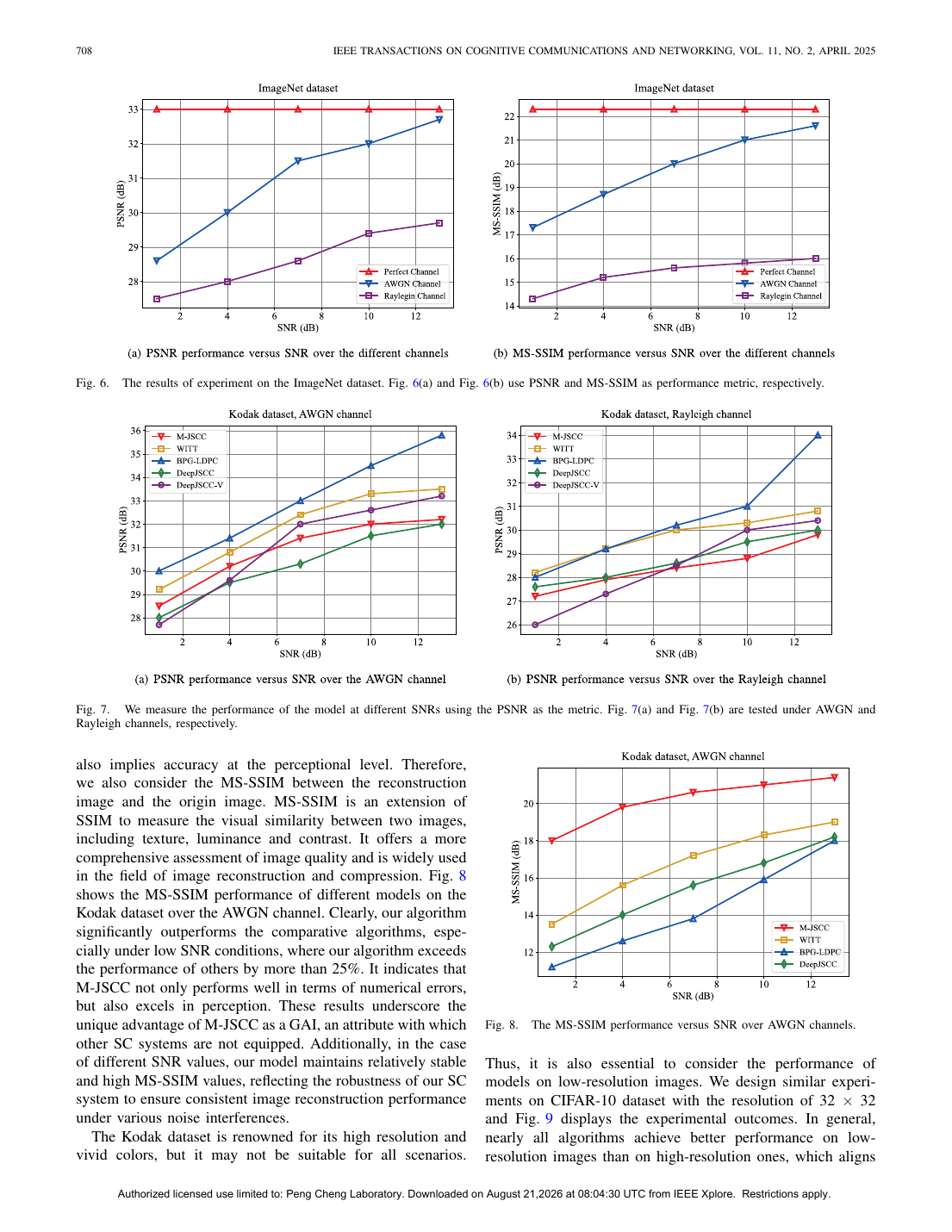
架构/方法图|来源:《GAI-Enhanced Robust Semantic Communication With Asymmetric Architecture》,原 PDF p.5,Fig. 2 The overall architecture of our M-JSCC for semantic-based image transmission。 核对论文关键实验结果图/表|来源:《GAI-Enhanced Robust Semantic Communication With Asymmetric Architecture》,原 PDF p.9,Fig. 6 The results of experiment on the ImageNet dataset。 核对论文
核心纳入2025视频传输、生成或控制
Generative AI Empowered Semantic Feature Multiple Access (SFMA) Over Wireless Networks
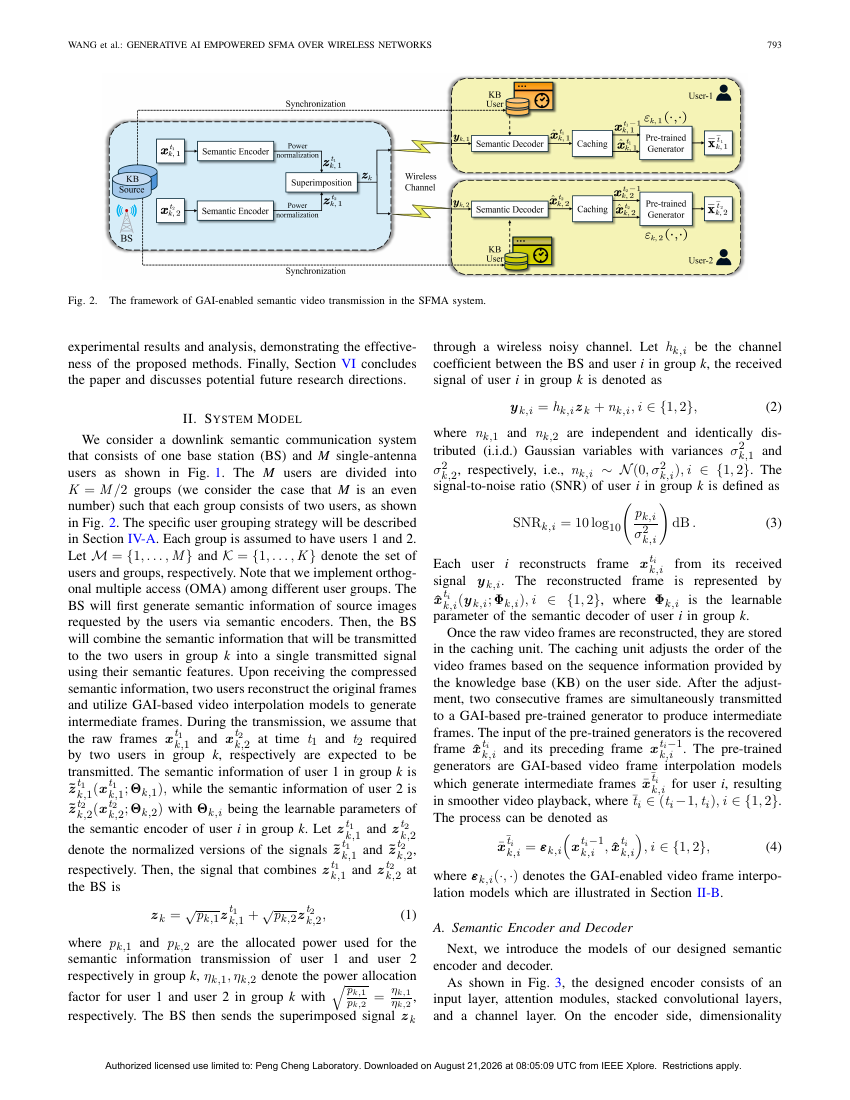
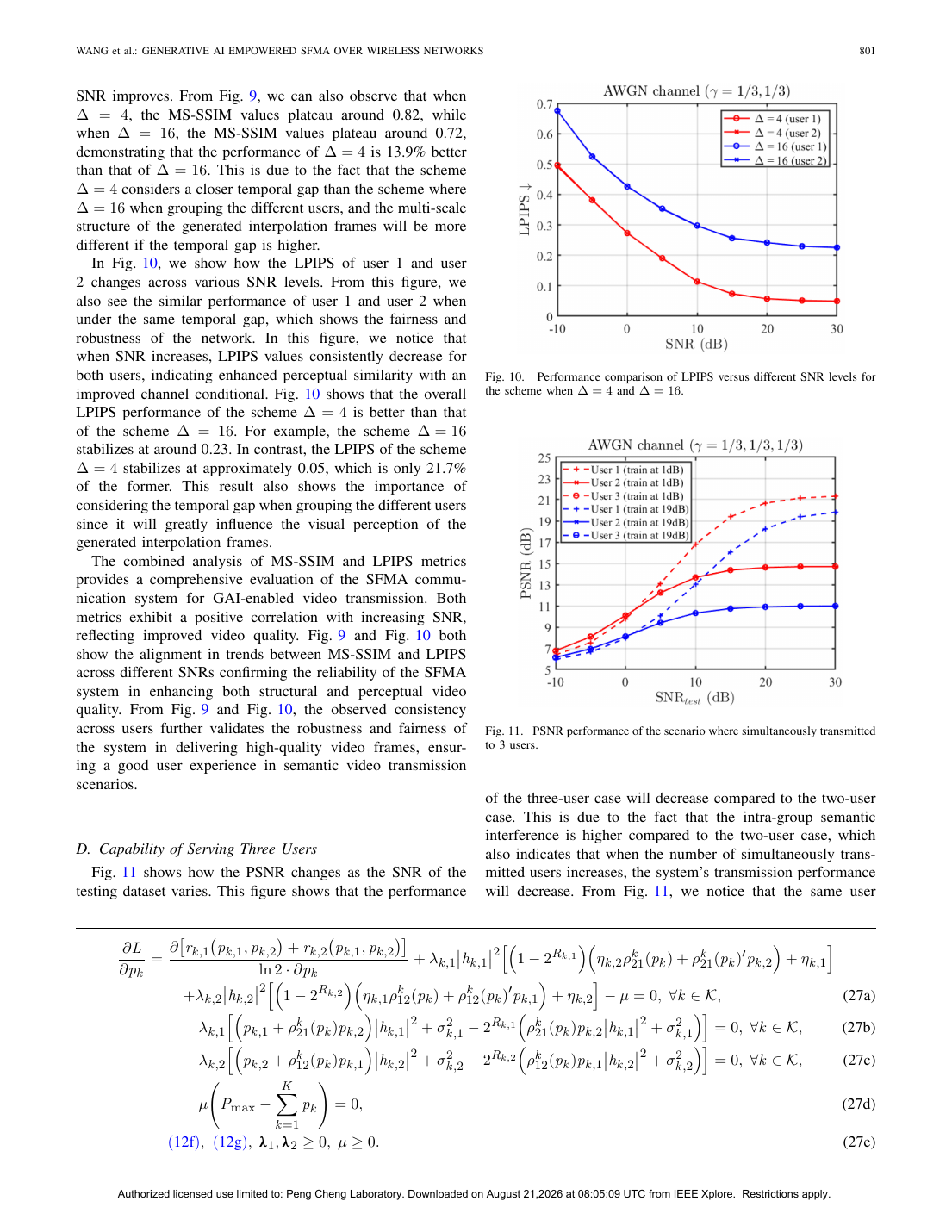
架构/方法图|来源:《Generative AI Empowered Semantic Feature Multiple Access (SFMA) Over Wireless Networks》,原 PDF p.3,Fig. 2 The framework of GAI-enabled semantic video transmission in the SFMA system。 核对论文关键实验结果图/表|来源:《Generative AI Empowered Semantic Feature Multiple Access (SFMA) Over Wireless Networks》,原 PDF p.11,Fig. 10 Performance comparison of LPIPS versus different SNR levels for improved channel conditional。 核对论文
相关但非核心2025综述、架构与研究路线
Generative AI Meets Wireless Networking: An Interactive Paradigm for Intent-Driven Communications
局限:没有完整离散接口,无法直接回答 bit/index/token 跳变问题。 未显式注入离散误码/丢包,鲁棒性结论不应外推到真实数字链路。 未报告统一可复核的 payload bit 数/CBR,跨论文带宽比较受限。 该文属于边界谱系,不能用它代表端到端语义通信主线。
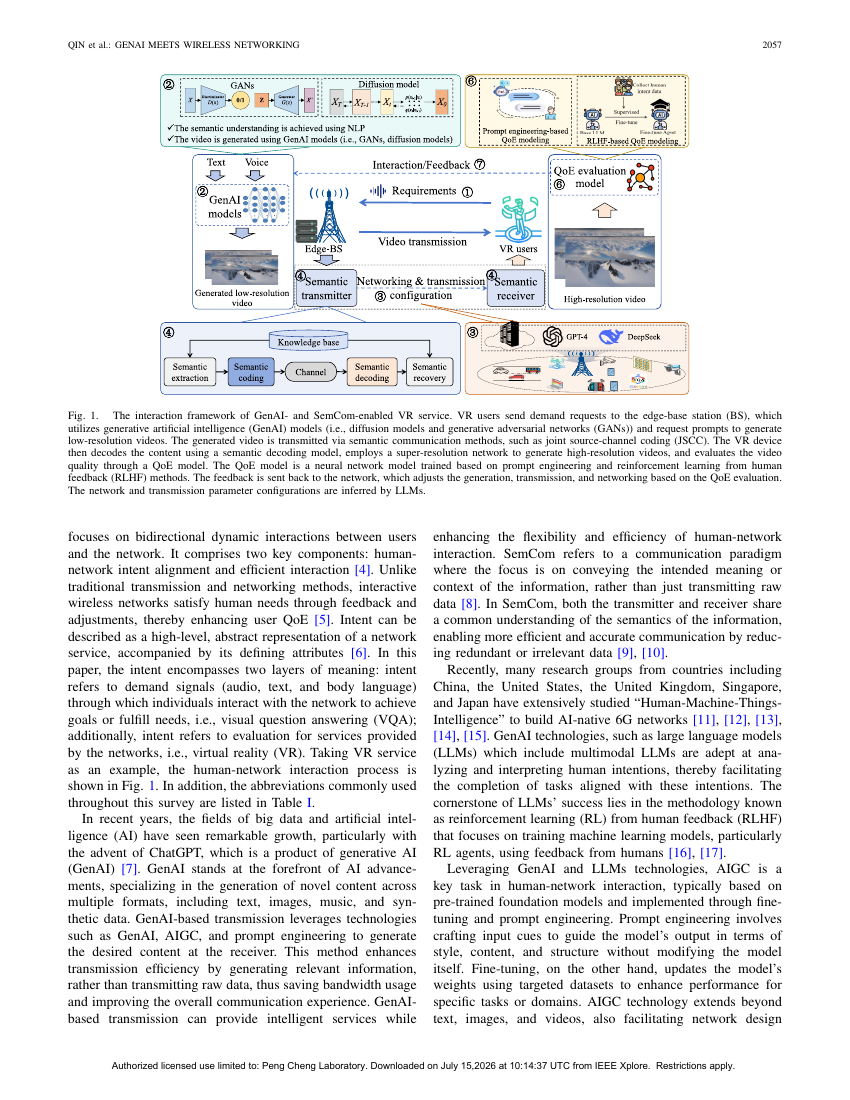
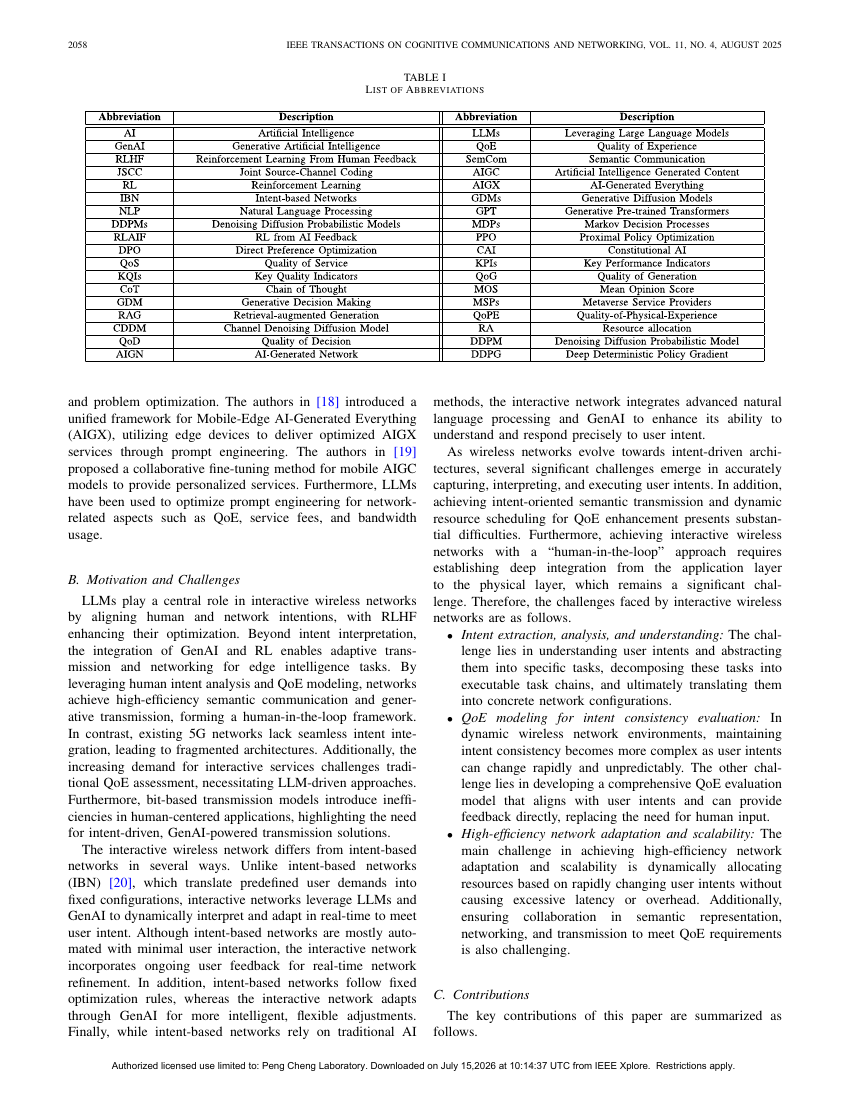
架构/方法图|来源:《Generative AI Meets Wireless Networking: An Interactive Paradigm for Intent-Driven Communications》,原 PDF p.2,Fig. 1 In addition, the abbreviations commonly used the completion of tasks aligned with these intentions. The throughout this survey are listed in 核对论文关键实验结果图/表|来源:《Generative AI Meets Wireless Networking: An Interactive Paradigm for Intent-Driven Communications》,原 PDF p.3,该页包含论文的关键实验结果图或表。 核对论文
核心纳入2025图像传输、压缩或生成
Generative AI-Driven Incentive Mechanism for Semantic Communications in RSMA Networks
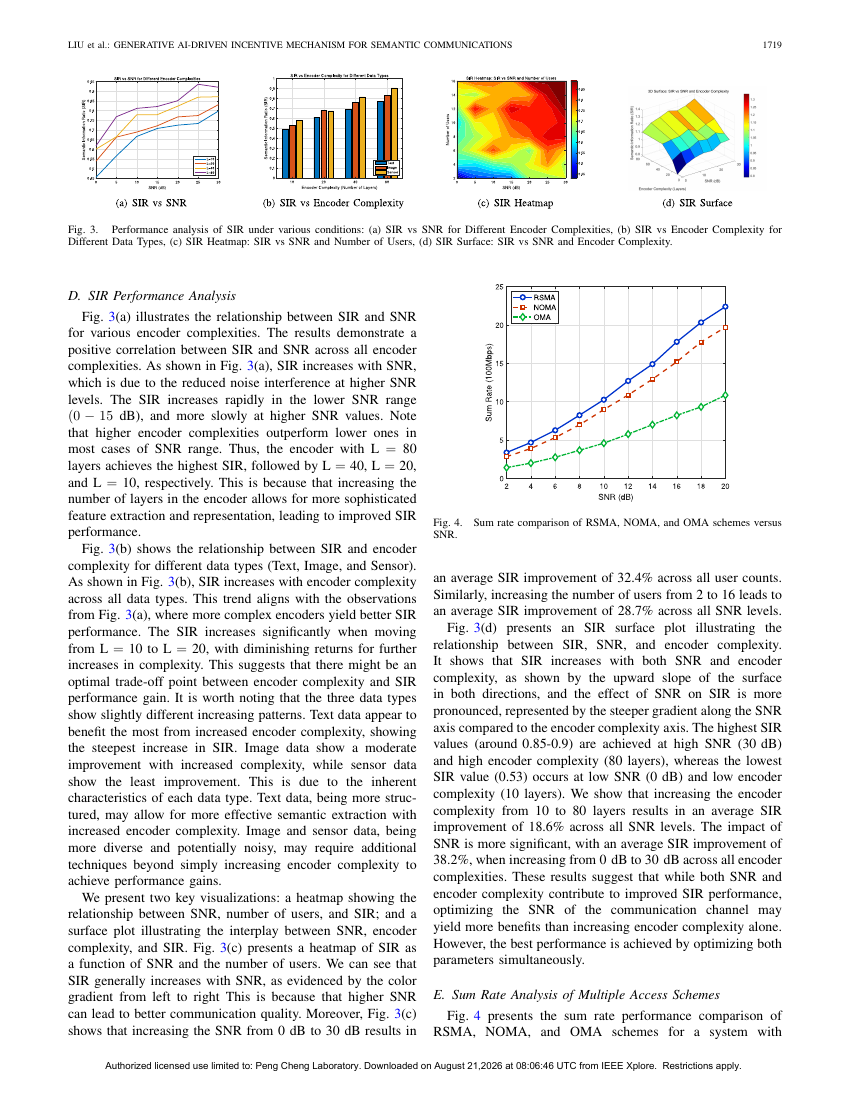
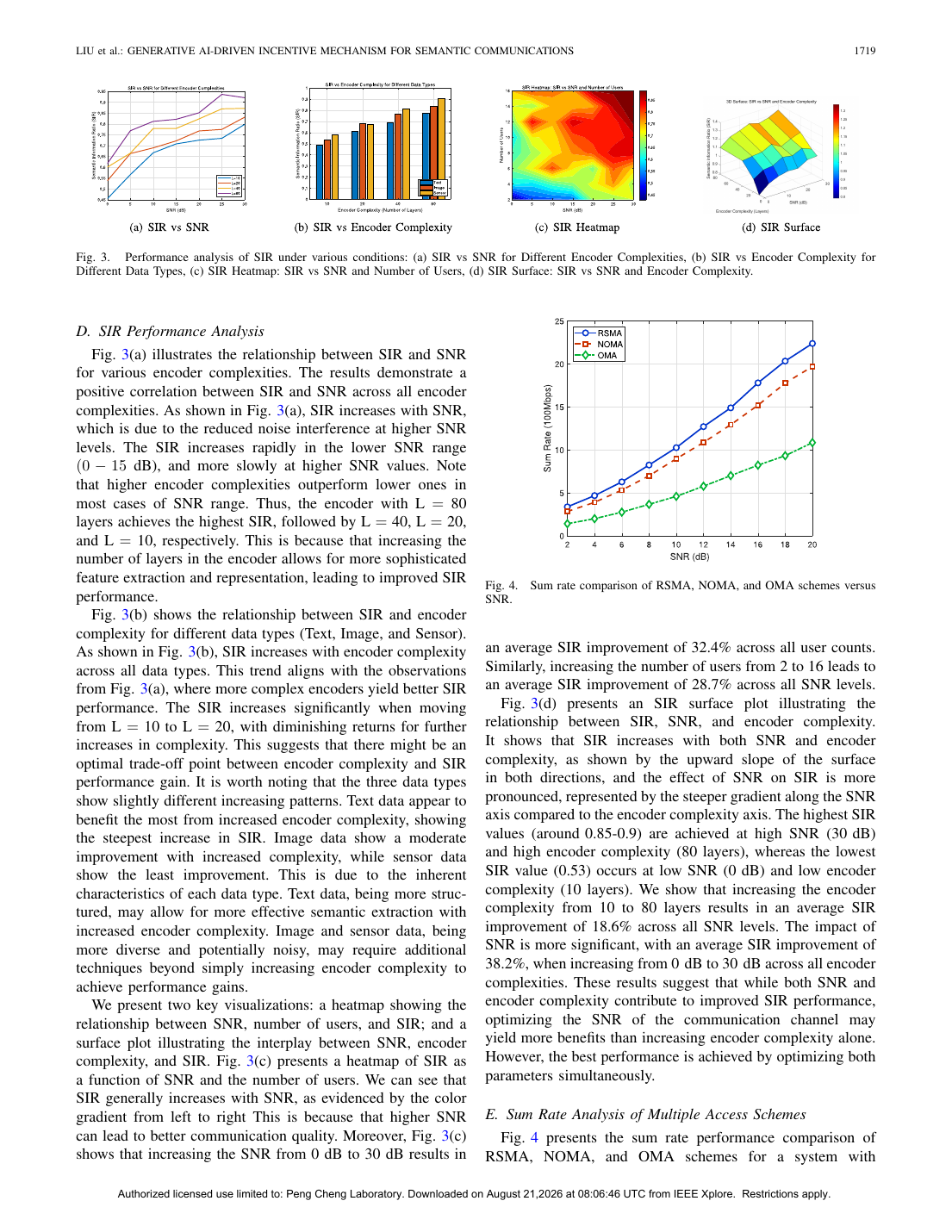
架构/方法图|来源:《Generative AI-Driven Incentive Mechanism for Semantic Communications in RSMA Networks》,原 PDF p.12,Fig. 4 Sum rate comparison of RSMA, NOMA, and OMA schemes versus performance. SNR。 核对论文关键实验结果图/表|来源:《Generative AI-Driven Incentive Mechanism for Semantic Communications in RSMA Networks》,原 PDF p.12,Fig. 4 Sum rate comparison of RSMA, NOMA, and OMA schemes versus performance. SNR。 核对论文
相关但非核心2025综述、架构与研究路线
Generative AI-Driven Semantic Communication Networks: Architecture, Technologies, and Applications
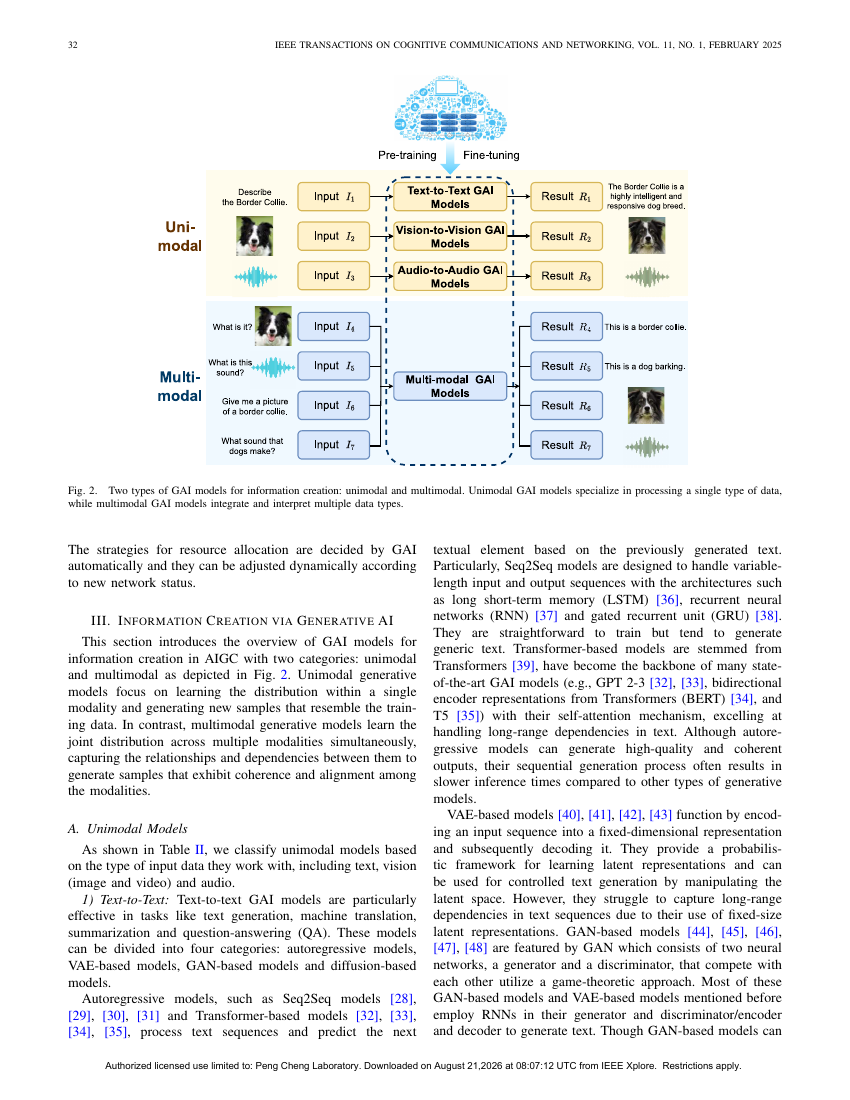
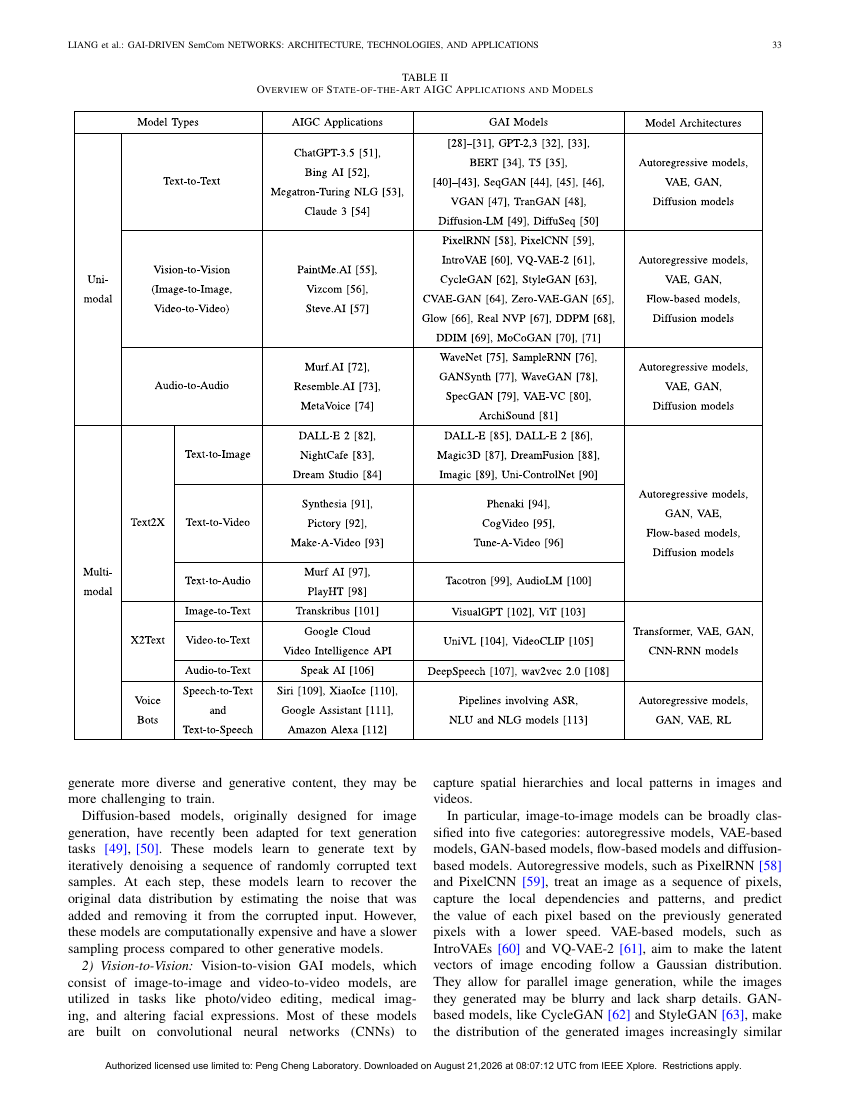
架构/方法图|来源:《Generative AI-Driven Semantic Communication Networks: Architecture, Technologies, and Applications》,原 PDF p.6,Fig. 2 Two types of GAI models for information creation: unimodal and multimodal. Unimodal GAI models specialize in processing a single type of data, while multimodal GAI models integrate and interpret multiple data types。 核对论文关键实验结果图/表|来源:《Generative AI-Driven Semantic Communication Networks: Architecture, Technologies, and Applications》,原 PDF p.7,该页包含论文的关键实验结果图或表。 核对论文
核心纳入2025语义信息度量与理论
Heterogeneous Gateway Planning for Semantic Communication in Industrial Networks
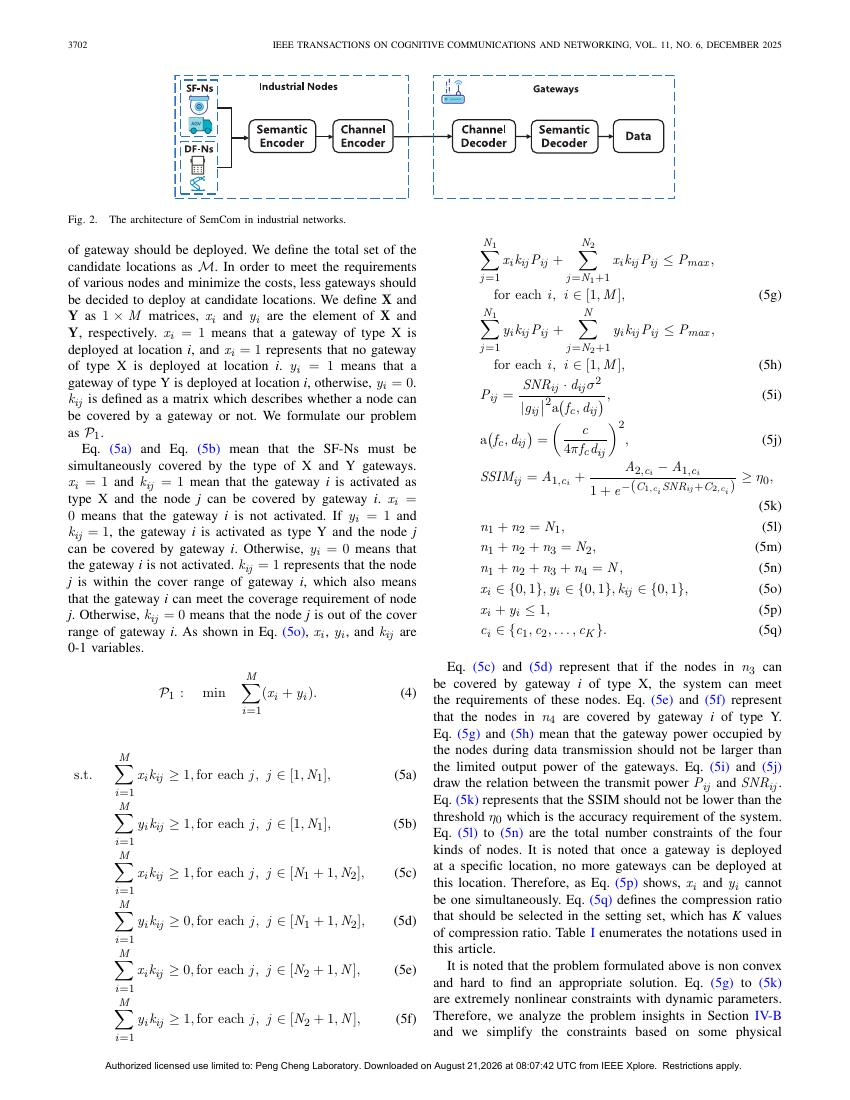
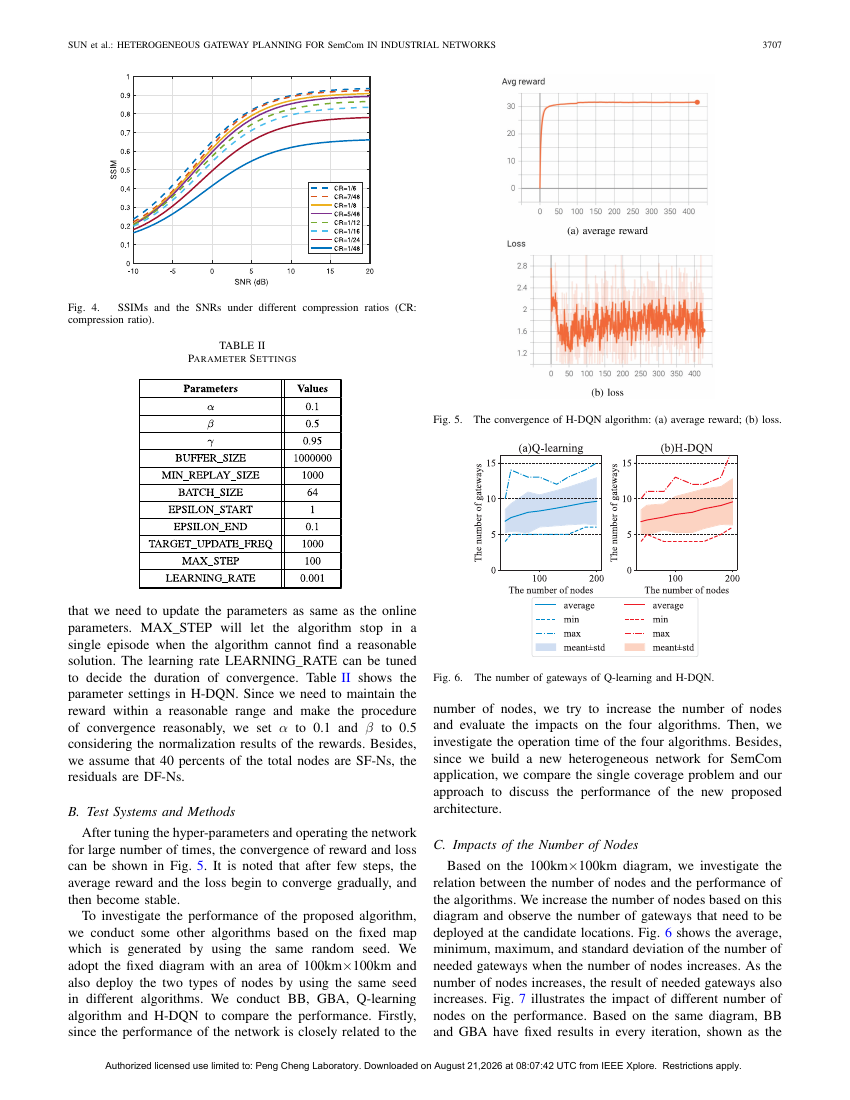
架构/方法图|来源:《Heterogeneous Gateway Planning for Semantic Communication in Industrial Networks》,原 PDF p.5,Fig. 2 The architecture of SemCom in industrial networks。 核对论文关键实验结果图/表|来源:《Heterogeneous Gateway Planning for Semantic Communication in Industrial Networks》,原 PDF p.10,Fig. 4 SSIMs and the SNRs under different compression ratios (CR: compression ratio)。 核对论文
核心纳入2025图像传输、压缩或生成
Joint Source-Channel Coding for Channel-Adaptive Digital Semantic Communications
一句话主旨:Joint Source-Channel Coding for Channel-Adaptive Digital Semantic Communications 面向图像传输、压缩或生成,把问题放在“数字语义编码与物理层接口”层处理;本调研把主接口判断为“显式数字语义表示:bit、离散 token 或码本 index”。
Motivation|Introduction 怎样导出本文方案
现有进展:本文介绍了一个新的信道自适应数字语义通信的联合信源信道编码算法。 PDF p.1
仍然存在的问题:为了解决这一问题,我们首先提出了一种新的解调方法,该方法通过评估解调输出的不确定性来提高数字语义通信系统的鲁棒性。 PDF p.1
为什么已有方法解决不了:连续 latent 或独立设计的传统链路没有回答语义特征怎样量化、映射为有限符号,以及 bit/index 出错后为何不会跳到完全不同的语义。仅改进信源网络无法补上这一接口。 PDF p.1
为什么这个问题重要:有限信道使用迫使系统决定哪些视觉内容值得保护;低 SNR 或高压缩率下,任务/感知关键结构往往比平均像素误差更重要。 PDF p.1
本文提出什么:为此,我们使用二进制对称擦除信道来建模编码器的输出和解码器的输入之间的关系,然后从不同的分布中采样这些信道的参数。 PDF p.1
方案为何可能有效:提出的方法包括三个新的组成部分:(i)鲁棒解调方法,(ii)鲁棒训练策略,和(iii)信道自适应调制技术。 PDF p.2
作者希望证明什么:我们还开发了一种用于推理阶段的信道自适应调制技术,以便在保持任务性能的同时减少通信延迟。 PDF p.1
方法与端到端信息流
为此,我们使用二进制对称擦除信道的编码器的输出和解码器的输入之间的关系建模,然后从不同的distribution. The所提出的方法包括三个新的组件采样这些信道的参数:(i)一个强大的解调方法,(ii)一个强大的训练策略,和(iii)一个信道自适应调制技术。 PDF p.1PDF p.2
输入输入是图像传输、压缩或生成所需的图像及其视觉/任务语义。
发送端发送端采用 Joint Source-Channel Coding for Channel-Adaptive Digital Semantic Communications:为此,我们使用二进制对称擦除信道的编码器的输出和解码器的输入之间的关系建模,然后从不同的distribution. The所提出的方法包括三个新的组件采样这些信道的参数:(i)一个强大的解调方法,(ii)一个强大的训练策略,和(iii)一个信道自适应调制技术。
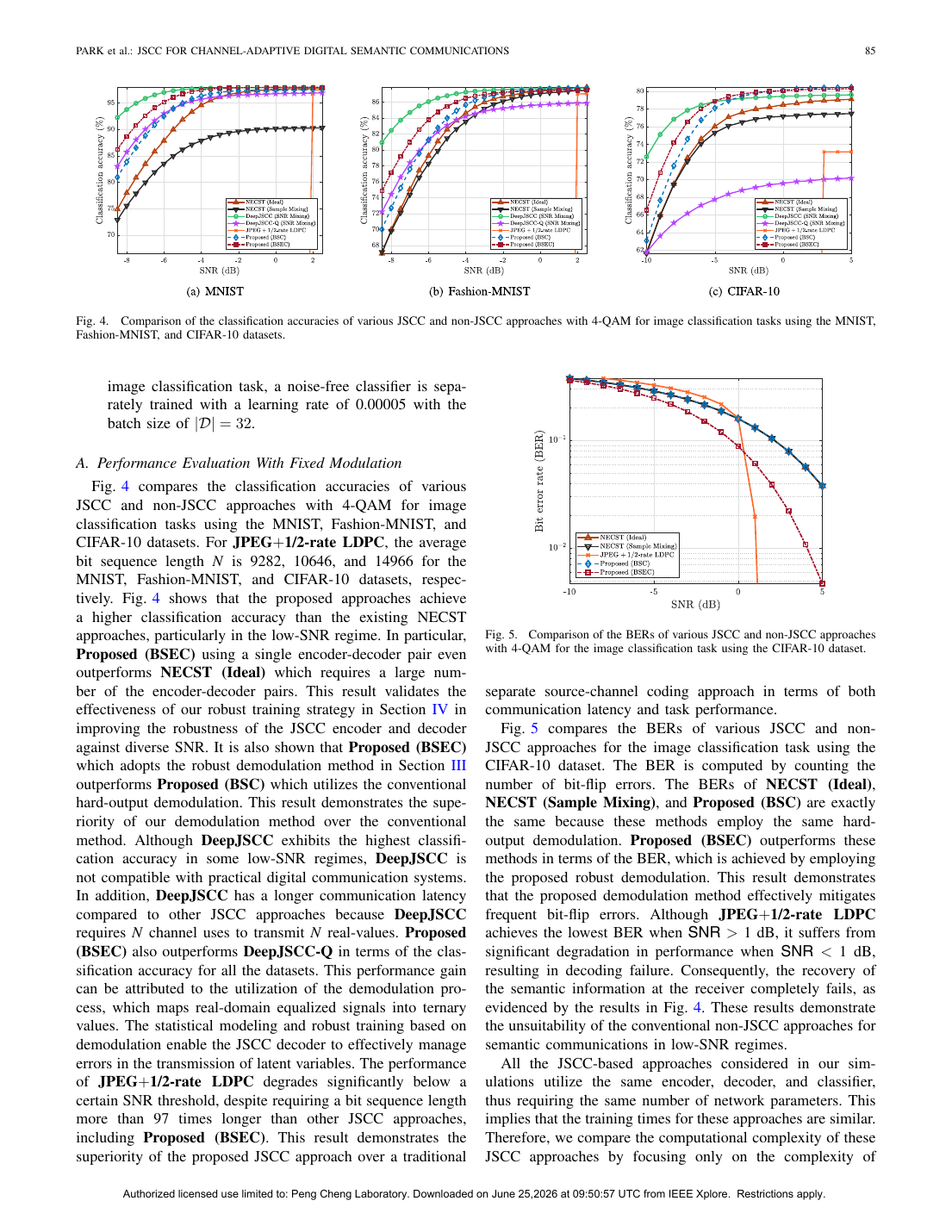
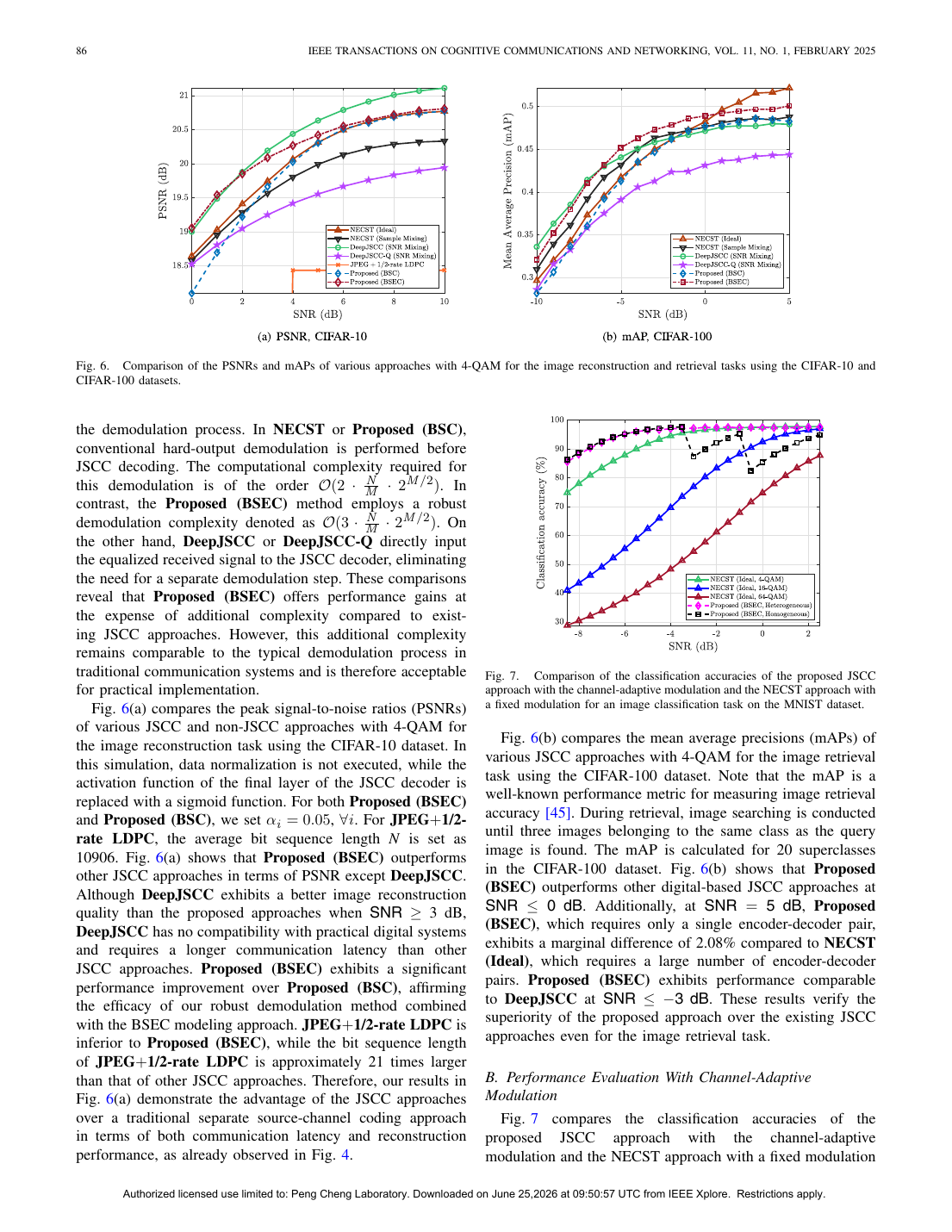
架构/方法图|来源:《Joint Source-Channel Coding for Channel-Adaptive Digital Semantic Communications》,原 PDF p.11,Fig. 4 Comparison of the classification accuracies of various JSCC and non-JSCC approaches with 4-QAM for image classification tasks using the MNIST, Fashion-MNIST, and CIFAR-10 datasets。 核对论文关键实验结果图/表|来源:《Joint Source-Channel Coding for Channel-Adaptive Digital Semantic Communications》,原 PDF p.12,Fig. 6 Comparison of the PSNRs and mAPs of various approaches with 4-QAM for the image reconstruction and retrieval tasks using the CIFAR-10 and CIFAR-100 datasets。 核对论文
核心纳入2025任务导向推理
Model-Enabled Task-Oriented Semantic Communications Through Knowledge Synchronization
作为比较,在衰落信道中,我们使用的神经网络架构在直接训练SVHN数据集时达到了94.80%的分类准确率,而我们的通信任务的准确率为91.02%。 本调研据此归为“类别 0:信道作用点不足,或由外部传统链路抽象承担”。 PDF p.8
语义 decoder 实际面对的是:由论文系统模型定义的语义 feature、任务状态或传统译码后数据。 PDF p.8
是否真正处理离散变量出错:未形成可复核的 bit/index/token 错误闭环。
实验设置与主要结论
数据集/场景CelebA、MNIST
BaselineDeepJSCC、JPEG、LDPC、GAN、ResNet、JSCC
评价指标PSNR、accuracy、FLOPs、classification accuracy
信道与工作点AWGN、Rayleigh、fading channel
数据集为CelebA、MNIST;实验小节中明确出现的比较对象包括DeepJSCC、JPEG、LDPC、GAN、ResNet、JSCC;指标包括PSNR、accuracy、FLOPs、classification accuracy;信道/链路条件包括AWGN、Rayleigh、fading channel。 PDF p.8
大量实验结果表明,MESC的性能优于SemCom基准测试和传统编码方法,达到了最佳的通信性能。 PDF p.1
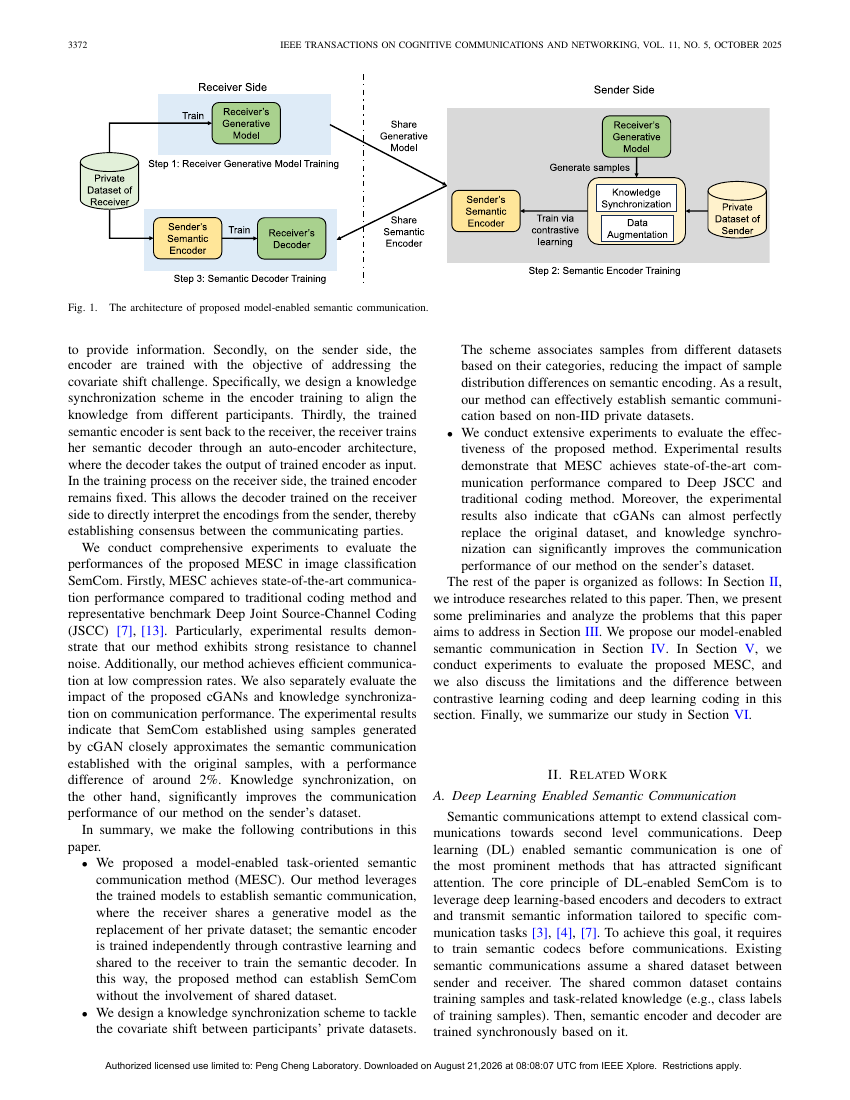
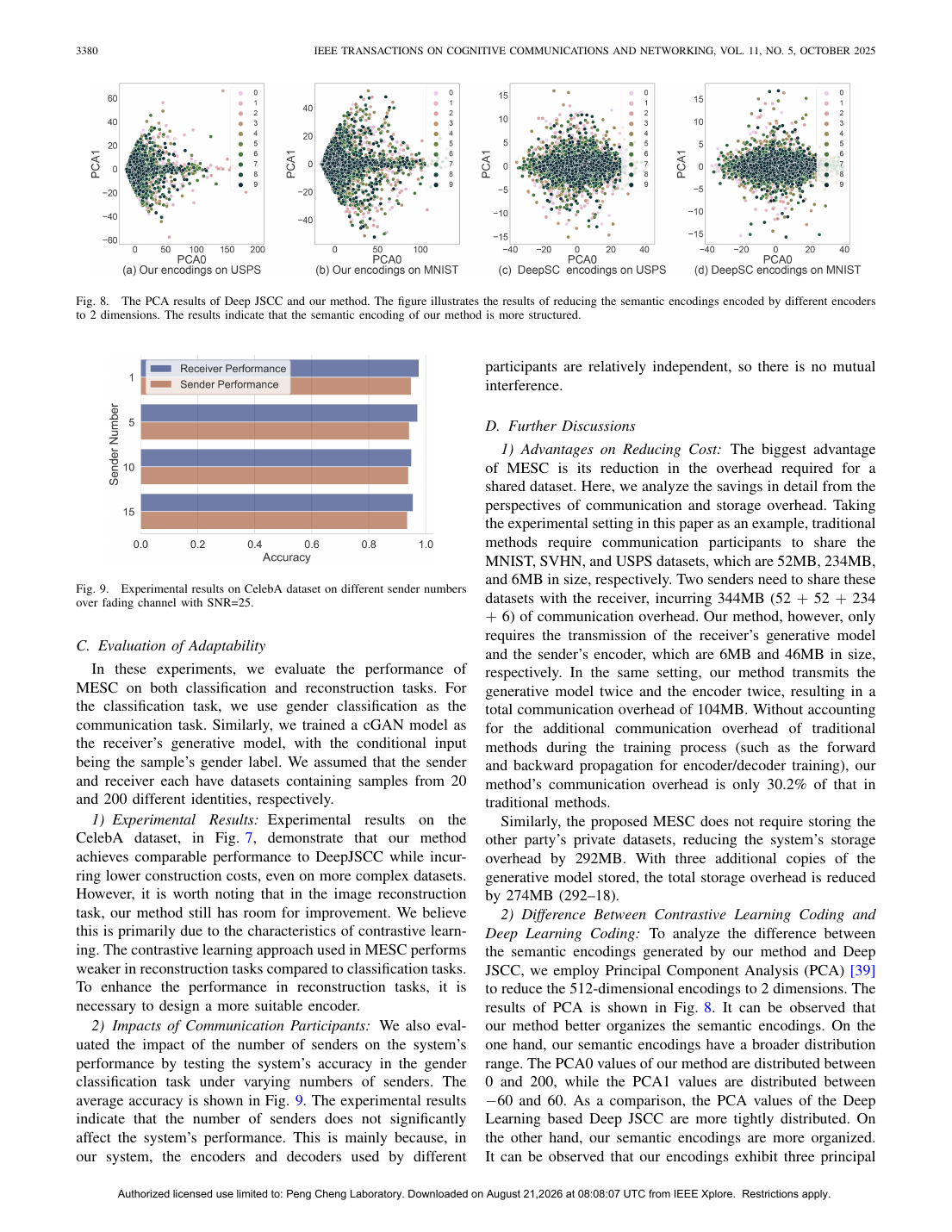
架构/方法图|来源:《Model-Enabled Task-Oriented Semantic Communications Through Knowledge Synchronization》,原 PDF p.2,Fig. 1 The architecture of proposed model-enabled semantic communication。 核对论文关键实验结果图/表|来源:《Model-Enabled Task-Oriented Semantic Communications Through Knowledge Synchronization》,原 PDF p.10,Fig. 8 The PCA results of Deep JSCC and our method. The figure illustrates the results of reducing the semantic encodings encoded by different encoders to 2 dimensions. The results indicate that the semantic encoding of our method is more structured。 核对论文
核心纳入2025多模态检索与任务通信
Optimizing Resource Allocation for Multi-Modal Semantic Communication in Mobile AIGC Networks: A Diffusion-Based Game Approach
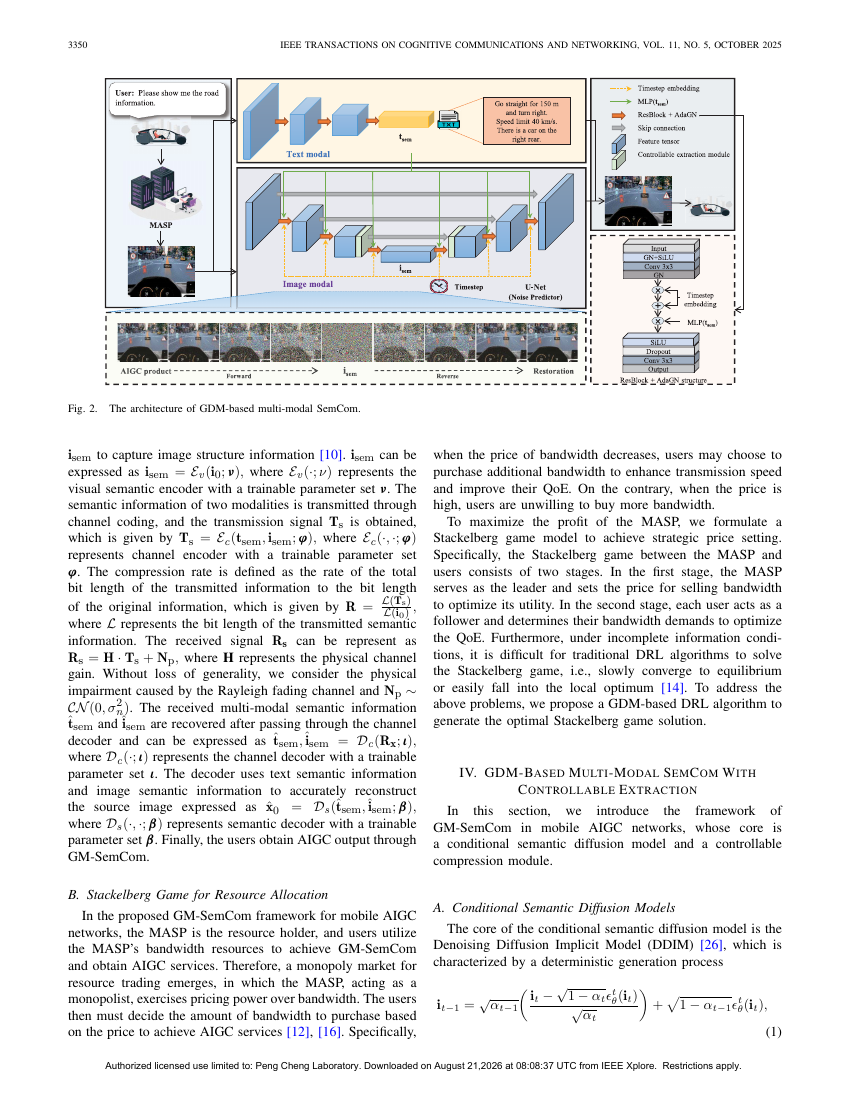
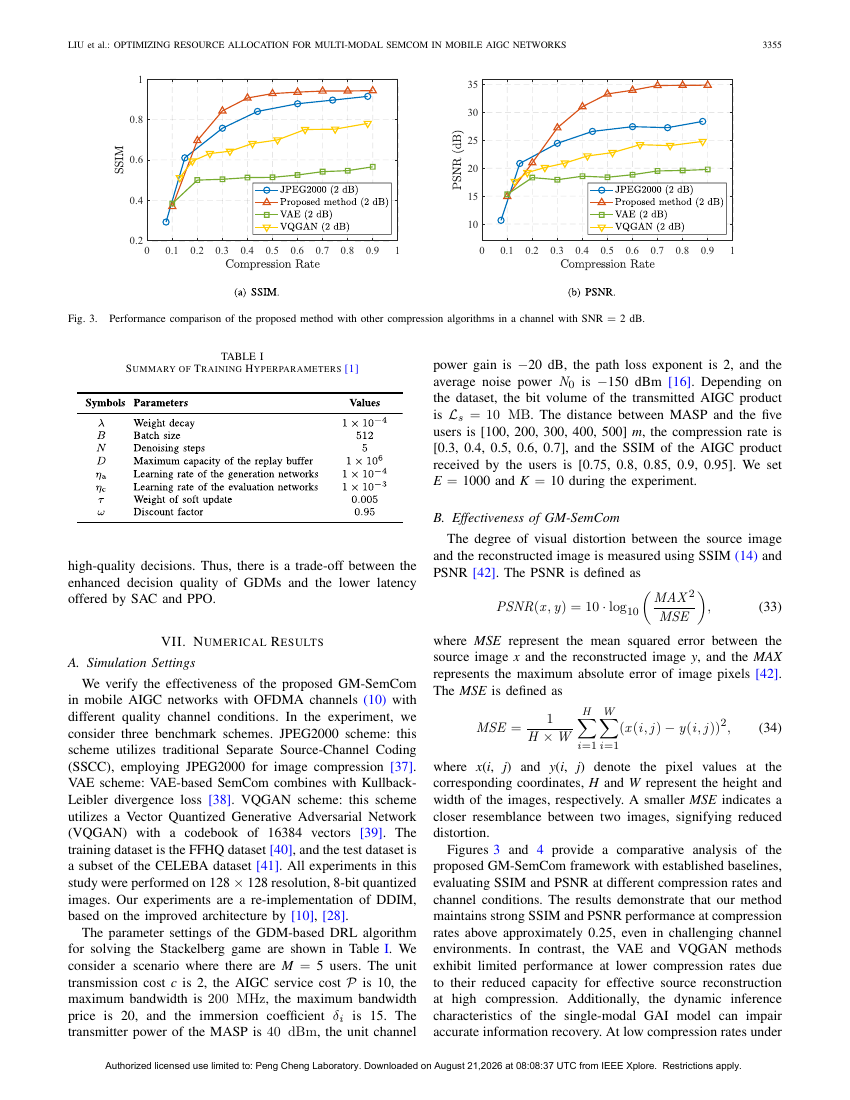
架构/方法图|来源:《Optimizing Resource Allocation for Multi-Modal Semantic Communication in Mobile AIGC Networks: A Diffusion-Based Game Approach》,原 PDF p.5,Fig. 2 The architecture of GDM-based multi-modal SemCom。 核对论文关键实验结果图/表|来源:《Optimizing Resource Allocation for Multi-Modal Semantic Communication in Mobile AIGC Networks: A Diffusion-Based Game Approach》,原 PDF p.10,Fig. 3 Performance comparison of the proposed method with other compression algorithms in a channel with SNR = 2 dB。 核对论文
核心纳入2025图像传输、压缩或生成
Progressive Learned Image Transmission for Semantic Communication Using Hierarchical VAE
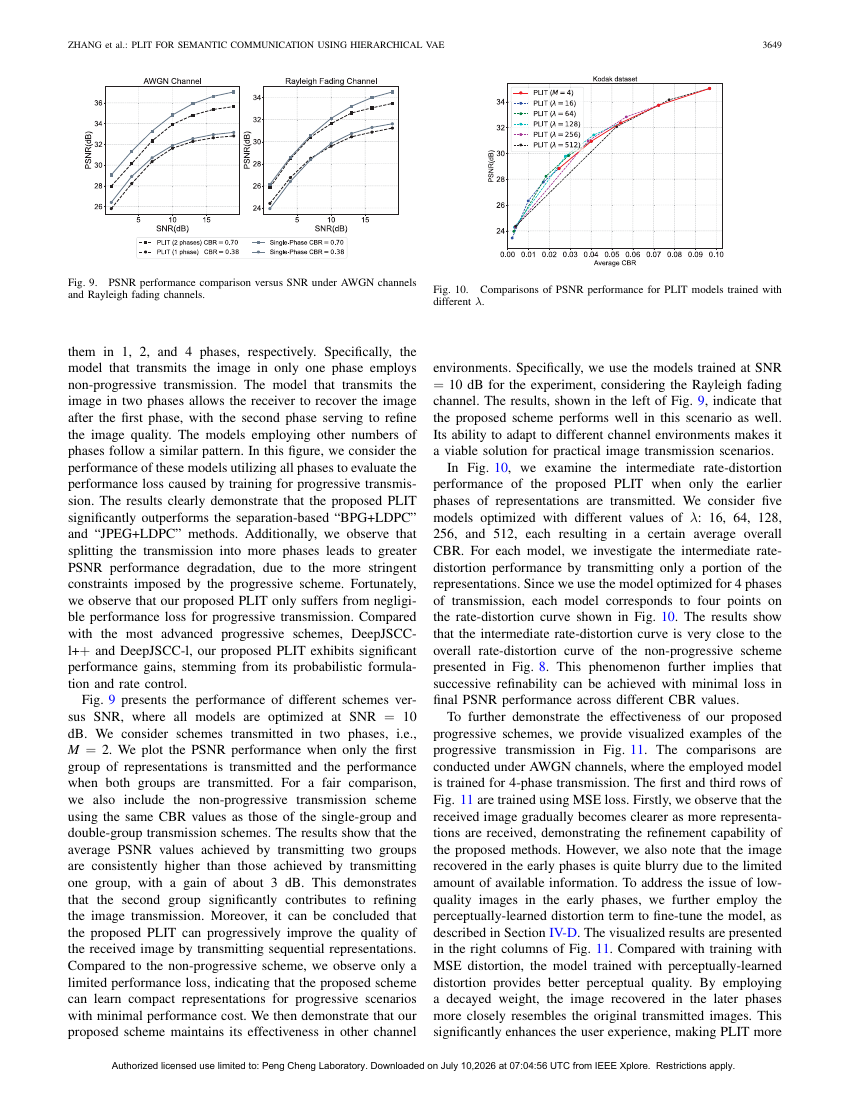
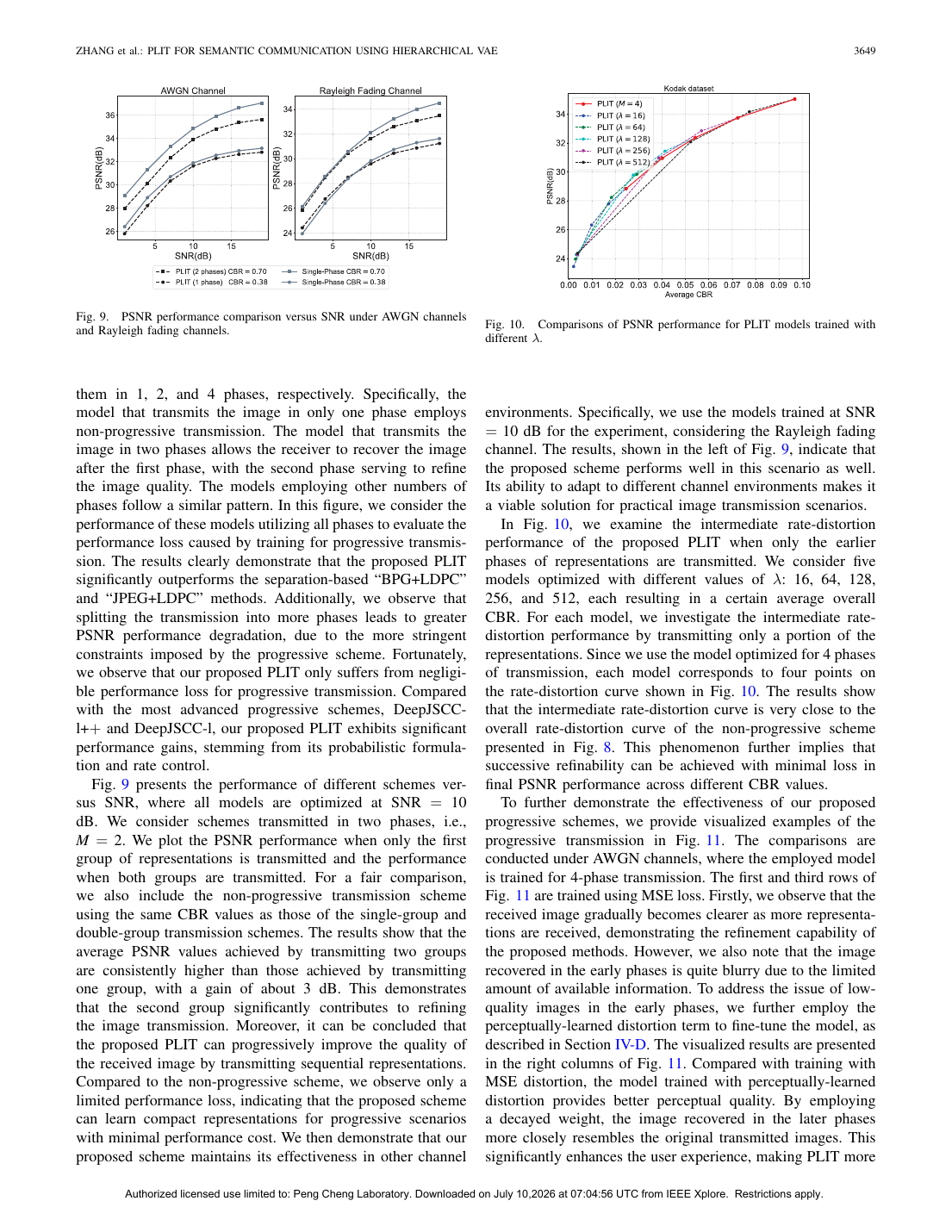
架构/方法图|来源:《Progressive Learned Image Transmission for Semantic Communication Using Hierarchical VAE》,原 PDF p.10,Fig. 10 Comparisons of PSNR performance for PLIT models trained with different λ。 核对论文关键实验结果图/表|来源:《Progressive Learned Image Transmission for Semantic Communication Using Hierarchical VAE》,原 PDF p.10,Fig. 9 PSNR performance comparison versus SNR under AWGN channels and Rayleigh fading channels。 核对论文
相关但非核心2025语义感知资源分配与网络优化
R-UAV-Net: Enhanced YOLOv4 With Graph-Semantic Compression for Transformative UAV Sensing in Paddy Agronomy
作者Arun Kumar Sangaiah; Jayakrishnan Anandakrishnan; Aniruth Reddy Devarapelly; Muhammad Luqman Arif Bin Mohamad; Gui-Bin Bian; Mohammed J. F. Alenazi; Salman A. AlQahtani
局限:没有完整离散接口,无法直接回答 bit/index/token 跳变问题。 未显式注入离散误码/丢包,鲁棒性结论不应外推到真实数字链路。 未报告统一可复核的 payload bit 数/CBR,跨论文带宽比较受限。 该文属于边界谱系,不能用它代表端到端语义通信主线。
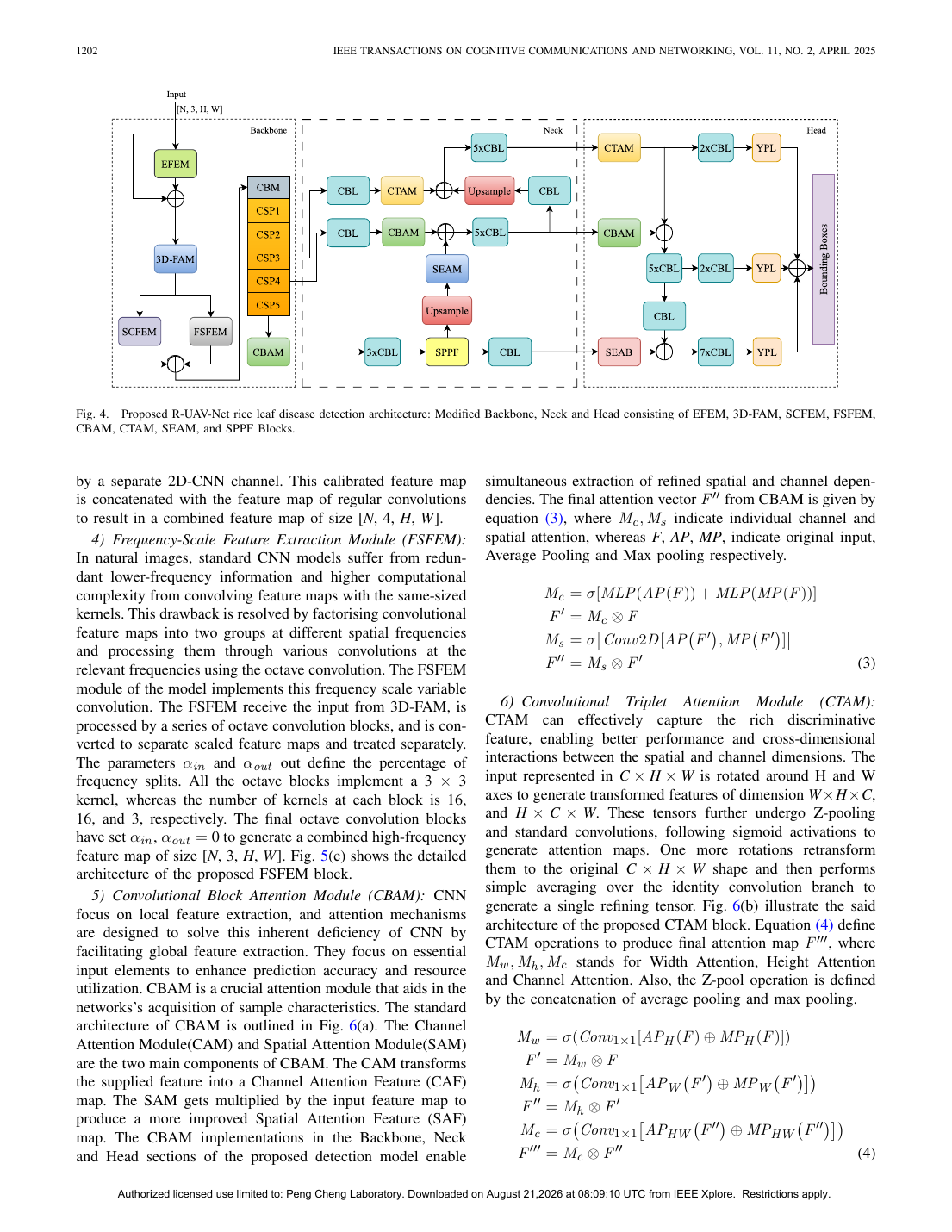
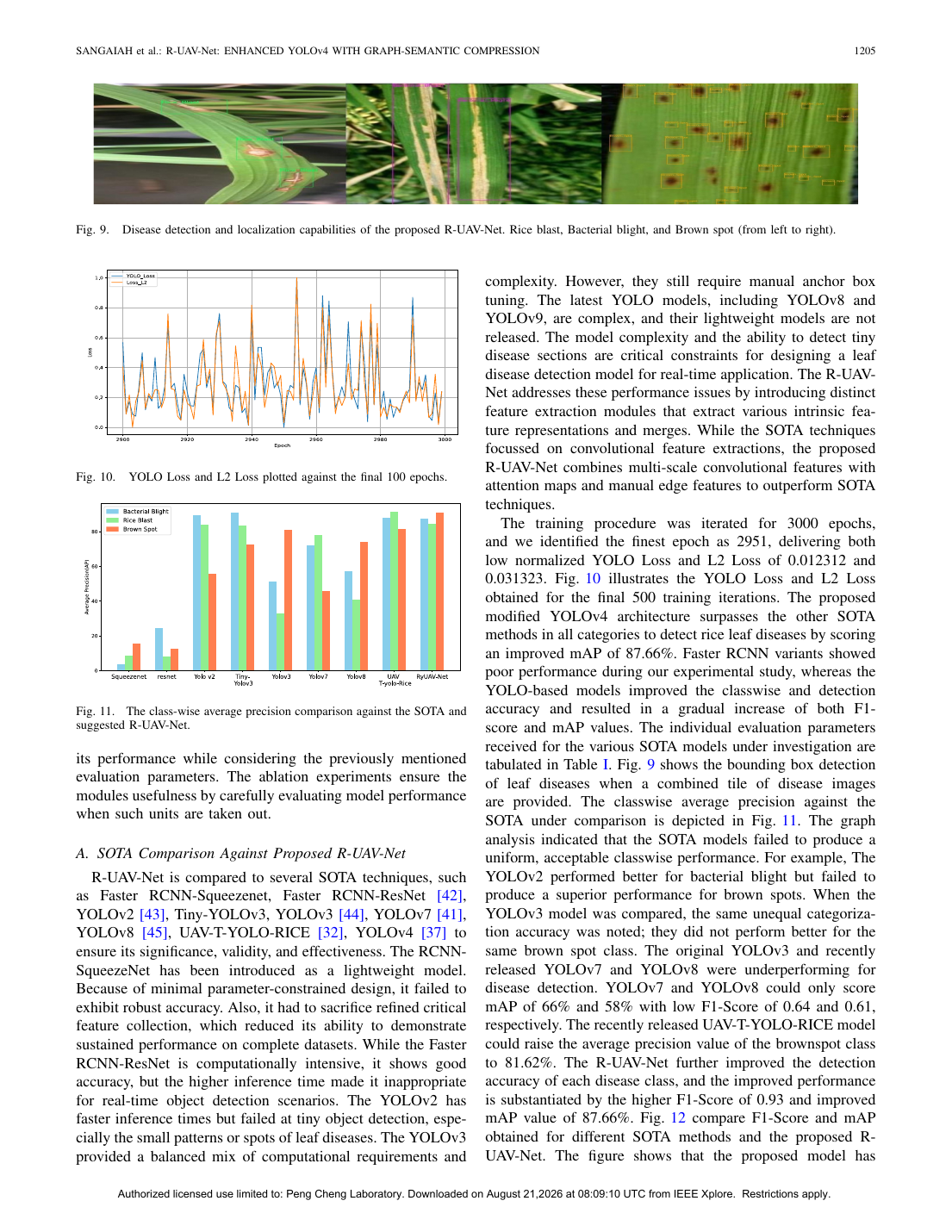
架构/方法图|来源:《R-UAV-Net: Enhanced YOLOv4 With Graph-Semantic Compression for Transformative UAV Sensing in Paddy Agronomy》,原 PDF p.6,Fig. 4 Proposed R-UAV-Net rice leaf disease detection architecture: Modified Backbone, Neck and Head consisting of EFEM, 3D-FAM, SCFEM, FSFEM, CBAM, CTAM, SEAM, and SPPF Blocks。 核对论文关键实验结果图/表|来源:《R-UAV-Net: Enhanced YOLOv4 With Graph-Semantic Compression for Transformative UAV Sensing in Paddy Agronomy》,原 PDF p.9,Fig. 11 The graph analysis indicated that the SOTA models failed to produce a A. SOTA Comparison Against Proposed R-UAV-Net uniform, accep 核对论文
核心纳入2025语义信息度量与理论
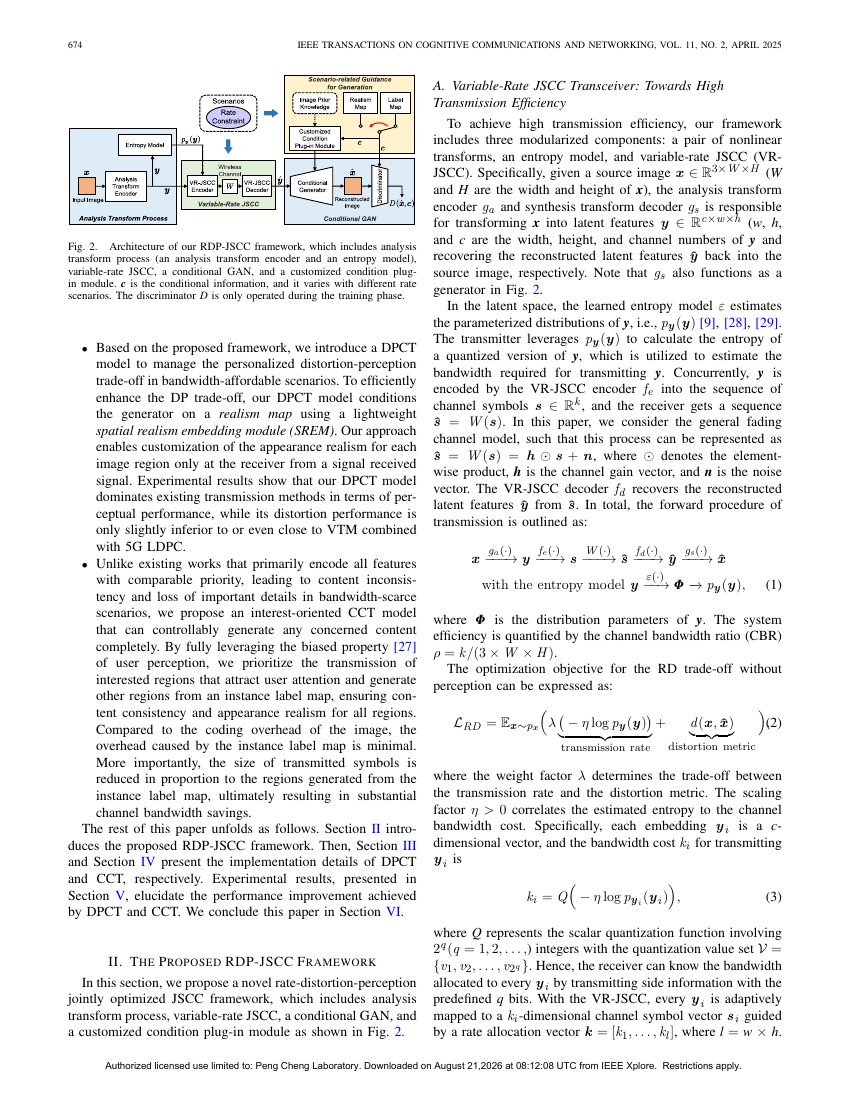
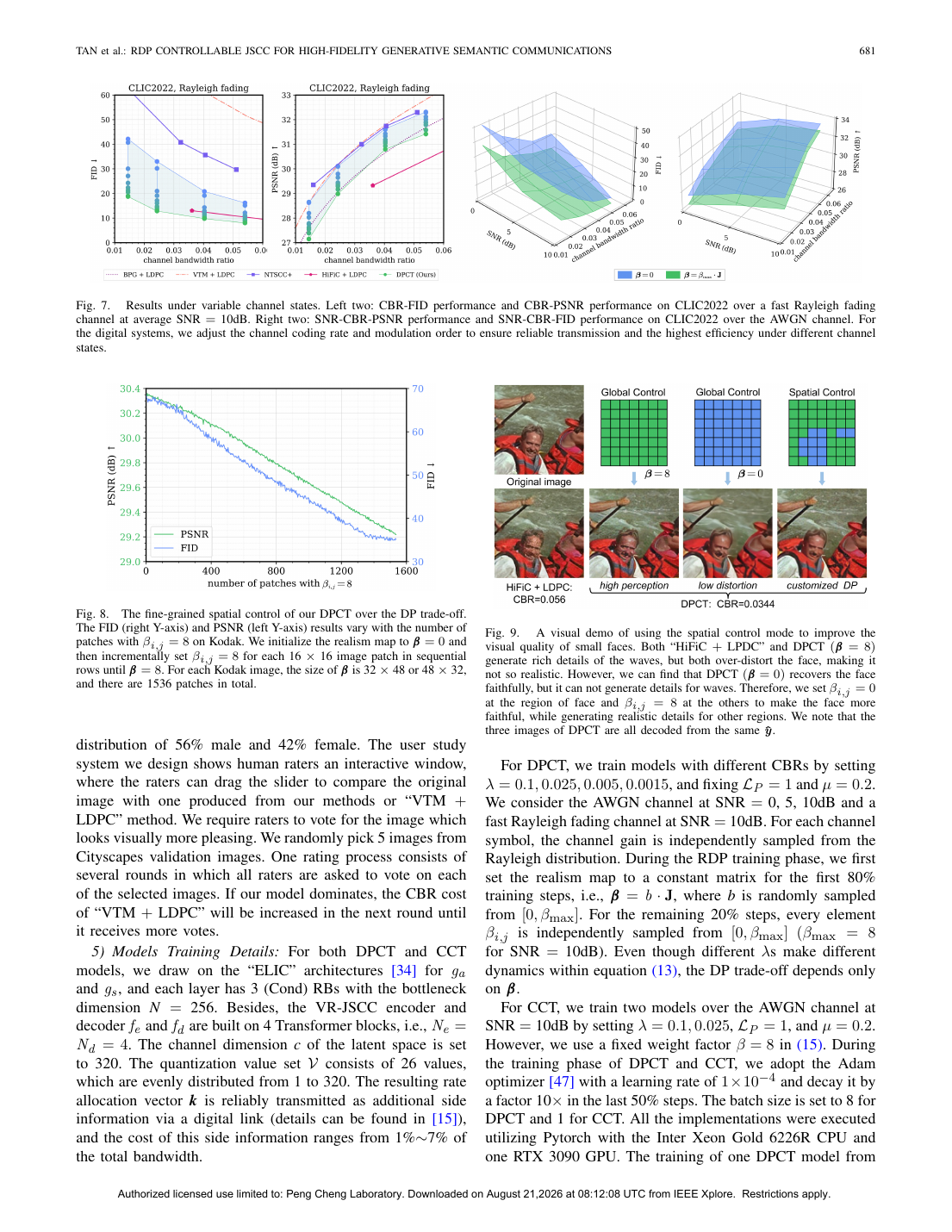
Rate-Distortion-Perception Controllable Joint Source-Channel Coding for High-Fidelity Generative Semantic Communications
架构/方法图|来源:《Rate-Distortion-Perception Controllable Joint Source-Channel Coding for High-Fidelity Generative Semantic Communications》,原 PDF p.3,Fig. 2 by a rate allocation vector k = [k1 , . . . , kl ], where l = w × h。 核对论文关键实验结果图/表|来源:《Rate-Distortion-Perception Controllable Joint Source-Channel Coding for High-Fidelity Generative Semantic Communications》,原 PDF p.10,Fig. 8 The fine-grained spatial control of our DPCT over the DP trade-off. The FID (right Y-axis) and PSNR (left Y-axis) results vary with the number of 核对论文
核心纳入2025图像传输、压缩或生成
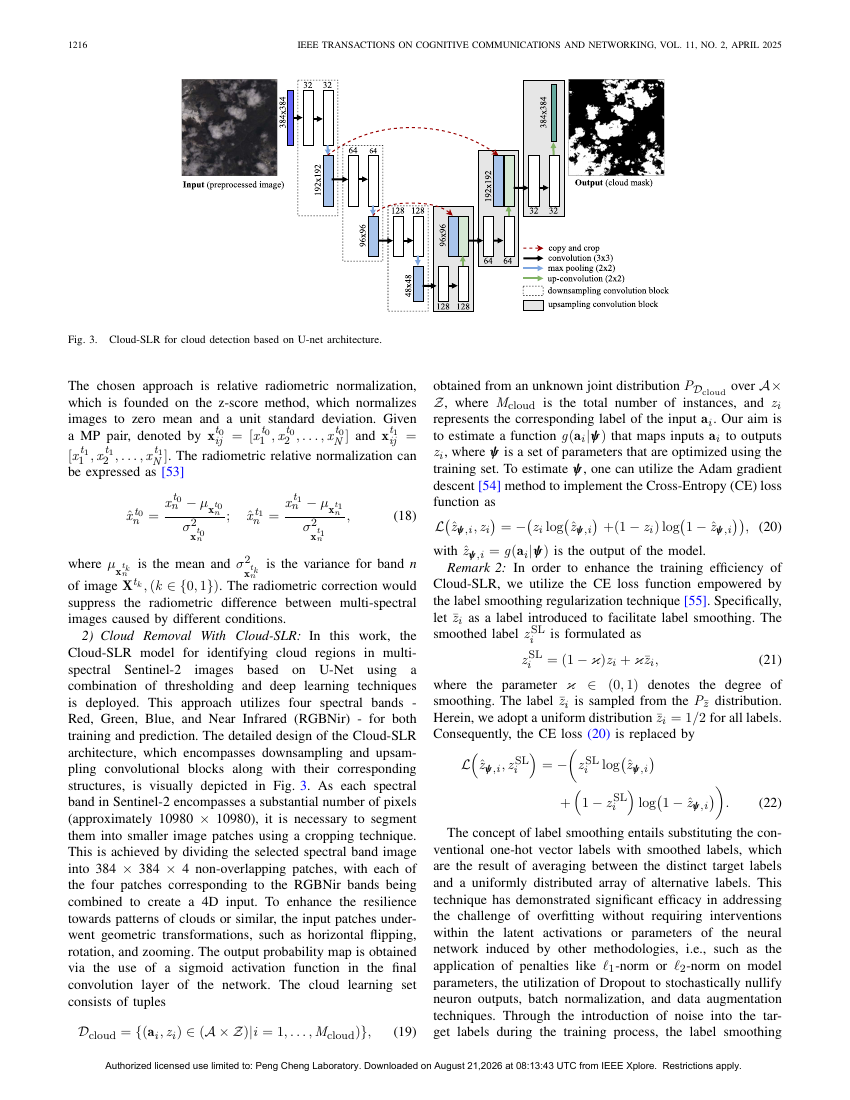
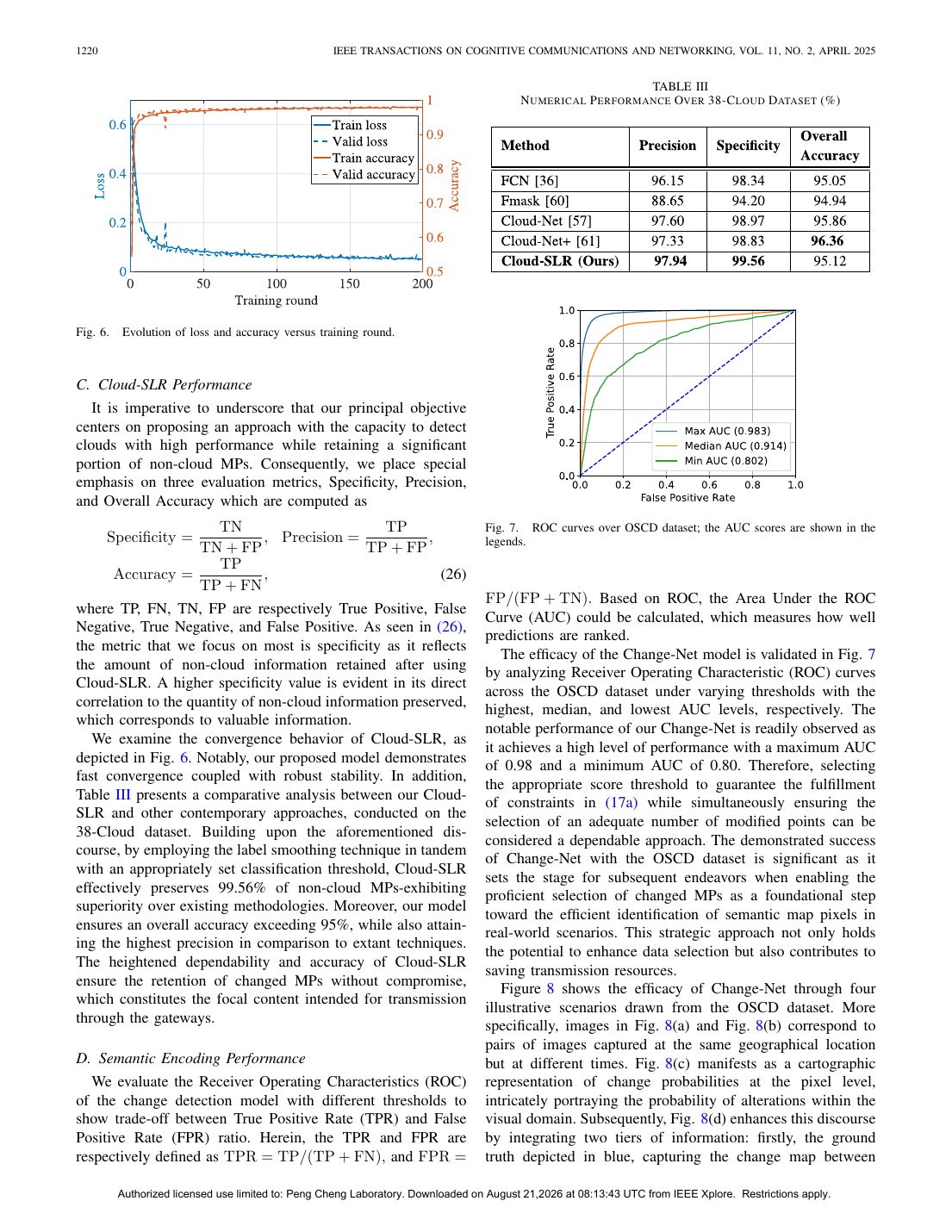
Semantic Image Encoding and Communication for Earth Observation With LEO Satellites
架构/方法图|来源:《Semantic Image Encoding and Communication for Earth Observation With LEO Satellites》,原 PDF p.7,Fig. 3 Cloud-SLR for cloud detection based on U-net architecture。 核对论文关键实验结果图/表|来源:《Semantic Image Encoding and Communication for Earth Observation With LEO Satellites》,原 PDF p.11,Fig. 6 Evolution of loss and accuracy versus training round。 核对论文
相关但非核心2025文本传输或语言任务
Semantic Information Extraction and Multi-Agent Communication Optimization Based on Generative Pre-Trained Transformer
局限:没有完整离散接口,无法直接回答 bit/index/token 跳变问题。 未显式注入离散误码/丢包,鲁棒性结论不应外推到真实数字链路。 未报告统一可复核的 payload bit 数/CBR,跨论文带宽比较受限。 该文属于边界谱系,不能用它代表端到端语义通信主线。
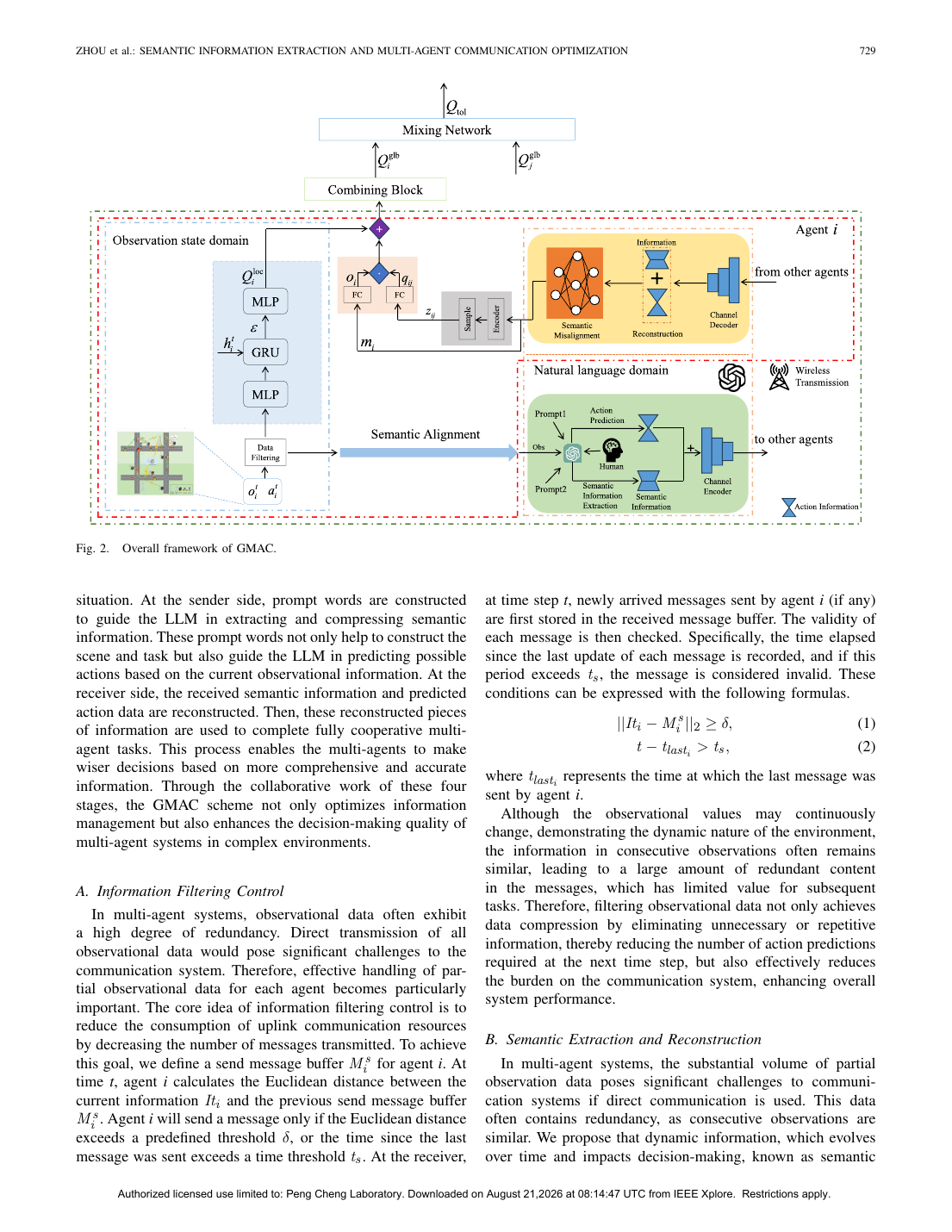
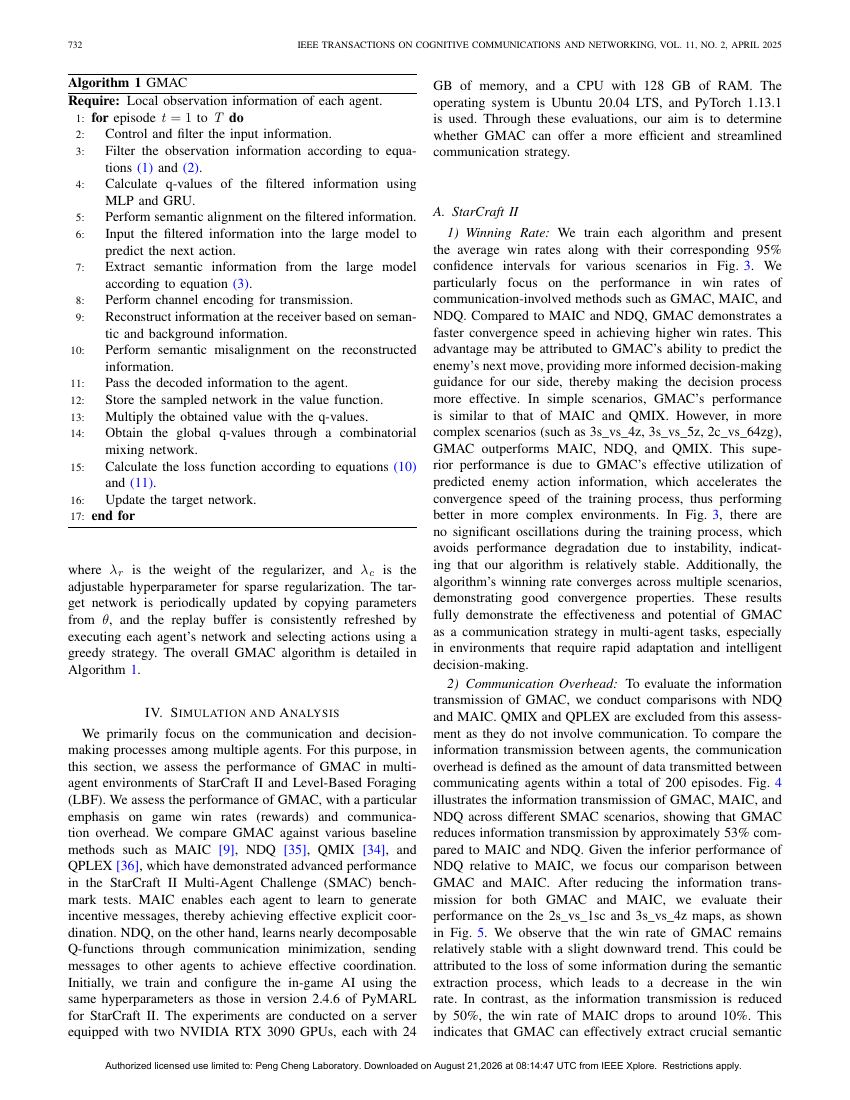
架构/方法图|来源:《Semantic Information Extraction and Multi-Agent Communication Optimization Based on Generative Pre-Trained Transformer》,原 PDF p.5,Fig. 2 Overall framework of GMAC。 核对论文关键实验结果图/表|来源:《Semantic Information Extraction and Multi-Agent Communication Optimization Based on Generative Pre-Trained Transformer》,原 PDF p.8,Fig. 5 We observe that the win rate of GMAC remains Q-functions through communication minimization, sending relatively s 核对论文
核心纳入2025图像传输、压缩或生成
Semantic Successive Refinement: A Generative AI-Aided Semantic Communication Framework
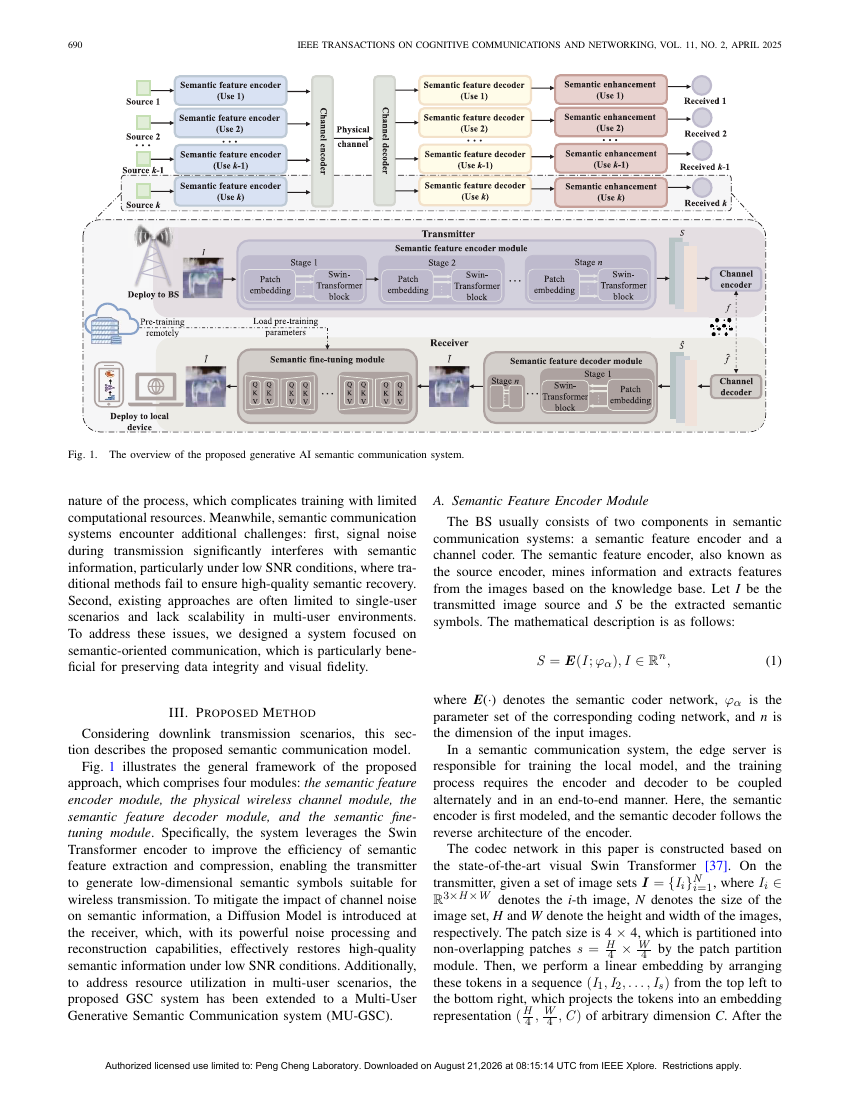
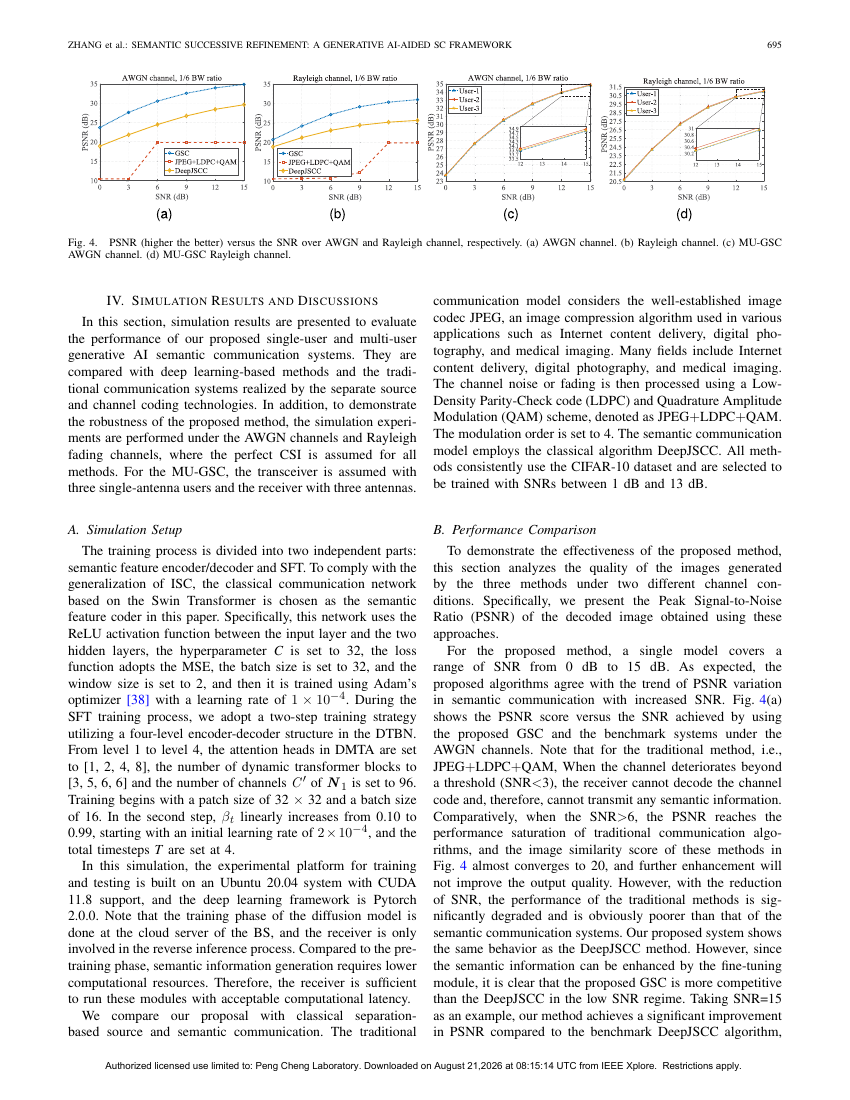
架构/方法图|来源:《Semantic Successive Refinement: A Generative AI-Aided Semantic Communication Framework》,原 PDF p.4,Fig. 1 The overview of the proposed generative AI semantic communication system。 核对论文关键实验结果图/表|来源:《Semantic Successive Refinement: A Generative AI-Aided Semantic Communication Framework》,原 PDF p.9,Fig. 4 PSNR (higher the better) versus the SNR over AWGN and Rayleigh channel, respectively. (a) AWGN channel. (b) Rayleigh channel. (c) MU-GSC AWGN channel. (d) MU-GSC Rayleigh channel。 核对论文
核心纳入2025语义感知资源分配与网络优化
Semantic Utility Loss of Information for Energy Efficient Semantic Status Update Communications
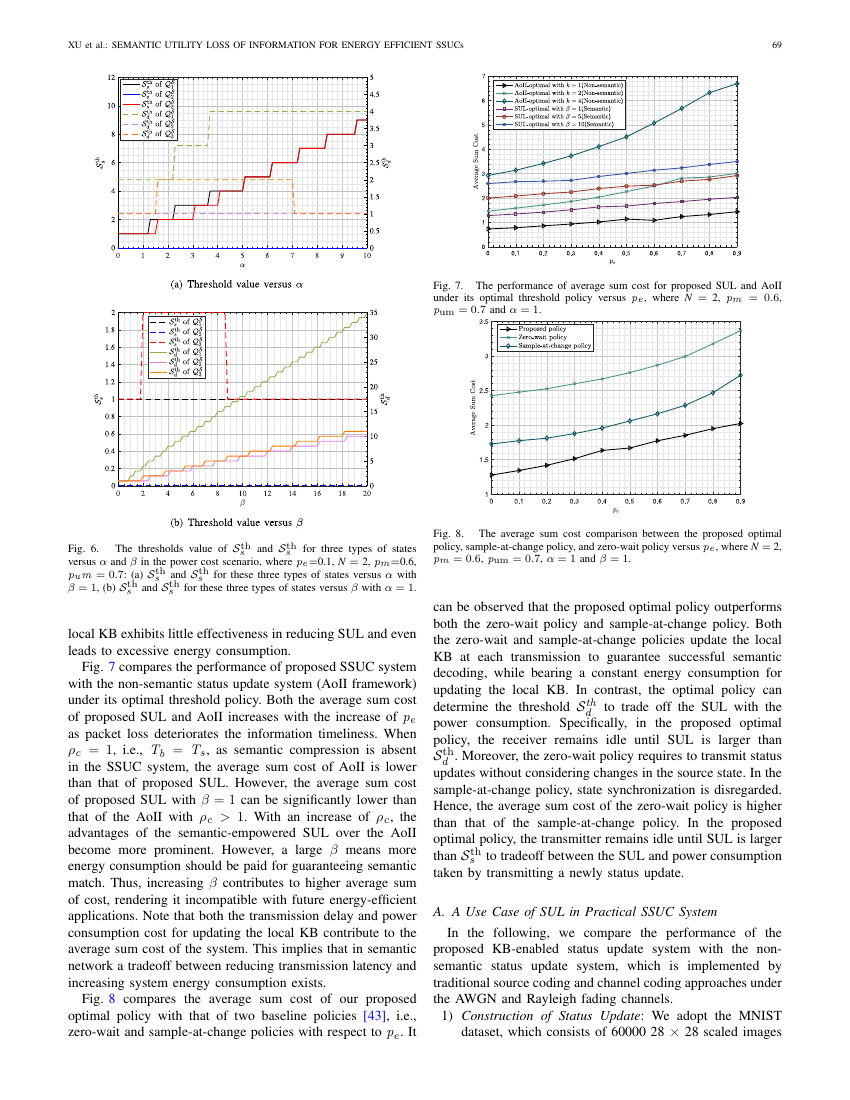
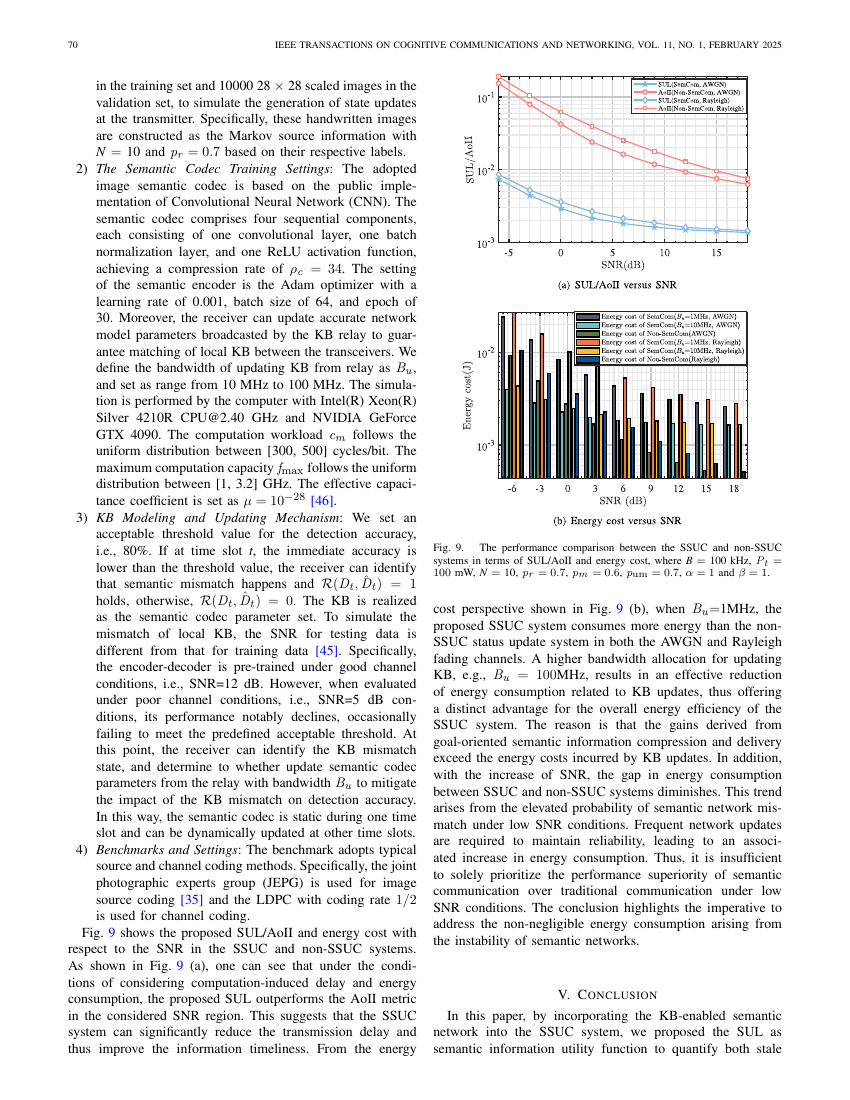
架构/方法图|来源:《Semantic Utility Loss of Information for Energy Efficient Semantic Status Update Communications》,原 PDF p.11,Fig. 8 The average sum cost comparison between the proposed optimal 核对论文关键实验结果图/表|来源:《Semantic Utility Loss of Information for Energy Efficient Semantic Status Update Communications》,原 PDF p.12,Fig. 9 shows the proposed SUL/AoII and energy cost with the instability of semantic networks. respect to the SNR in the SSUC and non-SSUC systems. As shown in 核对论文
核心纳入2025图像传输、压缩或生成
SINR-Adaptive and CBR-Controllable Semantic Cellular Communication Considering Imperfect CSI and Inter-Cell Co-Channel Interference
仍然存在的问题:然而,大多数现有的研究集中在点对点传输与完美的信道状态信息(CSI)和固定的信道带宽比(CBR)。 PDF p.1
为什么已有方法解决不了:为固定 SNR 或带宽训练的模型具有固定瓶颈和保护方式;条件变化时重复运行同一网络,不能把码率或冗余重新分给变得脆弱的信息。 PDF p.1
为什么这个问题重要:一个 token 错误就可能改变整句含义,因此仅看 BER 不足以评价链路;必须追踪最终语言意义或任务输出。 PDF p.1
本文提出什么:在该系统中,我们设计了一个语义编码器的转换器卷积神经网络(CNN)混合块,同时捕获非本地和本地潜像特征和SINR自适应模块的基础上的信道空间软注意力机制,根据SINR条件缩放图像特征。 PDF p.1
方案为何可能有效:在该系统中,我们设计了一个语义编码器的转换器卷积神经网络(CNN)混合块,同时捕获非本地和本地潜像特征和SINR自适应模块的基础上的信道空间软注意力机制,根据SINR条件缩放图像特征。 PDF p.1
作者希望证明什么:此外,实验结果表明,在FLOP,模型大小和计算延迟的现有先进的ADJSCC和WITT具有相当的性能有很大的改善。 PDF p.1
方法与端到端信息流
在该系统中,我们设计了一个基于变换器-卷积神经网络(CNN)混合模块的语义编码器来同时捕获非局部和局部潜像特征,并设计了一个基于信道-空间软注意机制的SINR自适应模块来根据SINR条件对图像特征进行缩放。我们研究了一种SINR自适应和CBR可控的语义蜂窝通信系统,该系统考虑了ICCI和不完全CSI。 PDF p.1PDF p.2
信道与工作点AWGN、Rayleigh、Rician、wireless channel、SINR、channel estimation、imperfect CSI、SNR of 10dB、SNR 10dB、CBR=1/32、CBR of 1/32
数据集为Kodak、Open Images;实验小节中明确出现的比较对象包括DeepJSCC、WITT、JPEG、LDPC、QAM、TCM、ADJSCC、JSCC;指标包括PSNR、LPIPS、latency、FLOPs;信道/链路条件包括AWGN、Rayleigh、Rician、wireless channel、SINR、channel estimation、imperfect CSI;正文可定位的代表性工作点有SNR of 10dB、SNR 10dB、CBR=1/32、CBR of 1/32。 PDF p.11
此外,实验结果表明,在FLOP,模型大小和计算延迟的现有先进的ADJSCC和WITT具有相当的性能有很大的改善。 PDF p.1
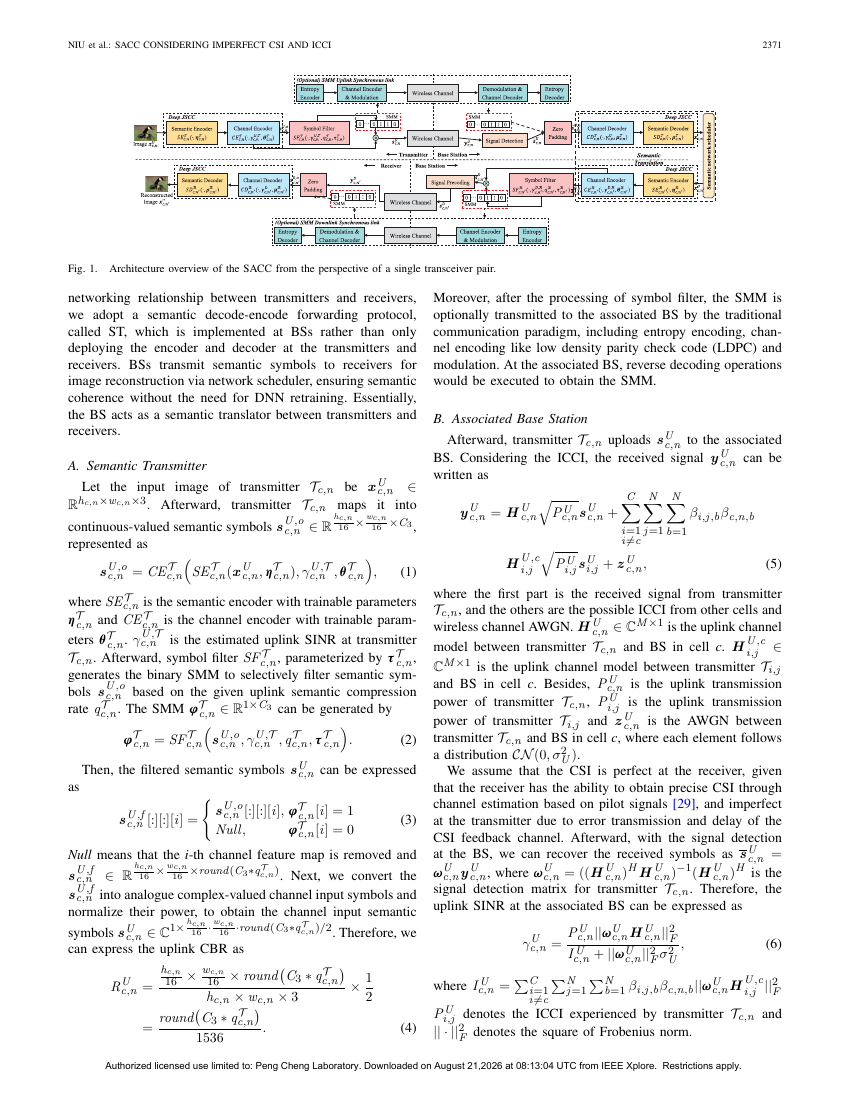
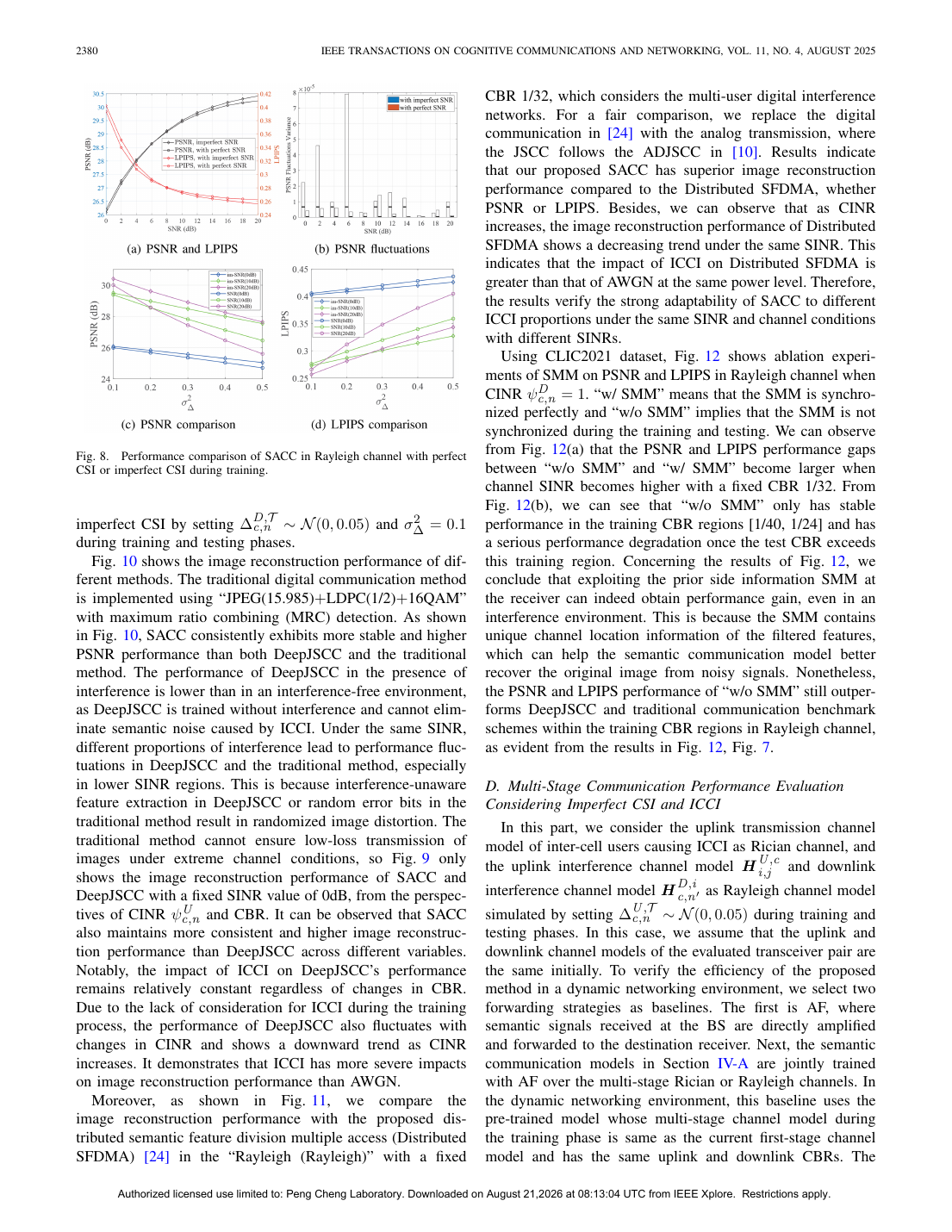
架构/方法图|来源:《SINR-Adaptive and CBR-Controllable Semantic Cellular Communication Considering Imperfect CSI and Inter-Cell Co-Channel Interference》,原 PDF p.4,Fig. 1 Architecture overview of the SACC from the perspective of a single transceiver pair。 核对论文关键实验结果图/表|来源:《SINR-Adaptive and CBR-Controllable Semantic Cellular Communication Considering Imperfect CSI and Inter-Cell Co-Channel Interference》,原 PDF p.13,Fig. 8 Performance comparison of SACC in Rayleigh channel with perfect from 核对论文
核心纳入2025图像传输、压缩或生成
SwinJSCC: Taming Swin Transformer for Deep Joint Source-Channel Coding
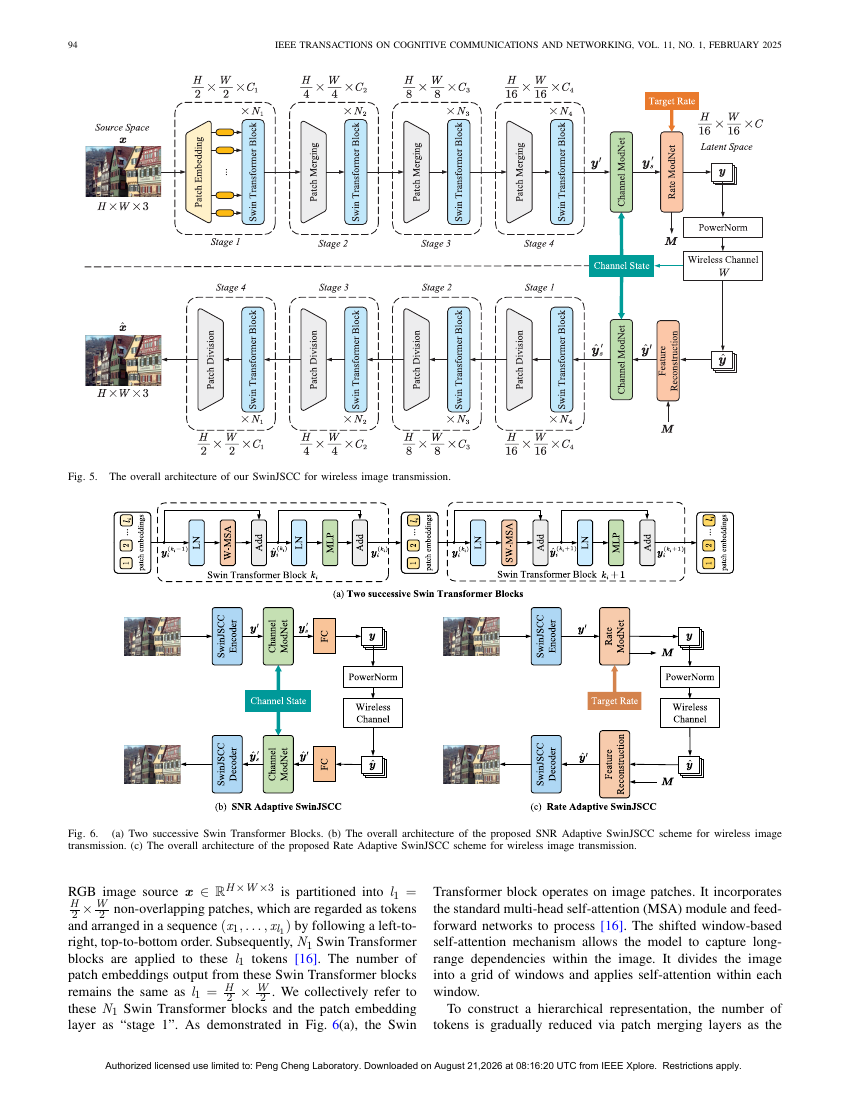
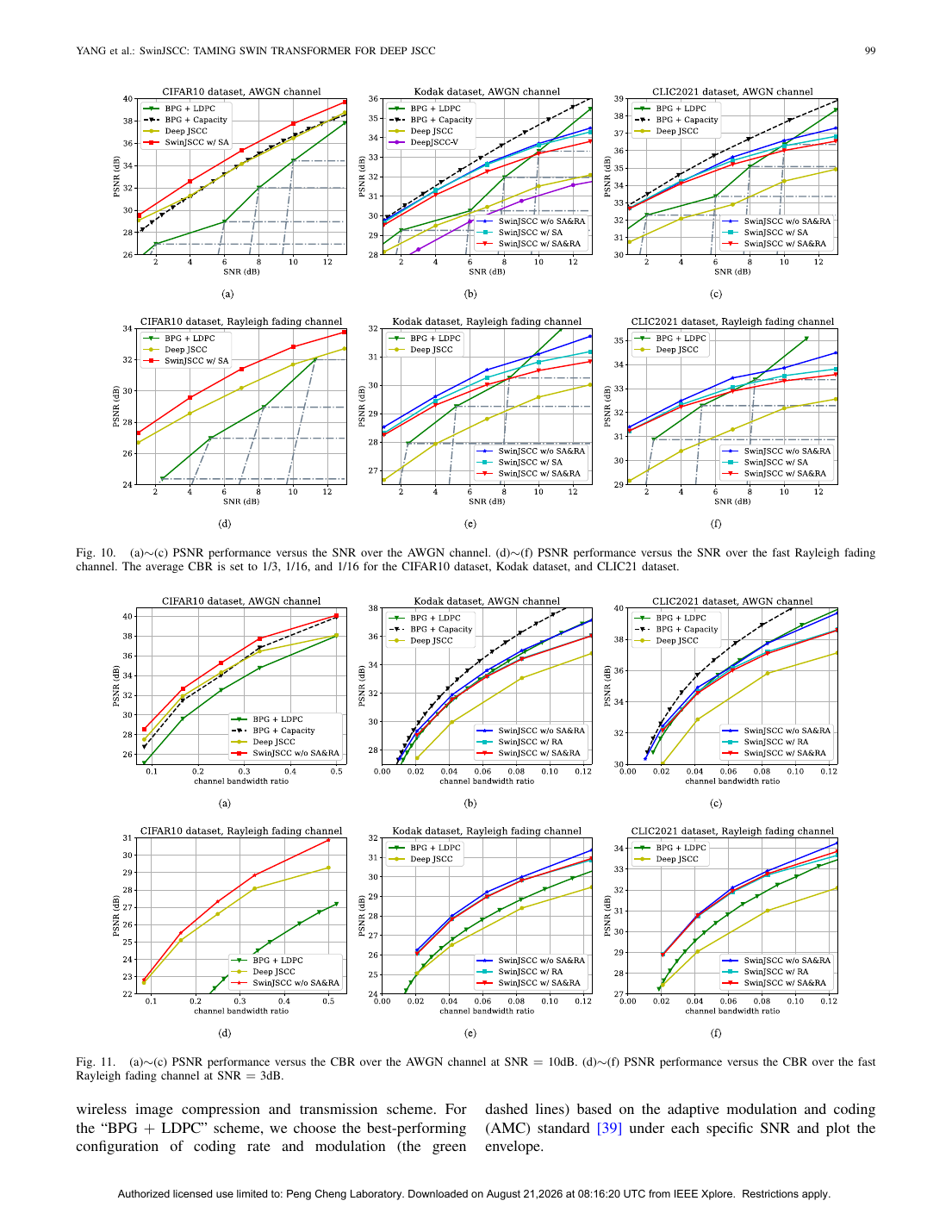
架构/方法图|来源:《SwinJSCC: Taming Swin Transformer for Deep Joint Source-Channel Coding》,原 PDF p.5,Fig. 5 The overall architecture of our SwinJSCC for wireless image transmission。 核对论文关键实验结果图/表|来源:《SwinJSCC: Taming Swin Transformer for Deep Joint Source-Channel Coding》,原 PDF p.10,Fig. 10 (a)∼(c) PSNR performance versus the SNR over the AWGN channel. (d)∼(f) PSNR performance versus the SNR over the fast Rayleigh fading channel. The average CBR is set to 1/3, 1/16, and 1/16 for the CIFAR10 dataset, Kodak dataset, and CLIC21 dataset。 核对论文
核心纳入2025任务导向推理
Task-Oriented Communication for Graph Data: A Graph Information Bottleneck Approach
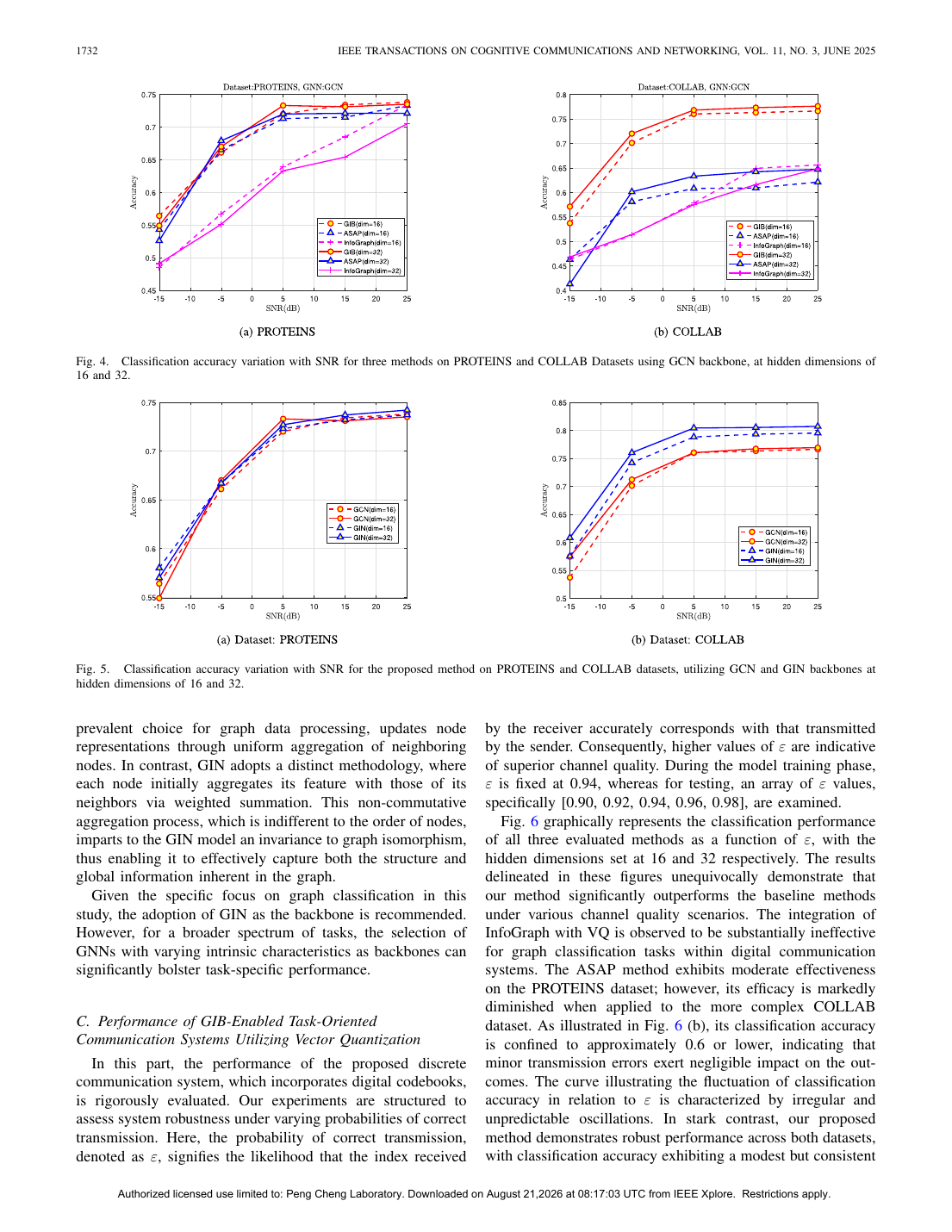
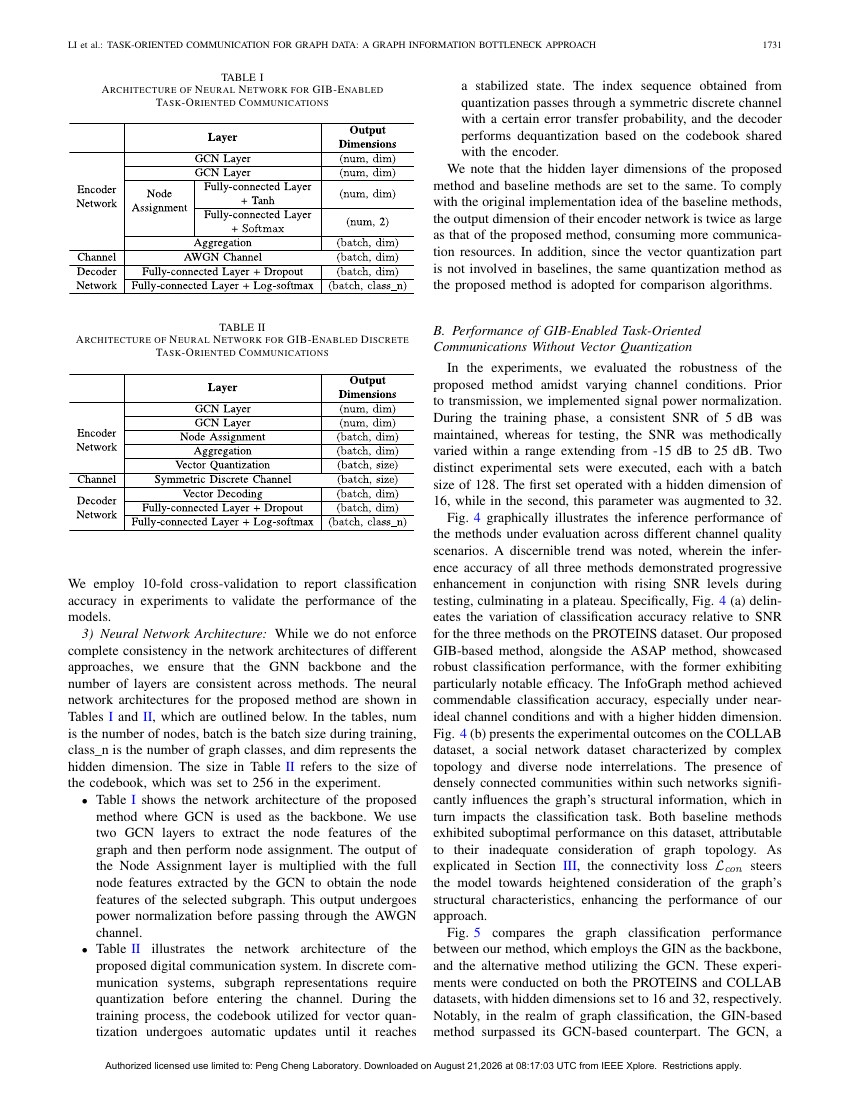
架构/方法图|来源:《Task-Oriented Communication for Graph Data: A Graph Information Bottleneck Approach》,原 PDF p.10,Fig. 4 Classification accuracy variation with SNR for three methods on PROTEINS and COLLAB Datasets using GCN backbone, at hidden dimensions of 16 and 32。 核对论文关键实验结果图/表|来源:《Task-Oriented Communication for Graph Data: A Graph Information Bottleneck Approach》,原 PDF p.9,Fig. 4 (b) presents the experimental outcomes on the COLLAB class_n is the number of graph classes, and dim represents the dataset, a social network dataset characterized by complex hidden dimension. The size in 核对论文
核心纳入2026点云/三维场景传输
3-D Gaussian SLAM Based on Joint Source-Channel Coding and Multi-Scale Constraints
现有进展:3D高斯溅射(3DGS)技术以其卓越的渲染效率和逼真的重建能力,成为实时场景重建和同步定位与制图(SLAM)应用的一种有前途的方法。 PDF p.1
仍然存在的问题:然而,在实际应用中,传统的3DGS方法仍然面临着两个关键的挑战:输入数据中的噪声和冗余,以及固定分辨率建模的适应性不足。 PDF p.1
为什么已有方法解决不了:把生成模型放在接收端并不等于通信开销自然降低;仍需明确发送什么条件、条件占多少资源,以及信道破坏条件时怎样约束幻觉和时延。 PDF p.1
为什么这个问题重要:XR 与三维感知的数据量极大而交互时延敏感;以更少信道使用保住几何和任务关键对象,会直接降低空口负担。 PDF p.1
本文提出什么:本文提出了一种新的三维高斯场景表示框架,联合集成联合信源信道编码(JSCC)与多尺度优化,以提高建模精度和鲁棒性,在复杂的操作环境。 PDF p.1
方案为何可能有效:我们结合了联合收割机的基于高斯的多尺度分解方案,处理渲染输出和JSCC增强的RGB-D数据。 PDF p.1
作者希望证明什么:所提出的框架实现了更优的性能相比,最先进的3DGS方法在绝对轨迹误差(ATE)的指标,同时保留实时渲染能力。 PDF p.1
方法与端到端信息流
为了提高复杂作战环境下的建模精度和鲁棒性,该文提出了一种新的三维高斯场景表示框架,该框架将联合信源信道编码(Joint Source-Channel Coding,JSCC)与多尺度优化技术相结合,并联合收割机了基于高斯金字塔的多尺度分解算法,该算法同时处理渲染输出和JSCC增强的RGB-D数据。 PDF p.1
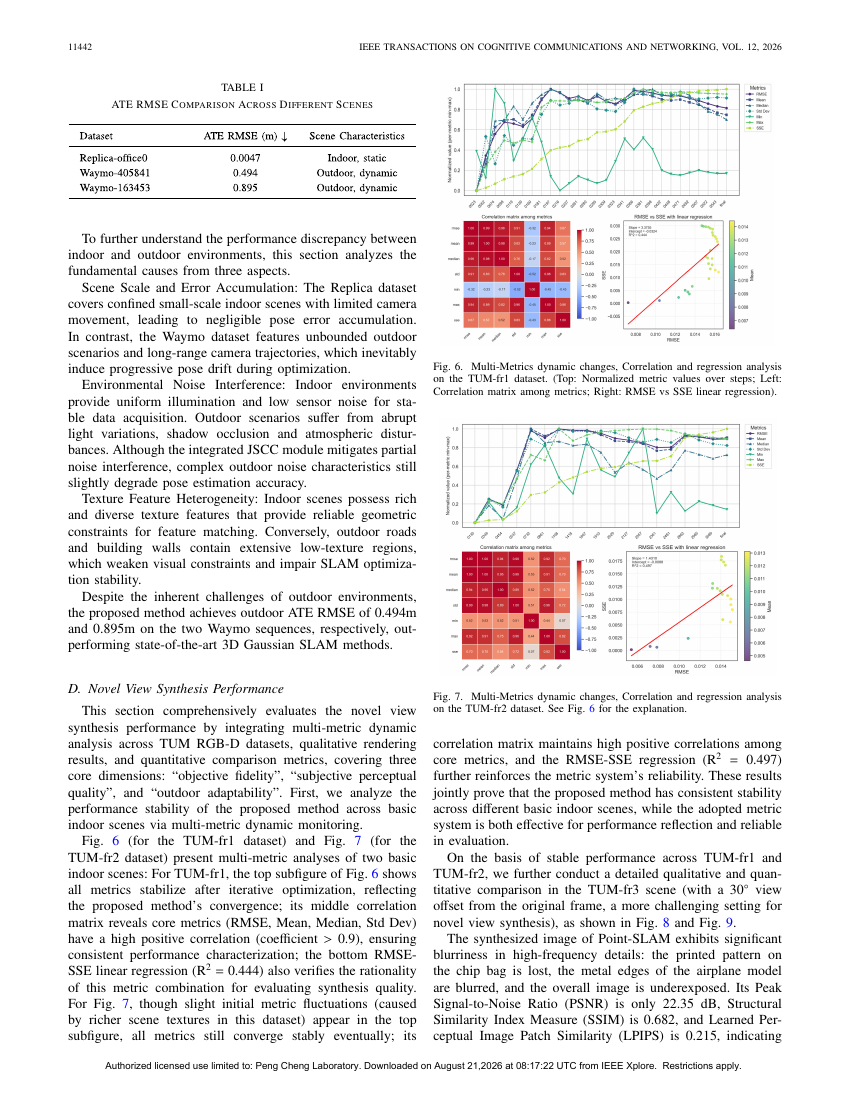
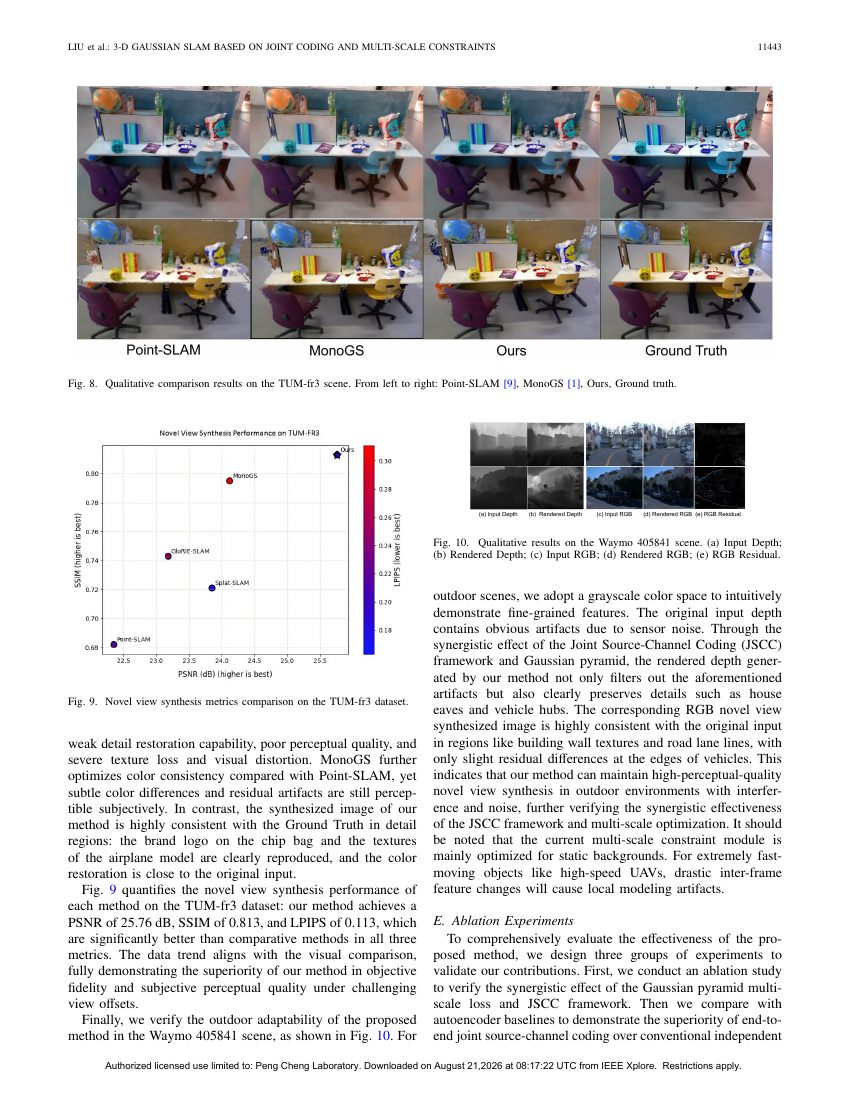
架构/方法图|来源:《3-D Gaussian SLAM Based on Joint Source-Channel Coding and Multi-Scale Constraints》,原 PDF p.10,Fig. 7 Multi-Metrics dynamic changes, Correlation and regression analysis This section comprehensively evaluates the novel view on the TUM-fr2 dataset. See 核对论文关键实验结果图/表|来源:《3-D Gaussian SLAM Based on Joint Source-Channel Coding and Multi-Scale Constraints》,原 PDF p.11,Fig. 8 Qualitative comparison results on the TUM-fr3 scene. From left to right: Point-SLAM [9], MonoGS [1], Ours, Ground truth。 核对论文
相关但非核心2026语音/音频传输或识别
6G-Oriented Semantic Extraction in Semantic Communications: From DL to Large AI Models
局限:没有完整离散接口,无法直接回答 bit/index/token 跳变问题。 未显式注入离散误码/丢包,鲁棒性结论不应外推到真实数字链路。 未报告统一可复核的 payload bit 数/CBR,跨论文带宽比较受限。 该文属于边界谱系,不能用它代表端到端语义通信主线。
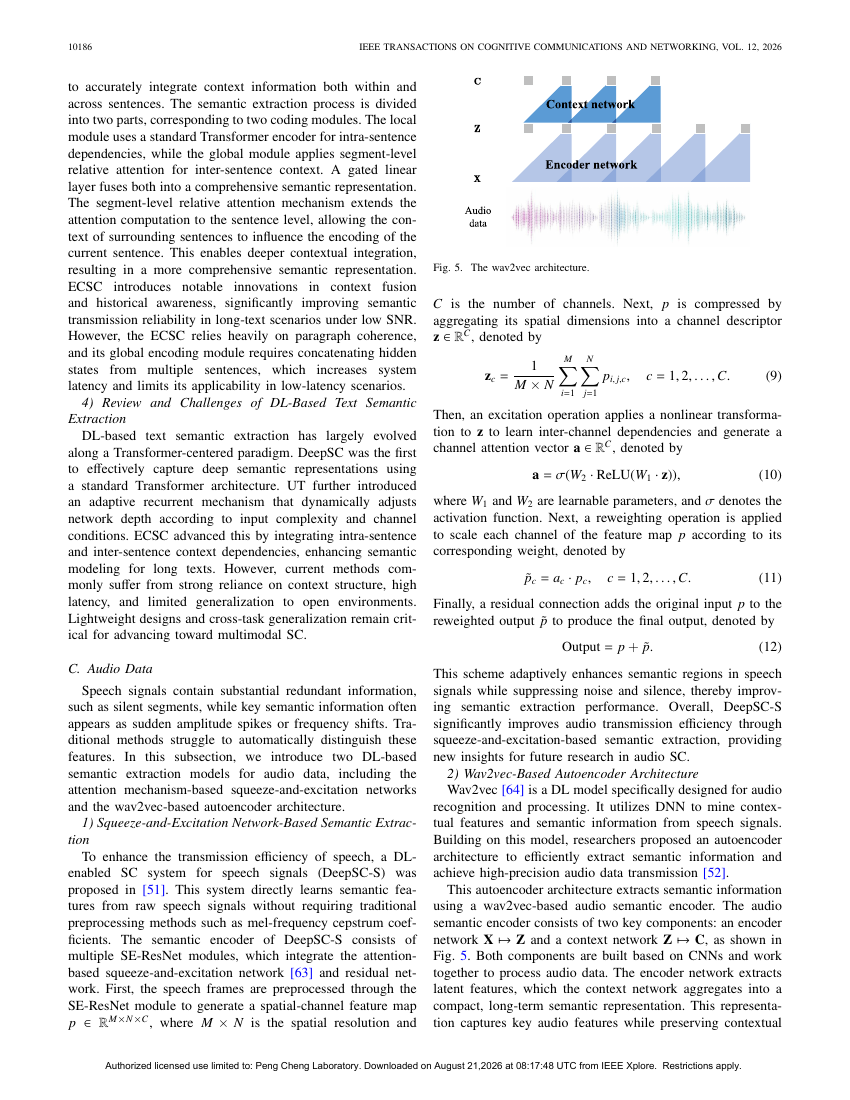
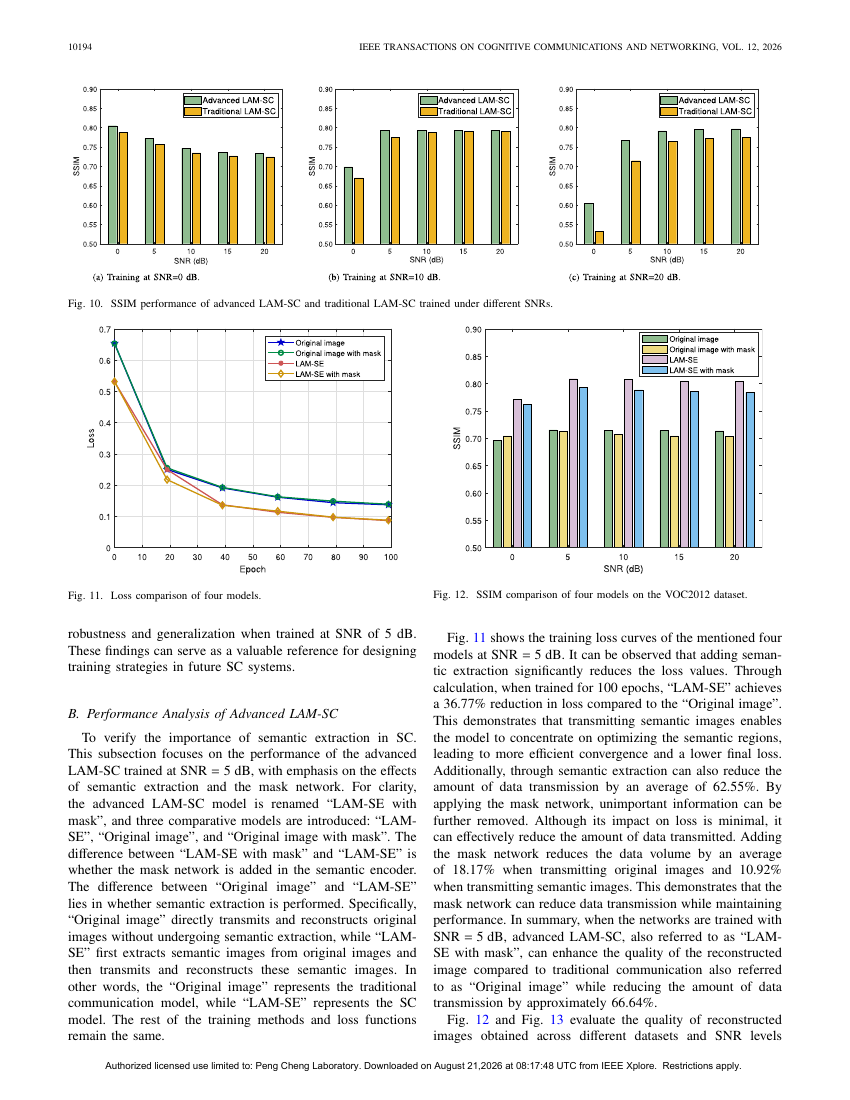
架构/方法图|来源:《6G-Oriented Semantic Extraction in Semantic Communications: From DL to Large AI Models》,原 PDF p.8,Fig. 5 The wav2vec architecture. ECSC introduces no 核对论文关键实验结果图/表|来源:《6G-Oriented Semantic Extraction in Semantic Communications: From DL to Large AI Models》,原 PDF p.16,Fig. 10 SSIM performance of advanced LAM-SC and traditional LAM-SC trained under different SNRs。 核对论文
核心纳入2026任务导向推理
A Dynamic Adaptive Deep Coding-Classification Framework for Intelligent Pragmatic Tasks in Semantic Communication
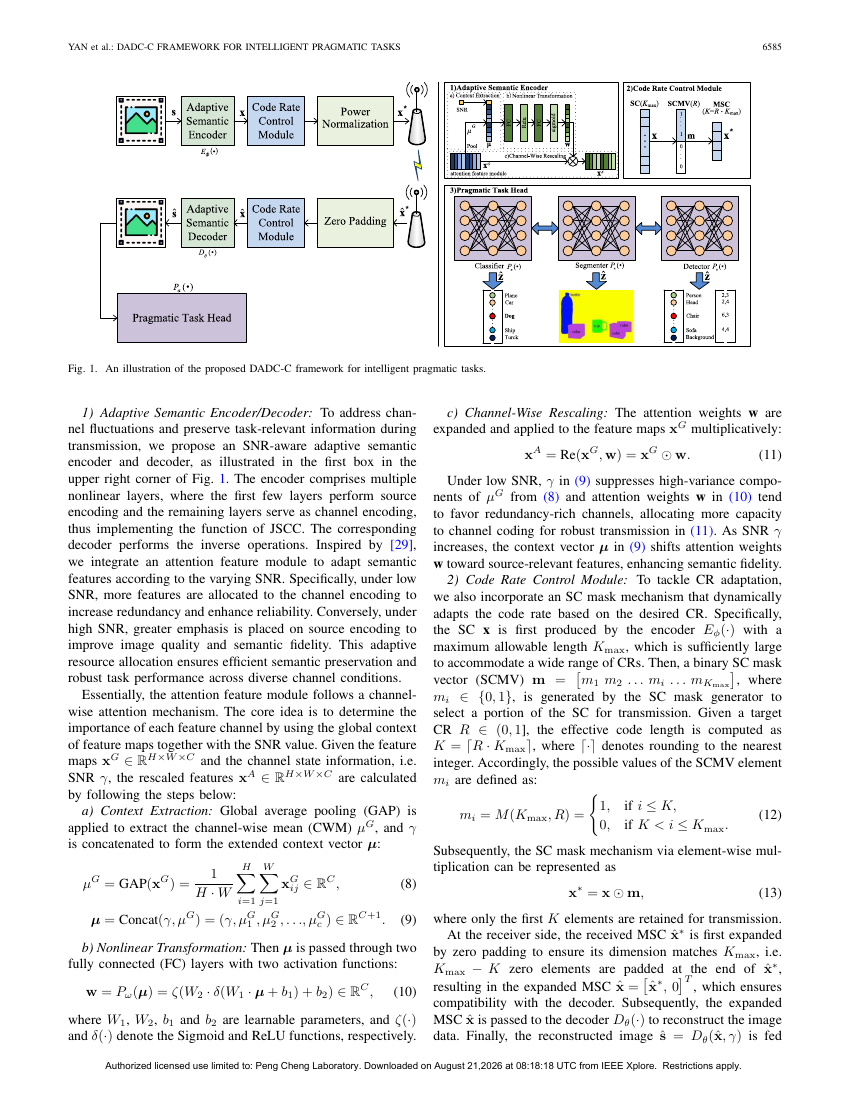
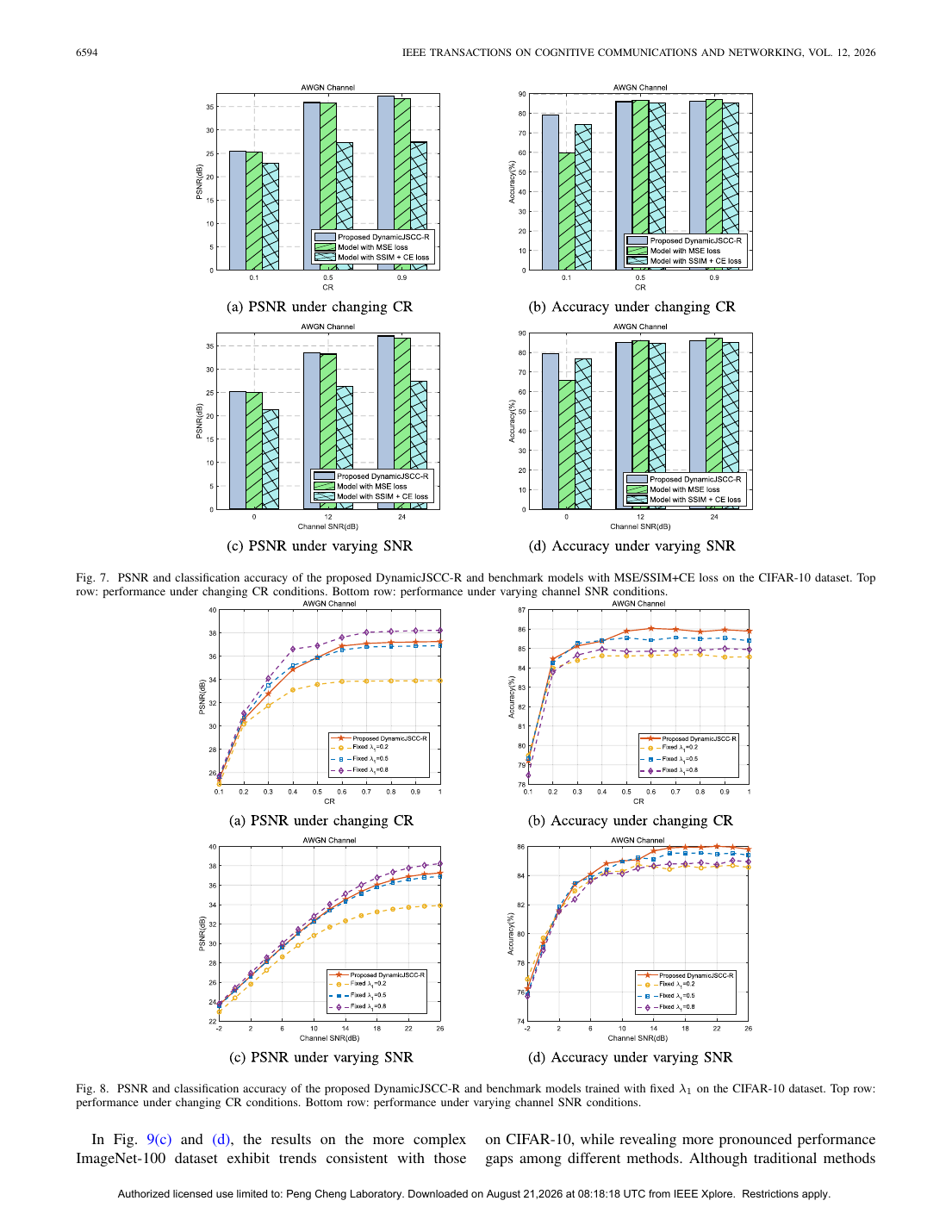
架构/方法图|来源:《A Dynamic Adaptive Deep Coding-Classification Framework for Intelligent Pragmatic Tasks in Semantic Communication》,原 PDF p.4,Fig. 1 An illustration of the proposed DADC-C framework for intelligent pragmatic tasks。 核对论文关键实验结果图/表|来源:《A Dynamic Adaptive Deep Coding-Classification Framework for Intelligent Pragmatic Tasks in Semantic Communication》,原 PDF p.13,Fig. 7 PSNR and classification accuracy of the proposed DynamicJSCC-R and benchmark models with MSE/SSIM+CE loss on the CIFAR-10 dataset. Top row: performance under changing CR conditions. Bottom row: performance under varying channel SNR conditions。 核对论文
相关但非核心2026图像传输、压缩或生成
A Learned Network Coding Scheme for Robust Image Transmission in Lossy Relay Networks
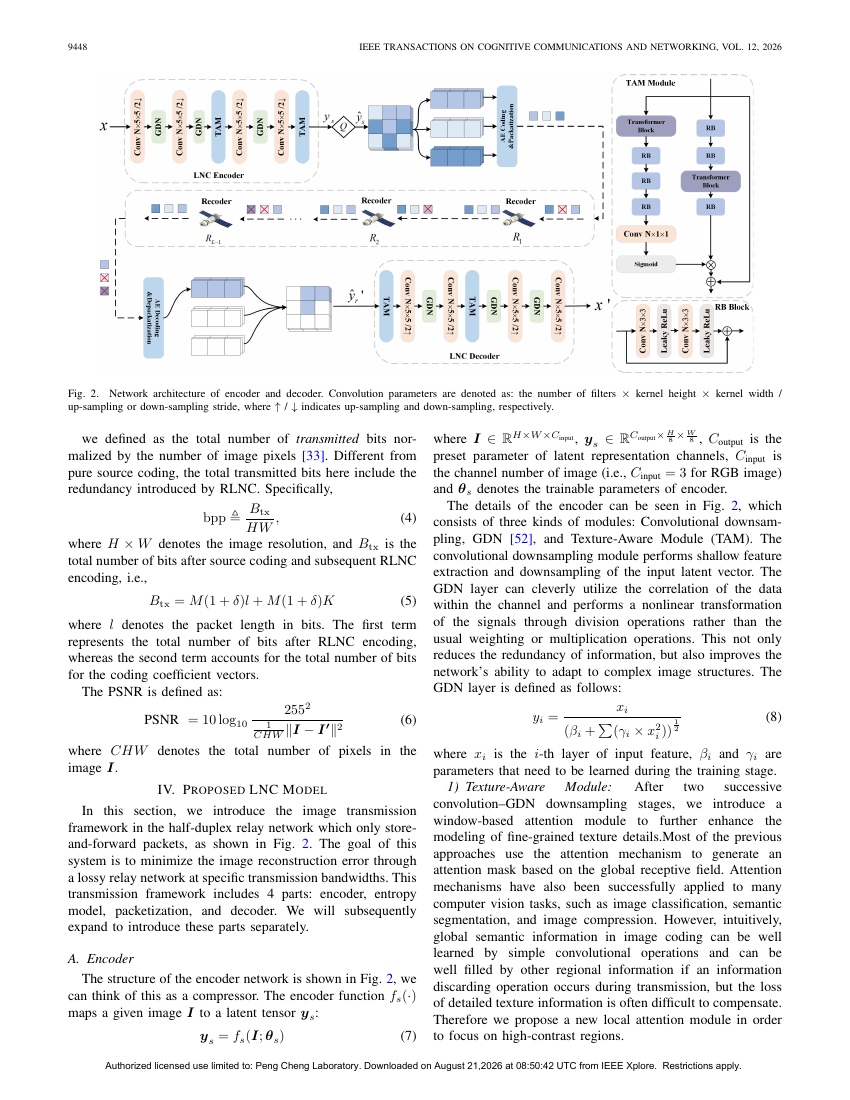
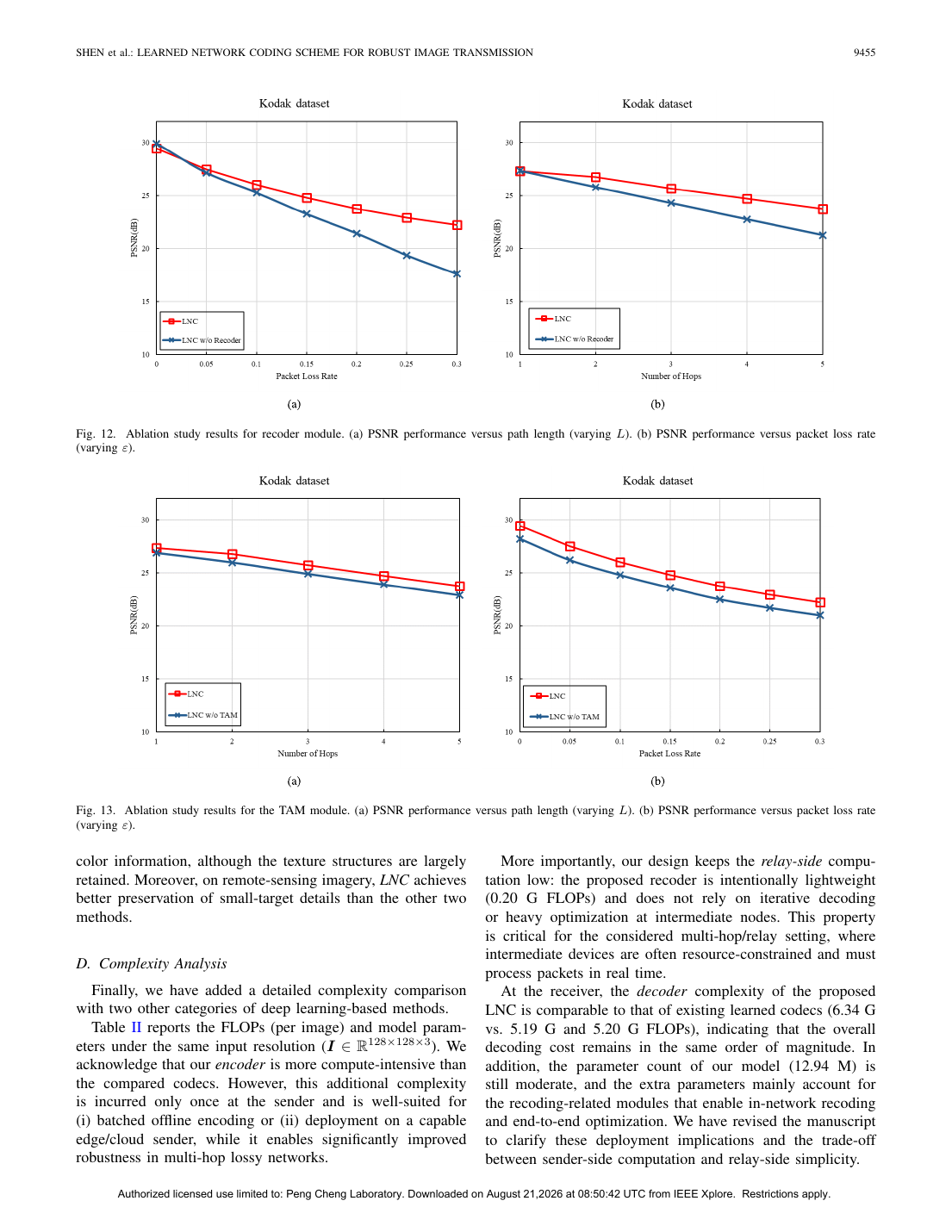
架构/方法图|来源:《A Learned Network Coding Scheme for Robust Image Transmission in Lossy Relay Networks》,原 PDF p.5,Fig. 2 Network architecture of encoder and decoder. Convolution parameters are denoted as: the number of filters × kernel height × kernel width / up-sampling or down-sampling stride, where ↑ / ↓ indicates up-sampling and down-sampling, respectively。 核对论文关键实验结果图/表|来源:《A Learned Network Coding Scheme for Robust Image Transmission in Lossy Relay Networks》,原 PDF p.12,Fig. 12 Ablation study results for recoder module. (a) PSNR performance versus path length (varying L). (b) PSNR performance versus packet loss rate (varying ε)。 核对论文
核心纳入2026语义感知资源分配与网络优化
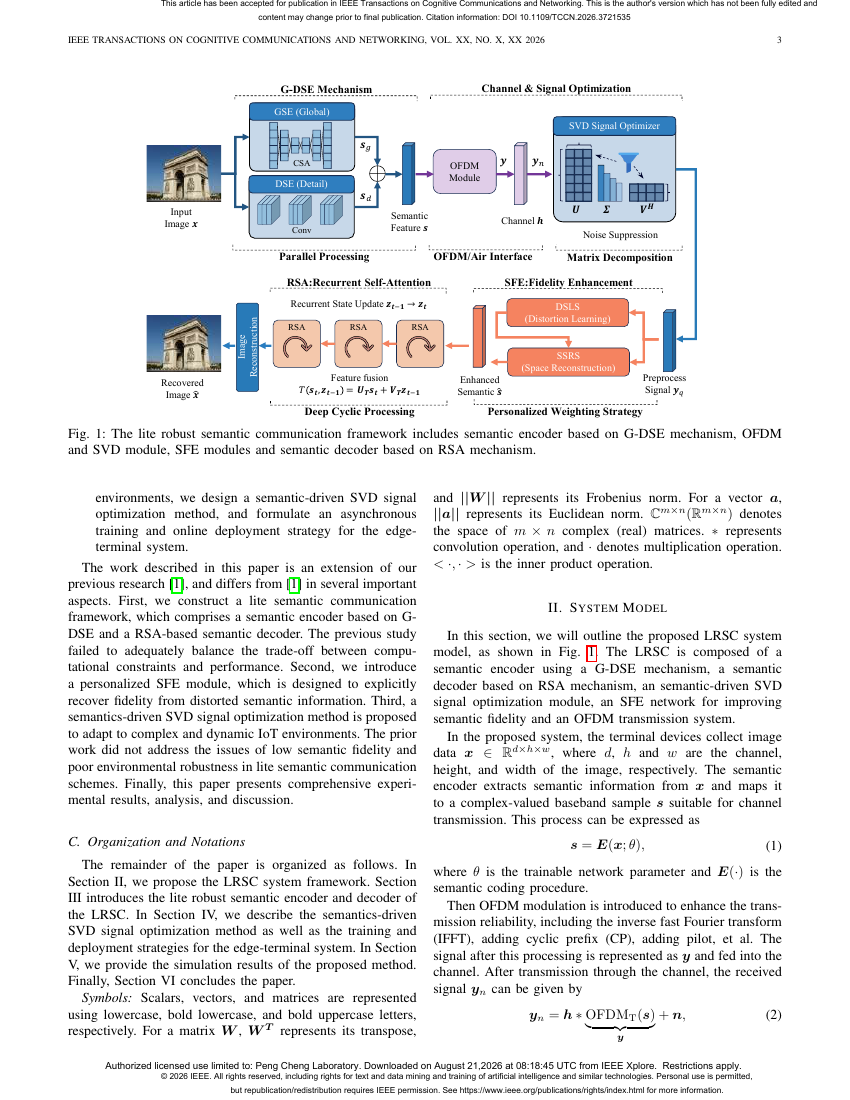
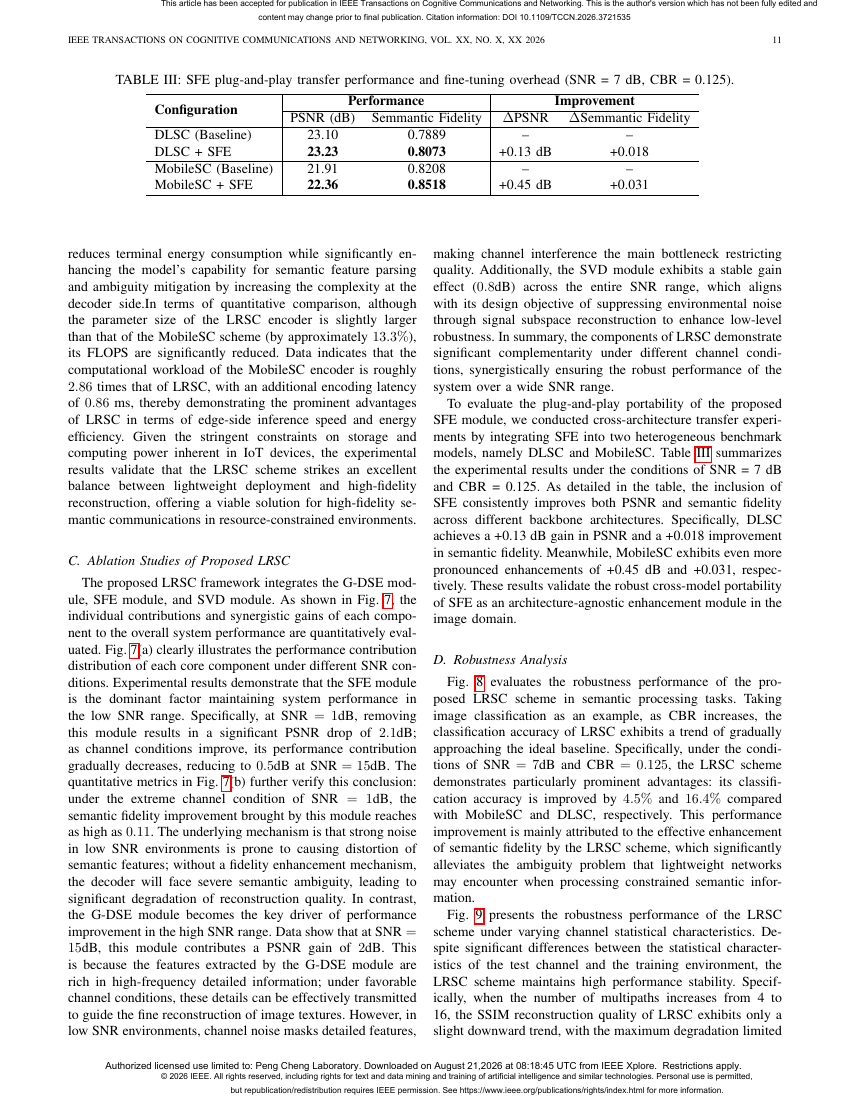
A Lite Robust Semantic Communication (LRSC) Scheme via Enhancing Fidelity
架构/方法图|来源:《A Lite Robust Semantic Communication (LRSC) Scheme via Enhancing Fidelity》,原 PDF p.3,该页包含论文的主要方法/架构图。 核对论文关键实验结果图/表|来源:《A Lite Robust Semantic Communication (LRSC) Scheme via Enhancing Fidelity》,原 PDF p.11,该页包含论文的关键实验结果图或表。 核对论文
核心纳入2026任务导向推理
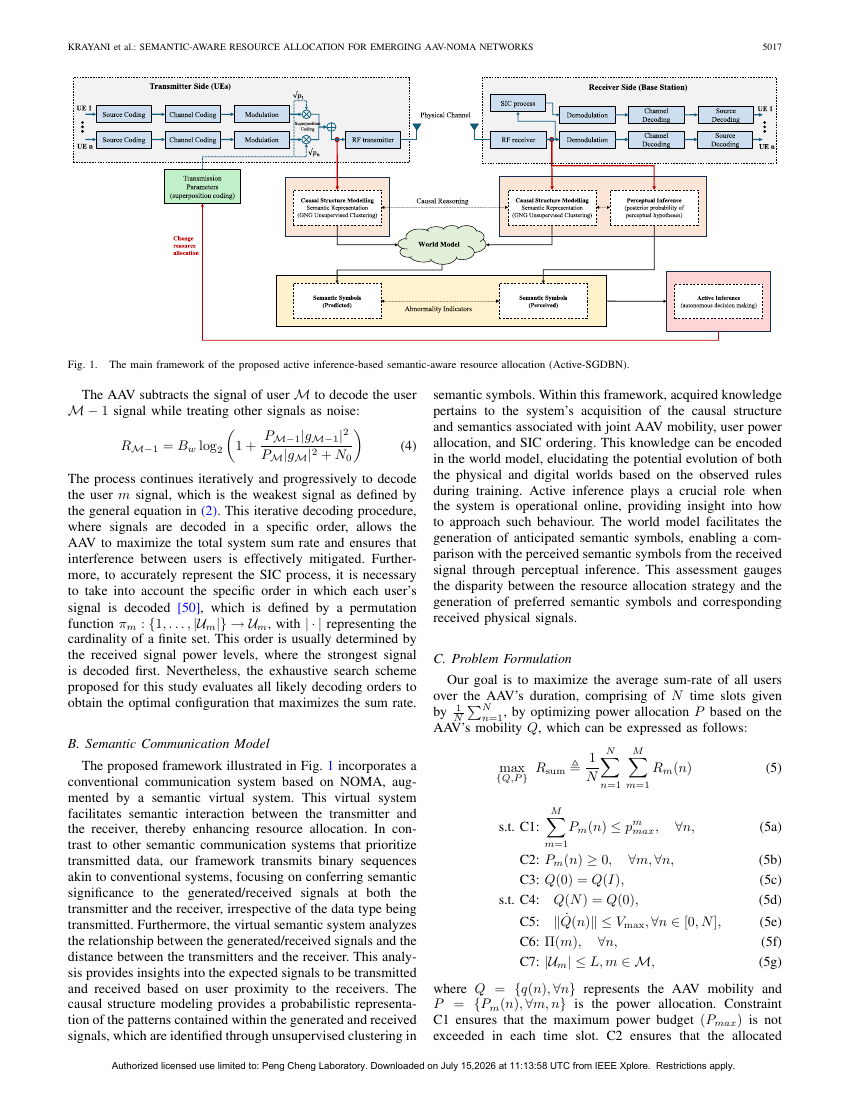
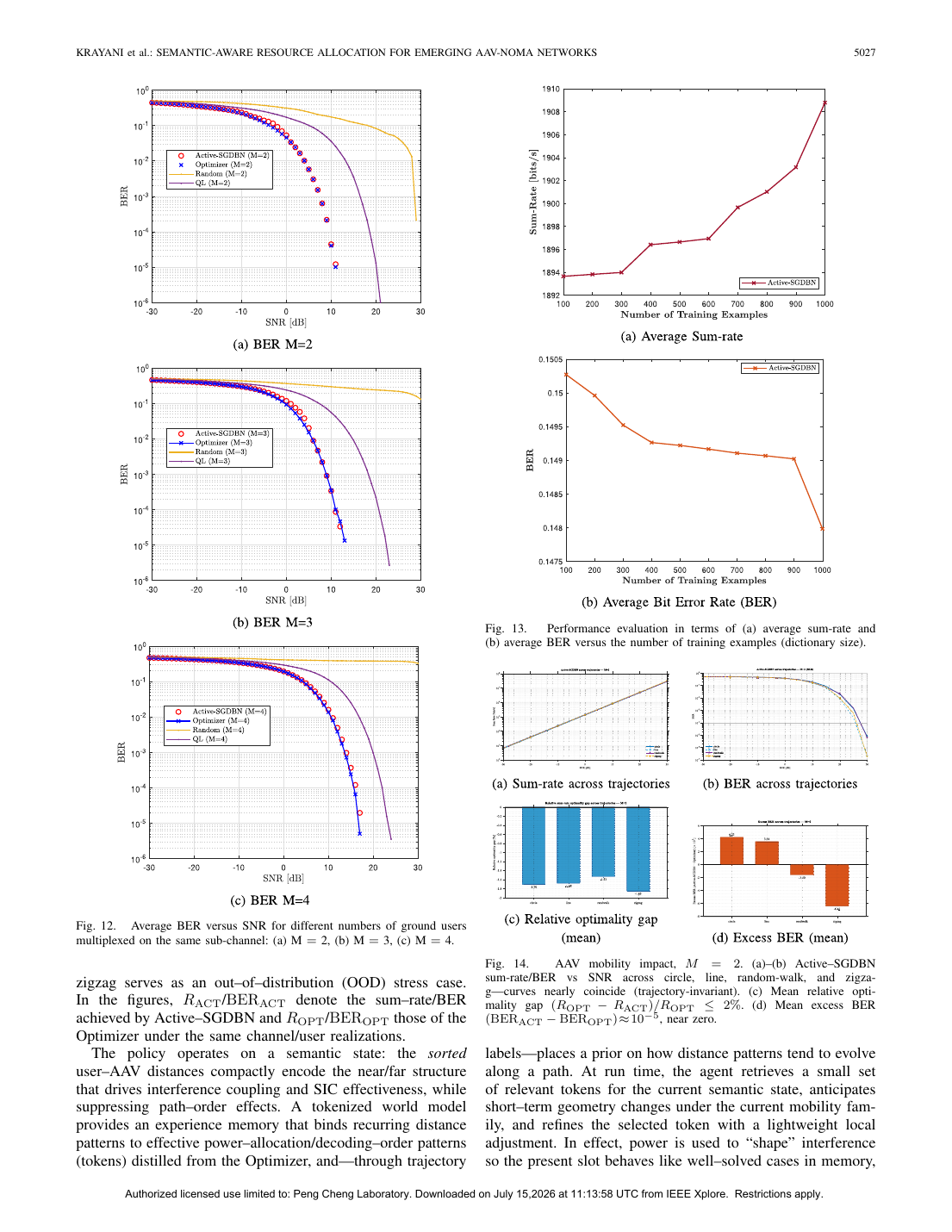
A Semantic-Aware Resource Allocation for Emerging AAV-NOMA Networks Empowered by Bayesian Active Inference
局限:没有完整离散接口,无法直接回答 bit/index/token 跳变问题。 未显式注入离散误码/丢包,鲁棒性结论不应外推到真实数字链路。 未报告统一可复核的 payload bit 数/CBR,跨论文带宽比较受限。
架构/方法图|来源:《A Semantic-Aware Resource Allocation for Emerging AAV-NOMA Networks Empowered by Bayesian Active Inference》,原 PDF p.4,Fig. 1 The main framework of the proposed active inference-based semantic-aware resource allocation (Active-SGDBN)。 核对论文关键实验结果图/表|来源:《A Semantic-Aware Resource Allocation for Emerging AAV-NOMA Networks Empowered by Bayesian Active Inference》,原 PDF p.14,Fig. 13 Performance evaluation in terms of (a) average sum-rate and (b) average BER versus the number of training examples (dictionary size)。 核对论文
核心纳入2026视频传输、生成或控制
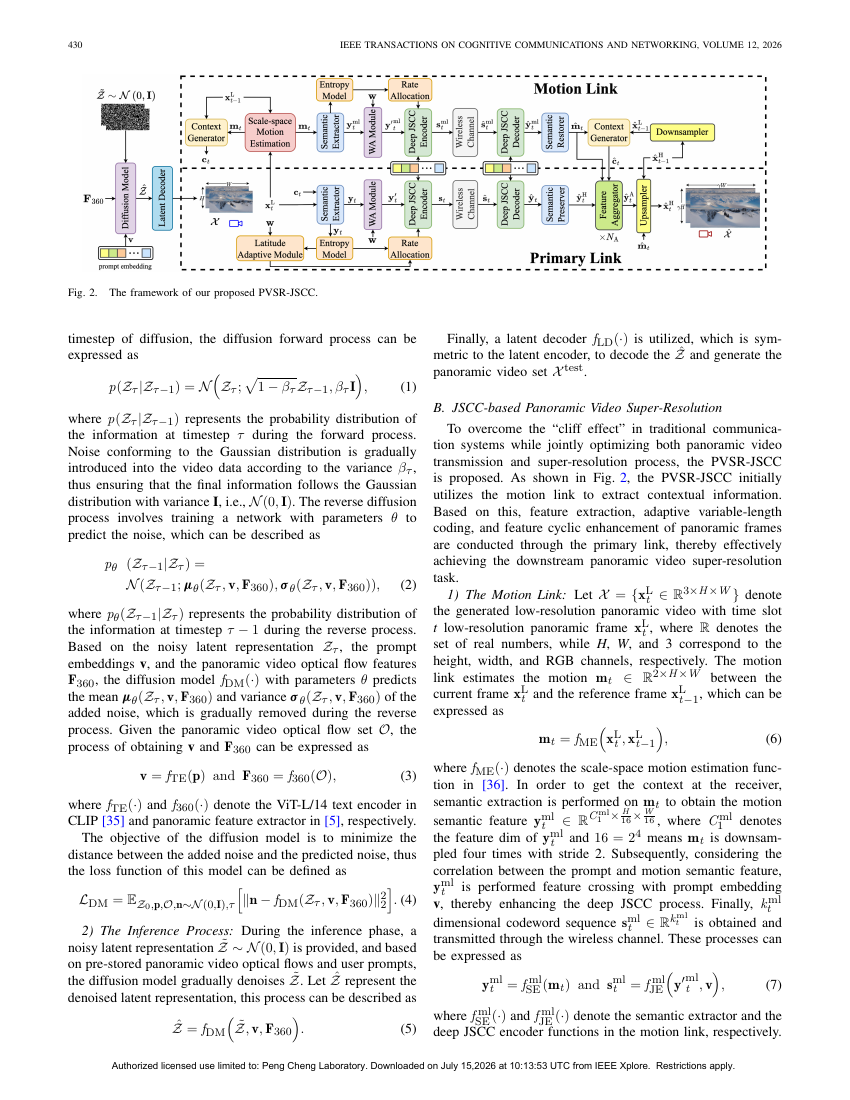
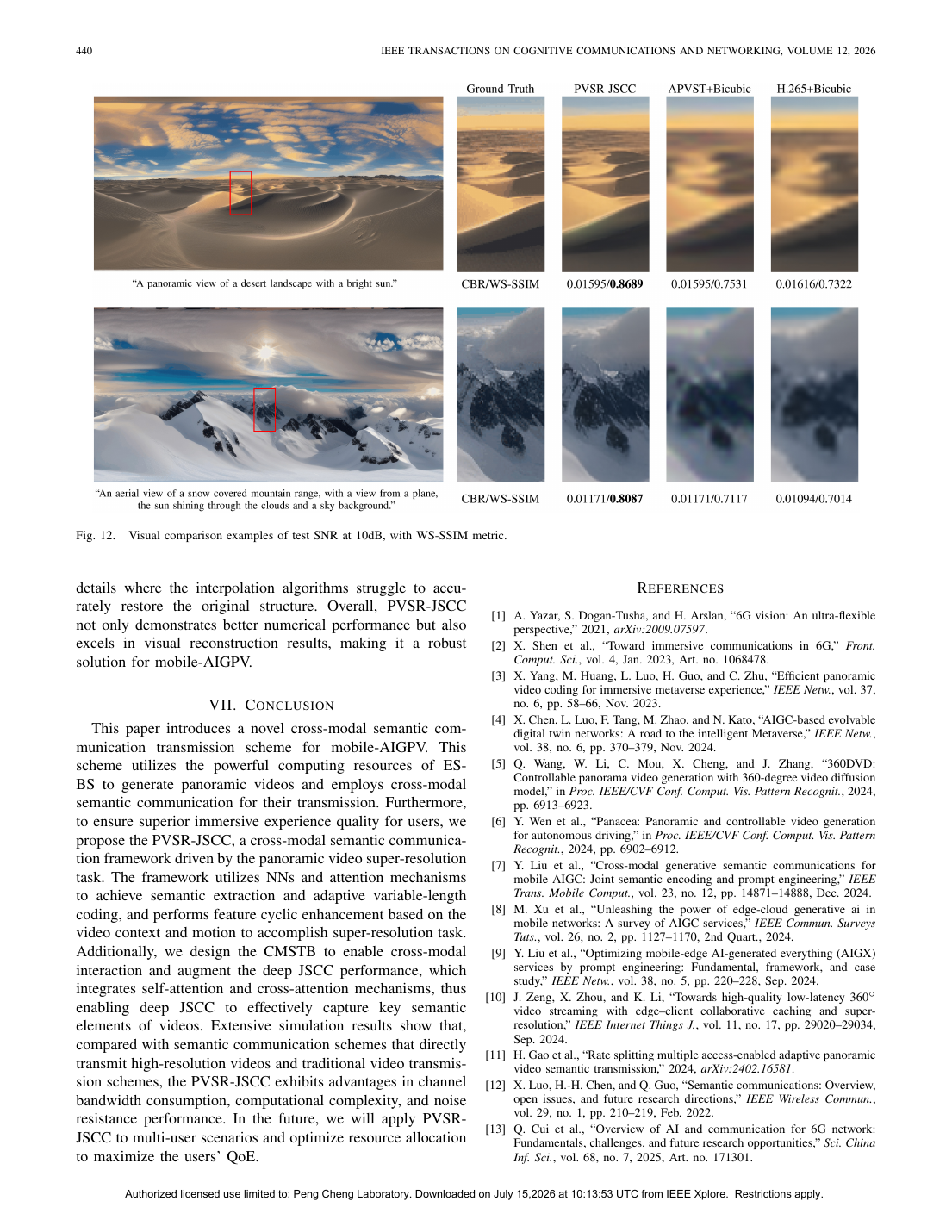
Adaptive Cross-Modal Super-Resolution Semantic Communication for Mobile AI-Generated Panoramic Video
信道与工作点Rayleigh、wireless channel、SNR of 29.7 dB、SNR of 10 dB
数据集为HEVC;实验小节中明确出现的比较对象包括NTSCC、HEVC、H.264、H.265、LDPC、Swin Transformer、ViT、DeepSC、JSCC、CLIP;指标包括PSNR、SSIM、mAP、QoE、latency、FLOPs、semantic similarity;信道/链路条件包括Rayleigh、wireless channel;正文可定位的代表性工作点有SNR of 29.7 dB、SNR of 10 dB。 PDF p.2
仿真结果表明,相比直接传输高分辨率视频的语义通信方案,我们提出的PVSR-JSCC不仅减少了36.7%的带宽消耗,但也降低了42.8%的语义模型的计算复杂度。 PDF p.1
架构/方法图|来源:《Adaptive Cross-Modal Super-Resolution Semantic Communication for Mobile AI-Generated Panoramic Video》,原 PDF p.4,Fig. 2 The framework of our proposed PVSR-JSCC。 核对论文关键实验结果图/表|来源:《Adaptive Cross-Modal Super-Resolution Semantic Communication for Mobile AI-Generated Panoramic Video》,原 PDF p.14,Fig. 12 Visual comparison examples of test SNR at 10dB, with WS-SSIM metric。 核对论文
核心纳入2026视频传输、生成或控制
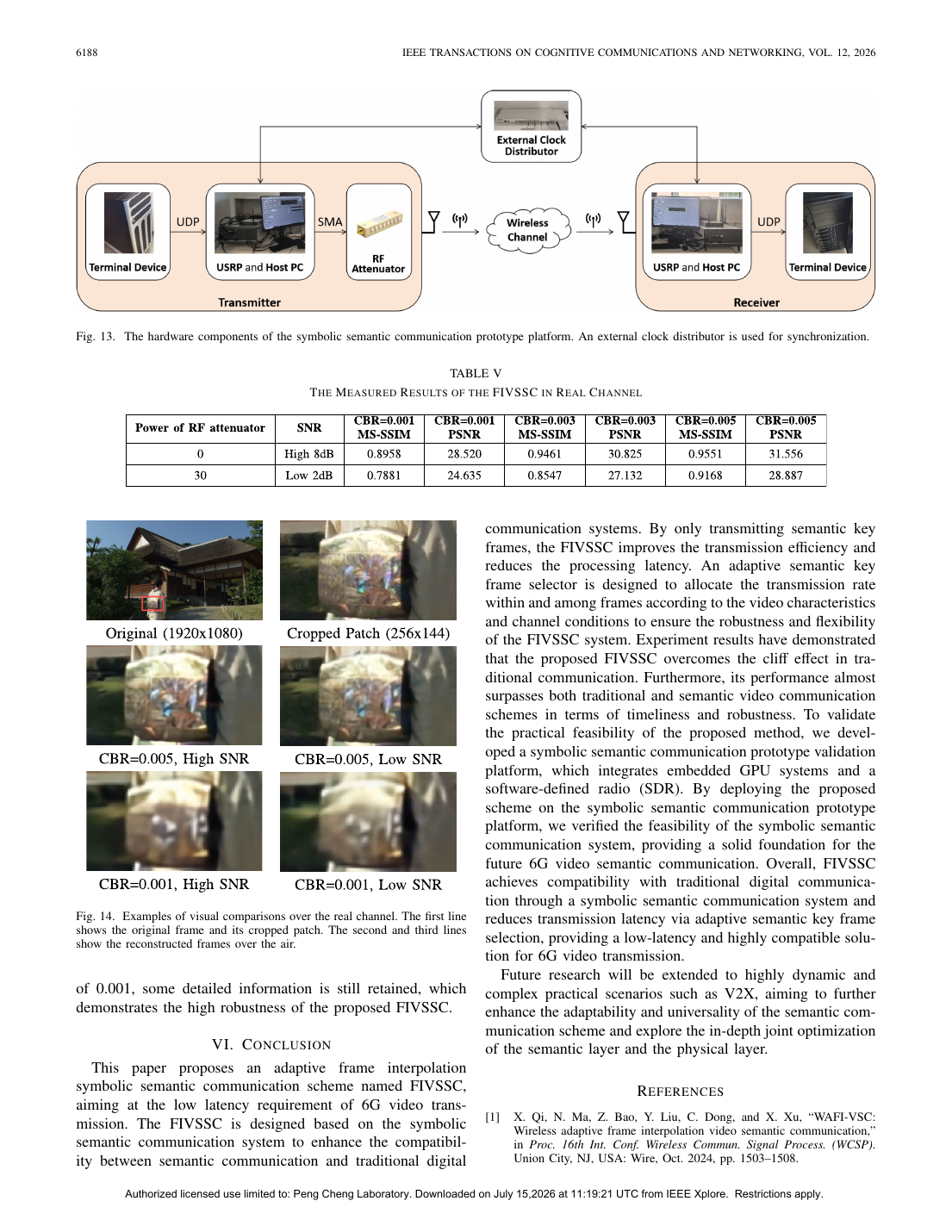
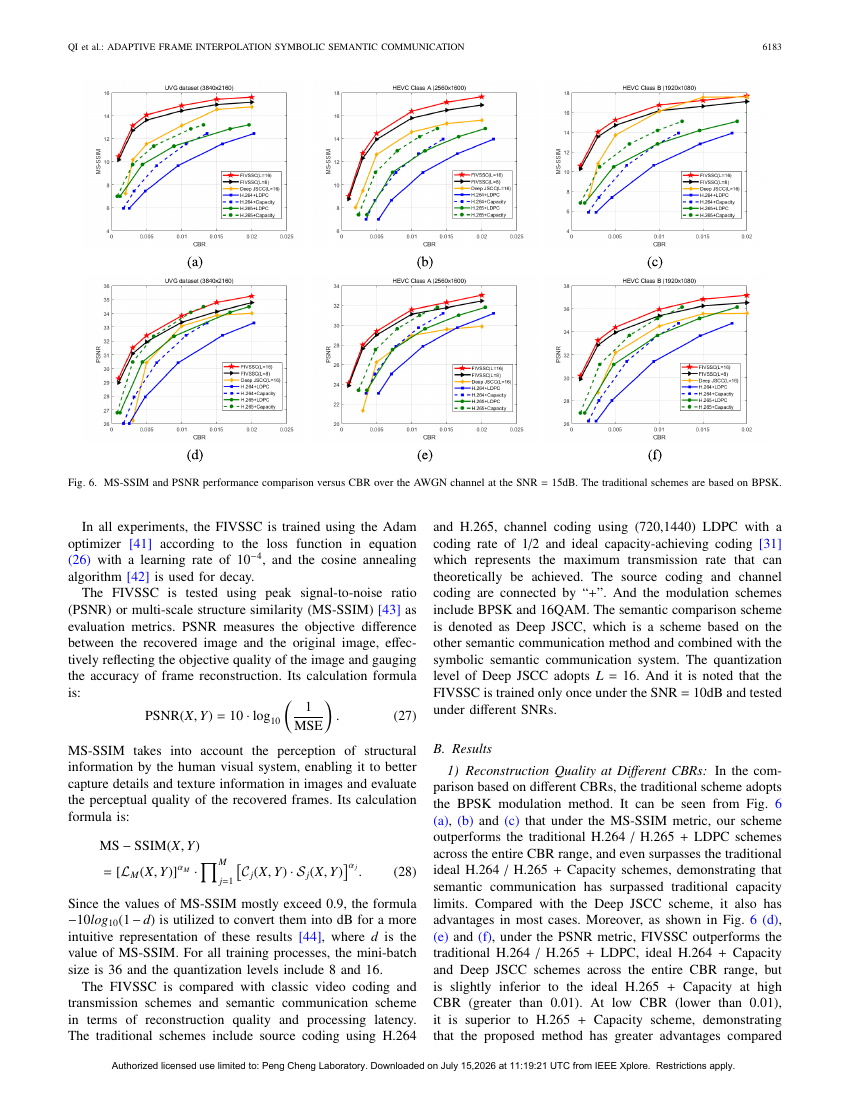
Adaptive Frame Interpolation Symbolic Semantic Communication for Low Latency Wireless Video Transmission
架构/方法图|来源:《Adaptive Frame Interpolation Symbolic Semantic Communication for Low Latency Wireless Video Transmission》,原 PDF p.14,Fig. 13 The hardware components of the symbolic semantic communication prototype platform. An external clock distributor is used for synchronization。 核对论文关键实验结果图/表|来源:《Adaptive Frame Interpolation Symbolic Semantic Communication for Low Latency Wireless Video Transmission》,原 PDF p.9,Fig. 6 MS-SSIM and PSNR performance comparison versus CBR over the AWGN channel at the SNR = 15dB. The traditional schemes are based on BPSK。 核对论文
核心纳入2026图像传输、压缩或生成
Adaptive Semantic Image Transmission With Object Prioritization and Over-the-Air Validation
正文未给出可单句摘录的更细信道流程;结合题名、摘要、方法与实验,本调研按“类别 3:连续语义变量直接经过有噪声信道并端到端恢复”解释信道作用点。 本调研据此归为“类别 3:连续语义变量直接经过有噪声信道并端到端恢复”。 PDF p.2PDF p.9
语义 decoder 实际面对的是:带噪连续 channel symbol / latent,经神经 decoder 恢复任务输出。 PDF p.2PDF p.9
是否真正处理离散变量出错:不适用 VQ index/bit 跳变;论文处理的是连续扰动和信道失配。
实验设置与主要结论
数据集/场景COCO
BaselineDeepJSCC、BPG、LDPC、ViT、YOLO、FCN、JSCC、OFDM
评价指标PSNR、SSIM、MSE、IoU、PER
信道与工作点AWGN、Rayleigh、OFDM、channel estimation、fading channel、at 0 dB SNR、At -5 dB SNR
数据集为COCO;实验小节中明确出现的比较对象包括DeepJSCC、BPG、LDPC、ViT、YOLO、FCN、JSCC、OFDM;指标包括PSNR、SSIM、MSE、IoU、PER;信道/链路条件包括AWGN、Rayleigh、OFDM、channel estimation、fading channel;正文可定位的代表性工作点有at 0 dB SNR、At -5 dB SNR。 PDF p.9
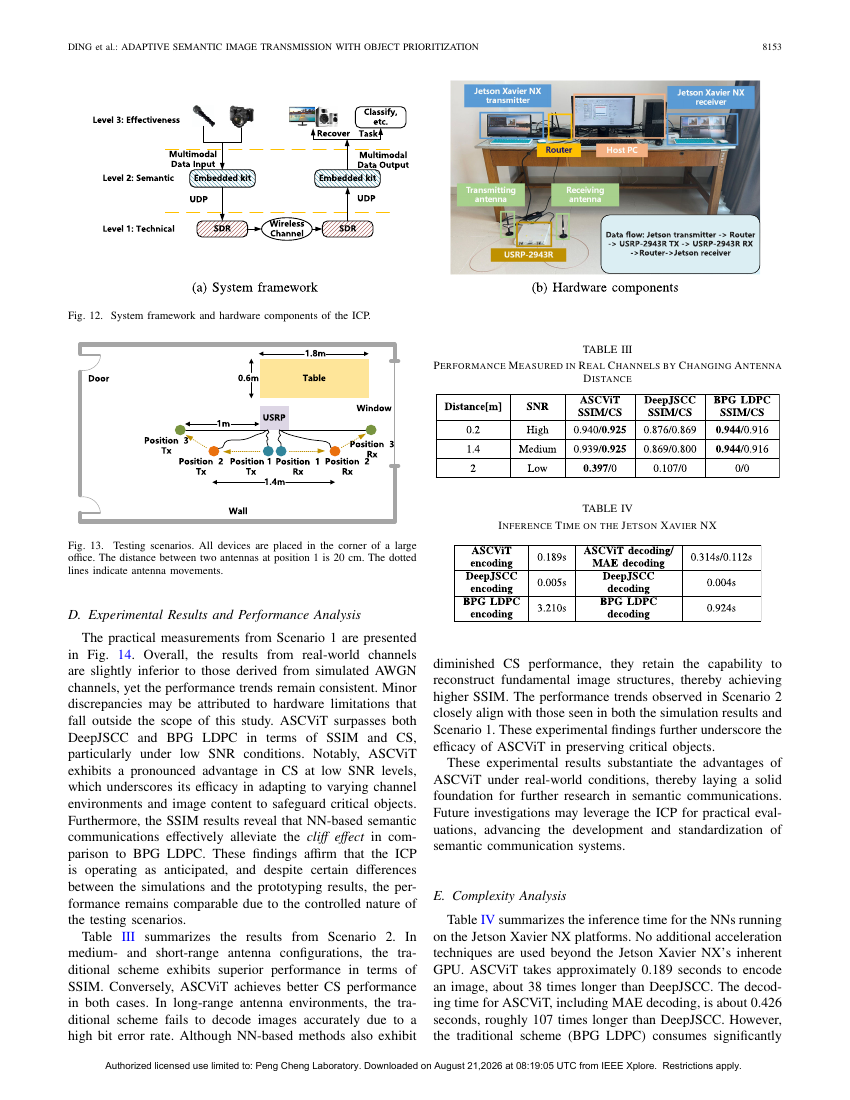
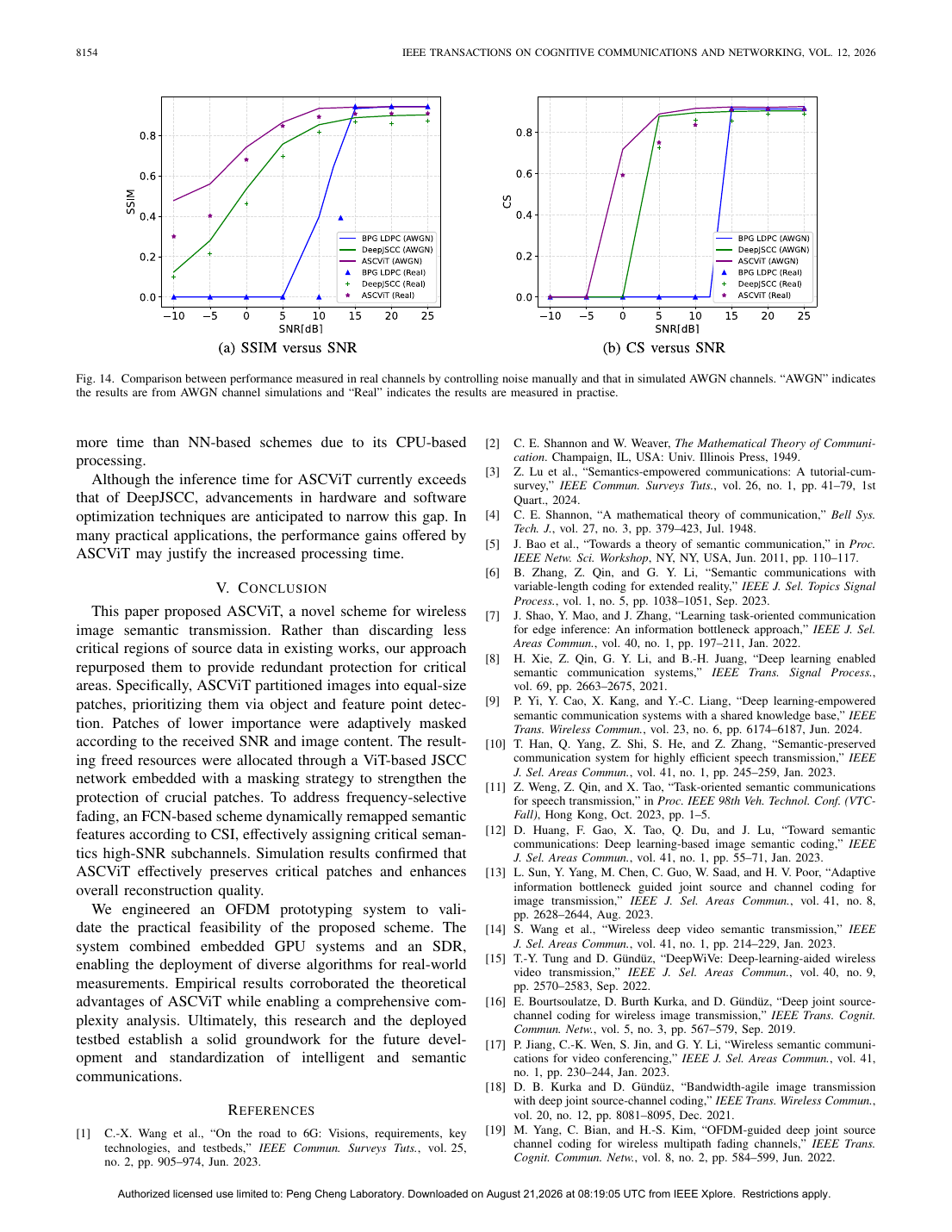
架构/方法图|来源:《Adaptive Semantic Image Transmission With Object Prioritization and Over-the-Air Validation》,原 PDF p.13,Fig. 12 System framework and hardware components of the ICP。 核对论文关键实验结果图/表|来源:《Adaptive Semantic Image Transmission With Object Prioritization and Over-the-Air Validation》,原 PDF p.14,Fig. 14 Comparison between performance measured in real channels by controlling noise manually and that in simulated AWGN channels. “AWGN” indicates the results are from AWGN channel simulations and “Real” indicates the results are measured in practise。 核对论文
核心纳入2026点云/三维场景传输
Channel-Adaptive Cross-Modal Generative Semantic Communication for Point Cloud Transmission
局限:没有完整离散接口,无法直接回答 bit/index/token 跳变问题。 未显式注入离散误码/丢包,鲁棒性结论不应外推到真实数字链路。 未报告统一可复核的 payload bit 数/CBR,跨论文带宽比较受限。
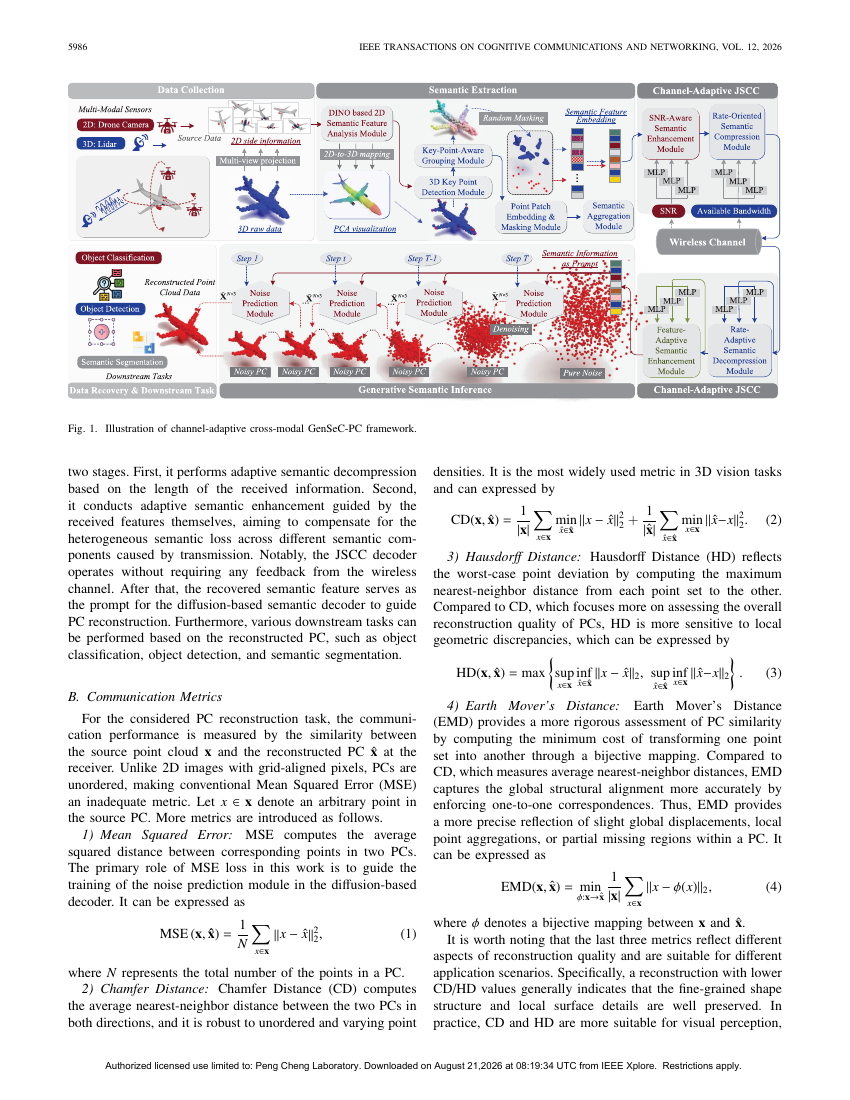
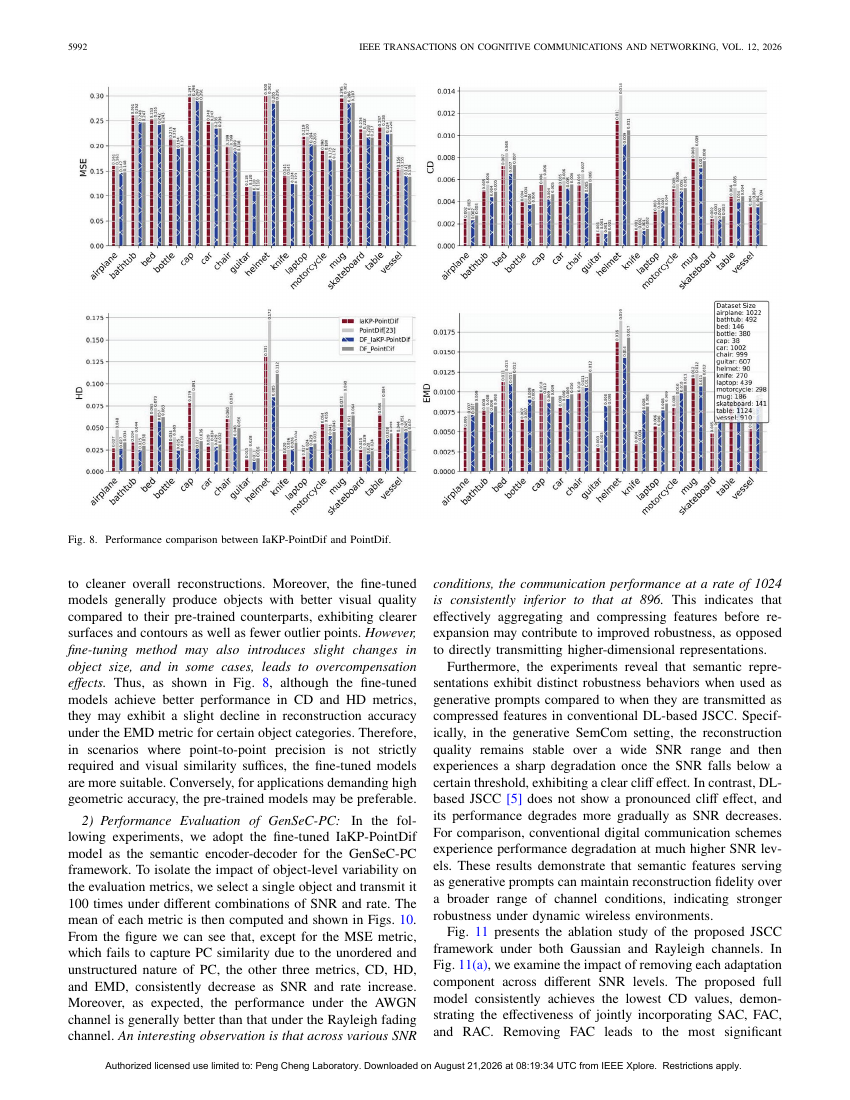
架构/方法图|来源:《Channel-Adaptive Cross-Modal Generative Semantic Communication for Point Cloud Transmission》,原 PDF p.4,Fig. 1 Illustration of channel-adaptive cross-modal GenSeC-PC framework。 核对论文关键实验结果图/表|来源:《Channel-Adaptive Cross-Modal Generative Semantic Communication for Point Cloud Transmission》,原 PDF p.10,Fig. 8 Performance comparison between IaKP-PointDif and PointDif。 核对论文
核心纳入2026点云/三维场景传输
Channel-Adaptive Semantic Communication for Stereoscopic Media: Design and Prototype Implementation
一句话主旨:Channel-Adaptive Semantic Communication for Stereoscopic Media: Design and Prototype Implementation 面向点云/三维场景传输,把问题放在“自适应联合信源信道编码”层处理;本调研把主接口判断为“连续神经 JSCC latent / 实复信道符号”。
Motivation|Introduction 怎样导出本文方案
现有进展:立体媒体因其在3D可视化、虚拟现实、虚拟实境和沉浸式媒体中的广泛应用而受到关注。 PDF p.1
仍然存在的问题:但是,考虑到立体媒体对之间的相关性,立体媒体通信将引入冗余。 PDF p.1
为什么已有方法解决不了:为固定 SNR 或带宽训练的模型具有固定瓶颈和保护方式;条件变化时重复运行同一网络,不能把码率或冗余重新分给变得脆弱的信息。 PDF p.1
为什么这个问题重要:XR 与三维感知的数据量极大而交互时延敏感;以更少信道使用保住几何和任务关键对象,会直接降低空口负担。 PDF p.1
本文提出什么:为此,提出了一种新的双视角深度联合信源-信道编码方案,该方案能够有效地提取和传输表示视角间相关性的语义特征,从而在提高重建质量的同时减少冗余。 PDF p.1
方案为何可能有效:通过利用视图之间的差异,立体媒体可以促进3D结构构建并增强空间感知。 PDF p.1
作者希望证明什么:相比于基准测试,基于WSNM的重构方法在不同条件下均能保持重构质量,可获得更高的峰值信噪比(Peak Signal to Noise Ratio,PSNR)和结构相似度(Structural Similarity Index,SSIM)。 PDF p.1
方法与端到端信息流
为了解决这个问题,我们提出了一种新的双视图深度联合信源信道编码方案,该方案有效地提取和传输表示视图间相关性的语义特征,从而在提高重建质量的同时减少冗余,通过利用视图之间的视差,立体媒体可以促进3D结构构建并增强空间感知。 PDF p.1
输入输入是点云/三维场景传输所需的三维点、视图或场景语义。
发送端发送端采用 Channel-Adaptive Semantic Communication for Stereoscopic Media: Design and Prototype Implementation:为了解决这个问题,我们提出了一种新的双视图深度联合信源信道编码方案,该方案有效地提取和传输表示视图间相关性的语义特征,从而在提高重建质量的同时减少冗余,通过利用视图之间的视差,立体媒体可以促进3D结构构建并增强空间感知。
实际发送实际发送对象是功率归一化的实数或复数神经信道符号。
信道信道作用方式按“类别 3:连续语义变量直接经过有噪声信道并端到端恢复”解释。
接收端接收端从AWGN/衰落作用后的带噪连续符号开始,再执行语义解码、任务推理或生成。
输出最终输出为三维重建、渲染或下游感知结果。
它在通信系统中的位置:让表示维度、保护强度或接收策略随带宽和信道条件变化。
数字化方案与真实传输开销
是否属于严格数字语义通信:否/不适用:主接口为连续 JSCC 或上层模型
表示判断:连续神经 JSCC latent / 实复信道符号
全文没有给出可复核的 VQ/codebook/index-to-bit 接口。根据系统模型,本调研将传输表示判断为“连续神经 JSCC latent / 实复信道符号”;不能把网络 latent 的每个浮点维度直接当成固定 bit。 独立判断:Channel-Adaptive Semantic Communication for Stereoscopic Media: Design and Prototype Implementation 的主传输单位应归为“连续神经 JSCC latent / 实复信道符号”。只有论文明确给出量化和映射时,才能把 token/index 数换算成总 bit;连续 channel symbol 只能按 channel uses/CBR 比较。 PDF p.2
论文未同时报告输入尺寸、encoder 输出尺寸、量化精度/码本大小和帧级开销,因此不能从全文唯一重建总 bit 数。页面保留论文实际使用的 CBR、bpp、token 数或信道使用次数;缺失项不作臆测。 PDF p.2PDF p.10
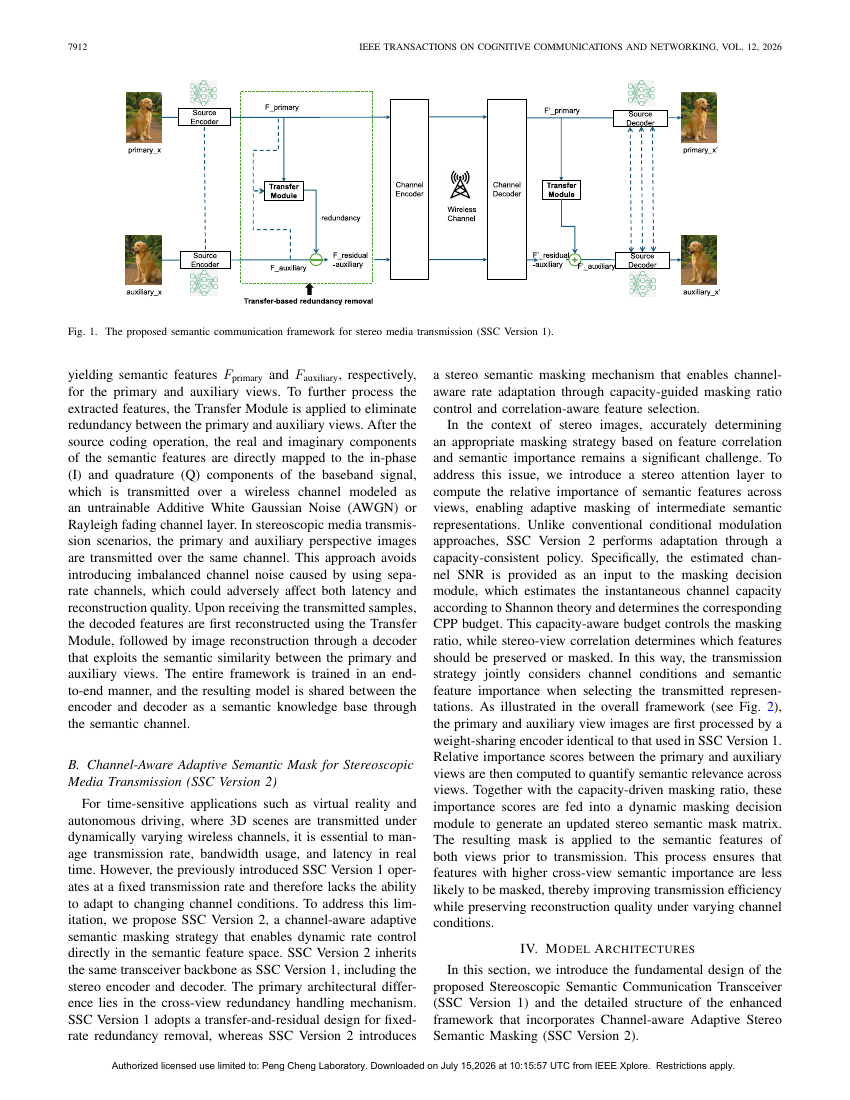
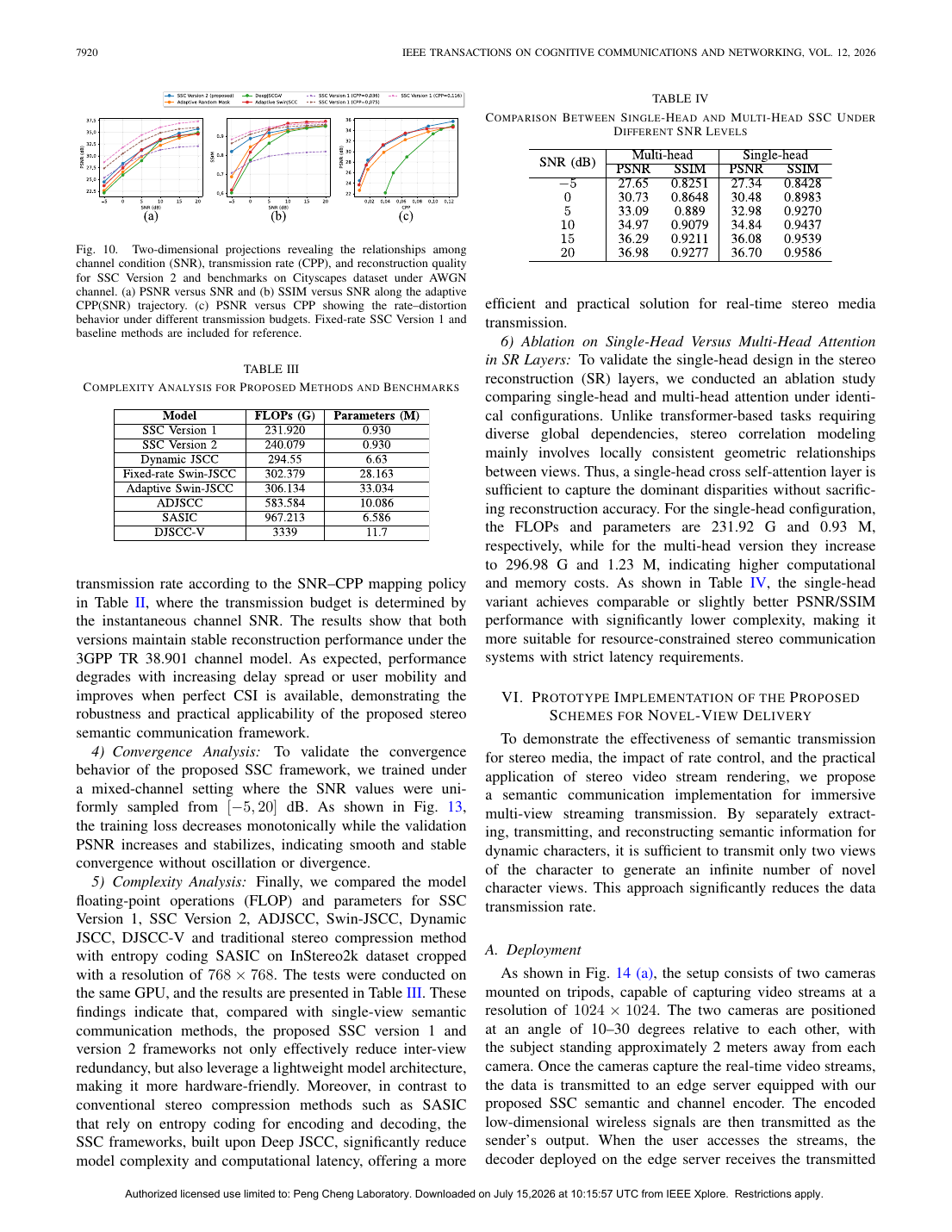
架构/方法图|来源:《Channel-Adaptive Semantic Communication for Stereoscopic Media: Design and Prototype Implementation》,原 PDF p.4,Fig. 1 The proposed semantic communication framework for stereo media transmission (SSC Version 1)。 核对论文关键实验结果图/表|来源:《Channel-Adaptive Semantic Communication for Stereoscopic Media: Design and Prototype Implementation》,原 PDF p.12,Fig. 14 (a), the setup consists of two cameras the same GPU, and the results are presented in 核对论文
核心纳入2026图像传输、压缩或生成
Channel-Aware Latent Flow-Matching Semantic Communication for Agentic AI
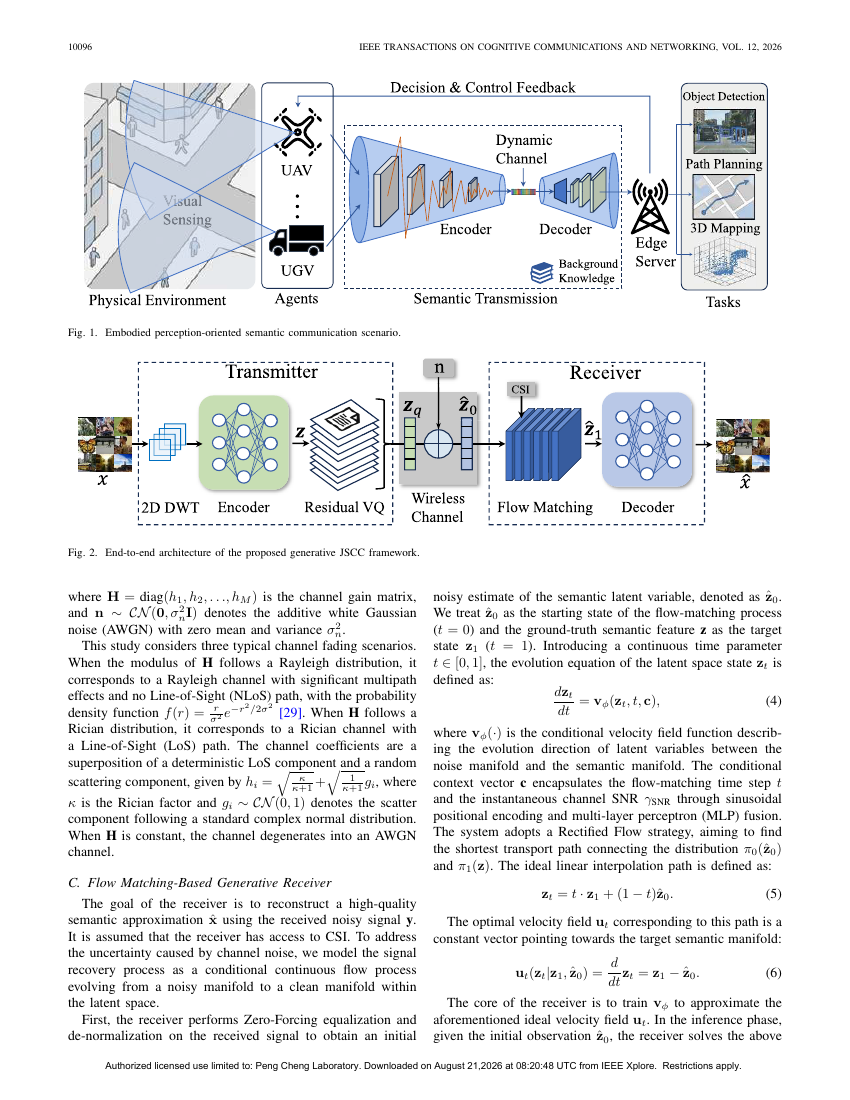
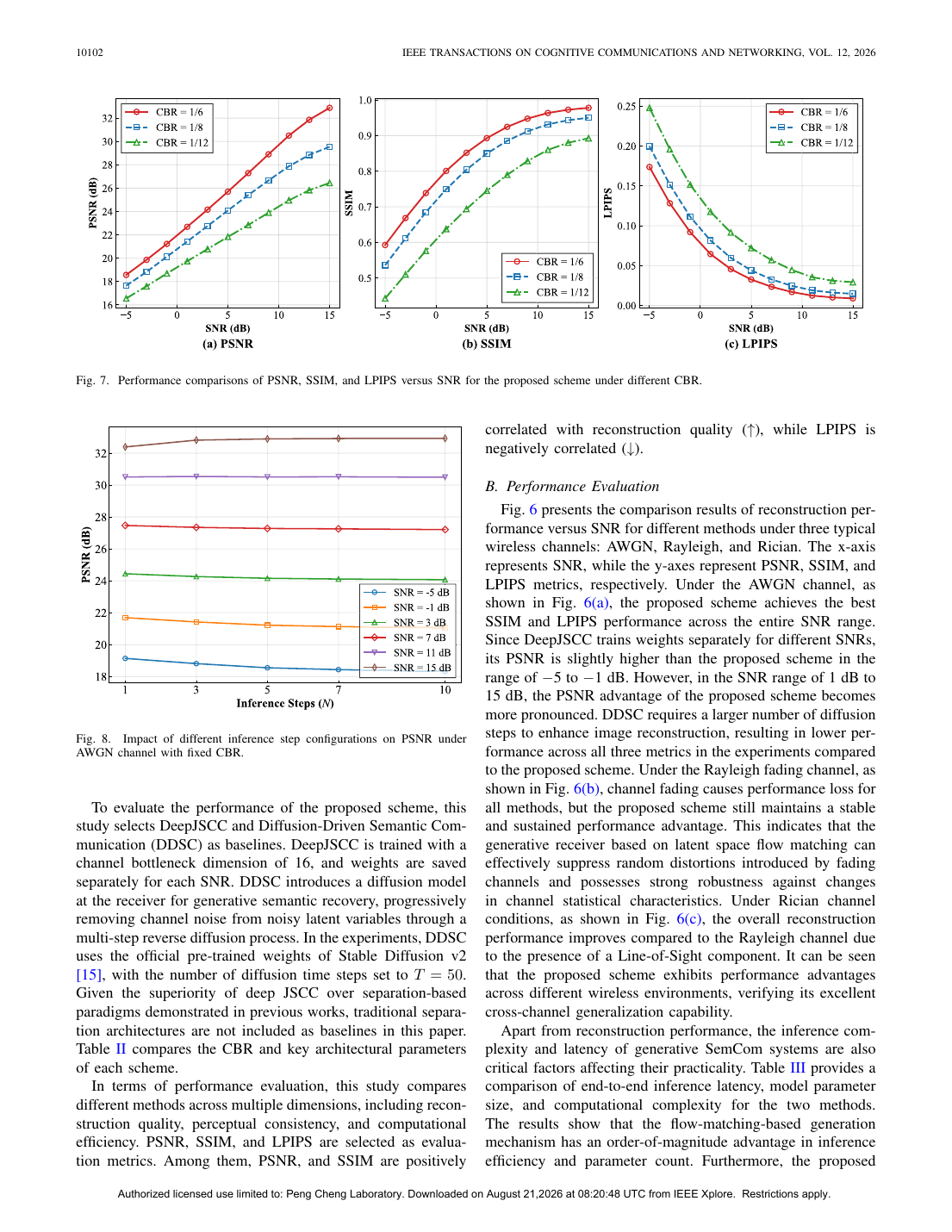
架构/方法图|来源:《Channel-Aware Latent Flow-Matching Semantic Communication for Agentic AI》,原 PDF p.4,Fig. 2 End-to-end architecture of the proposed generative JSCC framework。 核对论文关键实验结果图/表|来源:《Channel-Aware Latent Flow-Matching Semantic Communication for Agentic AI》,原 PDF p.10,Fig. 7 Performance comparisons of PSNR, SSIM, and LPIPS versus SNR for the proposed scheme under different CBR。 核对论文
核心纳入2026图像传输、压缩或生成
Complex Valued Linear Discriminant Analysis on mmWave Radar Face Signatures for Task-Oriented Semantic Communication
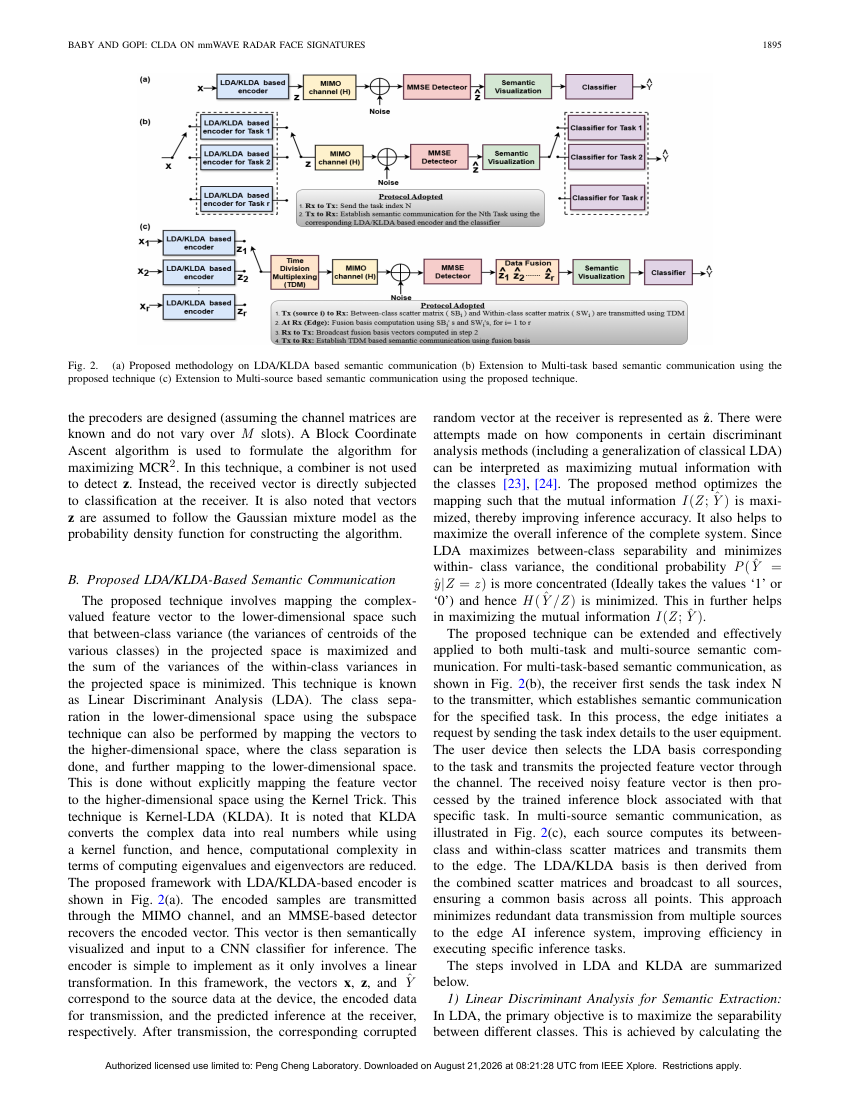
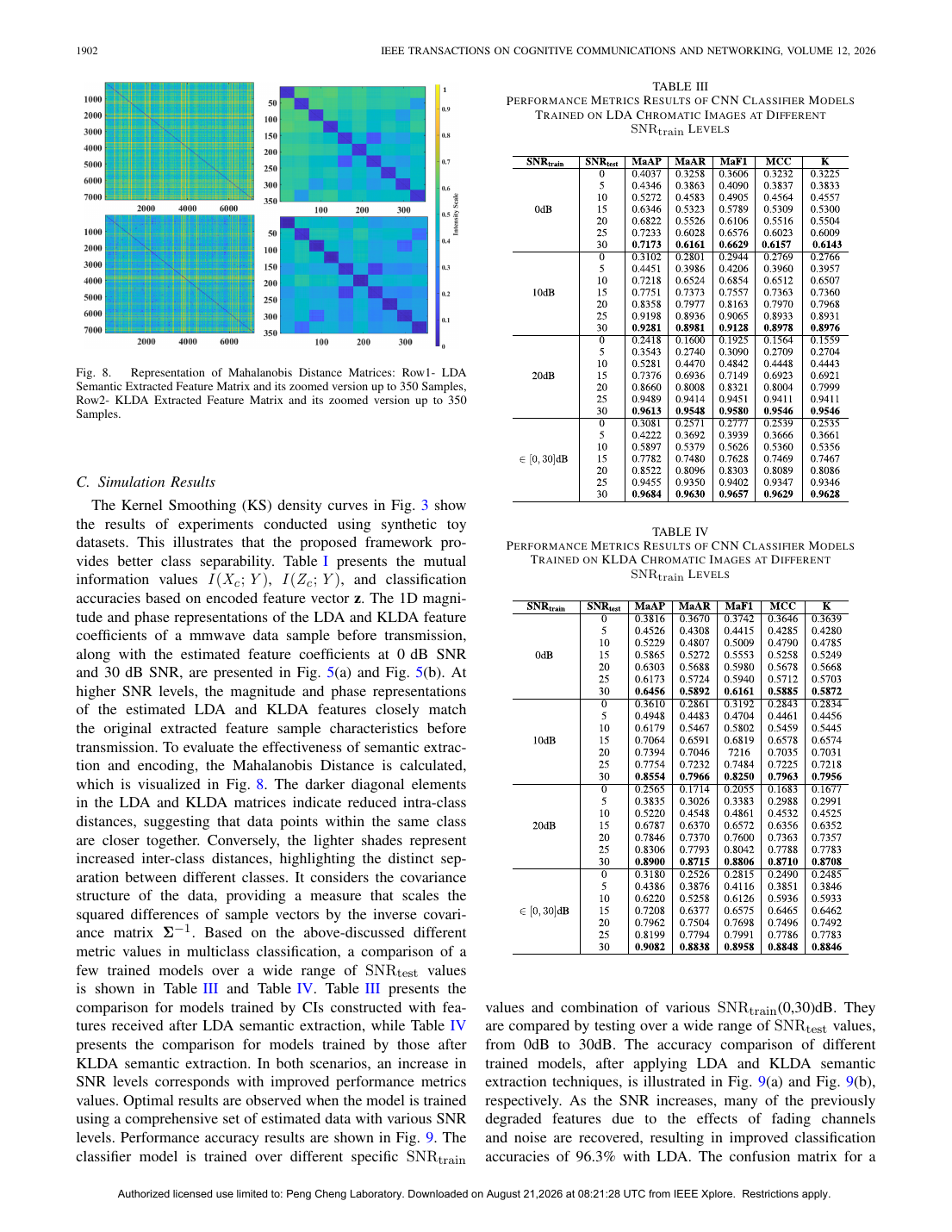
架构/方法图|来源:《Complex Valued Linear Discriminant Analysis on mmWave Radar Face Signatures for Task-Oriented Semantic Communication》,原 PDF p.4,Fig. 2 (a) Proposed methodology on LDA/KLDA based semantic communication (b) Extension to Multi-task based semantic communication using the proposed technique (c) Extension to Multi-source based semantic communication using the proposed technique。 核对论文关键实验结果图/表|来源:《Complex Valued Linear Discriminant Analysis on mmWave Radar Face Signatures for Task-Oriented Semantic Communication》,原 PDF p.11,Fig. 3 show the results of experiments conducted using synthetic toy 核对论文
核心纳入2026视频传输、生成或控制
Conquering High Packet-Loss Erasure: MoE Swin Transformer-Based Video Semantic Communication
信道与工作点packet loss、erasure、SNR of 26.169 dB、CBR of 0.0078
数据集为UVG、HEVC;实验小节中明确出现的比较对象包括DeepJSCC、VVC、HEVC、H.264、H.265、LDPC、Swin Transformer、SwinJSCC、JSCC、ETC;指标包括PSNR、SSIM、MS-SSIM、FPS、throughput、SER、PER;信道/链路条件包括packet loss、erasure;正文可定位的代表性工作点有SNR of 26.169 dB、CBR of 0.0078。 PDF p.11
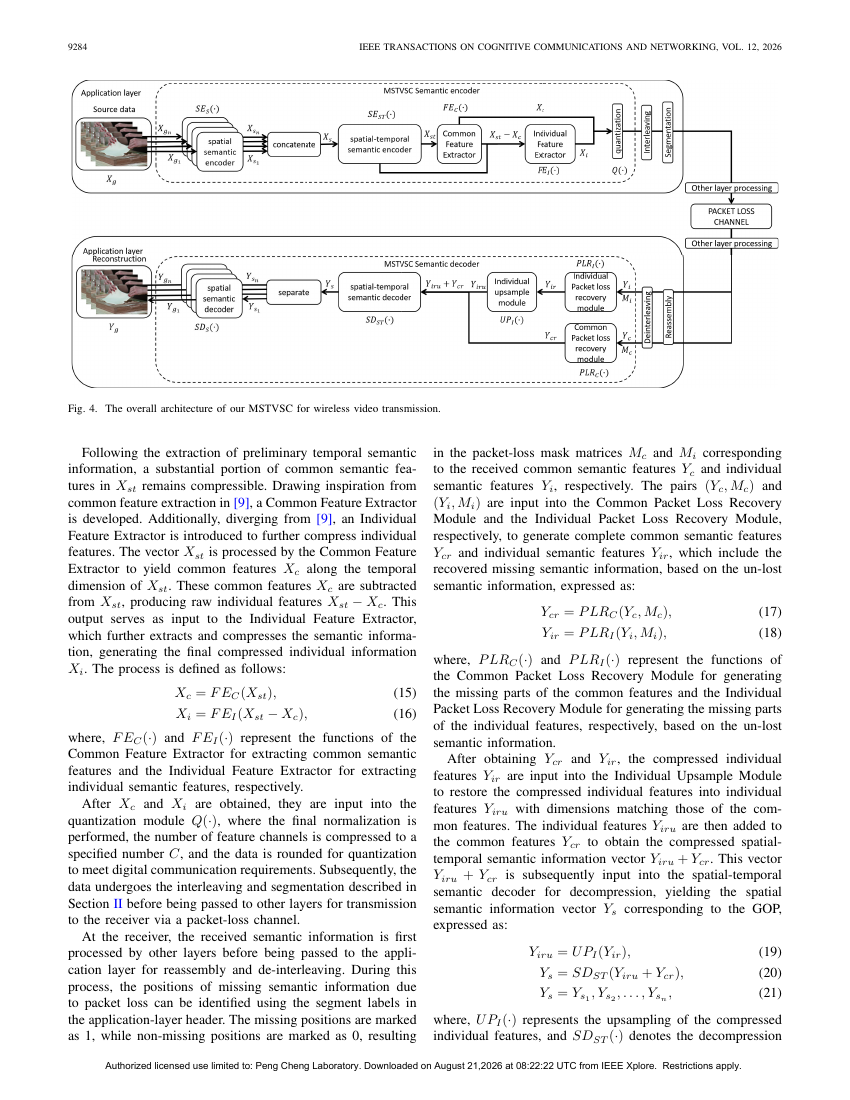
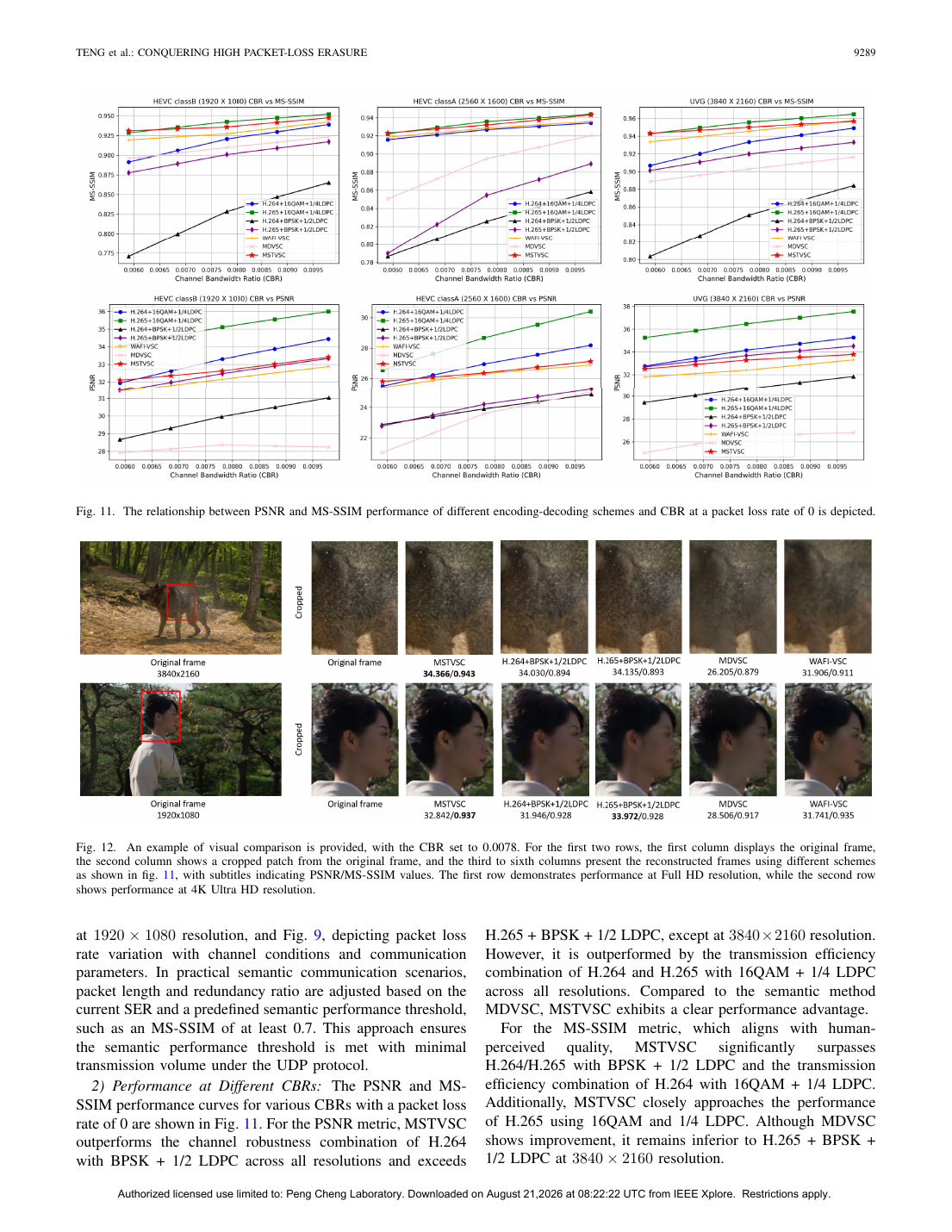
架构/方法图|来源:《Conquering High Packet-Loss Erasure: MoE Swin Transformer-Based Video Semantic Communication》,原 PDF p.6,Fig. 4 The overall architecture of our MSTVSC for wireless video transmission。 核对论文关键实验结果图/表|来源:《Conquering High Packet-Loss Erasure: MoE Swin Transformer-Based Video Semantic Communication》,原 PDF p.11,Fig. 11 The relationship between PSNR and MS-SSIM performance of different encoding-decoding schemes and CBR at a packet loss rate of 0 is depicted。 核对论文
核心纳入2026任务导向推理
Content-Aware Scheduling Policy for Goal-Oriented Status Updating With Multiple Sources
局限:没有完整离散接口,无法直接回答 bit/index/token 跳变问题。 未显式注入离散误码/丢包,鲁棒性结论不应外推到真实数字链路。 未报告统一可复核的 payload bit 数/CBR,跨论文带宽比较受限。
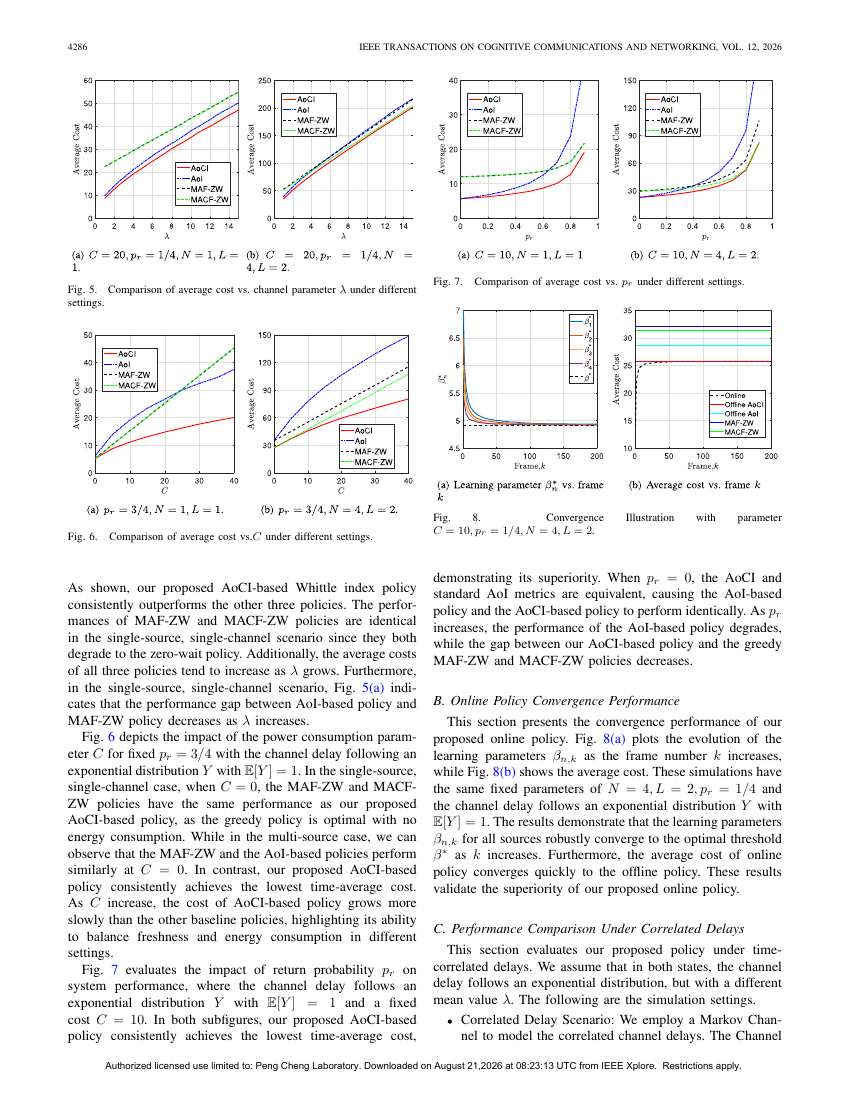
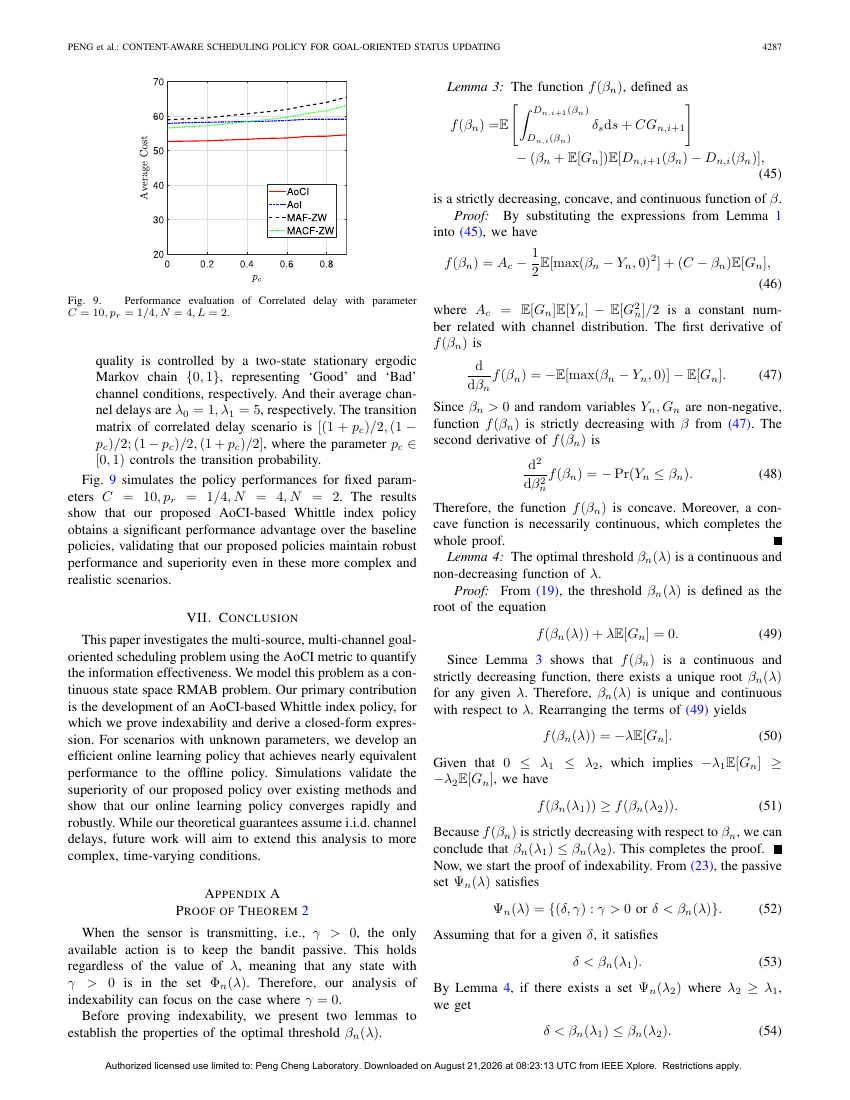
架构/方法图|来源:《Content-Aware Scheduling Policy for Goal-Oriented Status Updating With Multiple Sources》,原 PDF p.10,Fig. 7 Comparison of average cost vs. pr under different settings。 核对论文关键实验结果图/表|来源:《Content-Aware Scheduling Policy for Goal-Oriented Status Updating With Multiple Sources》,原 PDF p.11,该页包含论文的关键实验结果图或表。 核对论文
核心纳入2026图像传输、压缩或生成
Convolutional Autoencoder-Enhanced Semantic Communication in Optical Fiber Systems
现有进展:随着数据流量的指数增长,光纤通信系统需要先进的方法来优化传输效率,同时保持信号完整性。 PDF p.1
仍然存在的问题:本文提出了一种新的基于卷积自动编码器(CAE)的光纤网络语义通信框架,具有可调的压缩率,平衡带宽效率和传输质量。 PDF p.1
为什么已有方法解决不了:为固定 SNR 或带宽训练的模型具有固定瓶颈和保护方式;条件变化时重复运行同一网络,不能把码率或冗余重新分给变得脆弱的信息。 PDF p.1
为什么这个问题重要:有限信道使用迫使系统决定哪些视觉内容值得保护;低 SNR 或高压缩率下,任务/感知关键结构往往比平均像素误差更重要。 PDF p.1
本文提出什么:本文提出了一种新的基于卷积自动编码器(CAE)的光纤网络语义通信框架,具有可调的压缩率,平衡带宽效率和传输质量。 PDF p.1
方案为何可能有效:总的来说,所提出的基于CAE的光学语义通信框架通过在物理上真实的EGN模型下联合解决语义压缩和信道感知去噪来区分自己,提供可扩展的压缩控制,更高的重建保真度,以及比无线和光学领域中现有的基于深度学习的通信系统更低的计算成本。 PDF p.2
作者希望证明什么:新的数据集只需要很少的训练时间就可以达到接近甚至稍微超过MNIST结果的性能。 PDF p.1
方法与端到端信息流
本文提出了一种基于卷积自动编码器(CAE)的光纤语义通信框架,该框架具有可调的压缩率,平衡了带宽效率和传输质量。总体而言,所提出的基于CAE的光语义通信框架通过在物理上真实的EGN模型下联合解决语义压缩和信道感知去噪,提供可扩展的压缩控制,与无线和光领域现有的基于深度学习的通信系统相比,具有更高的重建保真度和更低的计算成本。 PDF p.1PDF p.2
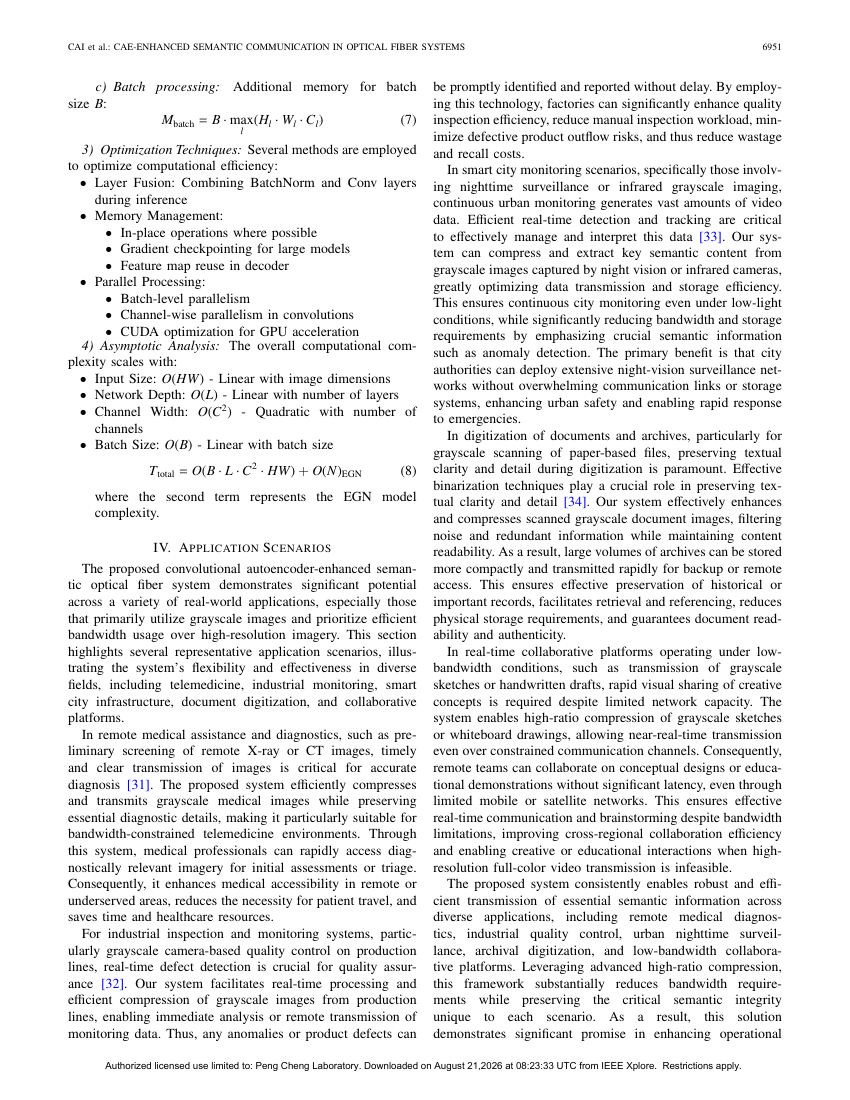
数据集为MNIST;实验小节中明确出现的比较对象包括QAM、FEC、Reed-Solomon;指标包括PSNR、SSIM、MSE、accuracy、recall、precision、latency;信道/链路条件包括AWGN、NOMA;正文可定位的代表性工作点有SNR of 5 dB、SNR of 15 dB。 PDF p.8
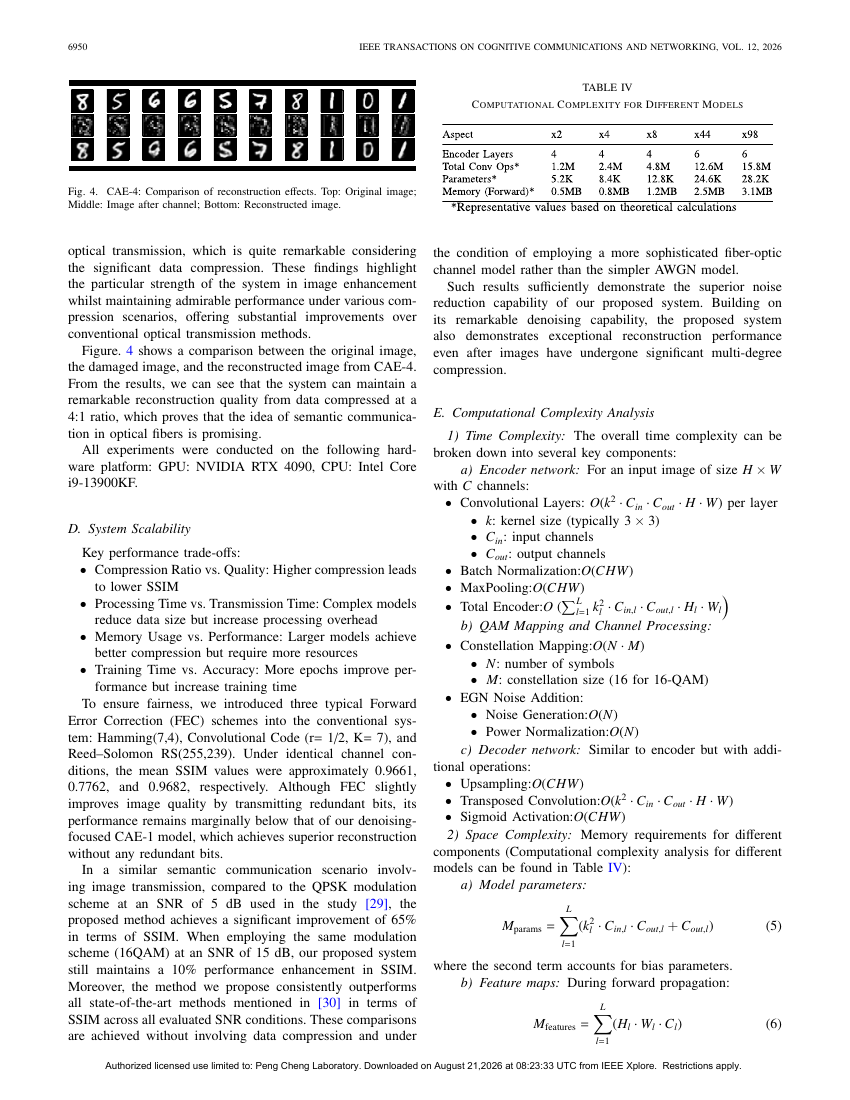
架构/方法图|来源:《Convolutional Autoencoder-Enhanced Semantic Communication in Optical Fiber Systems》,原 PDF p.9,Fig. 4 CAE-4: Comparison of reconstruction effects. Top: Original image; Middle: Image after channel; Bottom: Reconstructed image。 核对论文关键实验结果图/表|来源:《Convolutional Autoencoder-Enhanced Semantic Communication in Optical Fiber Systems》,原 PDF p.10,该页包含论文的关键实验结果图或表。 核对论文
核心纳入2026图像传输、压缩或生成
Cross-Domain Semantic Image Communication Empowered by LEO Embodied Intelligence
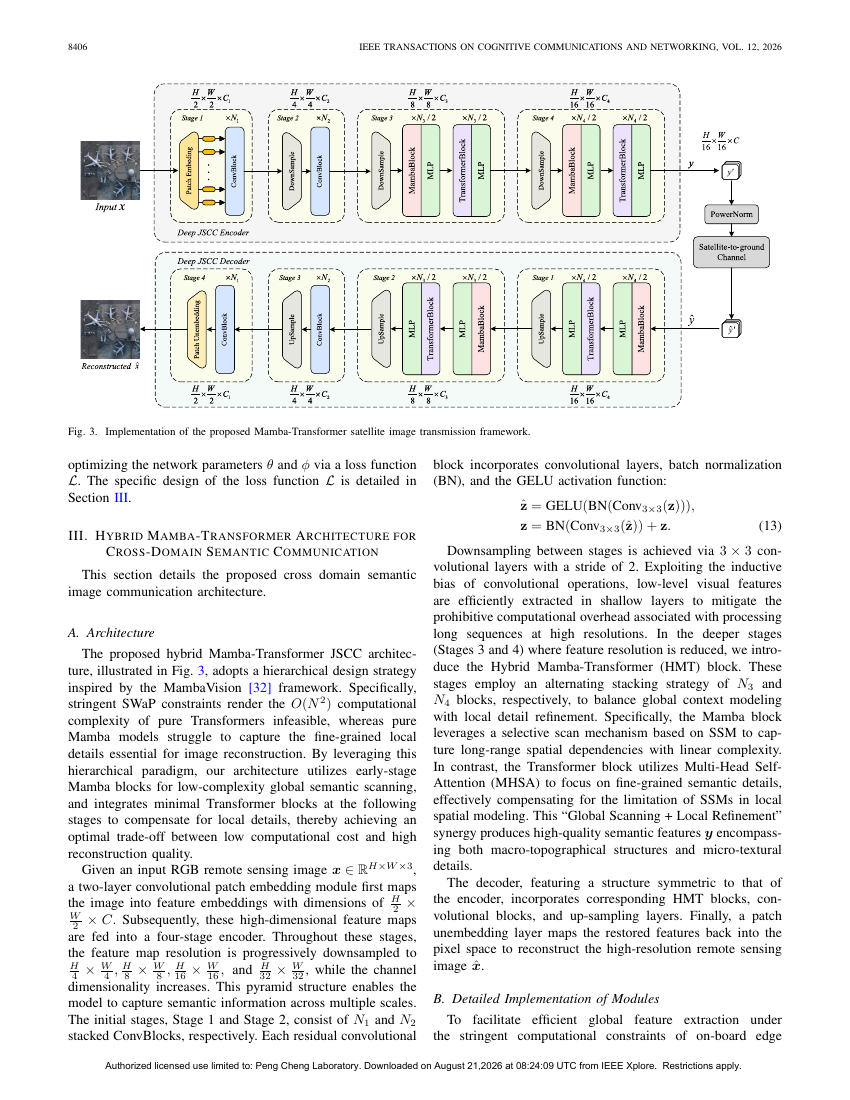
现有进展:为了提高基于空间的嵌入式边缘代理在恶劣信道环境中的感知连续性以及在严格的SWaP(大小、重量和功耗)约束下高级生成AI(GenAI)架构的计算能量平衡,提出了一种基于混合Mamba-Transformer架构的语义通信框架。 PDF p.1
仍然存在的问题:然而,尽管数据生成的爆炸性增长,卫星代理面临严格的体现在“感知-传输-决策”循环的限制。 PDF p.1
为什么已有方法解决不了:把生成模型放在接收端并不等于通信开销自然降低;仍需明确发送什么条件、条件占多少资源,以及信道破坏条件时怎样约束幻觉和时延。 PDF p.1
为什么这个问题重要:有限信道使用迫使系统决定哪些视觉内容值得保护;低 SNR 或高压缩率下,任务/感知关键结构往往比平均像素误差更重要。 PDF p.1
本文提出什么:为了提高基于空间的嵌入式边缘代理在恶劣信道环境中的感知连续性以及在严格的SWaP(大小、重量和功耗)约束下高级生成AI(GenAI)架构的计算能量平衡,提出了一种基于混合Mamba-Transformer架构的语义通信框架。 PDF p.1
方案为何可能有效:值得注意的是,制定的模型表现出上级跨域泛化,使关键的拓扑语义的精确重建。 PDF p.1
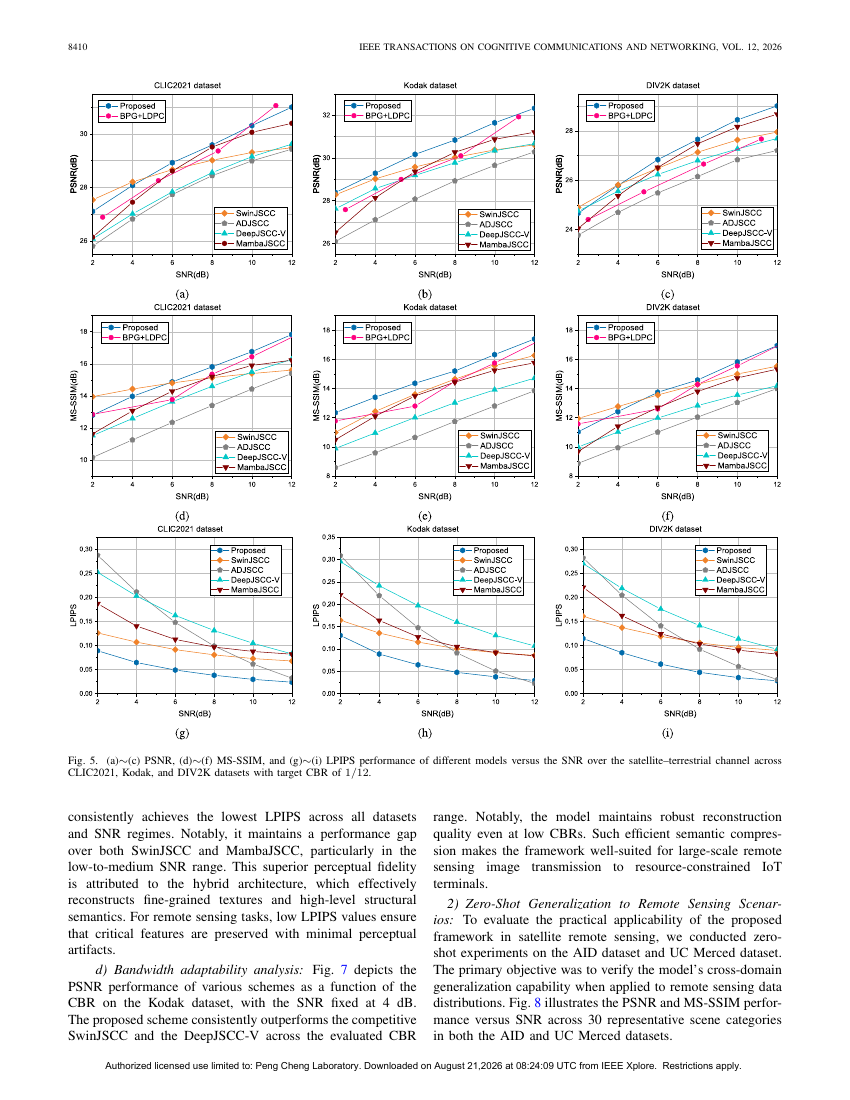
作者希望证明什么:在不同数据集上的仿真结果表明,该方案在PSNR,MS-SSIM和LPIPS指标方面明显优于传统的BPG+LDPC方案和最先进的深度学习方法。 PDF p.1
方法与端到端信息流
增强恶劣信道环境中基于空间的嵌入式边缘代理的感知连续性,以及严格SWaP下高级生成AI(GenAI)架构的计算能量平衡(Size,Weight,and Power)约束,提出了一种基于混合Mamba-Transformer架构的语义通信框架,该模型具有上级跨领域泛化能力,使得能够精确地重建关键拓扑语义。 PDF p.1
信道与工作点SNR = 4 dB、SNR of 4 dB、CBR of 1/12、CBR = 1/12
数据集为Kodak、DIV2K;实验小节中明确出现的比较对象包括DeepJSCC、BPG、LDPC、SwinJSCC、ADJSCC、JSCC、CLIP;指标包括PSNR、SSIM、MS-SSIM、LPIPS、MSE、accuracy、latency、FLOPs、semantic similarity、PER;正文可定位的代表性工作点有SNR = 4 dB、SNR of 4 dB、CBR of 1/12、CBR = 1/12。 PDF p.8
在不同数据集上的仿真结果表明,该方案在PSNR,MS-SSIM和LPIPS指标方面明显优于传统的BPG+LDPC方案和最先进的深度学习方法。 PDF p.1
架构/方法图|来源:《Cross-Domain Semantic Image Communication Empowered by LEO Embodied Intelligence》,原 PDF p.5,Fig. 3 Implementation of the proposed Mamba-Transformer satellite image transmission framework。 核对论文关键实验结果图/表|来源:《Cross-Domain Semantic Image Communication Empowered by LEO Embodied Intelligence》,原 PDF p.9,Fig. 5 (a)∼(c) PSNR, (d)∼(f) MS-SSIM, and (g)∼(i) LPIPS performance of different models versus the SNR over the satellite-terrestrial channel across CLIC2021, Kodak, and DIV2K datasets with target CBR of 1/12。 核对论文
核心纳入2026图像传输、压缩或生成
D-SIC: Energy-Efficient Digital Semantic Image Communication via Large Generative Models
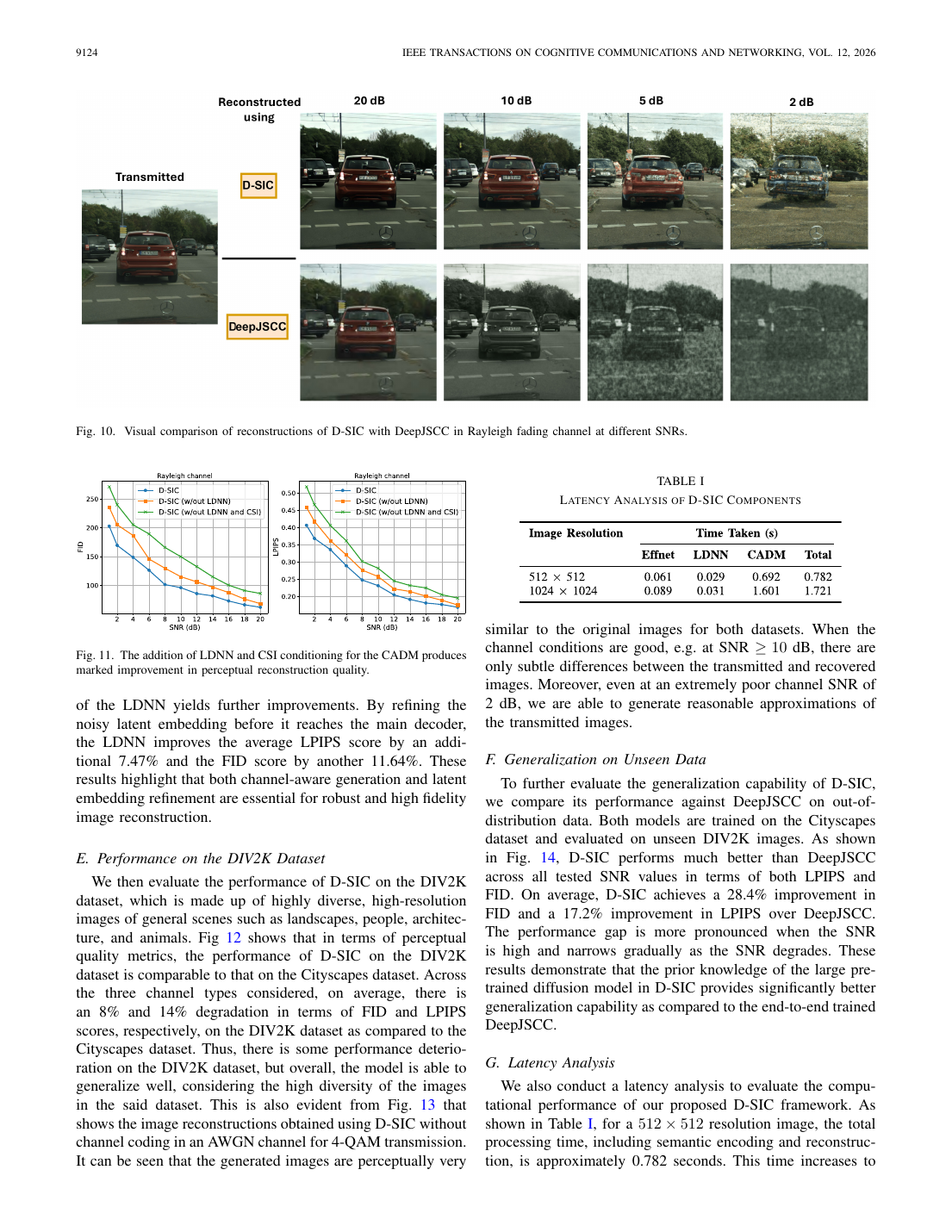
信道与工作点AWGN、Rayleigh、Rician、fading channel、SNR of 1 dB、SNR of 2 dB
数据集为DIV2K、Cityscapes;实验小节中明确出现的比较对象包括DeepJSCC、JPEG、JPEG2000、BPG、LDPC、QAM、JSCC;指标包括PSNR、SSIM、LPIPS、FID、latency、energy efficiency、BER、PER;信道/链路条件包括AWGN、Rayleigh、Rician、fading channel;正文可定位的代表性工作点有SNR of 1 dB、SNR of 2 dB。 PDF p.10
我们表明,D-SIC优于传统的数字图像压缩编解码器,JPEG 2000和更好的便携式图形(BPG),低密度奇偶校验(LDPC)编码的感知质量指标和能源效率。 PDF p.1
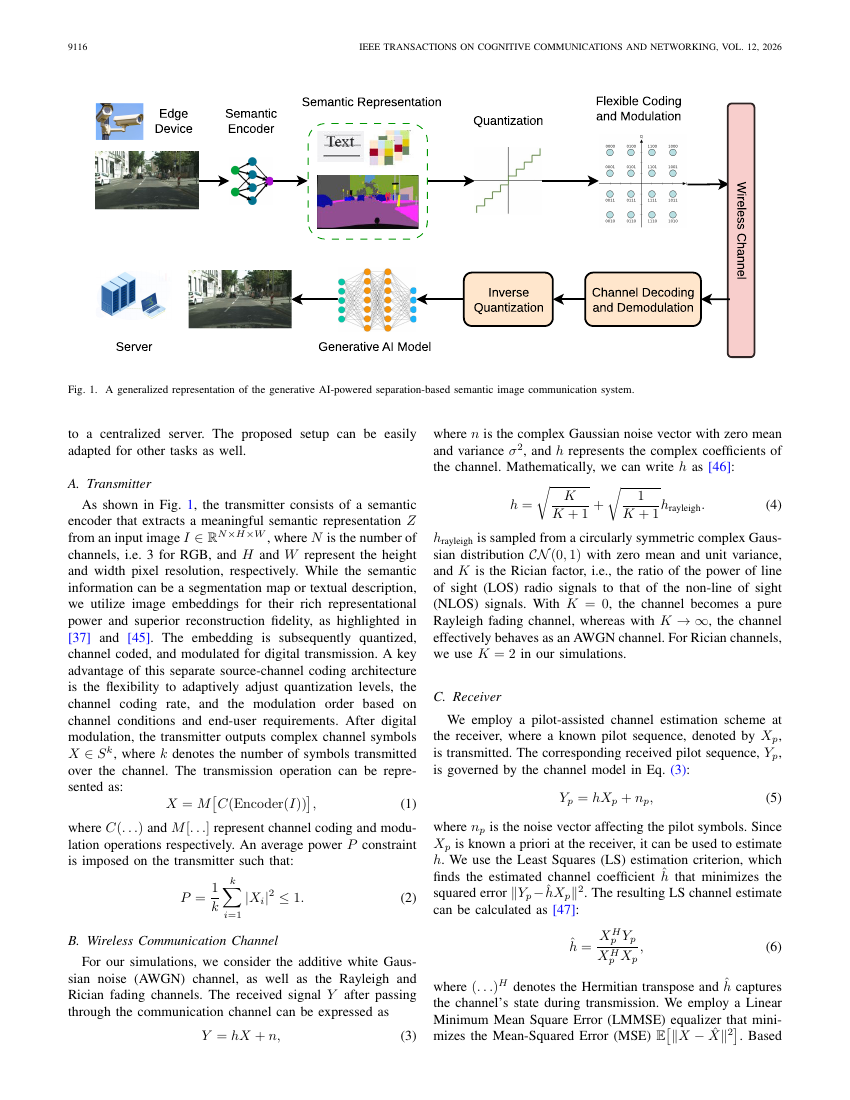
架构/方法图|来源:《D-SIC: Energy-Efficient Digital Semantic Image Communication via Large Generative Models》,原 PDF p.3,Fig. 1 A generalized representation of the generative AI-powered separation-based semantic image communication system。 核对论文关键实验结果图/表|来源:《D-SIC: Energy-Efficient Digital Semantic Image Communication via Large Generative Models》,原 PDF p.11,Fig. 10 Visual comparison of reconstructions of D-SIC with DeepJSCC in Rayleigh fading channel at different SNRs。 核对论文
核心纳入2026图像传输、压缩或生成
DiT-JSCC: Rethinking Deep JSCC With Diffusion Transformers and Semantic Representations
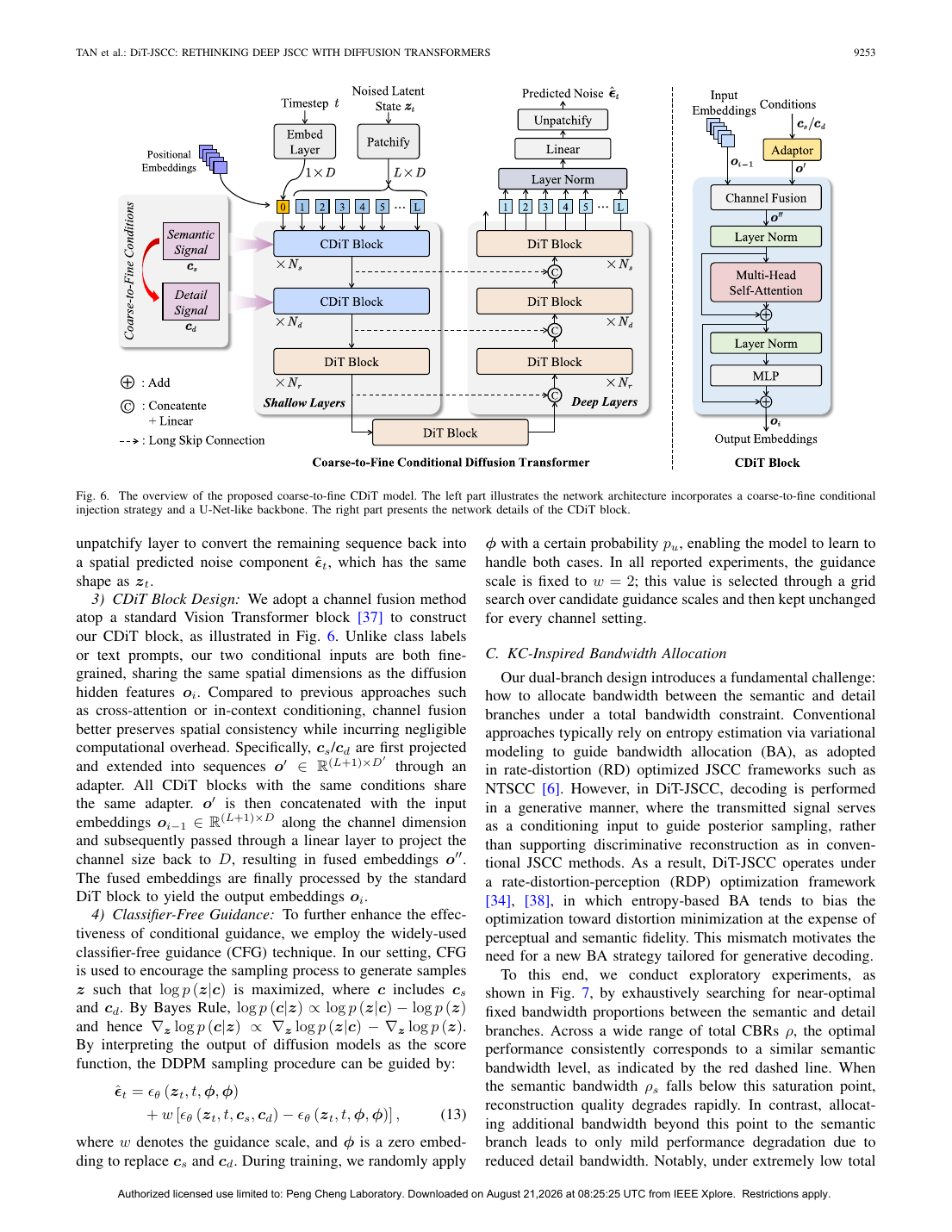
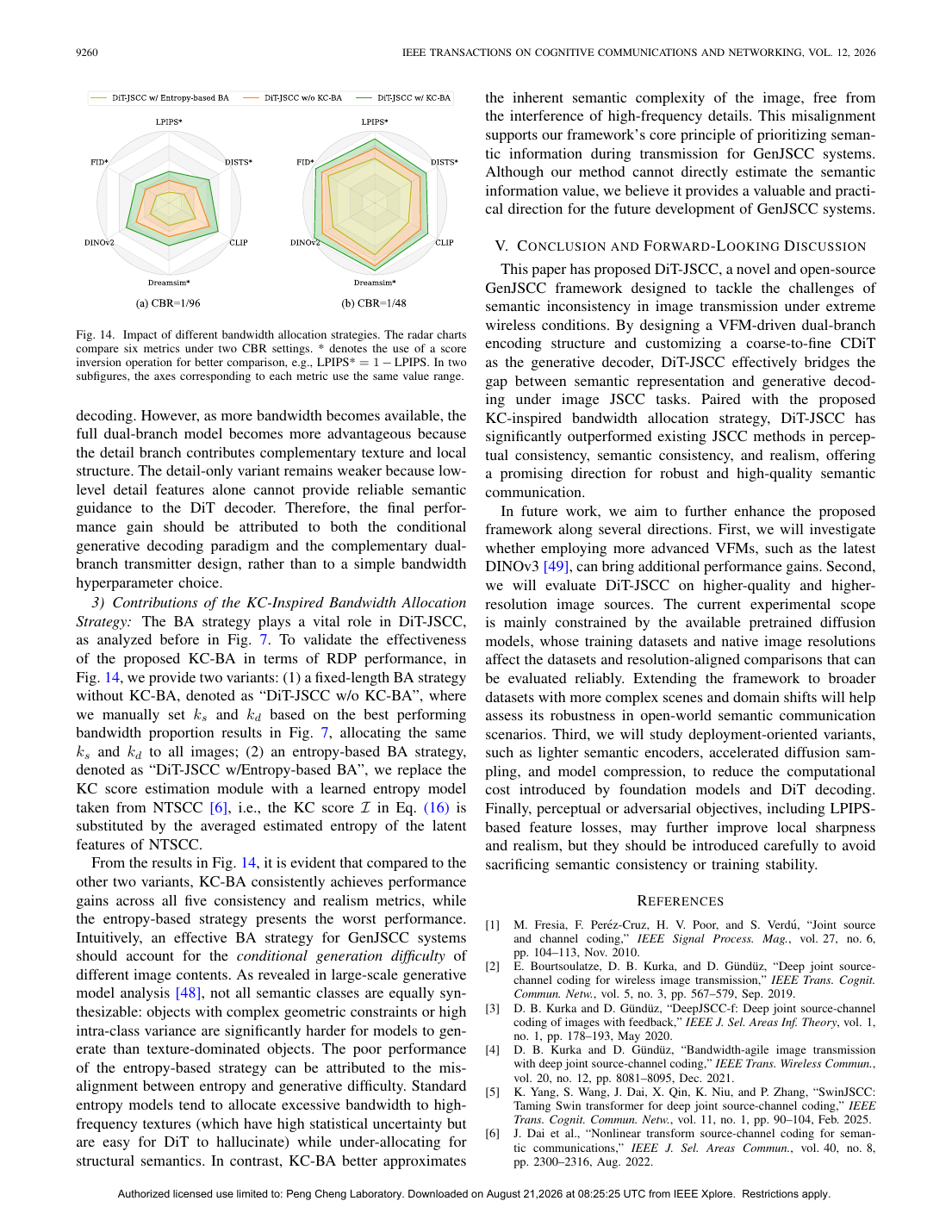
架构/方法图|来源:《DiT-JSCC: Rethinking Deep JSCC With Diffusion Transformers and Semantic Representations》,原 PDF p.7,Fig. 6 The overview of the proposed coarse-to-fine CDiT model. The left part illustrates the network architecture incorporates a coarse-to-fine conditional injection strategy and a U-Net-like backbone. The right part presents the network details of the CDiT block。 核对论文关键实验结果图/表|来源:《DiT-JSCC: Rethinking Deep JSCC With Diffusion Transformers and Semantic Representations》,原 PDF p.14,Fig. 7 To validate the effectiveness models, whose training datasets and native image resolutions of the proposed KC-BA in terms of RDP performance, in affect the datasets and resolution-aligned comparisons that can 核对论文
核心纳入2026图像传输、压缩或生成
Frame-Based Zero-Shot Semantic Channel Equalization for AI-Native Communications
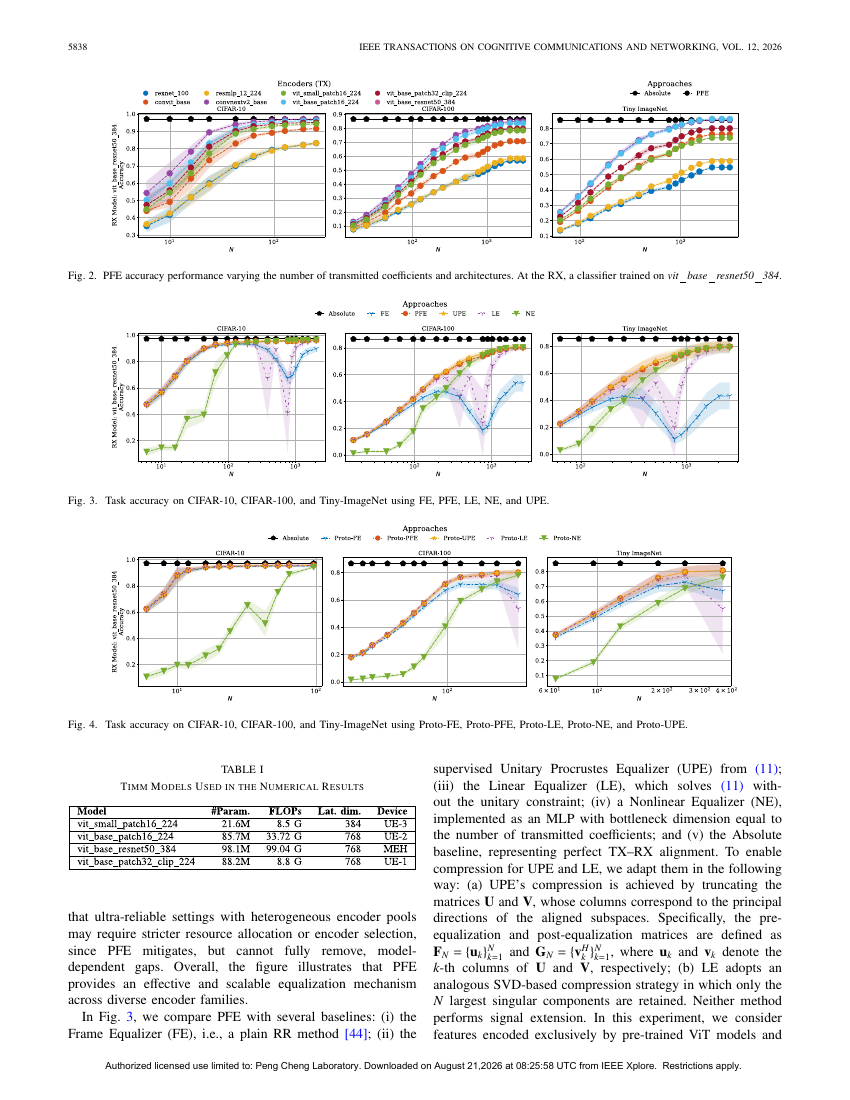
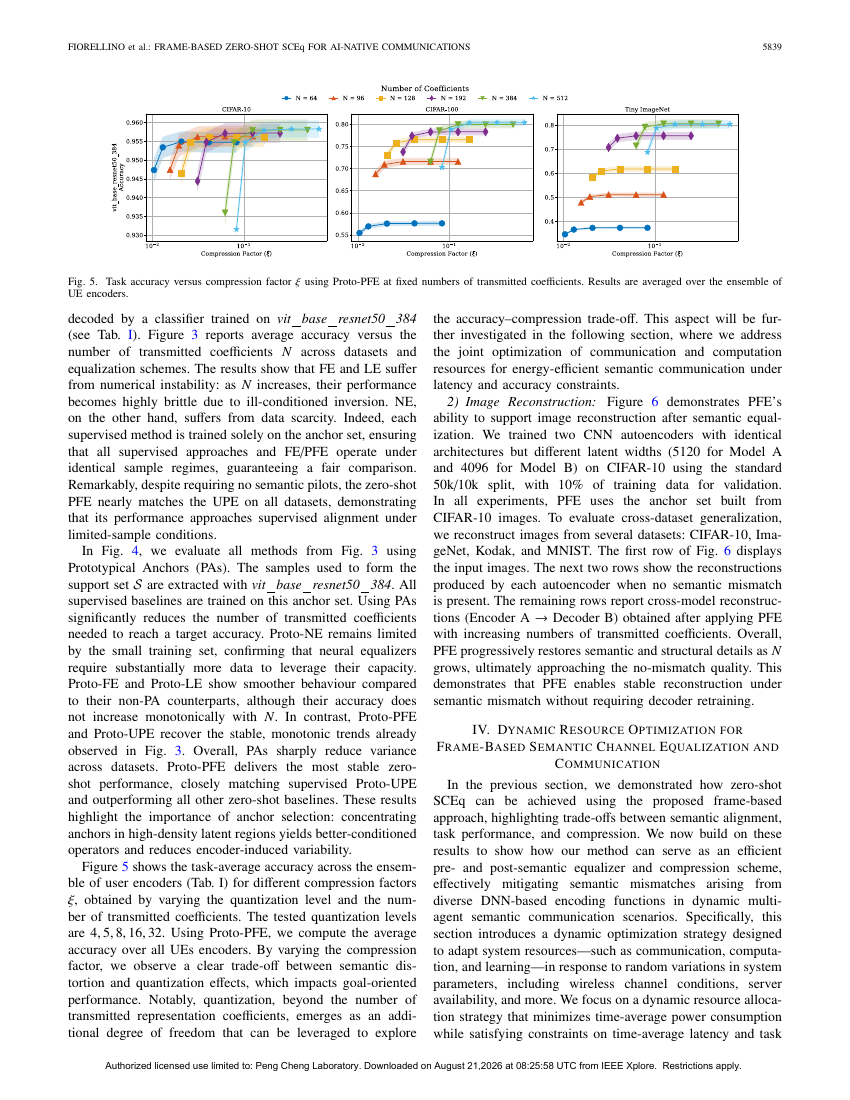
架构/方法图|来源:《Frame-Based Zero-Shot Semantic Channel Equalization for AI-Native Communications》,原 PDF p.7,Fig. 2 PFE accuracy performance varying the number of transmitted coefficients and architectures. At the RX, a classifier trained on vit base resnet50 384。 核对论文关键实验结果图/表|来源:《Frame-Based Zero-Shot Semantic Channel Equalization for AI-Native Communications》,原 PDF p.8,Fig. 5 Task accuracy versus compression factor ξ using Proto-PFE at fixed numbers of transmitted coefficients. Results are averaged over the ensemble of UE encoders。 核对论文
核心纳入2026点云/三维场景传输
From Local to Global: Semantic Communication-Driven Remote 3D Scene Reconstruction Using Low-Altitude Platforms
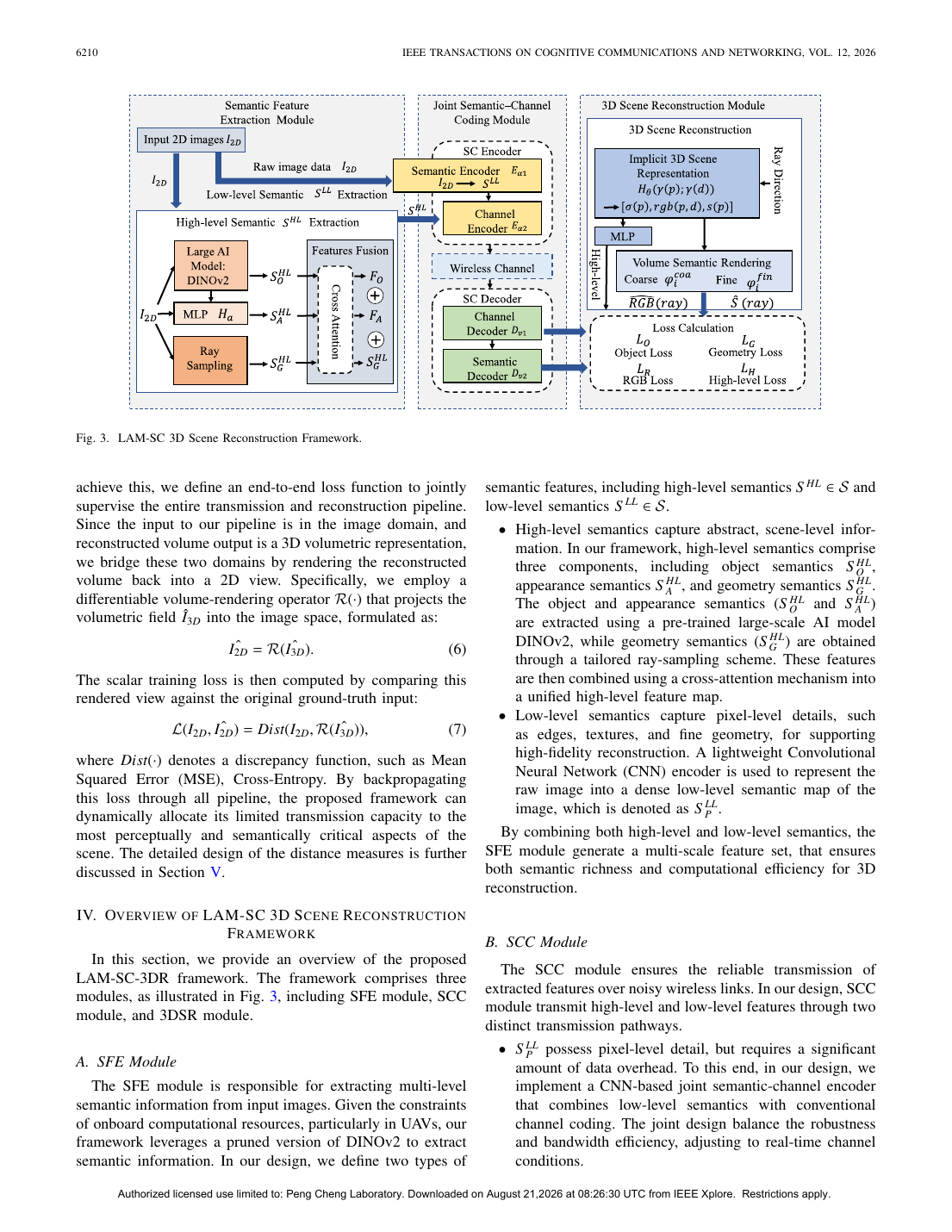
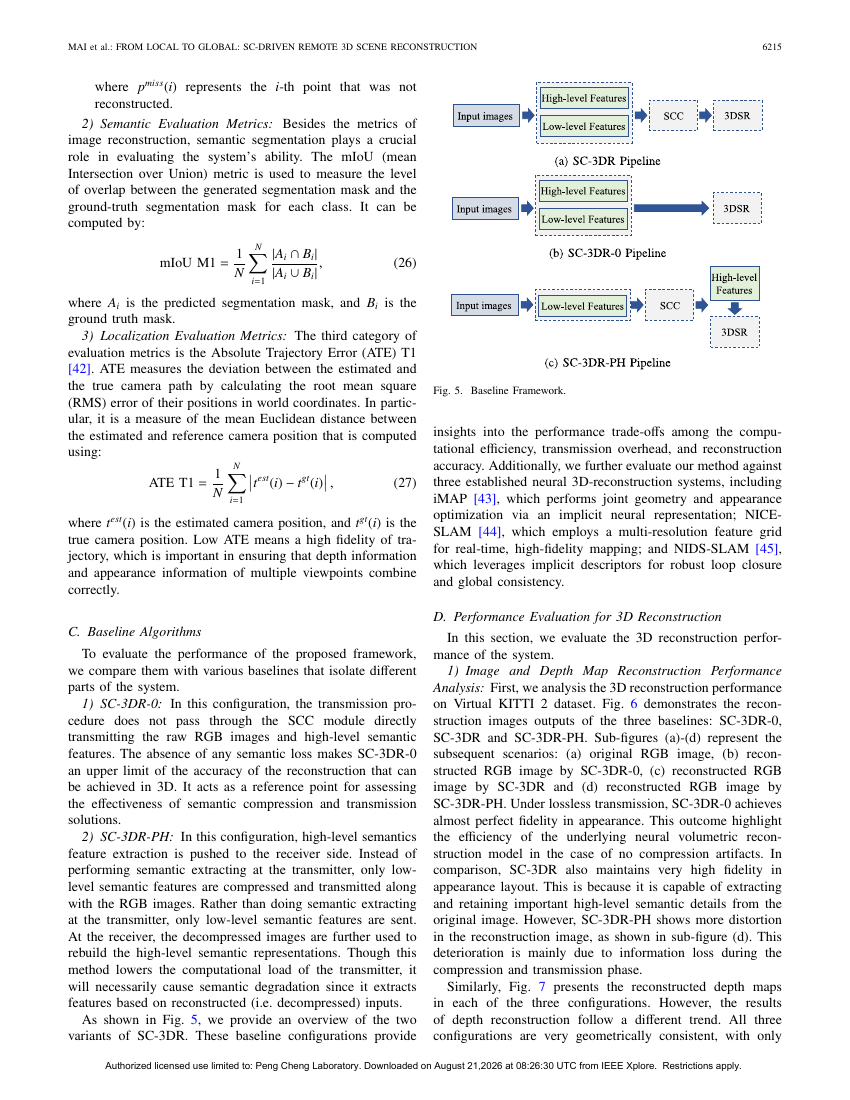
架构/方法图|来源:《From Local to Global: Semantic Communication-Driven Remote 3D Scene Reconstruction Using Low-Altitude Platforms》,原 PDF p.4,Fig. 3 LAM-SC 3D Scene Reconstruction Framework。 核对论文关键实验结果图/表|来源:《From Local to Global: Semantic Communication-Driven Remote 3D Scene Reconstruction Using Low-Altitude Platforms》,原 PDF p.9,Fig. 7 presents the reconstructed depth maps features based on reconstructed (i.e. decompressed) inputs. in each of the three configurations. However, the results As shown in 核对论文
核心纳入2026任务导向推理
GDE: A Generative Diffusion Equalizer for ICSI-Free Semantic Communications in SAGINs
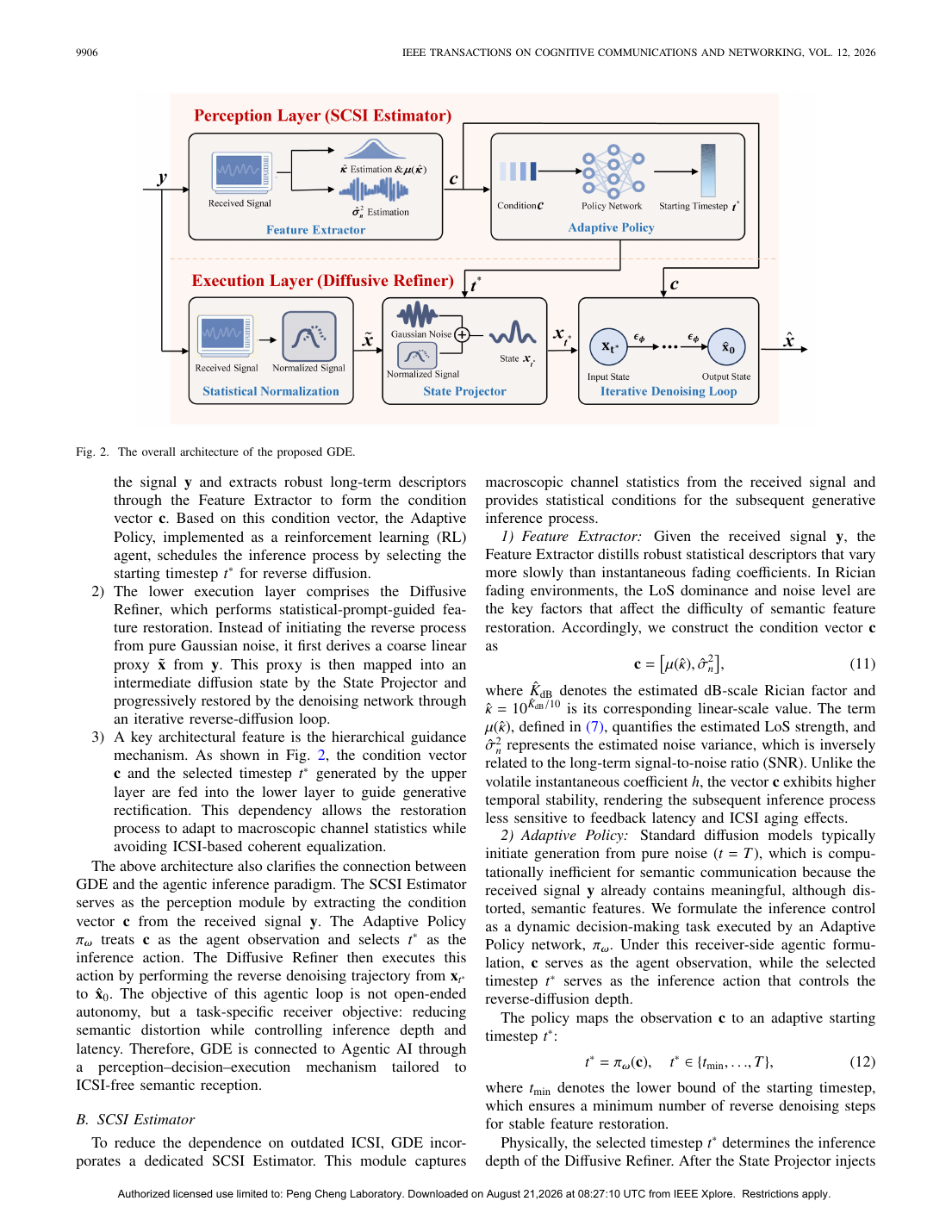
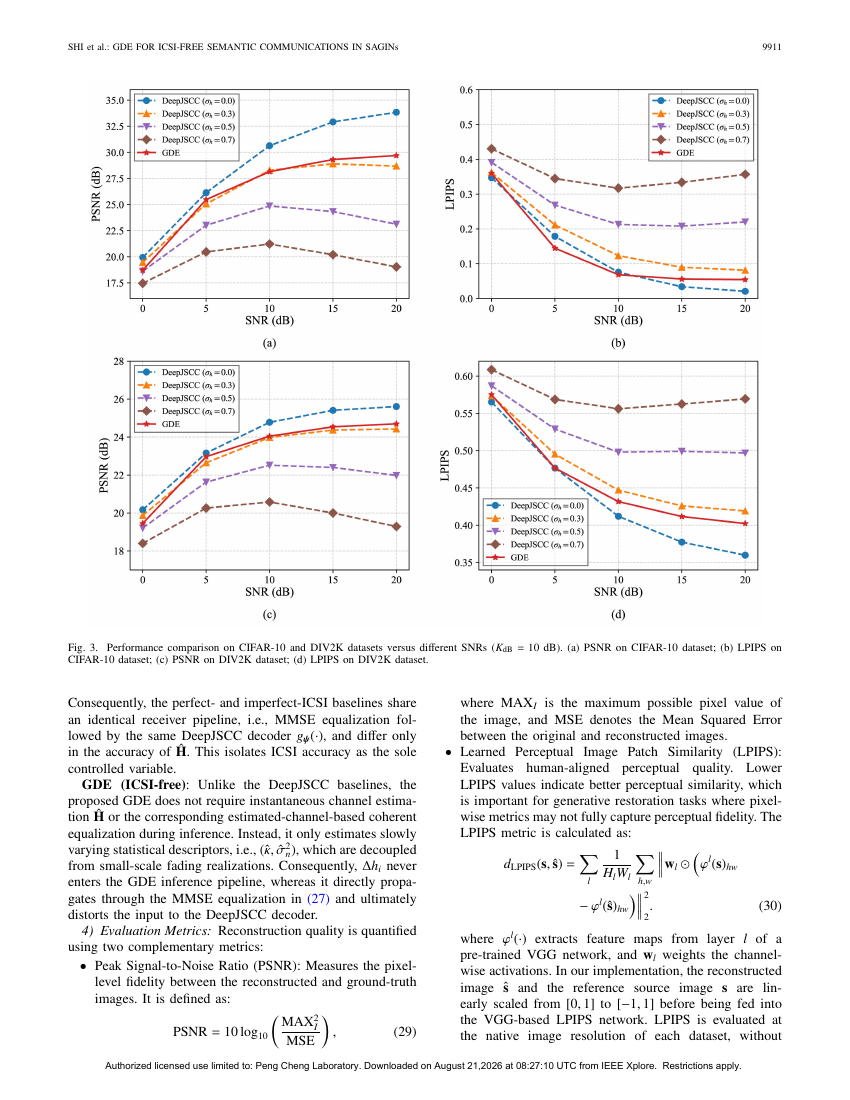
架构/方法图|来源:《GDE: A Generative Diffusion Equalizer for ICSI-Free Semantic Communications in SAGINs》,原 PDF p.5,Fig. 2 The overall architecture of the proposed GDE。 核对论文关键实验结果图/表|来源:《GDE: A Generative Diffusion Equalizer for ICSI-Free Semantic Communications in SAGINs》,原 PDF p.10,Fig. 3 Performance comparison on CIFAR-10 and DIV2K datasets versus different SNRs (KdB = 10 dB). (a) PSNR on CIFAR-10 dataset; (b) LPIPS on CIFAR-10 dataset; (c) PSNR on DIV2K dataset; (d) LPIPS on DIV2K dataset。 核对论文
核心纳入2026图像传输、压缩或生成
Generative Semantic Communication: Diffusion Models Beyond Bit Recovery
一句话主旨:Generative Semantic Communication 面向图像传输、压缩或生成,把问题放在“生成式语义信源编码”层处理;本调研把主接口判断为“语义 feature/latent;量化到 bitstream 的接口未完整报告”。
Motivation|Introduction 怎样导出本文方案
现有进展:语义通信被认为是下一代人工智能通信的核心之一。 PDF p.1
仍然存在的问题:然而,典型地,已经对干净数据研究了这种模型,并且还没有研究它们对通过压缩或通过噪声信道传播而改变的数据的扩展。 PDF p.1
为什么已有方法解决不了:把生成模型放在接收端并不等于通信开销自然降低;仍需明确发送什么条件、条件占多少资源,以及信道破坏条件时怎样约束幻觉和时延。 PDF p.1
为什么这个问题重要:有限信道使用迫使系统决定哪些视觉内容值得保护;低 SNR 或高压缩率下,任务/感知关键结构往往比平均像素误差更重要。 PDF p.1
本文提出什么:此外,我们还提出了一种训练策略,以使生成模型对由于通过通信信道传播而产生的加性噪声具有鲁棒性。 PDF p.1
方案为何可能有效:我们在不同的信道条件和数据集下测试我们的方法,我们展示了我们的方法如何生成与传输的语义信息一致的逼真图像,即使在接收到的布局极其损坏的情况下,以及在传输数据速率非常低的情况下。 PDF p.2
作者希望证明什么:更具体地说,我们的结果表明,即使在通信信道存在极高噪声的情况下,物体、位置和深度仍然是可识别的。 PDF p.1
方法与端到端信息流
此外,我们还提出了一种训练策略,以使生成模型对由于通过通信信道传播而引起的加性噪声具有鲁棒性。我们在不同的信道条件和数据集下测试了我们的方法,并且我们展示了我们的方法如何即使在接收到的布局严重损坏的情况下以及在传输数据速率非常低的情况下也能够生成与所传输的语义信息一致的真实感图像。 PDF p.1PDF p.2
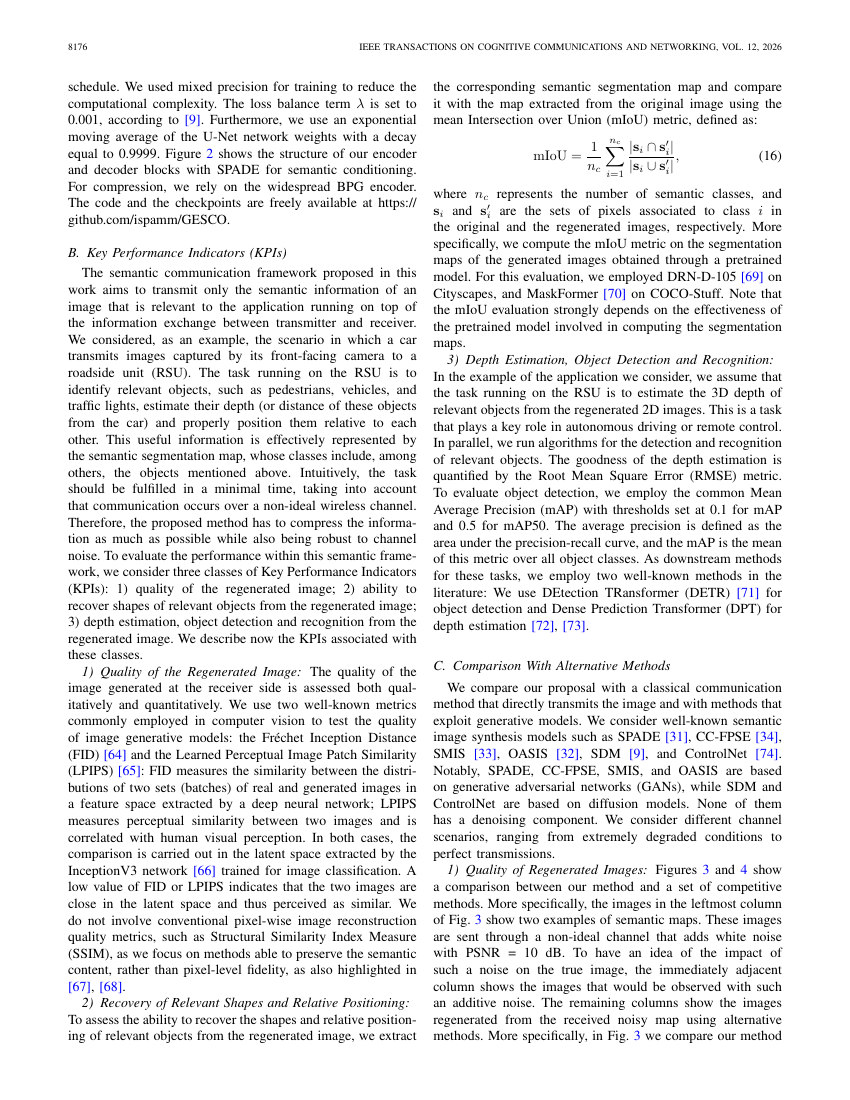
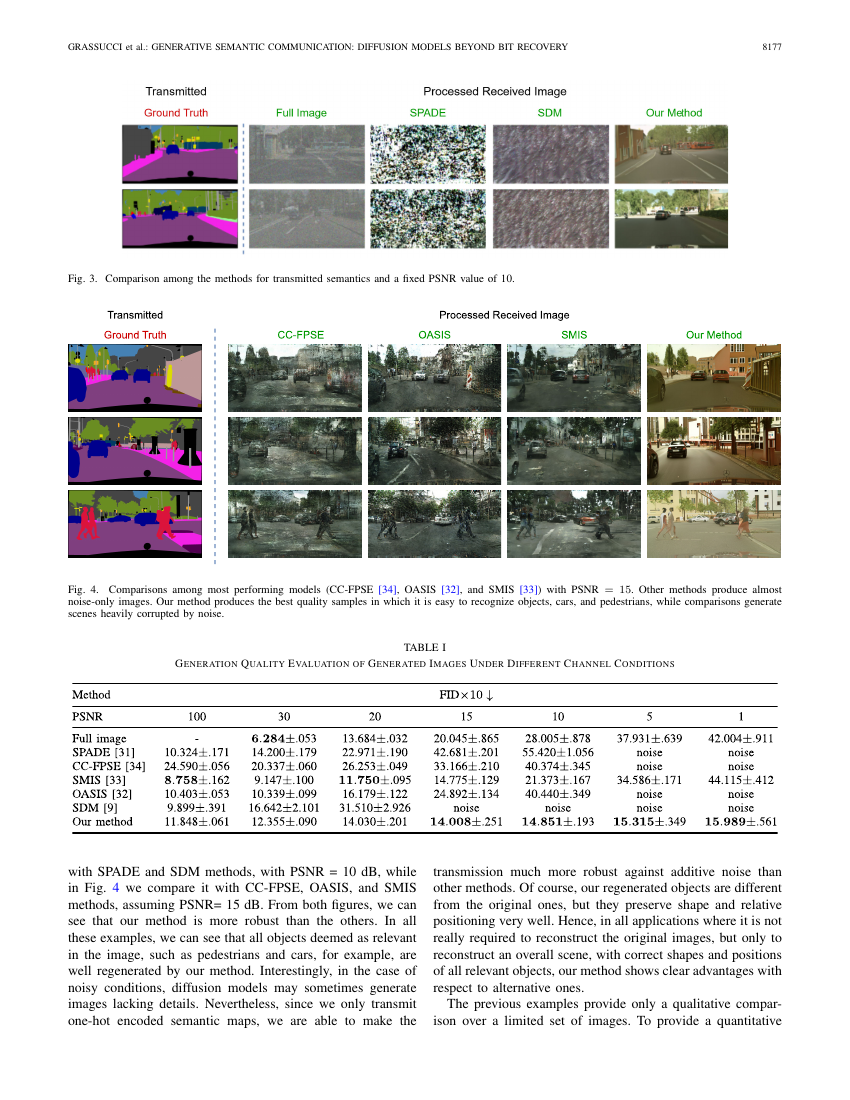
架构/方法图|来源:《Generative Semantic Communication: Diffusion Models Beyond Bit Recovery》,原 PDF p.6,Fig. 3 we compare our method 核对论文关键实验结果图/表|来源:《Generative Semantic Communication: Diffusion Models Beyond Bit Recovery》,原 PDF p.7,Fig. 3 Comparison among the methods for transmitted semantics and a fixed PSNR value of 10。 核对论文
核心纳入2026任务导向推理
Group-Level Feature-Aware Hybrid Coding for Adaptive Task-Oriented Tactile Communication
数据集为CIFAR-10;实验小节中明确出现的比较对象包括Polar、JSCC、VIB;指标包括accuracy、latency、throughput、classification accuracy、BER、PER;信道/链路条件包括AWGN、Rayleigh、fading channel;正文可定位的代表性工作点有ber of 128。 PDF p.9
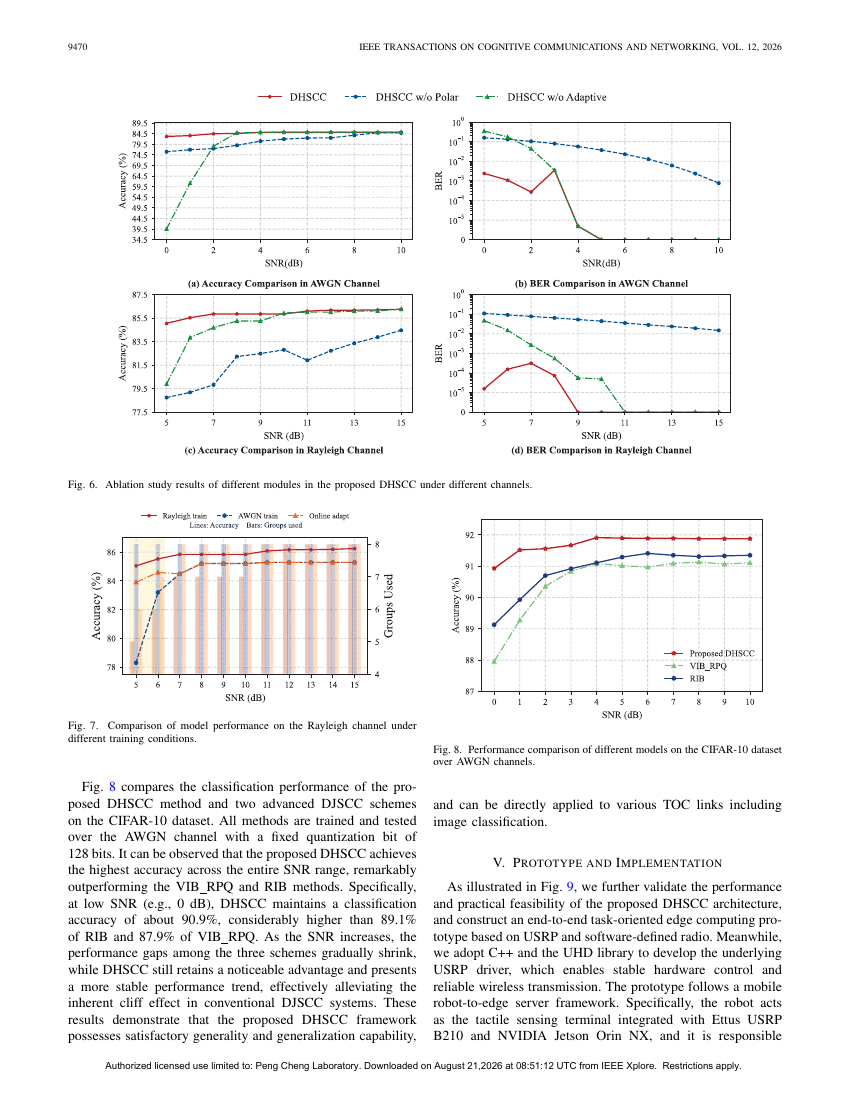
设计了一种基于胶囊网络的组级重要性估计模块,结合自适应特征组,实现了对关键触觉信息的不等错误保护(unequivalerrorprotection,UEP),缓解了时变信道下的“悬崖效应.” PDF p.1
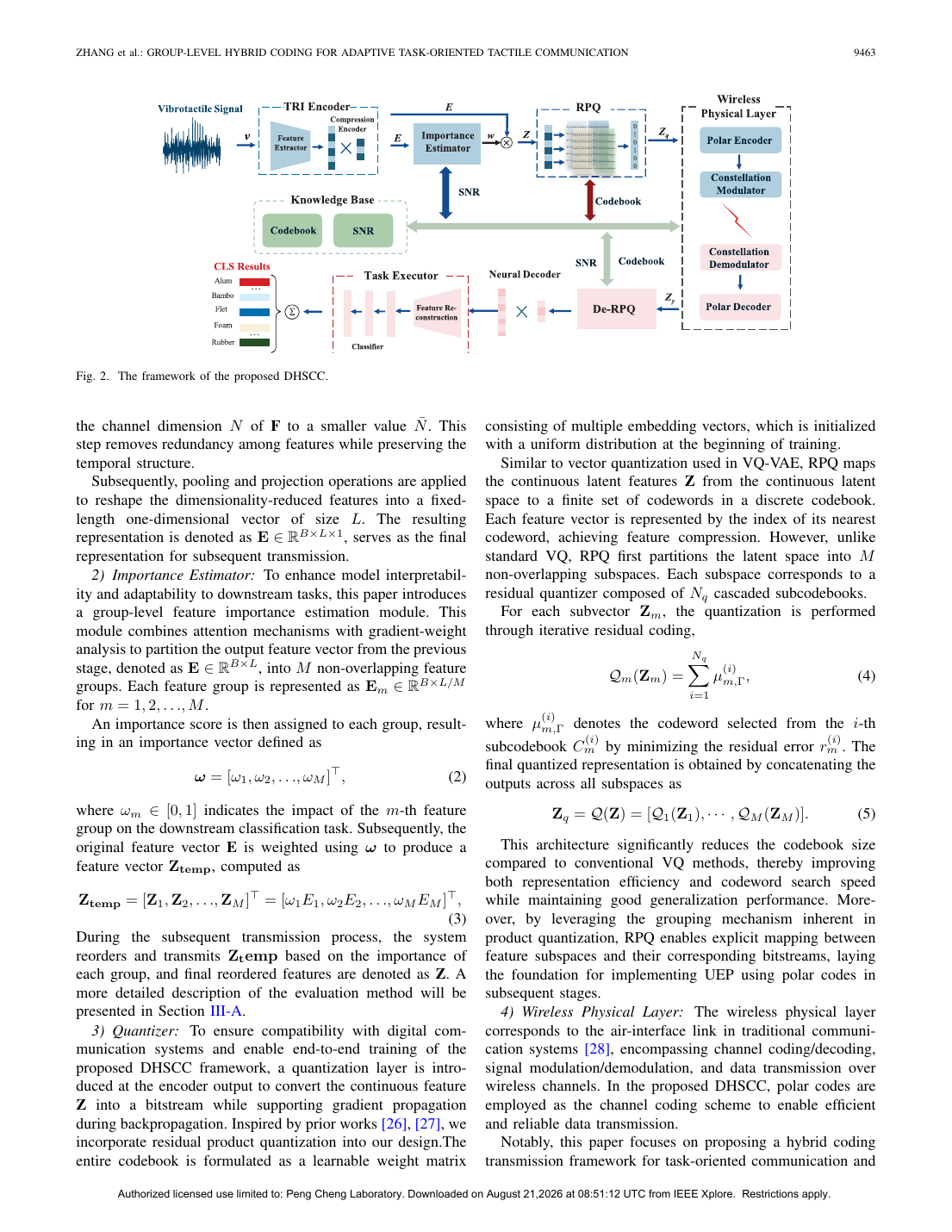
架构/方法图|来源:《Group-Level Feature-Aware Hybrid Coding for Adaptive Task-Oriented Tactile Communication》,原 PDF p.4,Fig. 2 The framework of the proposed DHSCC。 核对论文关键实验结果图/表|来源:《Group-Level Feature-Aware Hybrid Coding for Adaptive Task-Oriented Tactile Communication》,原 PDF p.11,Fig. 6 Ablation study results of different modules in the proposed DHSCC under different channels。 核对论文
核心纳入2026语音/音频传输或识别
High Quality and Secure Speech Transmission at Low Bitrate via Semantic-Acoustic Hybrid Coding for Low-Altitude Intelligent Systems
一句话主旨:High Quality and Secure Speech Transmission at Low Bitrate via Semantic-Acoustic Hybrid Coding for Low-Altitude Intelligent Systems 面向语音/音频传输或识别,把问题放在“通信安全与隐私”层处理;本调研把主接口判断为“语义 feature/latent;量化到 bitstream 的接口未完整报告”。
Motivation|Introduction 怎样导出本文方案
现有进展:最近基于神经网络的编解码器在将语音压缩成离散语义表示方面表现出显著的性能,同时降低了带宽消耗。 PDF p.1
仍然存在的问题:然而,这些方法仍然面临着保持感知质量,实现灵活的带宽利用率,并防止说话人身份泄漏的挑战。 PDF p.1
为什么已有方法解决不了:只优化合法接收端的重建或任务 loss,并不会自动消除 latent 泄露、窃听或操纵风险;缺少的是把攻击者与保护目标放进同一系统模型。 PDF p.1
为什么这个问题重要:语音的可懂度、识别正确率与波形误差并不总是同步,少量包丢失也可能破坏整段语言内容;有限码率下应优先保护语言与说话人语义。 PDF p.1
本文提出什么:为了解决这些局限性,本文提出了一种语义-声学混合编码框架,该框架在端到端编解码器架构中集成了预训练的语义建模和轻量级声学表示。 PDF p.1
方案为何可能有效:该框架还支持语义驱动的自适应比特率控制,通过训练期间的超参数调谐在语音质量和带宽之间提供灵活的折衷。 PDF p.1
作者希望证明什么:试验结果证明,本文方法能提供具有语义增强的高保真重建,MUSHRA评分达到88,优于传统的单信道低比特率编解码器,具有近感知无损的语音重建性能。 PDF p.1
方法与端到端信息流
为了解决这些问题,本文提出了一种语义-声学混合编码框架,该框架在端到端的编解码器架构中集成了预先训练的语义建模和轻量级声学表示,并进一步实现了语义驱动的自适应比特率控制,通过训练过程中的超参数调整,在语音质量和带宽之间实现灵活的权衡。 PDF p.1
输入输入是语音/音频传输或识别所需的语音波形、声学特征或说话人信息。
发送端发送端采用 High Quality and Secure Speech Transmission at Low Bitrate via Semantic-Acoustic Hybrid Coding for Low-Altitude Intelligent Systems:为了解决这些问题,本文提出了一种语义-声学混合编码框架,该框架在端到端的编解码器架构中集成了预先训练的语义建模和轻量级声学表示,并进一步实现了语义驱动的自适应比特率控制,通过训练过程中的超参数调整,在语音质量和带宽之间实现灵活的权衡。
实际发送实际发送对象是语义 feature 或未完整规定 bit 映射的 latent。
信道信道作用方式按“类别 0:信道作用点不足,或由外部传统链路抽象承担”解释。
接收端接收端从论文假设已经恢复的语义特征开始,再执行语义解码、任务推理或生成。
输出最终输出为重建语音、识别文本或说话人任务结果。
它在通信系统中的位置:把窃听、攻击或隐私泄露纳入语义链路,同时考察合法端质量与攻击端获得的信息。
数字化方案与真实传输开销
是否属于严格数字语义通信:否/不适用:主接口为连续 JSCC 或上层模型
表示判断:语义 feature/latent;量化到 bitstream 的接口未完整报告
全文没有给出可复核的 VQ/codebook/index-to-bit 接口。根据系统模型,本调研将传输表示判断为“语义 feature/latent;量化到 bitstream 的接口未完整报告”;不能把网络 latent 的每个浮点维度直接当成固定 bit。 独立判断:High Quality and Secure Speech Transmission at Low Bitrate via Semantic-Acoustic Hybrid Coding for Low-Altitude Intelligent Systems 的主传输单位应归为“语义 feature/latent;量化到 bitstream 的接口未完整报告”。只有论文明确给出量化和映射时,才能把 token/index 数换算成总 bit;连续 channel symbol 只能按 channel uses/CBR 比较。 PDF p.3
这种改进来自于我们的方法:我们使用额外的声学约束来改善音频重建质量,而不是在更高的比特率下扩展语义代码维度。 PDF p.7
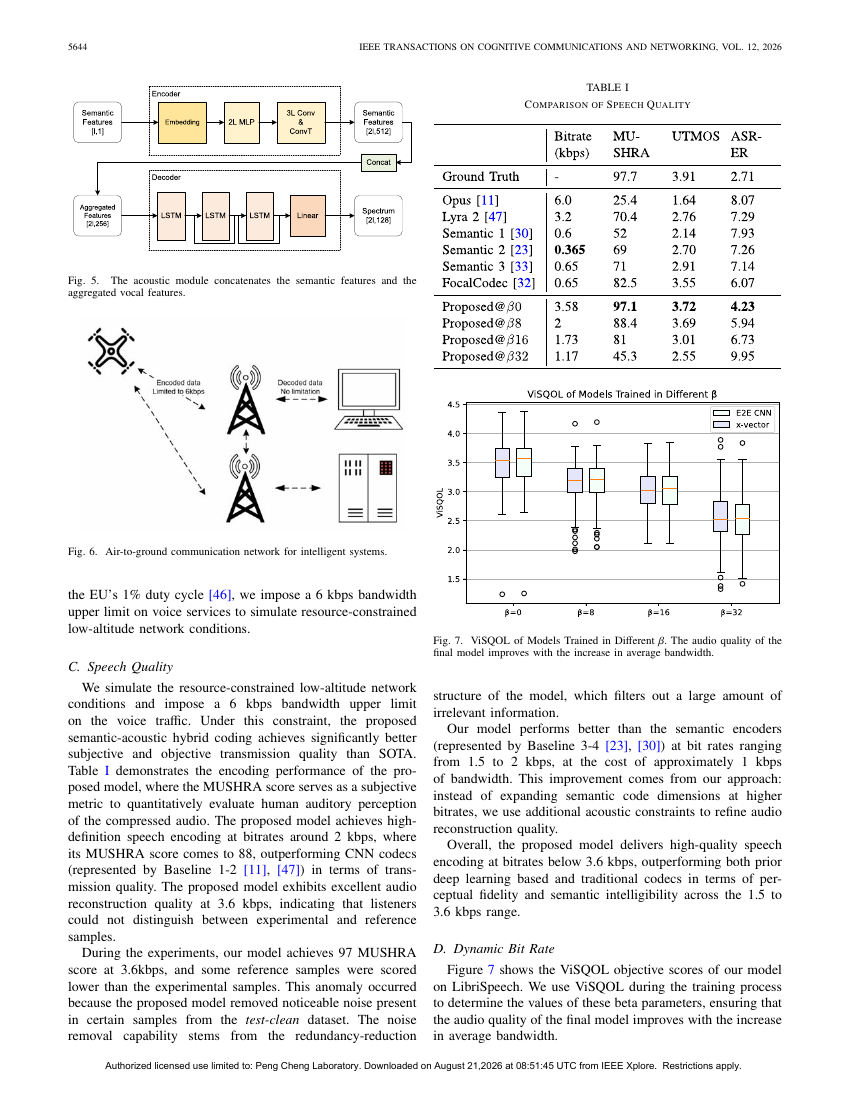
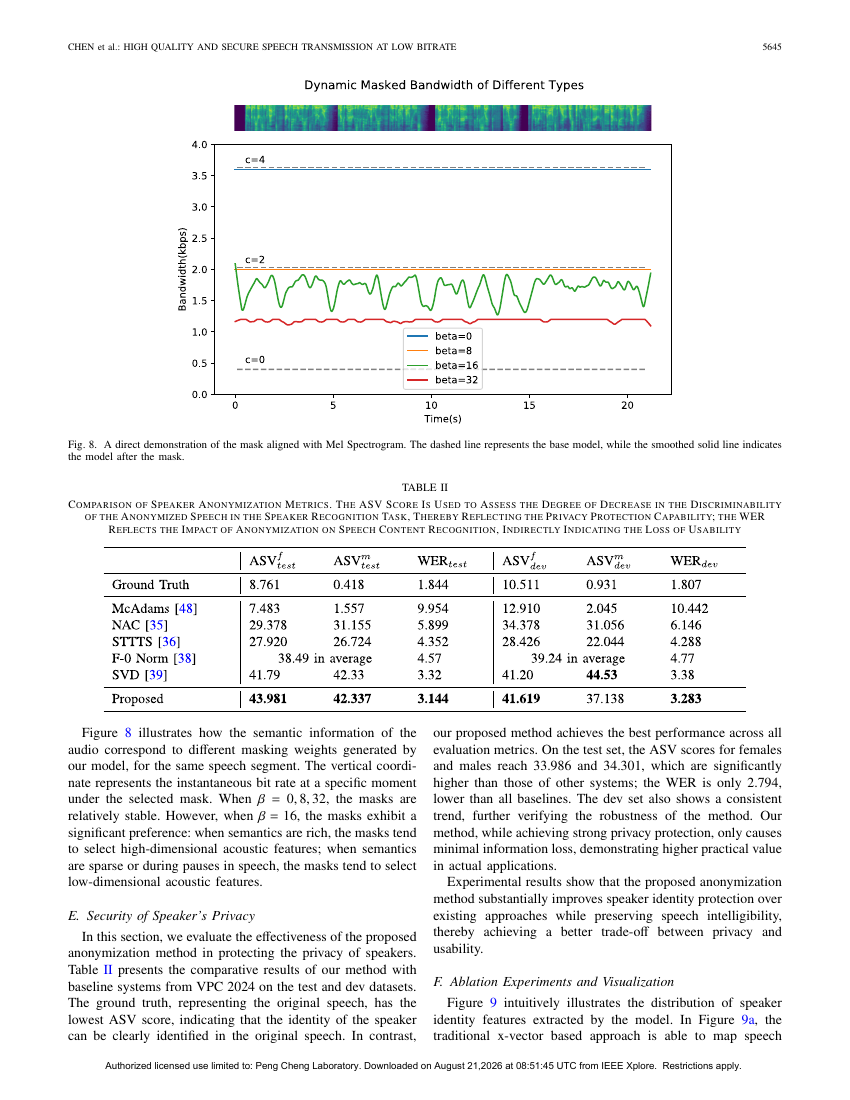
架构/方法图|来源:《High Quality and Secure Speech Transmission at Low Bitrate via Semantic-Acoustic Hybrid Coding for Low-Altitude Intelligent Systems》,原 PDF p.7,Fig. 6 Air-to-ground communication network for intelligent systems。 核对论文关键实验结果图/表|来源:《High Quality and Secure Speech Transmission at Low Bitrate via Semantic-Acoustic Hybrid Coding for Low-Altitude Intelligent Systems》,原 PDF p.8,Fig. 8 A direct demonstration of the mask aligned with Mel Spectrogram. The dashed line represents the base model, while the smoothed solid line indicates the model after the mask。 核对论文
核心纳入2026视频传输、生成或控制
Joint Semantic Compression and Massive MIMO Transmission for Edge Video Analytics
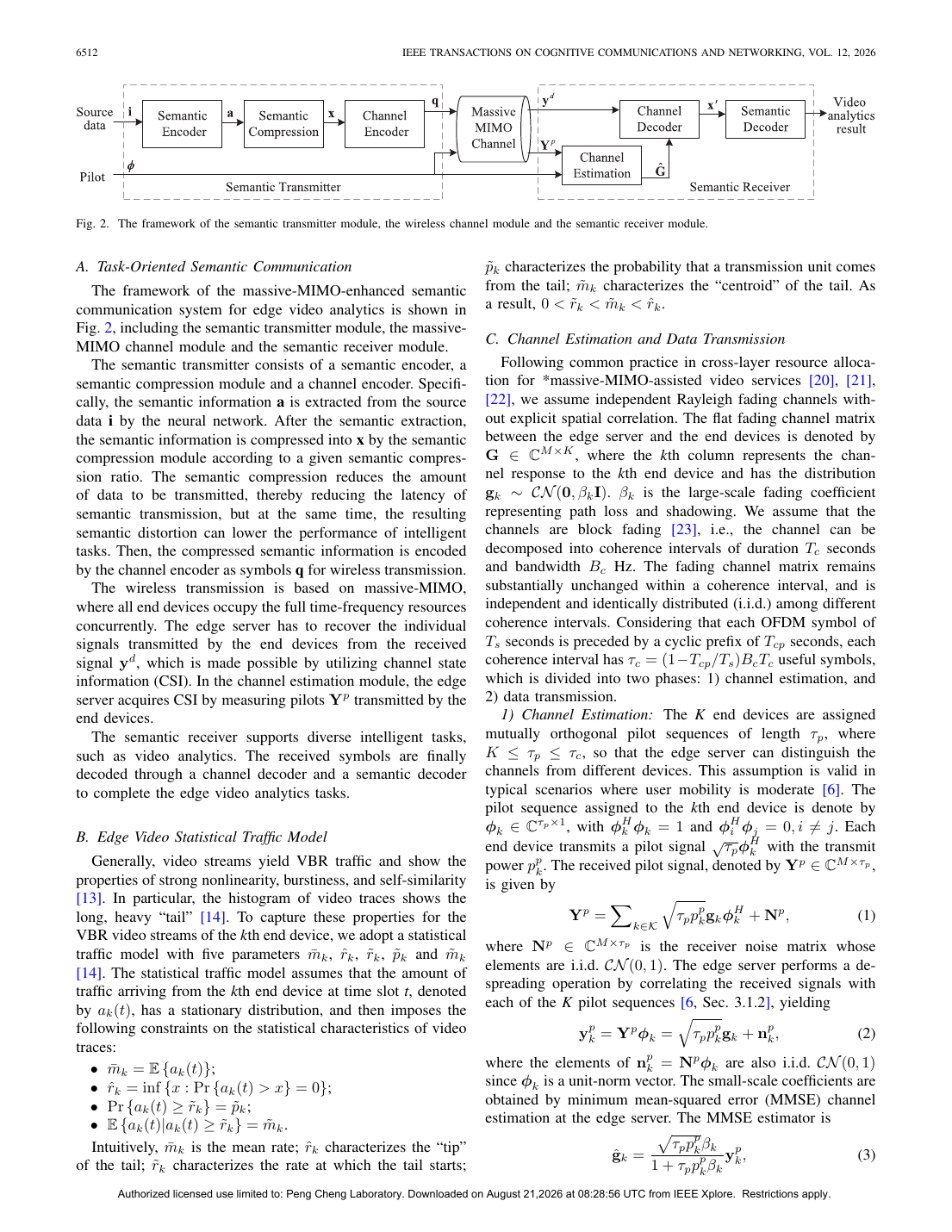
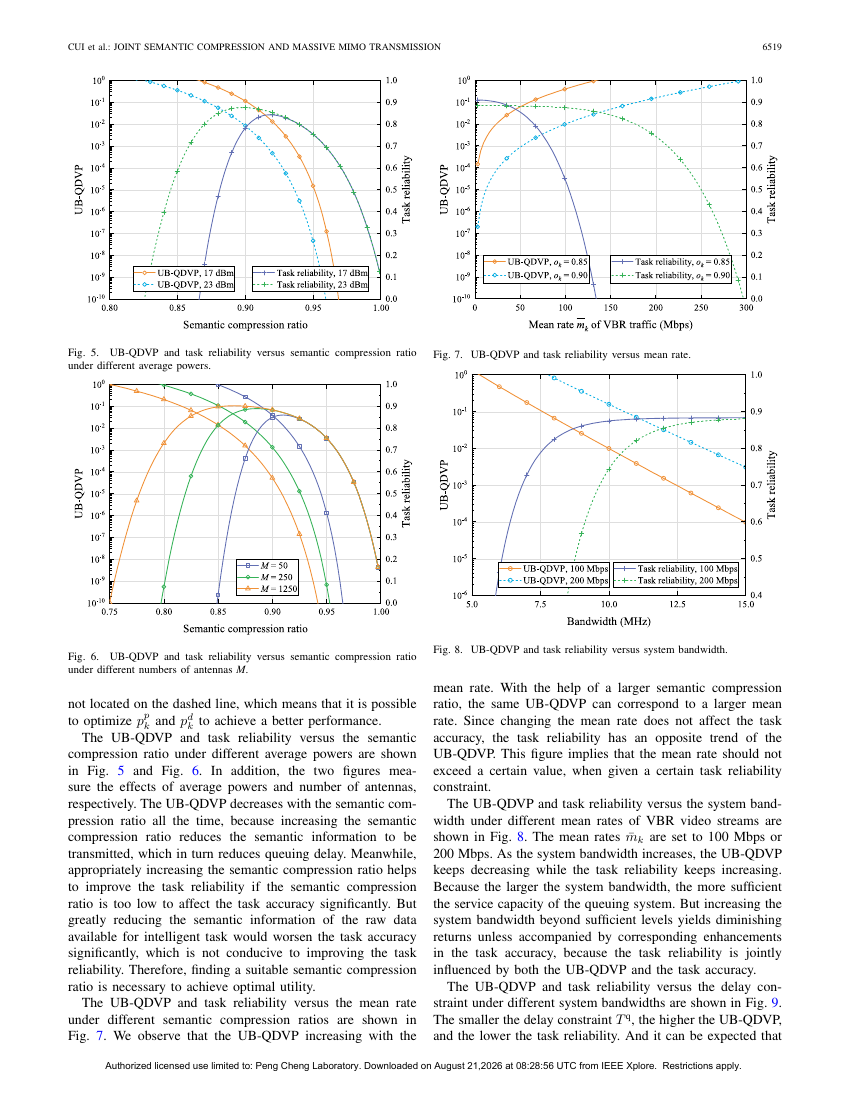
架构/方法图|来源:《Joint Semantic Compression and Massive MIMO Transmission for Edge Video Analytics》,原 PDF p.4,Fig. 2 The framework of the semantic transmitter module, the wireless channel module and the semantic receiver module。 核对论文关键实验结果图/表|来源:《Joint Semantic Compression and Massive MIMO Transmission for Edge Video Analytics》,原 PDF p.11,Fig. 7 UB-QDVP and task reliability versus mean rate. under different average powers。 核对论文
核心纳入2026图像传输、压缩或生成
Joint Trajectory Planning and Semantic Communication Design for Urban Low-Altitude UAVs
局限:没有完整离散接口,无法直接回答 bit/index/token 跳变问题。 未显式注入离散误码/丢包,鲁棒性结论不应外推到真实数字链路。 未报告统一可复核的 payload bit 数/CBR,跨论文带宽比较受限。
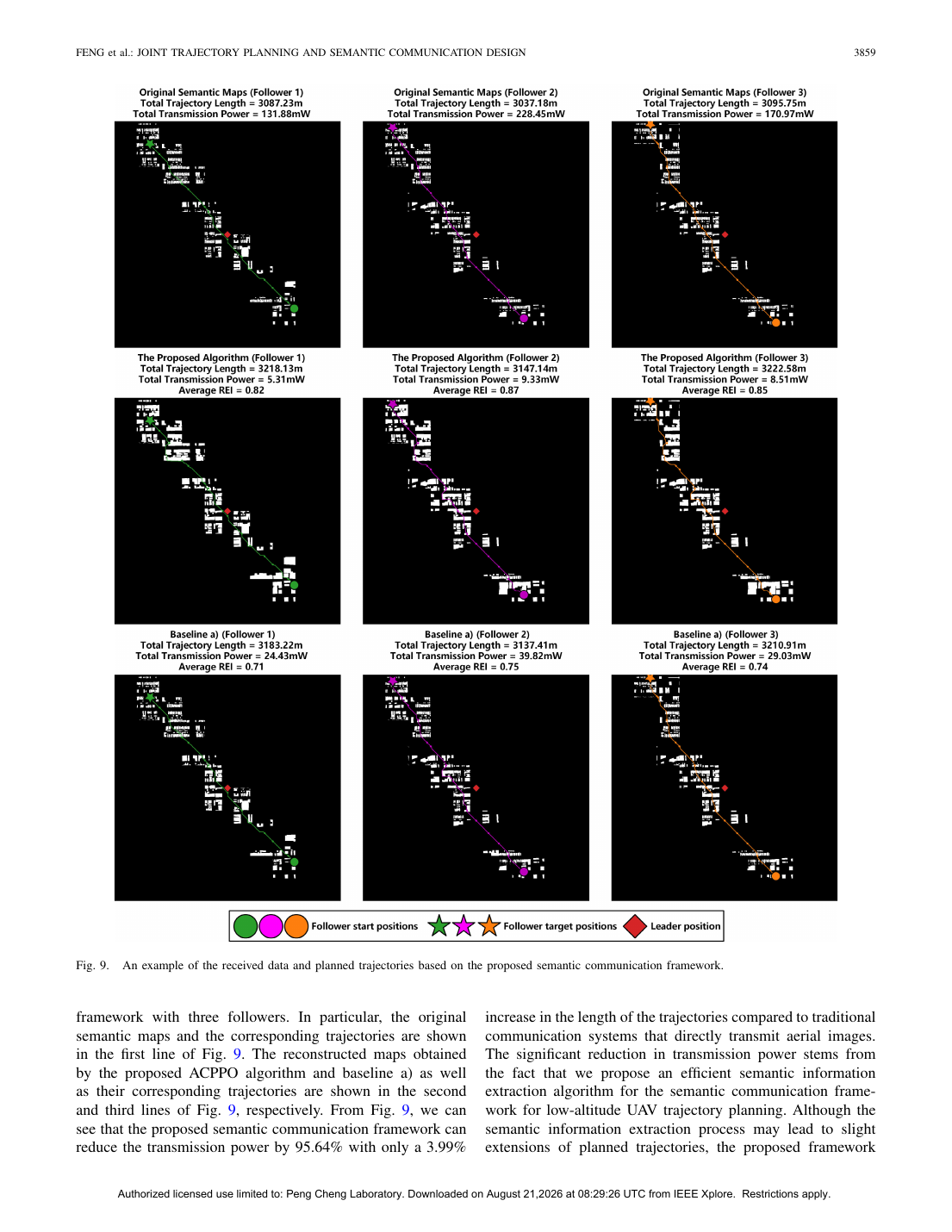
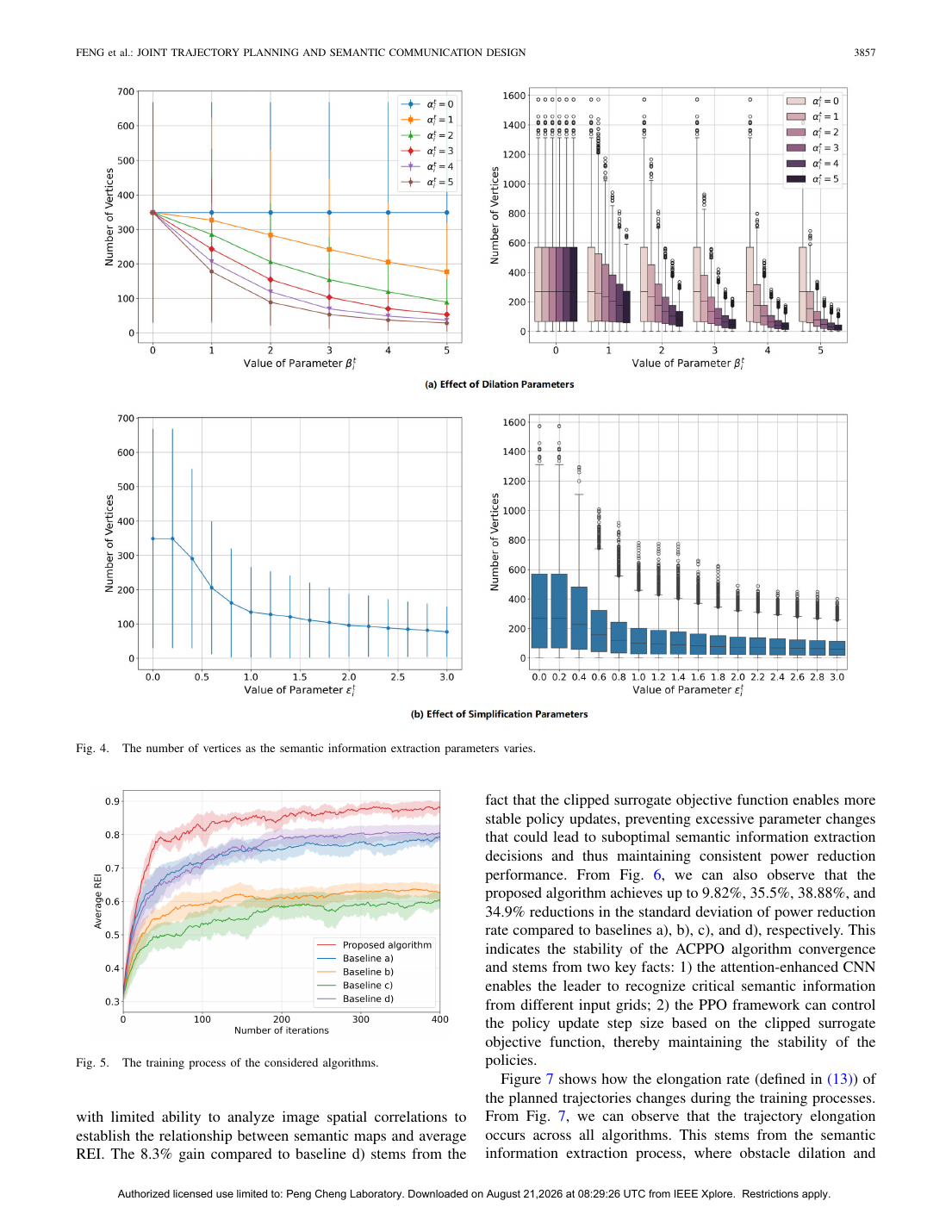
架构/方法图|来源:《Joint Trajectory Planning and Semantic Communication Design for Urban Low-Altitude UAVs》,原 PDF p.14,Fig. 9 An example of the received data and planned trajectories based on the proposed semantic communication framework。 核对论文关键实验结果图/表|来源:《Joint Trajectory Planning and Semantic Communication Design for Urban Low-Altitude UAVs》,原 PDF p.12,Fig. 4 The number of vertices as the semantic information extraction parameters varies。 核对论文
核心纳入2026语义感知资源分配与网络优化
Knowledge-Driven 3D Semantic Spectrum Map: KE-VQ-Transformer-Based AAV Semantic Communication and Map Completion
现有进展:人工智能(AI)-原生三维(3D)频谱图在智能通信网络的频谱监测中至关重要。 PDF p.1
仍然存在的问题:然而,以频谱高效、计算高效和人工智能驱动的方式来获得和传输3D频谱图是具有挑战性的,尤其是在复杂的通信环境和稀疏的采样数据下。 PDF p.1
为什么已有方法解决不了:连续 latent 或独立设计的传统链路没有回答语义特征怎样量化、映射为有限符号,以及 bit/index 出错后为何不会跳到完全不同的语义。仅改进信源网络无法补上这一接口。 PDF p.1
为什么这个问题重要:功率、带宽、算力和时延是共享资源;若调度器不知道语义效用,它可能增加吞吐量却没有改善任何用户真正关心的任务。 PDF p.1
本文提出什么:由于统计机器学习很容易被误导的表面数据的相关性缺乏可解释性,我们提出了一种新的知识增强的语义频谱图完成框架与两个专家知识驱动的物理信号传播模型的约束。 PDF p.1
方案为何可能有效:由于频谱完成遵循真实世界的物理模型,因此我们可以探索AI原生语义通信网络,以实现健壮且可解释的频谱图完成。 PDF p.2
作者希望证明什么:仿真结果表明,所提出的方案在RKMSE方面都优于现有的基准方案,更适合大规模地应用。 PDF p.1
方法与端到端信息流
针对统计机器学习容易被表面数据相关性误导且缺乏可解释性的问题,本文提出了一种新的知识增强的语义频谱图完成框架,该框架具有来自物理信号传播模型的两个专家知识驱动的约束。由于频谱完成遵循真实世界的物理模型,因此我们可以探索一种AI原生语义通信网络,以实现鲁棒且可解释的频谱图完成。 PDF p.1PDF p.2
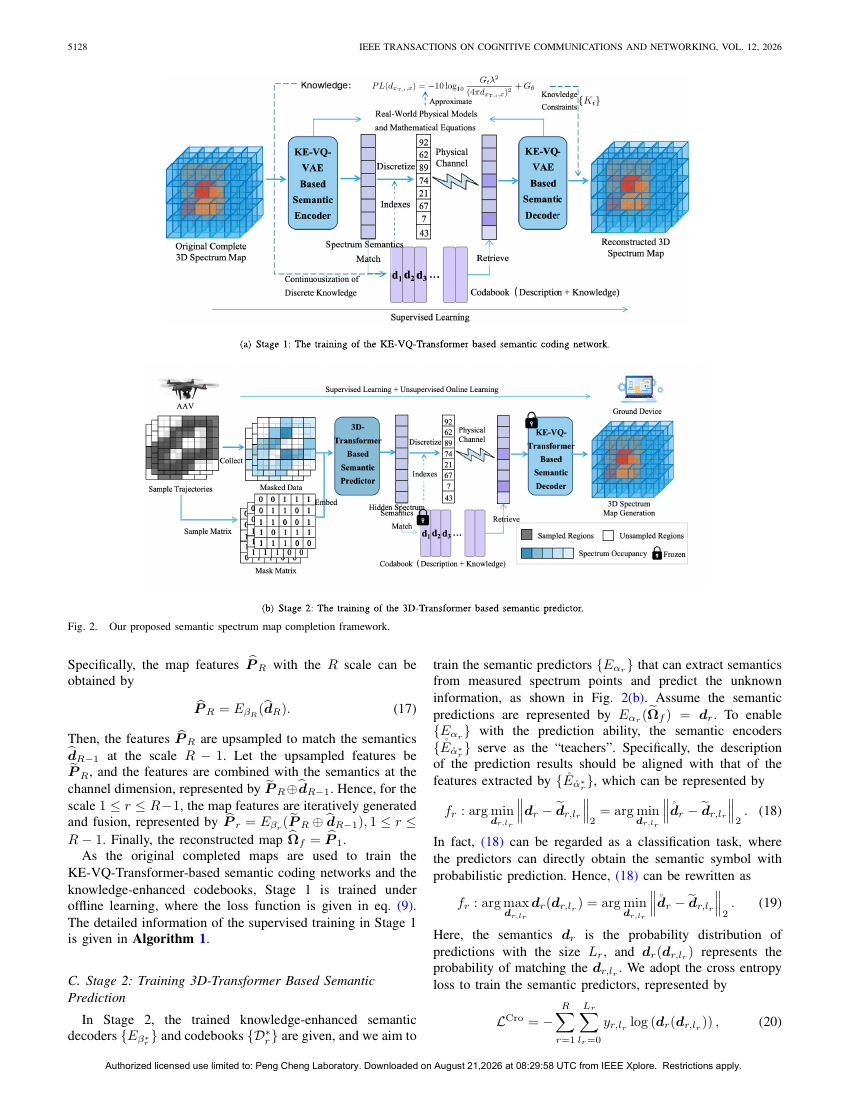
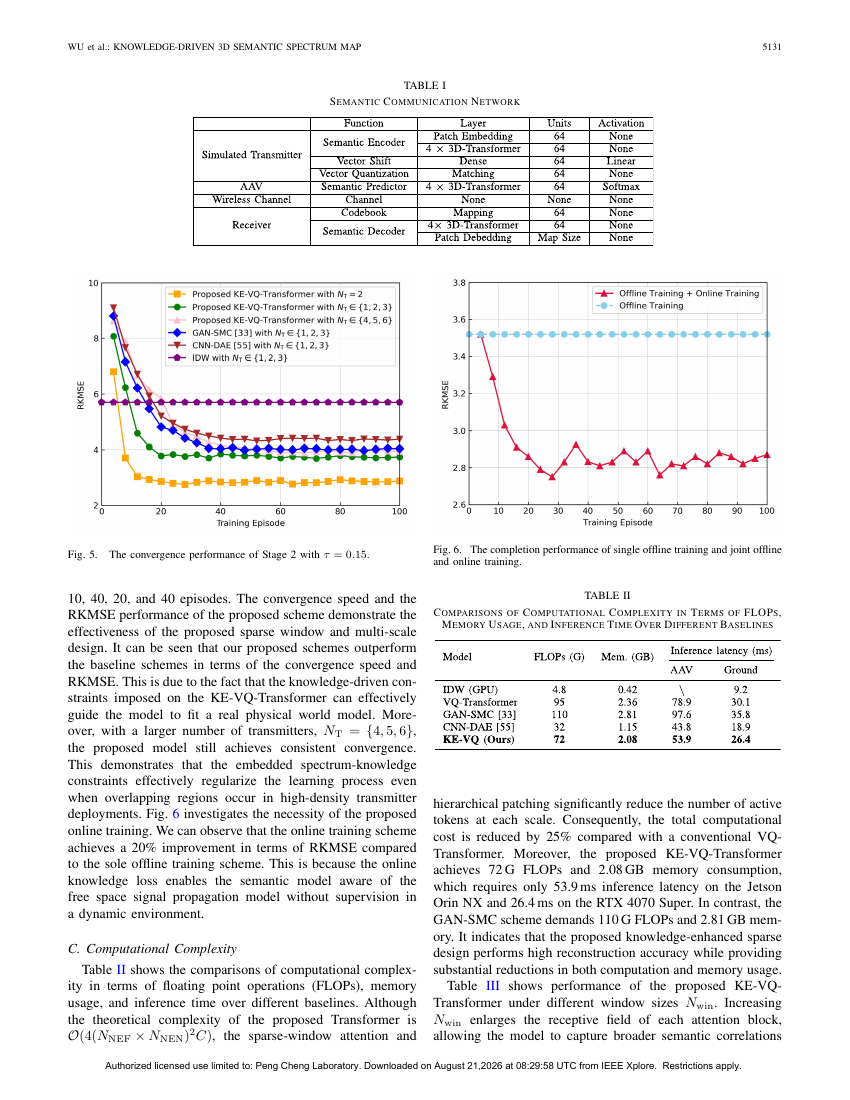
架构/方法图|来源:《Knowledge-Driven 3D Semantic Spectrum Map: KE-VQ-Transformer-Based AAV Semantic Communication and Map Completion》,原 PDF p.9,Fig. 2 Our proposed semantic spectrum map completion framework。 核对论文关键实验结果图/表|来源:《Knowledge-Driven 3D Semantic Spectrum Map: KE-VQ-Transformer-Based AAV Semantic Communication and Map Completion》,原 PDF p.12,Fig. 5 The convergence performance of Stage 2 with τ = 0.15。 核对论文
核心纳入2026任务导向推理
Lagrangian-Augmented Learning for Stochastic Age of Accurate Semantic Information Minimization in Mobile Edge Computing Systems
实验小节中明确出现的比较对象包括HM、PPO、BERT、OFDM、DDPG;指标包括mAP、accuracy、precision、QoE、latency、BERTScore、throughput、AoI、AoII、energy efficiency;信道/链路条件包括AWGN、wireless channel、NOMA、SINR、OFDM。 PDF p.2
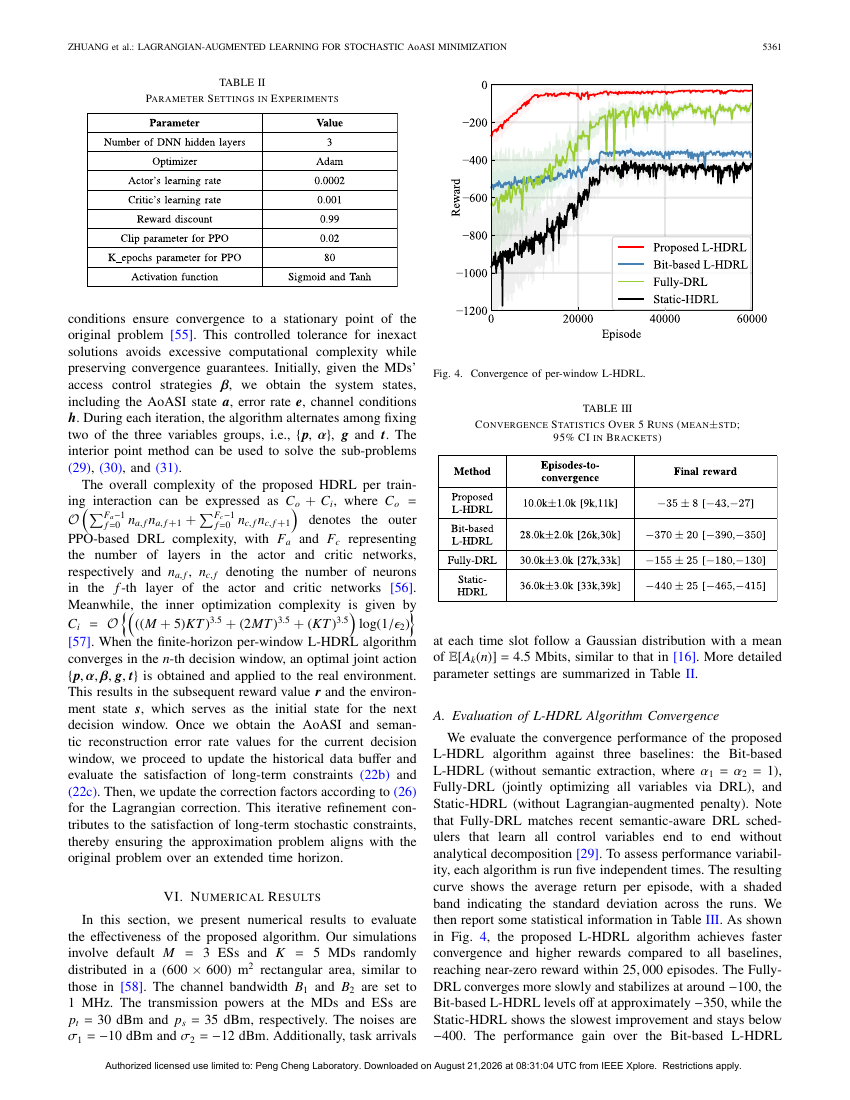
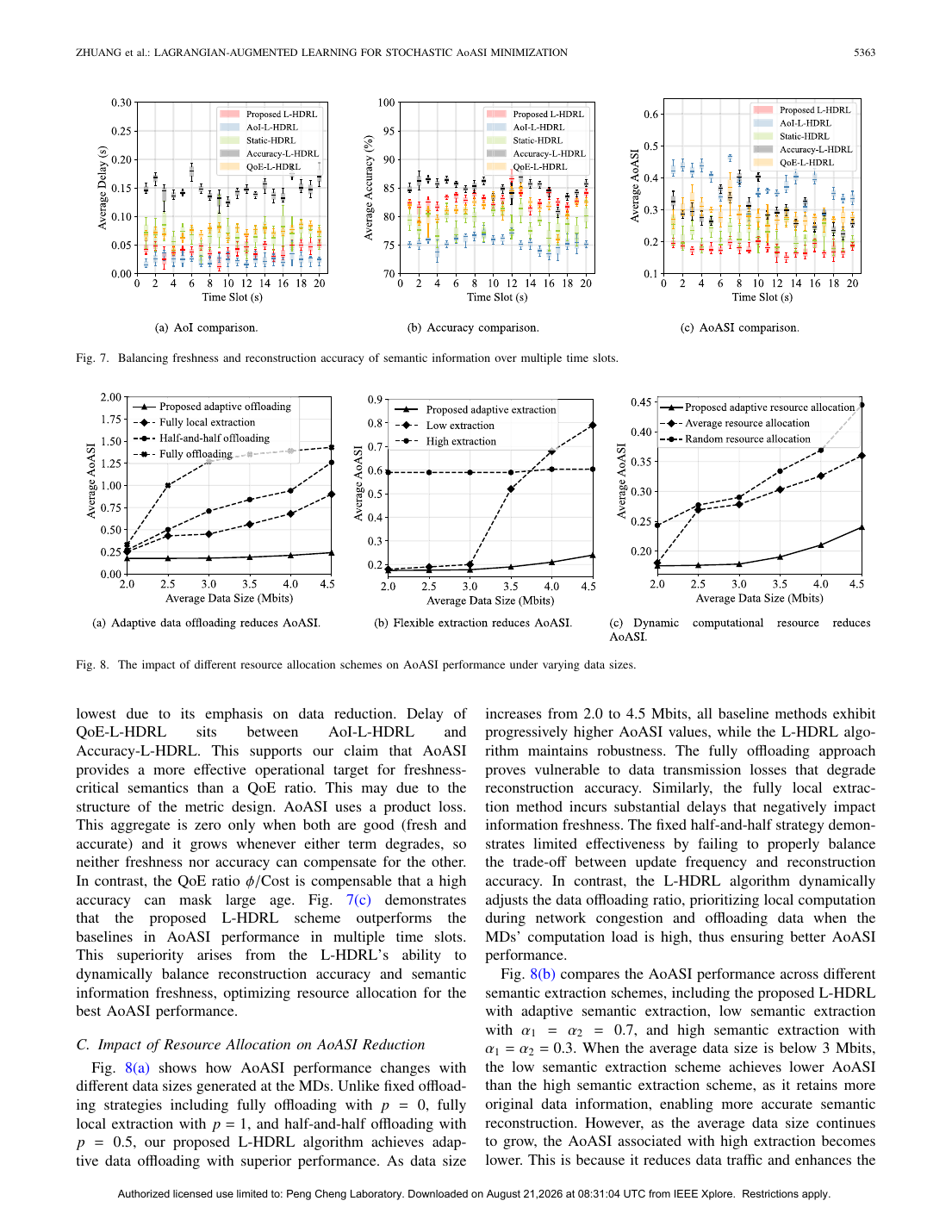
架构/方法图|来源:《Lagrangian-Augmented Learning for Stochastic Age of Accurate Semantic Information Minimization in Mobile Edge Computing Systems》,原 PDF p.11,Fig. 4 Convergence of per-window L-HDRL. access control strategies β, we obtain the system states, including the AoASI state a, error rate e, channel conditions 核对论文关键实验结果图/表|来源:《Lagrangian-Augmented Learning for Stochastic Age of Accurate Semantic Information Minimization in Mobile Edge Computing Systems》,原 PDF p.13,Fig. 7 Balancing freshness and reconstruction accuracy of semantic information over multiple time slots。 核对论文
核心纳入2026图像传输、压缩或生成
Large-Scale Model-Enabled Semantic Communication via Robust Knowledge Distillation and Lightweight Architecture Search
信道与工作点AWGN、Rayleigh、channel estimation、fading channel、SNR of -10 dB、SNR of 0 dB、SNR of 12 dB、SNR of -5 dB
数据集为ImageNet、CIFAR10、CIFAR100;实验小节中明确出现的比较对象包括JPEG、LDPC、ViT、DeepSC、JSCC、CLIP;指标包括MSE、accuracy、latency、FLOPs、throughput、classification accuracy;信道/链路条件包括AWGN、Rayleigh、channel estimation、fading channel;正文可定位的代表性工作点有SNR of -10 dB、SNR of 0 dB、SNR of 12 dB、SNR of -5 dB。 PDF p.9
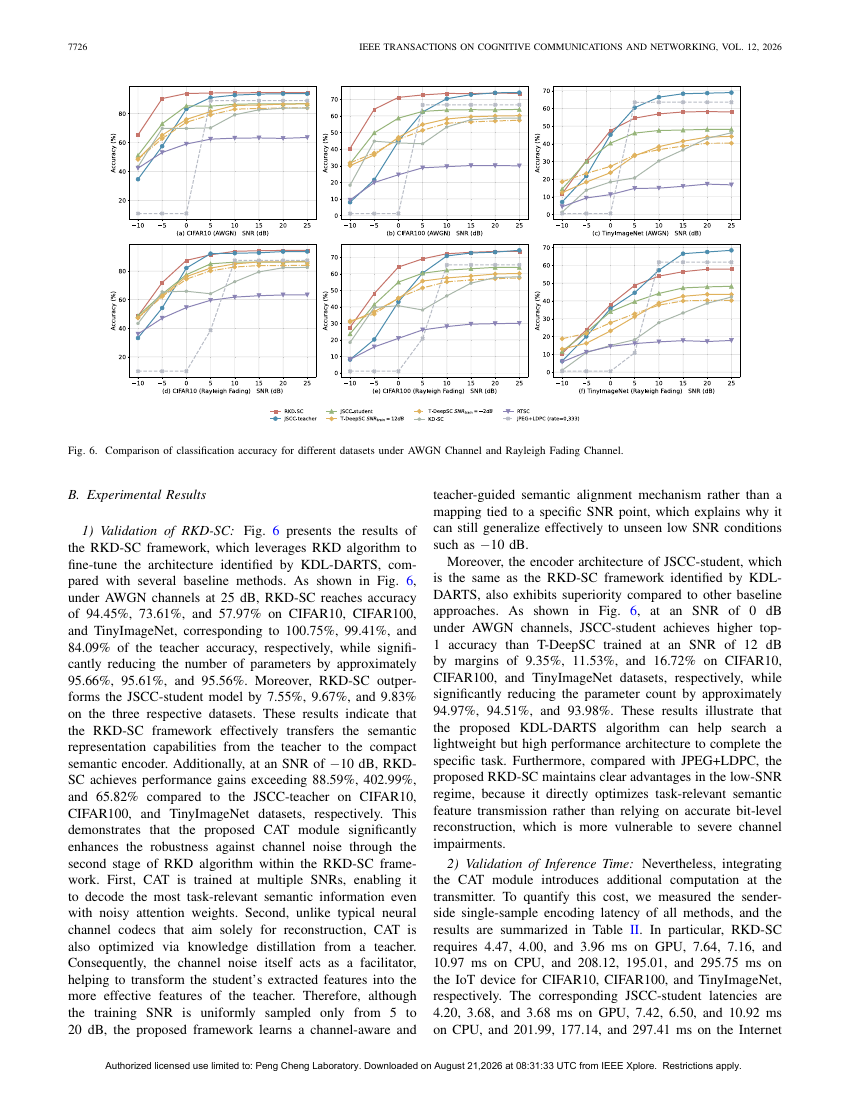
对图像分类任务的大量仿真结果表明,与现有方法相比,RKD-SC框架在保持教师模型较高性能的同时,显著减少了模型参数,表现出更好的鲁棒性。 PDF p.1
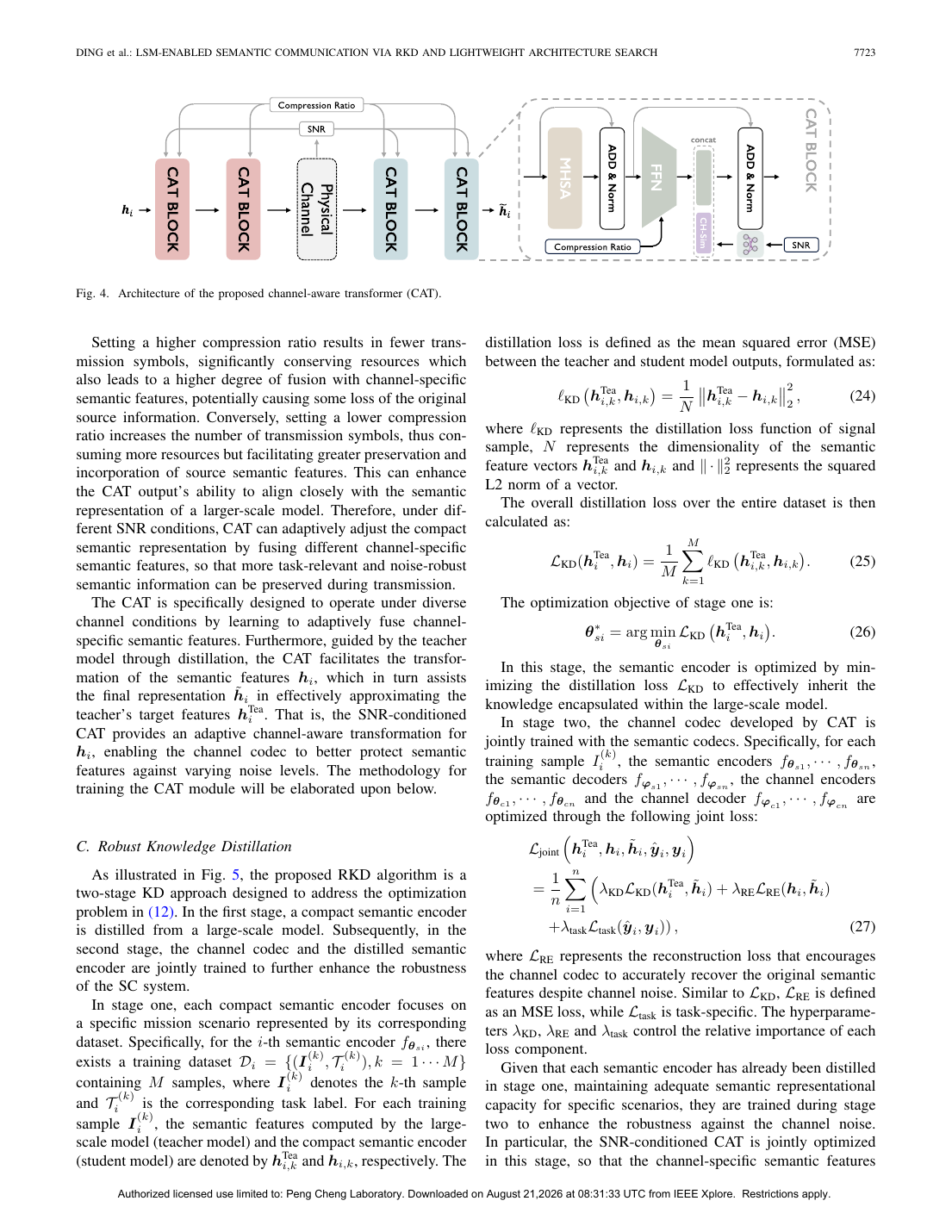
架构/方法图|来源:《Large-Scale Model-Enabled Semantic Communication via Robust Knowledge Distillation and Lightweight Architecture Search》,原 PDF p.8,Fig. 4 Architecture of the proposed channel-aware transformer (CAT)。 核对论文关键实验结果图/表|来源:《Large-Scale Model-Enabled Semantic Communication via Robust Knowledge Distillation and Lightweight Architecture Search》,原 PDF p.11,Fig. 6 Comparison of classification accuracy for different datasets under AWGN Channel and Rayleigh Fading Channel。 核对论文
核心纳入2026点云/三维场景传输
LLM-Empowered Semantic Communication for Multi-Task 3D Scene Understanding in Low-Altitude Economy Networks
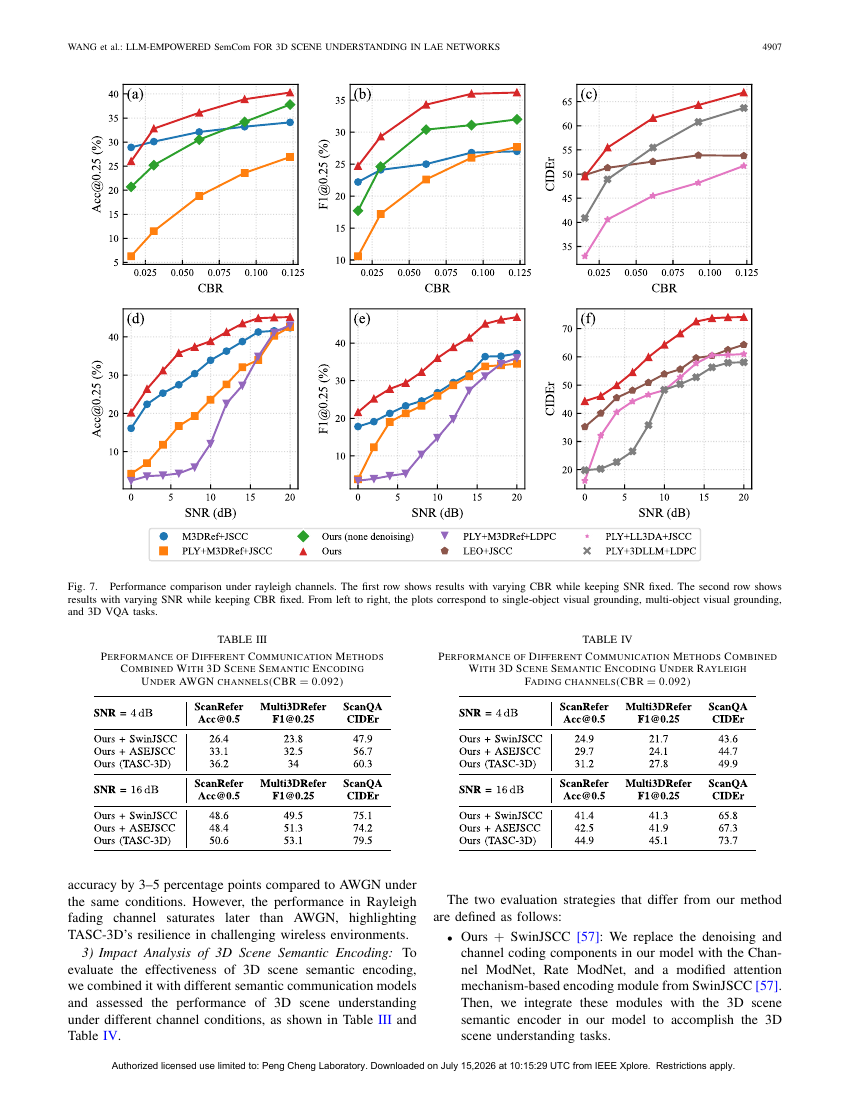
架构/方法图|来源:《LLM-Empowered Semantic Communication for Multi-Task 3D Scene Understanding in Low-Altitude Economy Networks》,原 PDF p.3,该页包含论文的主要方法/架构图。 核对论文关键实验结果图/表|来源:《LLM-Empowered Semantic Communication for Multi-Task 3D Scene Understanding in Low-Altitude Economy Networks》,原 PDF p.12,该页包含论文的关键实验结果图或表。 核对论文
核心纳入2026图像传输、压缩或生成
LRGD: Low-Rank Guided Diffusion for Robust Image Transmission in Semantic Communication
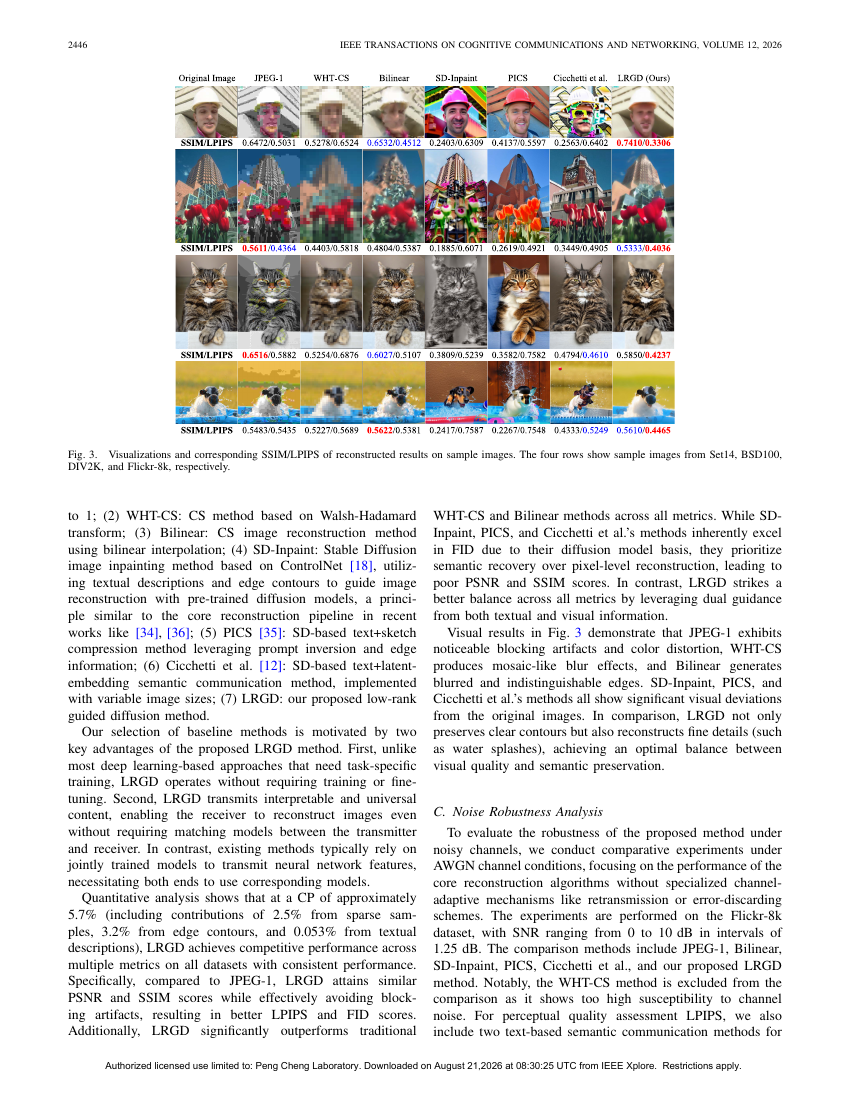
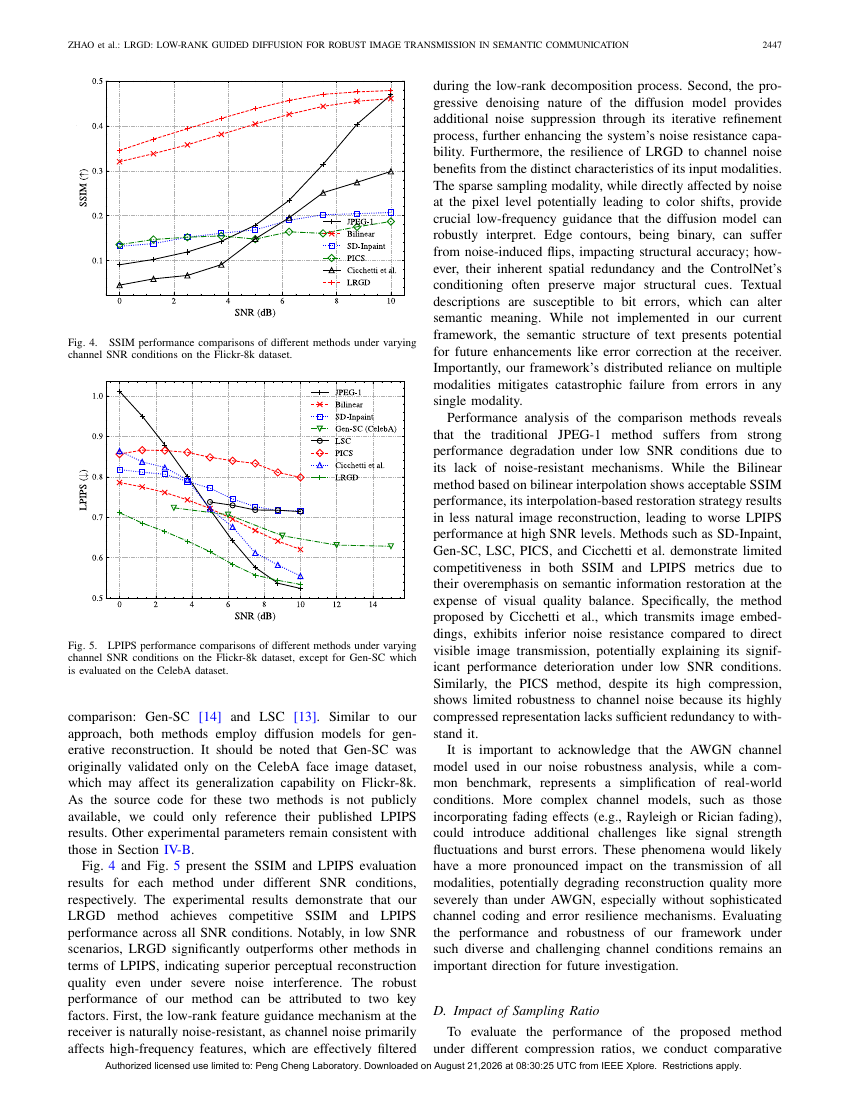
架构/方法图|来源:《LRGD: Low-Rank Guided Diffusion for Robust Image Transmission in Semantic Communication》,原 PDF p.8,Fig. 3 Visualizations and corresponding SSIM/LPIPS of reconstructed results on sample images. The four rows show sample images from Set14, BSD100, DIV2K, and Flickr-8k, respectively。 核对论文关键实验结果图/表|来源:《LRGD: Low-Rank Guided Diffusion for Robust Image Transmission in Semantic Communication》,原 PDF p.9,Fig. 4 SSIM performance comparisons of different methods under varying channel SNR conditions on the Flickr-8k dataset 核对论文
核心纳入2026任务导向推理
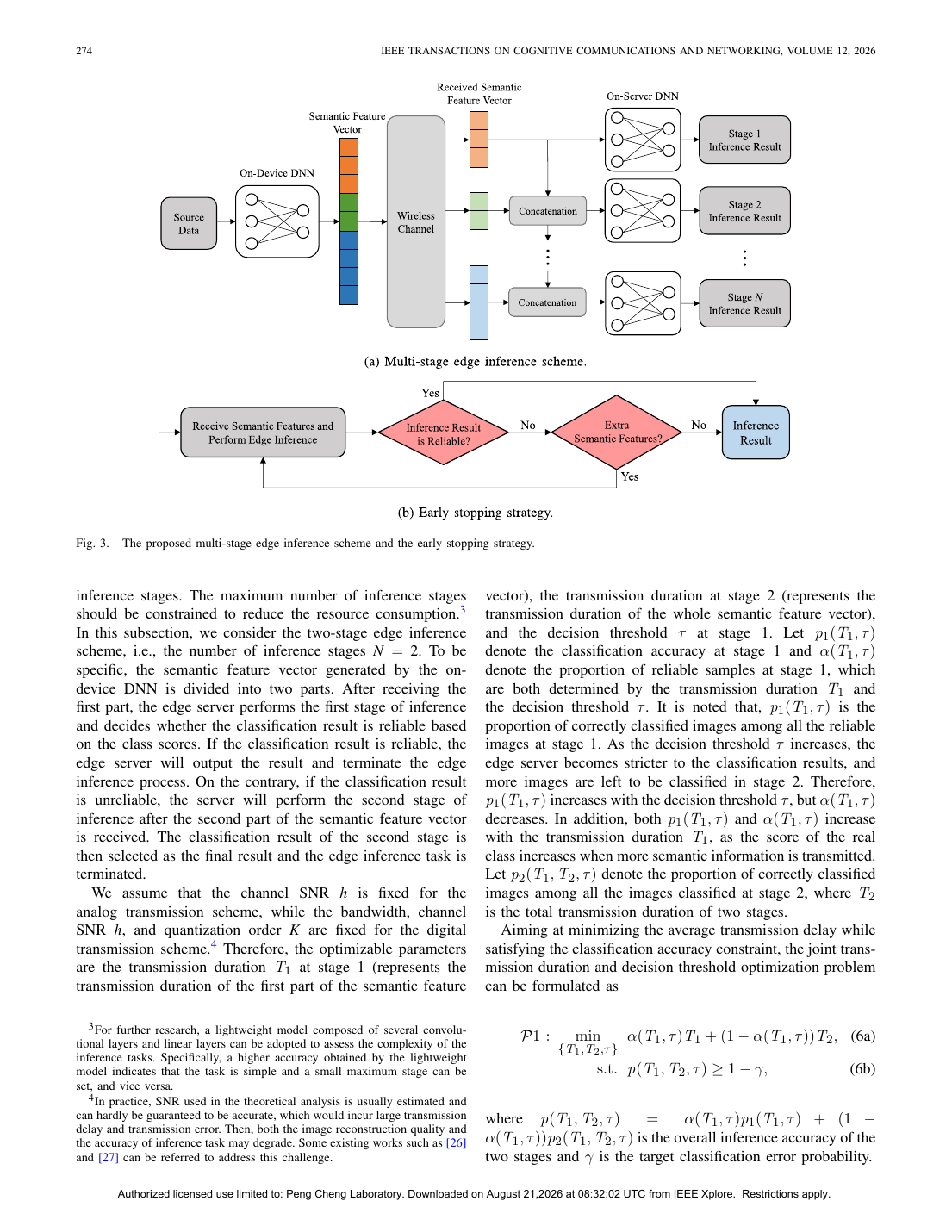
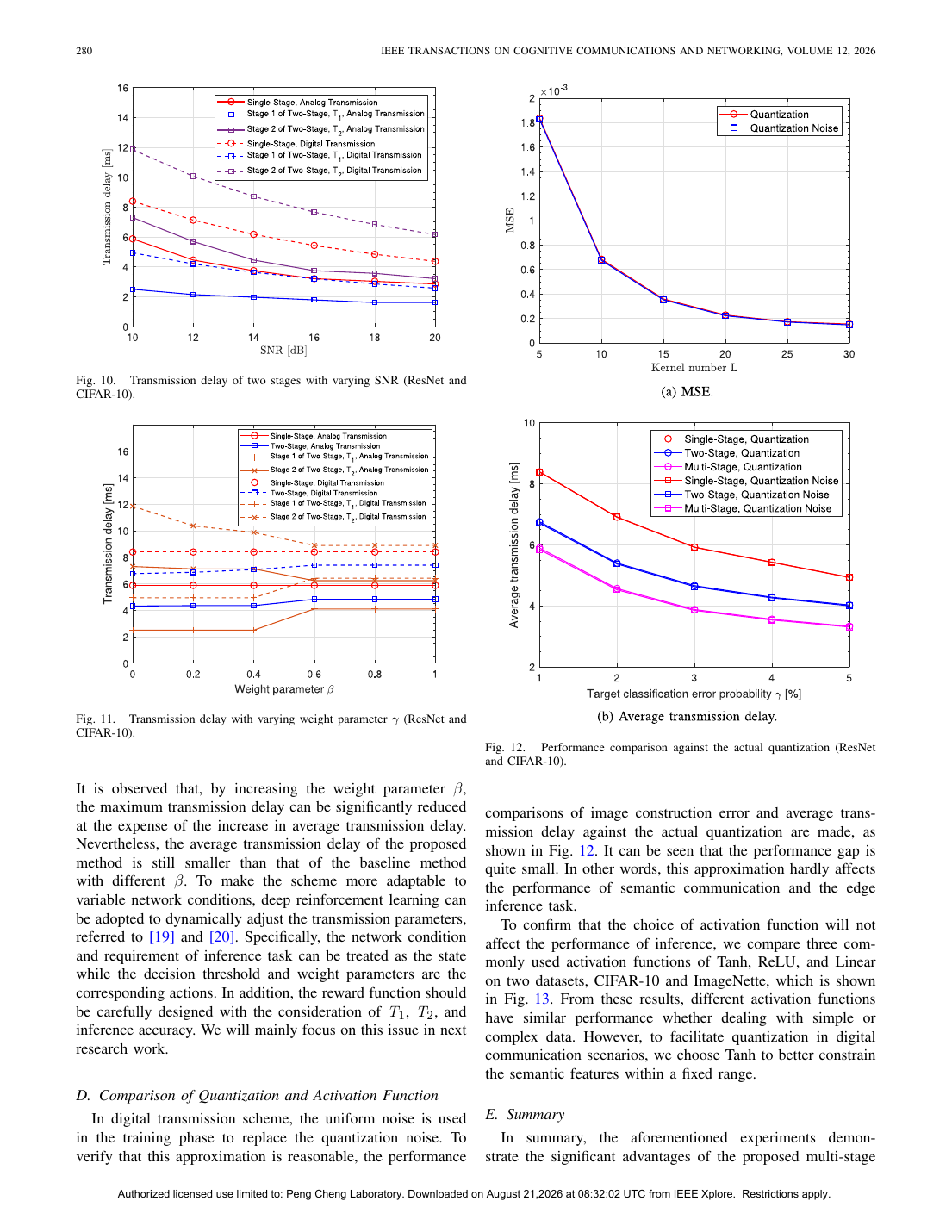
Multi-Stage Semantic Communication for Low-Latency Edge Inference
架构/方法图|来源:《Multi-Stage Semantic Communication for Low-Latency Edge Inference》,原 PDF p.8,Fig. 3 The proposed multi-stage edge inference scheme and the early stopping strategy。 核对论文关键实验结果图/表|来源:《Multi-Stage Semantic Communication for Low-Latency Edge Inference》,原 PDF p.14,Fig. 12 Performance comparison against the actual quantization (ResNet and CIFAR-10)。 核对论文
核心纳入2026图像传输、压缩或生成
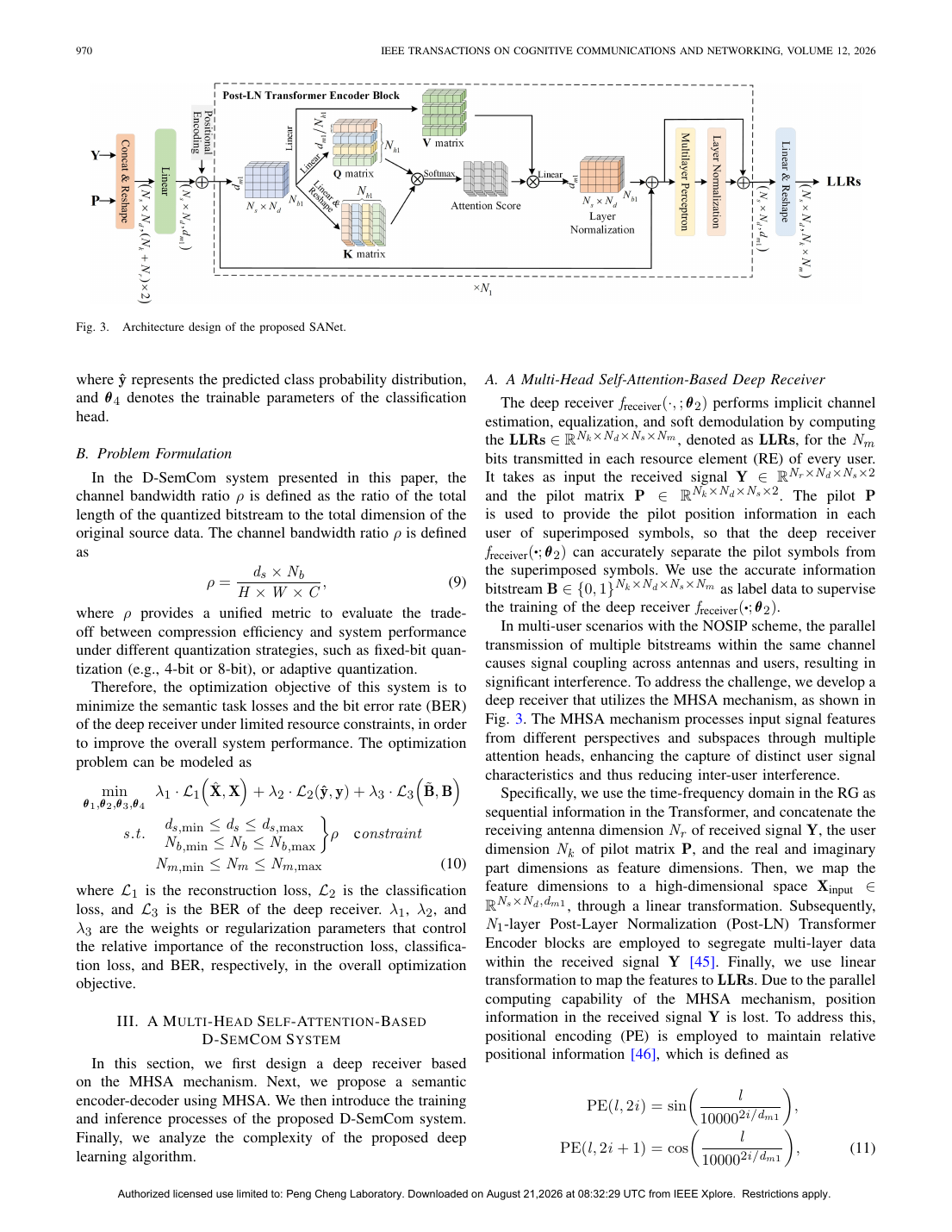
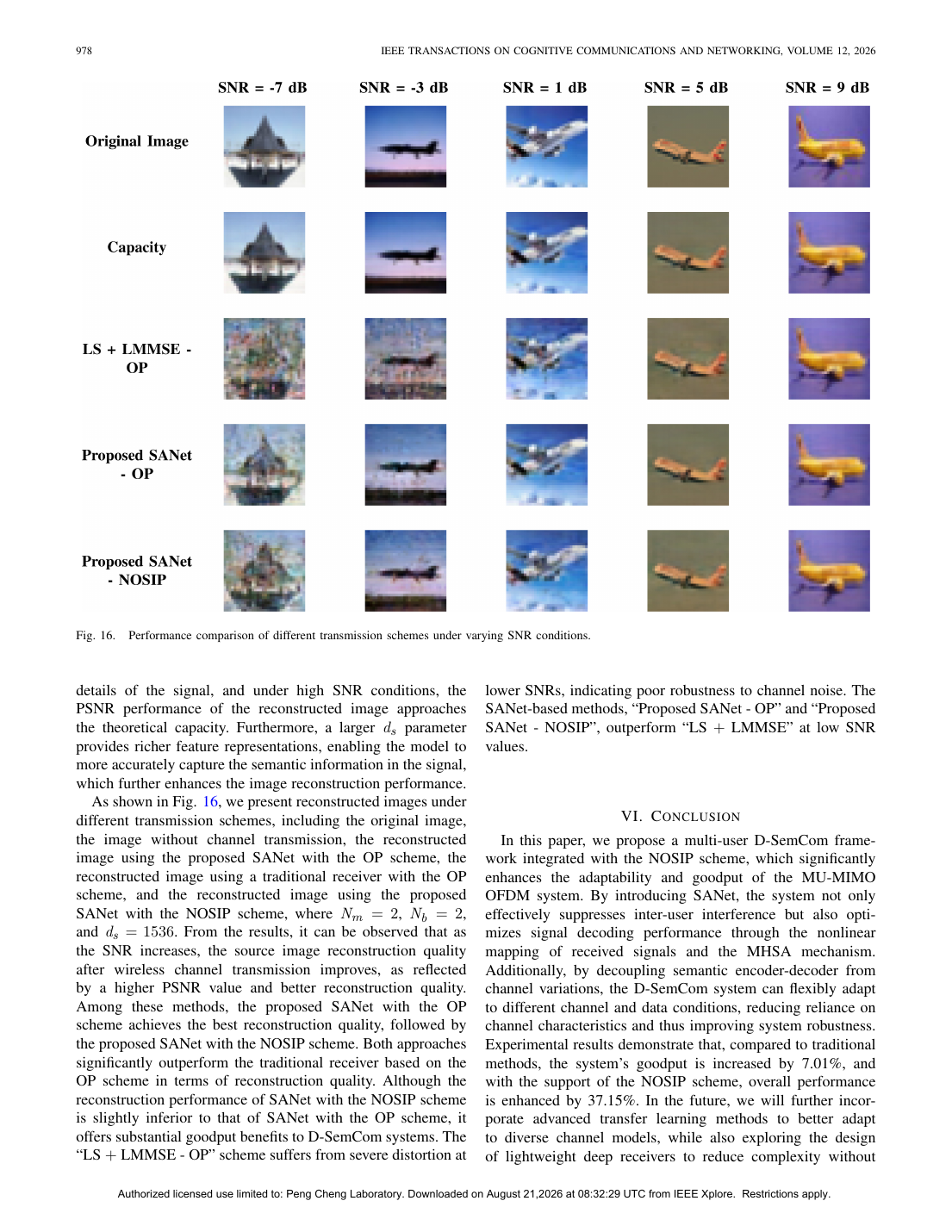
Non-Orthogonal Superimposed Pilot for Goodput Enhancement in Digital Semantic Communication
架构/方法图|来源:《Non-Orthogonal Superimposed Pilot for Goodput Enhancement in Digital Semantic Communication》,原 PDF p.5,Fig. 3 Architecture design of the proposed SANet。 核对论文关键实验结果图/表|来源:《Non-Orthogonal Superimposed Pilot for Goodput Enhancement in Digital Semantic Communication》,原 PDF p.13,Fig. 16 Performance comparison of different transmission schemes under varying SNR conditions。 核对论文
核心纳入2026任务导向推理
On the Effectiveness of Task-Oriented Digital Semantic Communication System
一句话主旨:On the Effectiveness of Task-Oriented Digital Semantic Communication System 面向任务导向推理,把问题放在“数字语义编码与物理层接口”层处理;本调研把主接口判断为“显式数字语义表示:bit、离散 token 或码本 index”。
Motivation|Introduction 怎样导出本文方案
现有进展:面向任务的数字语义通信系统利用神经网络提取和传递与任务相关的特征,与传统的交流系统相比,显著提高了交流效率。 PDF p.1
仍然存在的问题:然而,现有的研究在优化在发射机处提取的特征的信息表示效率方面存在局限性,从而限制了系统的有效性,如通过分类准确性等推理性能来测量。 PDF p.1
为什么已有方法解决不了:连续 latent 或独立设计的传统链路没有回答语义特征怎样量化、映射为有限符号,以及 bit/index 出错后为何不会跳到完全不同的语义。仅改进信源网络无法补上这一接口。 PDF p.1
为什么这个问题重要:边缘设备常需要及时决策而不是完整副本;只发送任务充分信息可以降低时延与带宽,但前提是关键证据确实能穿过信道。 PDF p.1
本文提出什么:这些系统还确保了与现代数字通信框架的兼容性,从而在新兴的资源受限的通信场景中吸引了很多关注。 PDF p.1
方案为何可能有效:在本文中,我们分别在系统和执行层级上引入两个正则化条件,以使面向任务的数位语意沟通系统能有更有效的编码。 PDF p.2
作者希望证明什么:实验结果表明,与基准方案相比,该方案在低延迟的情况下获得了更好的推理性能,并且在训练信道和测试信道不匹配的情况下具有更强的鲁棒性。 PDF p.1
方法与端到端信息流
这些系统还保证了与现代数字通信框架的兼容性,因此在新兴的资源受限通信场景中受到了广泛的关注。在本工作中,我们分别在系统和实现层引入了两个正则化项,以便能够更有效地为面向任务的数字语义通信系统编码。 PDF p.1PDF p.2
输入输入是任务导向推理所需的源数据与下游任务所需特征。
发送端发送端采用 On the Effectiveness of Task-Oriented Digital Semantic Communication System:这些系统还保证了与现代数字通信框架的兼容性,因此在新兴的资源受限通信场景中受到了广泛的关注。在本工作中,我们分别在系统和实现层引入了两个正则化项,以便能够更有效地为面向任务的数字语义通信系统编码。
其次,提出了一种半正交正则化项来优化矢量量化模块,通过最大化码字分离和最小化码字之间的线性相关性来提高量化效率和模型泛化能力。 独立判断:On the Effectiveness of Task-Oriented Digital Semantic Communication System 的主传输单位应归为“显式数字语义表示:bit、离散 token 或码本 index”。只有论文明确给出量化和映射时,才能把 token/index 数换算成总 bit;连续 channel symbol 只能按 channel uses/CBR 比较。 PDF p.1
论文未同时报告输入尺寸、encoder 输出尺寸、量化精度/码本大小和帧级开销,因此不能从全文唯一重建总 bit 数。页面保留论文实际使用的 CBR、bpp、token 数或信道使用次数;缺失项不作臆测。 PDF p.2PDF p.10
数据集为ImageNet、CIFAR-10、CIFAR-100、MNIST、Tiny ImageNet;实验小节中明确出现的比较对象包括DeepJSCC、ResNet、JSCC;指标包括SSIM、accuracy、latency、classification accuracy;信道/链路条件包括AWGN;正文可定位的代表性工作点有SNR=4dB、SNR=8dB。 PDF p.10
实验结果表明,与基准方案相比,该方案在低延迟的情况下获得了更好的推理性能,并且在训练信道和测试信道不匹配的情况下具有更强的鲁棒性。 PDF p.1
局限:未显式注入离散误码/丢包,鲁棒性结论不应外推到真实数字链路。 未报告统一可复核的 payload bit 数/CBR,跨论文带宽比较受限。
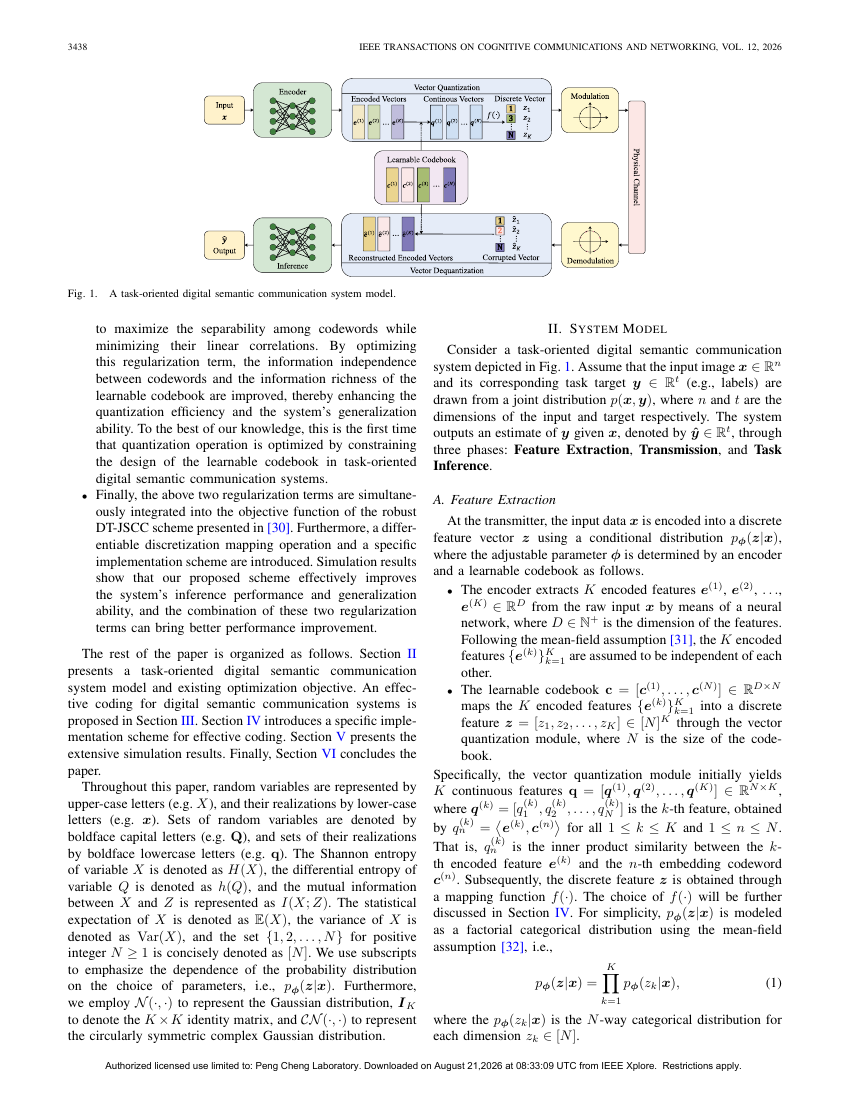
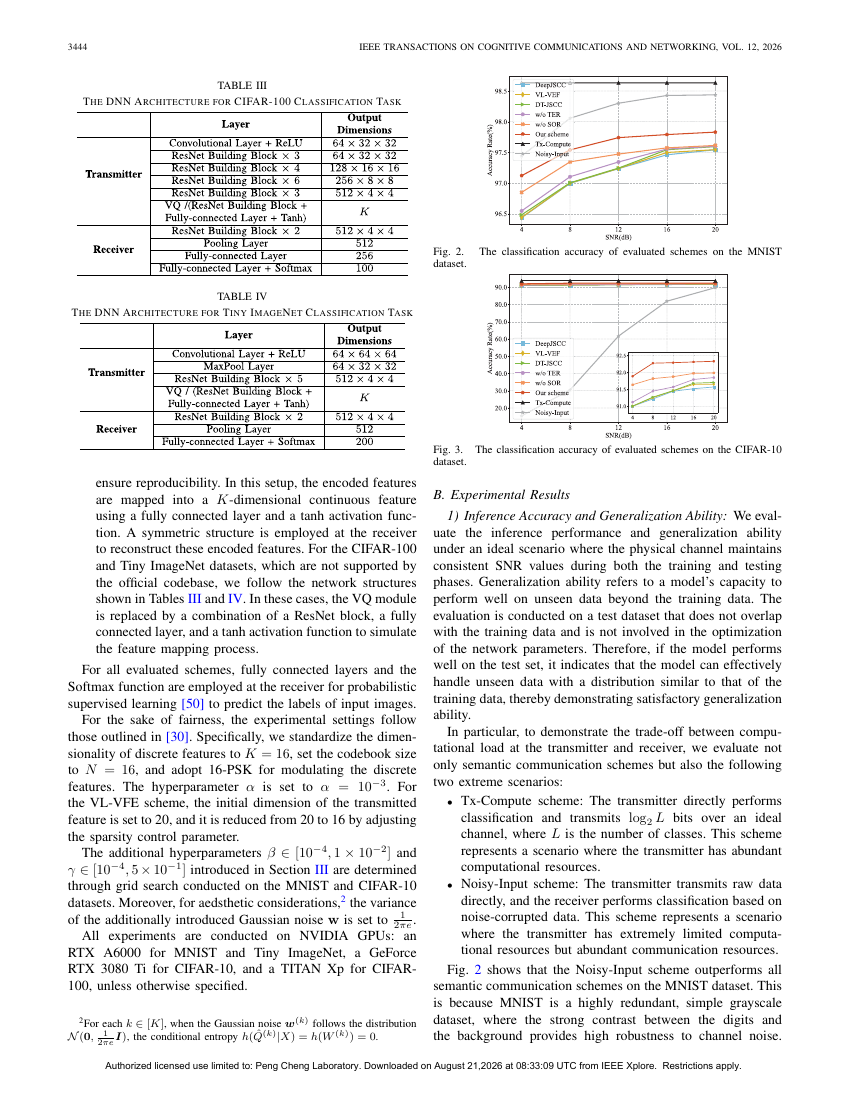
架构/方法图|来源:《On the Effectiveness of Task-Oriented Digital Semantic Communication System》,原 PDF p.3,Fig. 1 A task-oriented digital semantic communication system model。 核对论文关键实验结果图/表|来源:《On the Effectiveness of Task-Oriented Digital Semantic Communication System》,原 PDF p.9,Fig. 2 The classification accuracy of evaluated schemes on the MNIST dataset。 核对论文
核心纳入2026任务导向推理
Over-the-Air ODE-Inspired Neural Network for Dual Task-Oriented Semantic Communications
信道与工作点Rayleigh、Rician、IRS、MIMO、channel estimation、imperfect CSI、Under 30 dB SNR
实验小节中明确出现的比较对象包括DeepJSCC、JSCC;指标包括PSNR、SSIM、MSE、mAP、accuracy、latency、FLOPs、energy efficiency;信道/链路条件包括Rayleigh、Rician、IRS、MIMO、channel estimation、imperfect CSI;正文可定位的代表性工作点有Under 30 dB SNR。 PDF p.9
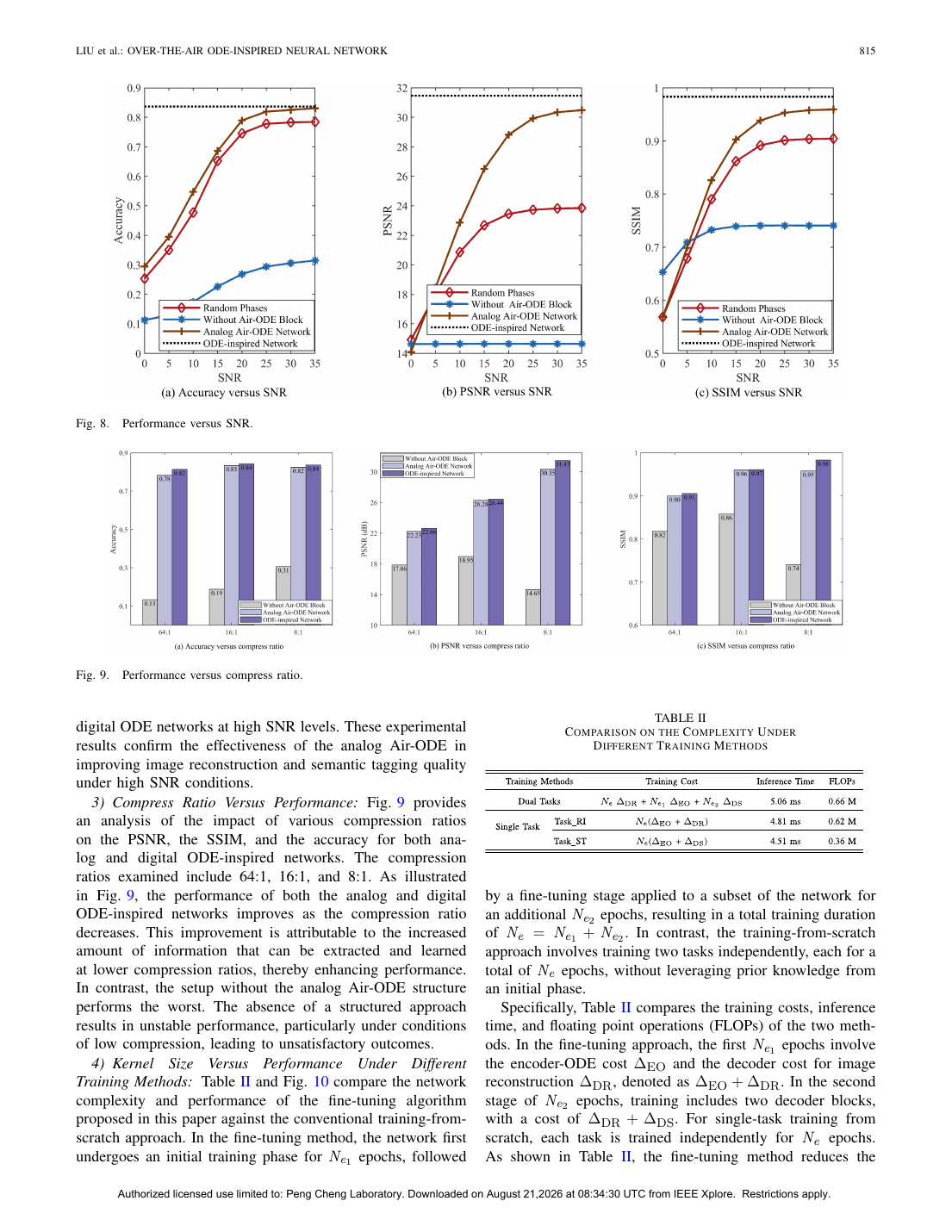
具体而言,对于图像重建和语义标注任务,与没有Air-ODE块的模拟网络相比,Air-ODE块可以在重建质量和标注精度方面实现约2倍的增益。 PDF p.1
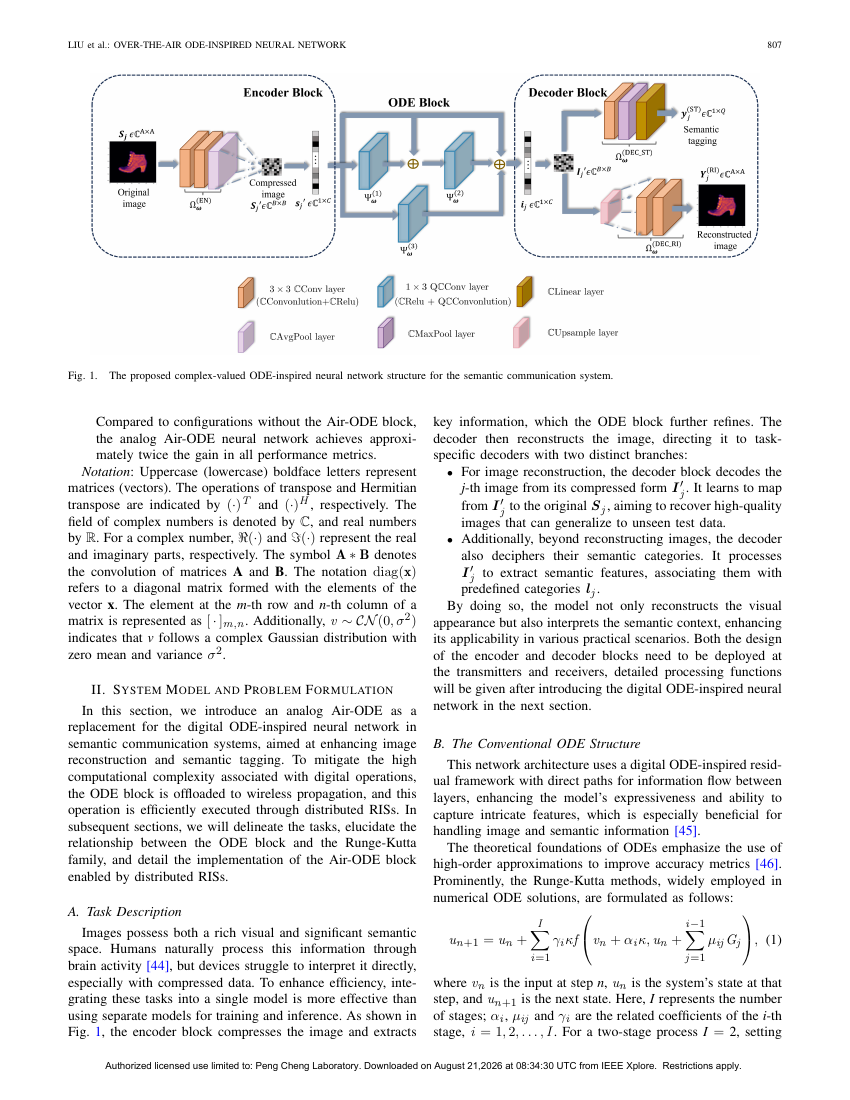
架构/方法图|来源:《Over-the-Air ODE-Inspired Neural Network for Dual Task-Oriented Semantic Communications》,原 PDF p.3,Fig. 1 The proposed complex-valued ODE-inspired neural network structure for the semantic communication system。 核对论文关键实验结果图/表|来源:《Over-the-Air ODE-Inspired Neural Network for Dual Task-Oriented Semantic Communications》,原 PDF p.11,Fig. 8 Performance versus SNR。 核对论文
核心纳入2026边缘学习与任务通信
Personalized Federated Learning for GAI-Assisted Semantic Communications
通信模型我们认为正交频分多址(OFDMA)被采用用于用户和BS之间的链路。 本调研据此归为“类别 0:信道作用点不足,或由外部传统链路抽象承担”。 PDF p.5
语义 decoder 实际面对的是:由论文系统模型定义的语义 feature、任务状态或传统译码后数据。 PDF p.5
是否真正处理离散变量出错:未形成可复核的 bit/index/token 错误闭环。
实验设置与主要结论
数据集/场景CIFAR-10、CIFAR-100、MNIST、Fashion-MNIST
BaselineViT、ResNet、OFDM、FedAvg
评价指标PSNR、SSIM、MSE、accuracy
信道与工作点AWGN、OFDM、wireless channel
数据集为CIFAR-10、CIFAR-100、MNIST、Fashion-MNIST;实验小节中明确出现的比较对象包括ViT、ResNet、OFDM、FedAvg;指标包括PSNR、SSIM、MSE、accuracy;信道/链路条件包括AWGN、OFDM、wireless channel。 PDF p.2
然后,为了实现部署在每个用户的GSC模型的有效学习,个性化语义联邦学习(PSFL)框架的建议。 PDF p.1
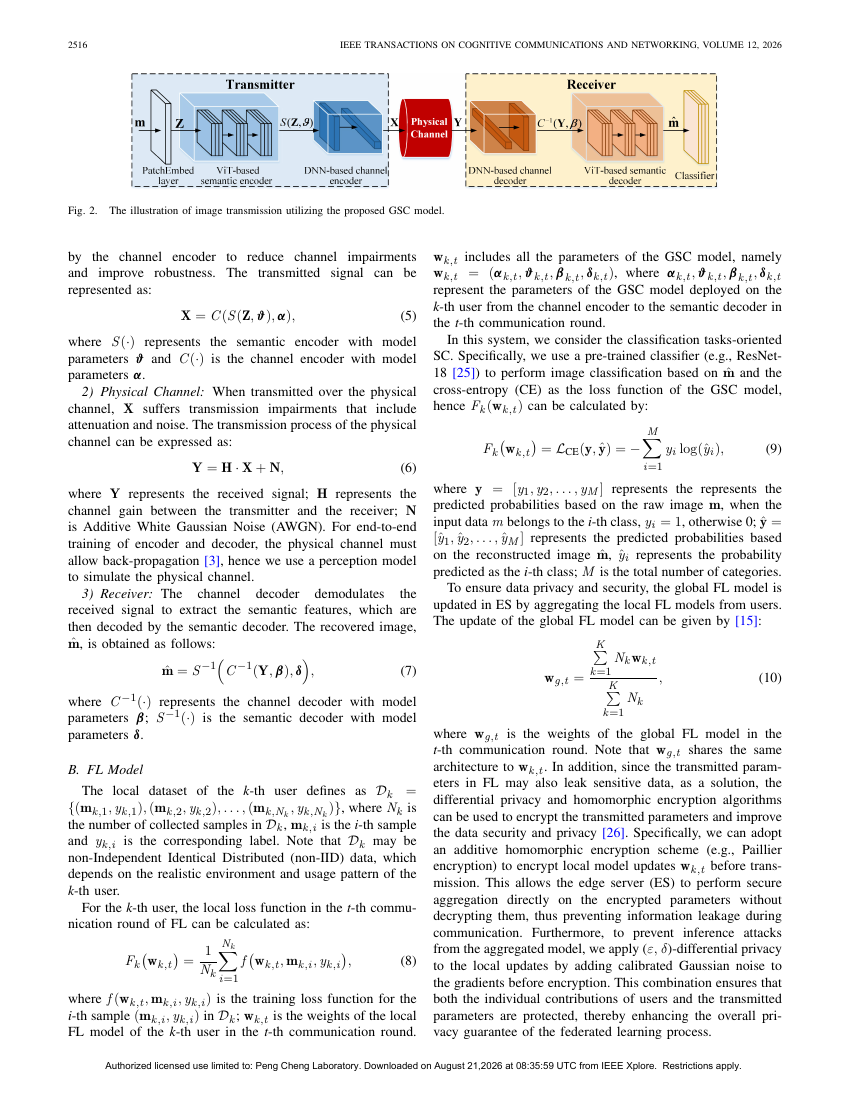
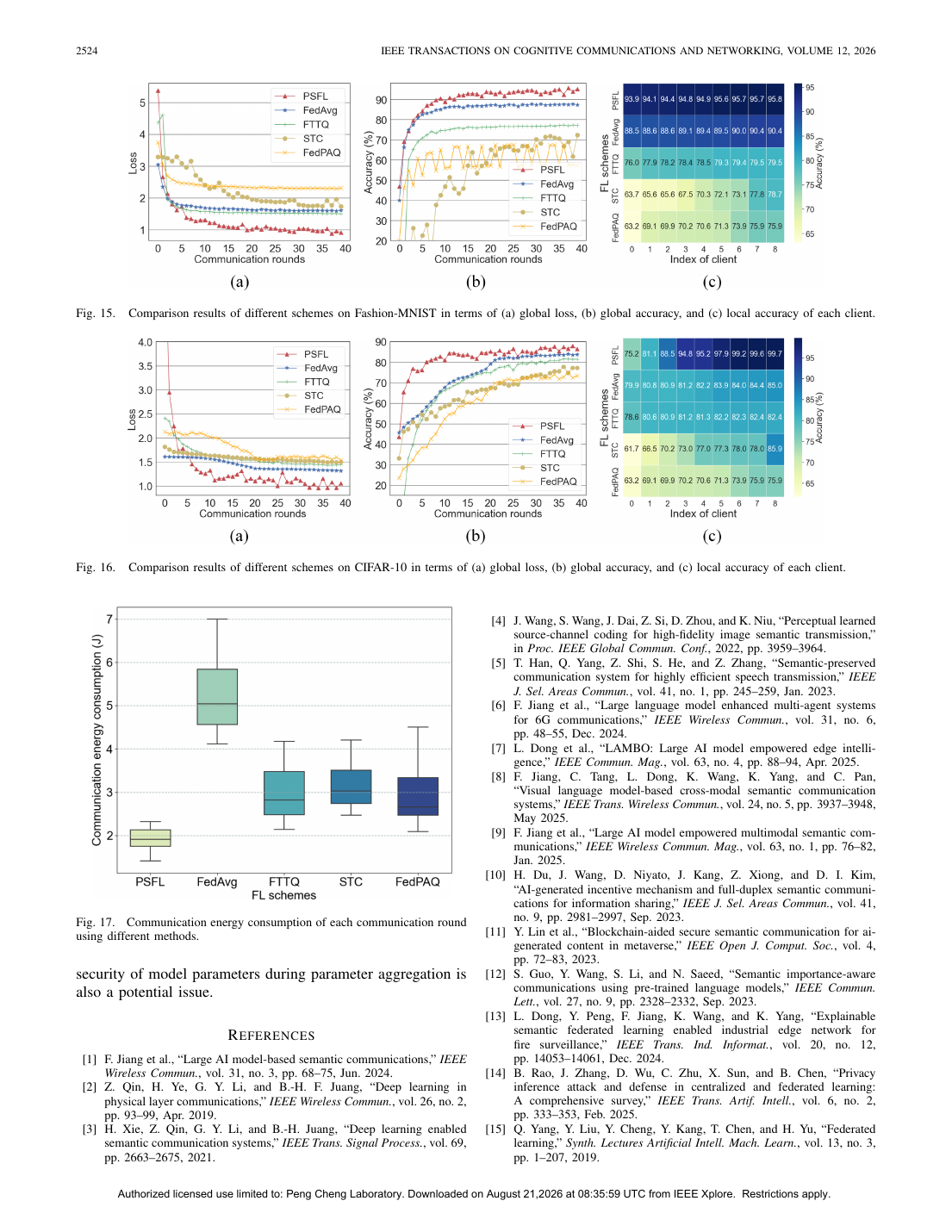
架构/方法图|来源:《Personalized Federated Learning for GAI-Assisted Semantic Communications》,原 PDF p.4,Fig. 2 The illustration of image transmission utilizing the proposed GSC model。 核对论文关键实验结果图/表|来源:《Personalized Federated Learning for GAI-Assisted Semantic Communications》,原 PDF p.12,Fig. 15 Comparison results of different schemes on Fashion-MNIST in terms of (a) global loss, (b) global accuracy, and (c) local accuracy of each client。 核对论文
核心纳入2026任务导向推理
PLM-Based Two-Stage Semantic Encoding for Task-Oriented Semantic Communication on the Fly
现有进展:语义通信(SemCom)通过传递语义特征而超越了比特级传输,面向任务的通信(TOC)进一步以任务相关特征的传输为目标,提高了通信效率。 PDF p.1
仍然存在的问题:然而,现有的TOC方案对于每个数据输入仍然依赖于基于高维深度学习(DL)的语义源编码器,导致通信期间的高编码复杂度。 PDF p.1
为什么已有方法解决不了:像素级重建是比下游决策更强、也更昂贵的目标;但只压缩 feature 又可能丢掉决定任务的少量证据,因此需要把任务 loss 与通信瓶颈联合设计。 PDF p.1
为什么这个问题重要:边缘设备常需要及时决策而不是完整副本;只发送任务充分信息可以降低时延与带宽,但前提是关键证据确实能穿过信道。 PDF p.1
本文提出什么:本文提出了一种名为面向任务的SemCom on-the-fly(TO-SemComFly)的新范式,该范式利用预训练语言模型(PLM)离线预计算语义特征,从而实现快速且低复杂度的动态编码。 PDF p.1
方案为何可能有效:提出了一种高效的面向任务的SemCom框架TO-SemComFly,该框架由基于PLM的两阶段语义编码器实现,第一阶段采用PAC语义编码器从基于PLM的缓存中检索原始语义特征,第二阶段采用LF语义编码器,以形成连贯和信道鲁棒的语义特征。 PDF p.3
作者希望证明什么:与现有的TOC方案相比,TO-SemComFly实现了至少63.4%和51.7%的精度提高在低信噪比下,和11.5%和20.7%的效率提高在AWGN和瑞利衰落信道。 PDF p.1
方法与端到端信息流
本文提出了一种面向任务的SemCom on-the-fly模式(TO-SemComFly),它利用预训练语言模型(PLM)离线预计算语义特征,实现了快速、低复杂度的动态编码。·提出了一种面向任务的高效SemCom框架TO-SemComFly,该方法在第一阶段采用PAC语义编码器从基于PLM的缓存中检索原始语义特征,在第二阶段采用LF语义编码器以形成连贯且信道鲁棒的语义特征。 PDF p.1PDF p.3
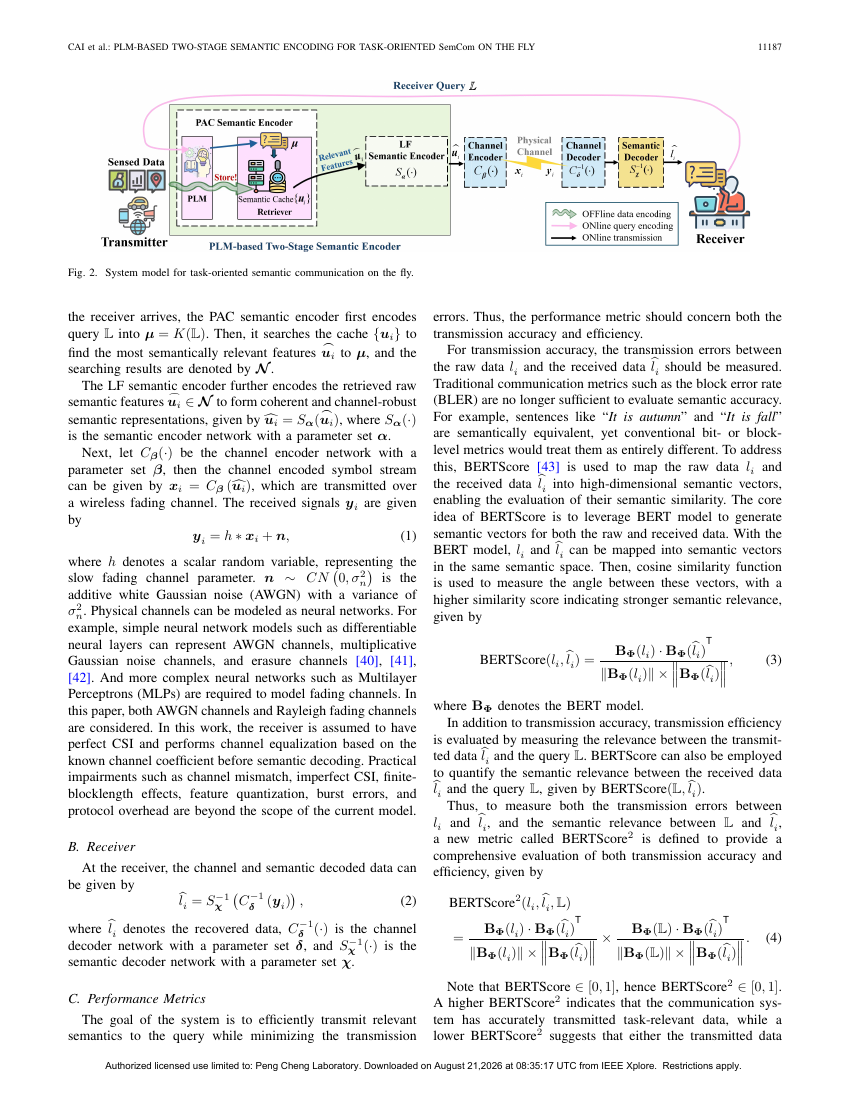
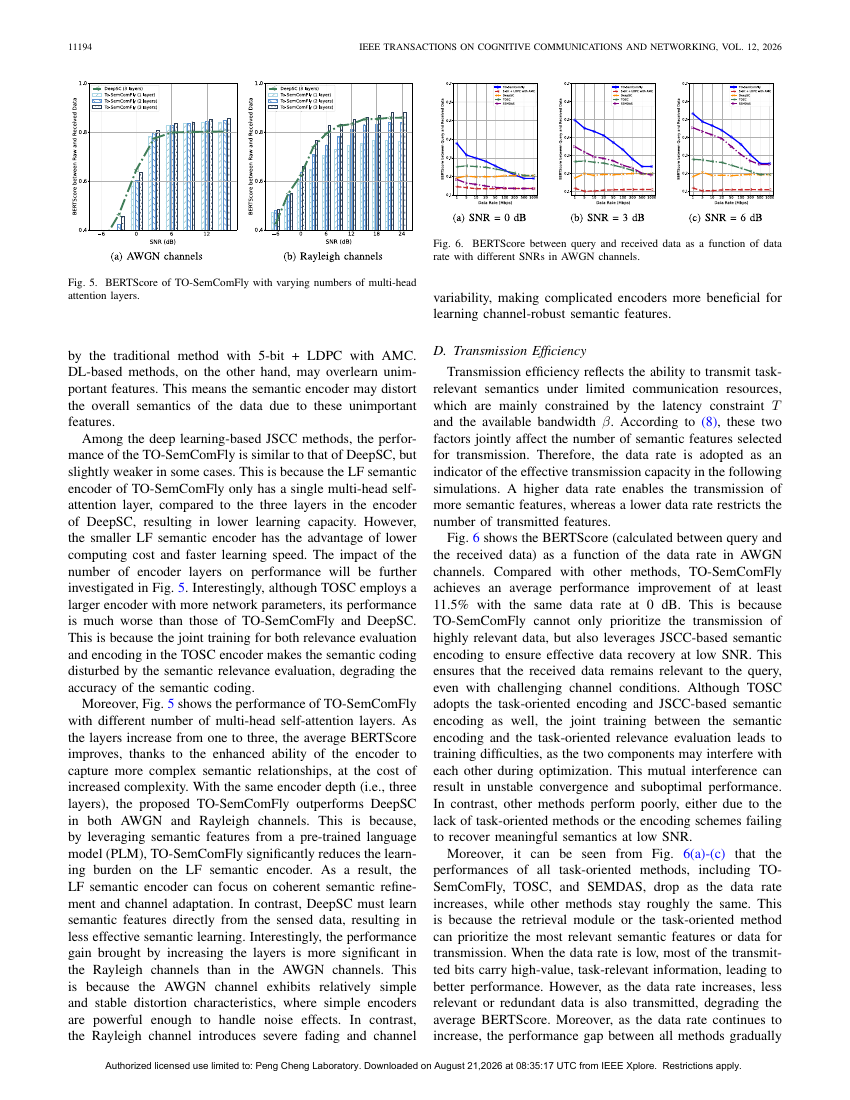
架构/方法图|来源:《PLM-Based Two-Stage Semantic Encoding for Task-Oriented Semantic Communication on the Fly》,原 PDF p.5,Fig. 2 System model for task-oriented semantic communication on the fly。 核对论文关键实验结果图/表|来源:《PLM-Based Two-Stage Semantic Encoding for Task-Oriented Semantic Communication on the Fly》,原 PDF p.12,Fig. 6 BERTScore between query and received data as a function of data rate with different SNRs in AWGN channels。 核对论文
核心纳入2026图像传输、压缩或生成
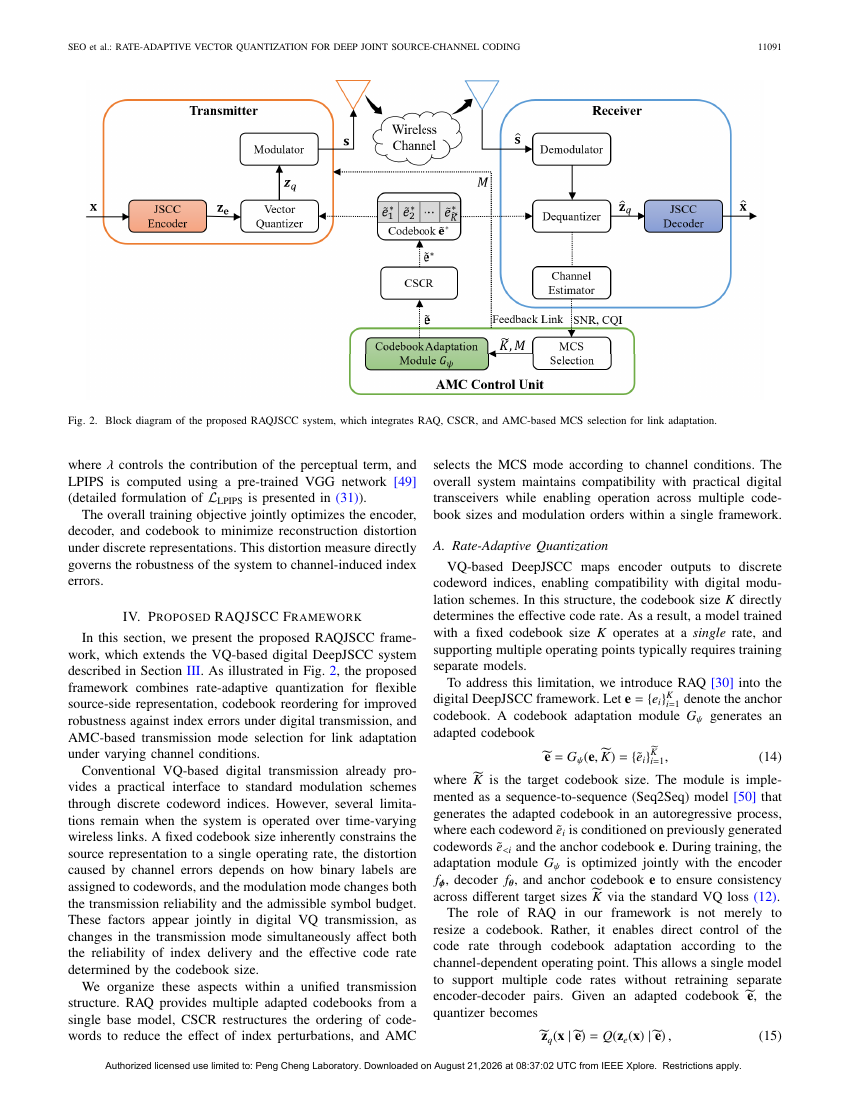
Rate-Adaptive Vector Quantization for Deep Joint Source-Channel Coding
现有进展:传统的基于深度学习的联合信源信道编码(DeepJSCC)框架通常需要针对不同码率和信道条件的单独模型,并且由于其模拟传输性质而与实际数字通信系统不兼容。 PDF p.1
仍然存在的问题:在本文设定中,现有方法不能同时满足“图像传输、压缩或生成”的语义目标与通信、计算或资源约束;后续方案需要补齐这一具体瓶颈。 PDF p.1
为什么已有方法解决不了:连续 latent 或独立设计的传统链路没有回答语义特征怎样量化、映射为有限符号,以及 bit/index 出错后为何不会跳到完全不同的语义。仅改进信源网络无法补上这一接口。 PDF p.1
为什么这个问题重要:有限信道使用迫使系统决定哪些视觉内容值得保护;低 SNR 或高压缩率下,任务/感知关键结构往往比平均像素误差更重要。 PDF p.1
本文提出什么:为了解决这些限制,我们提出了一个统一的基于速率自适应量化的DeepJSCC(RAQJSCC)框架,该框架在单个模型内实现信道感知速率自适应,同时保持与传统数字通信系统的兼容性。 PDF p.1
方案为何可能有效:此外,我们将自适应调制和编码(AMC)单元,共同选择调制阶数和有效的码本大小的基础上的信道条件,使动态链路自适应不同的SNR制度。 PDF p.1
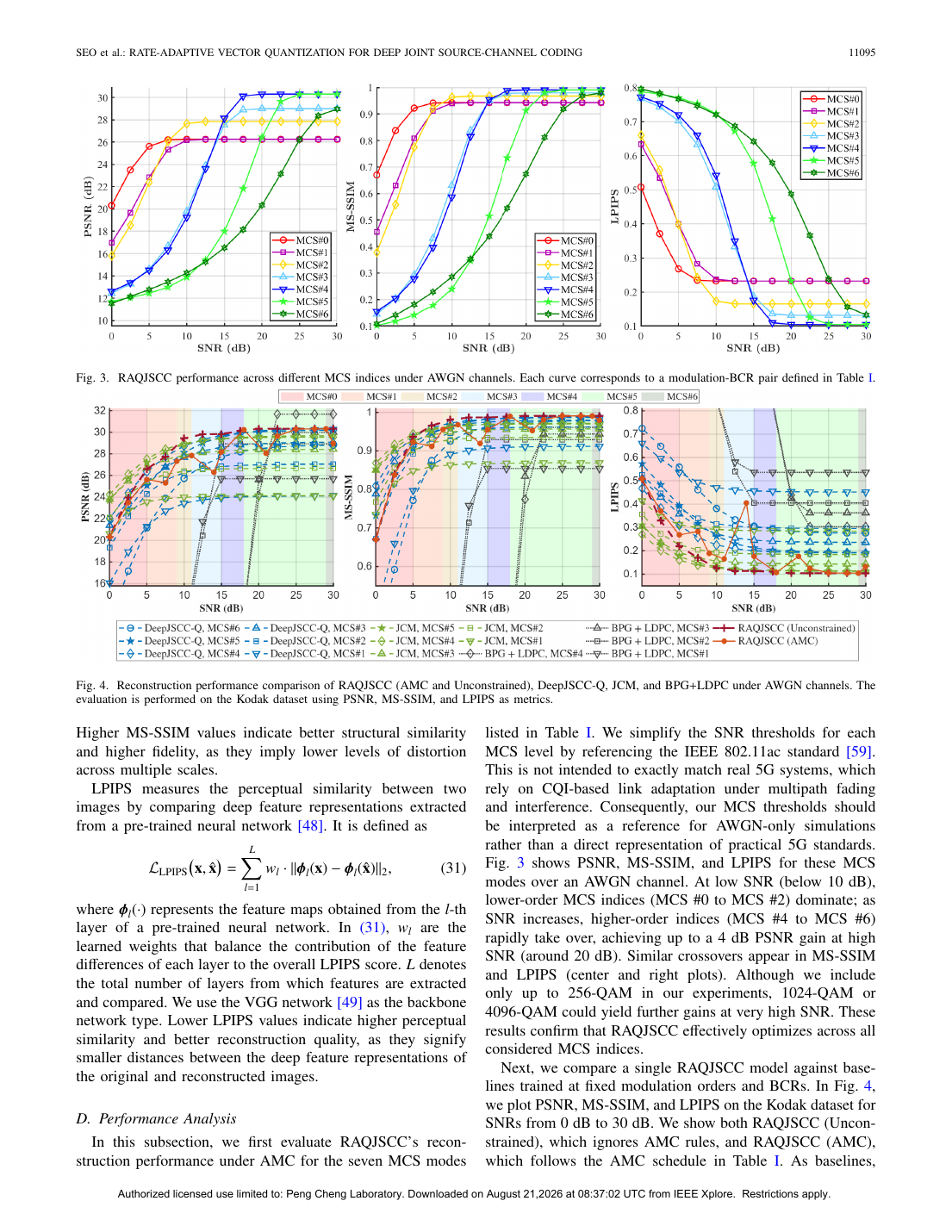
作者希望证明什么:实验结果表明,所提出的RAQJSCC框架优于现有的DeepJSCC和基于分离的方法在重建质量方面在宽范围的SNR,同时有效地减轻悬崖效应。 PDF p.1
方法与端到端信息流
为了解决这些局限性,我们提出了一个统一的基于速率自适应量化的DeepJSCC(RAQJSCC)框架,该框架在保持与传统数字通信系统兼容的同时,能够在单个模型内实现信道感知的速率自适应。此外,我们还结合了自适应调制和编码(AMC)单元,该单元基于信道条件联合选择调制阶数和有效码本大小,使得能够在不同的SNR体制上进行动态链路自适应。 PDF p.1
架构/方法图|来源:《Rate-Adaptive Vector Quantization for Deep Joint Source-Channel Coding》,原 PDF p.5,Fig. 2 Block diagram of the proposed RAQJSCC system, which integrates RAQ, CSCR, and AMC-based MCS selection for link adaptation。 核对论文关键实验结果图/表|来源:《Rate-Adaptive Vector Quantization for Deep Joint Source-Channel Coding》,原 PDF p.9,Fig. 3 RAQJSCC performance across different MCS indices under AWGN channels. Each curve corresponds to a modulation-BCR pair defined in 核对论文
核心纳入2026图像传输、压缩或生成
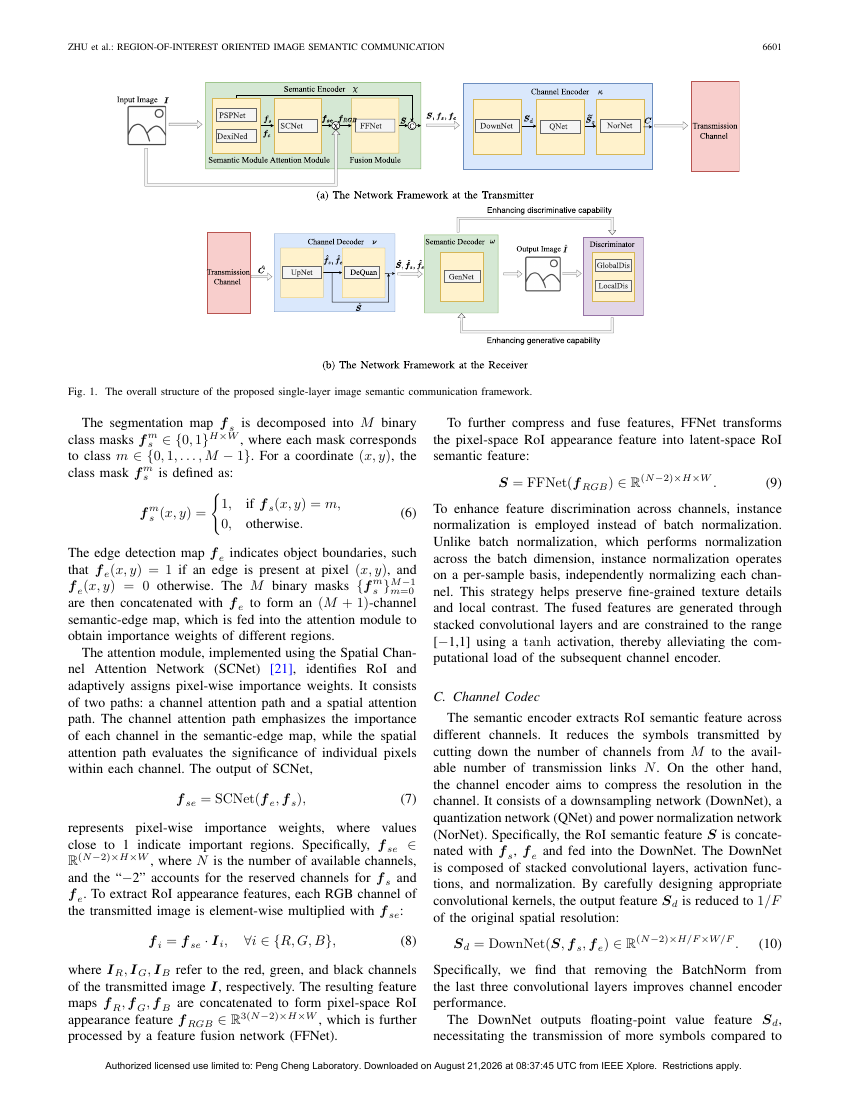
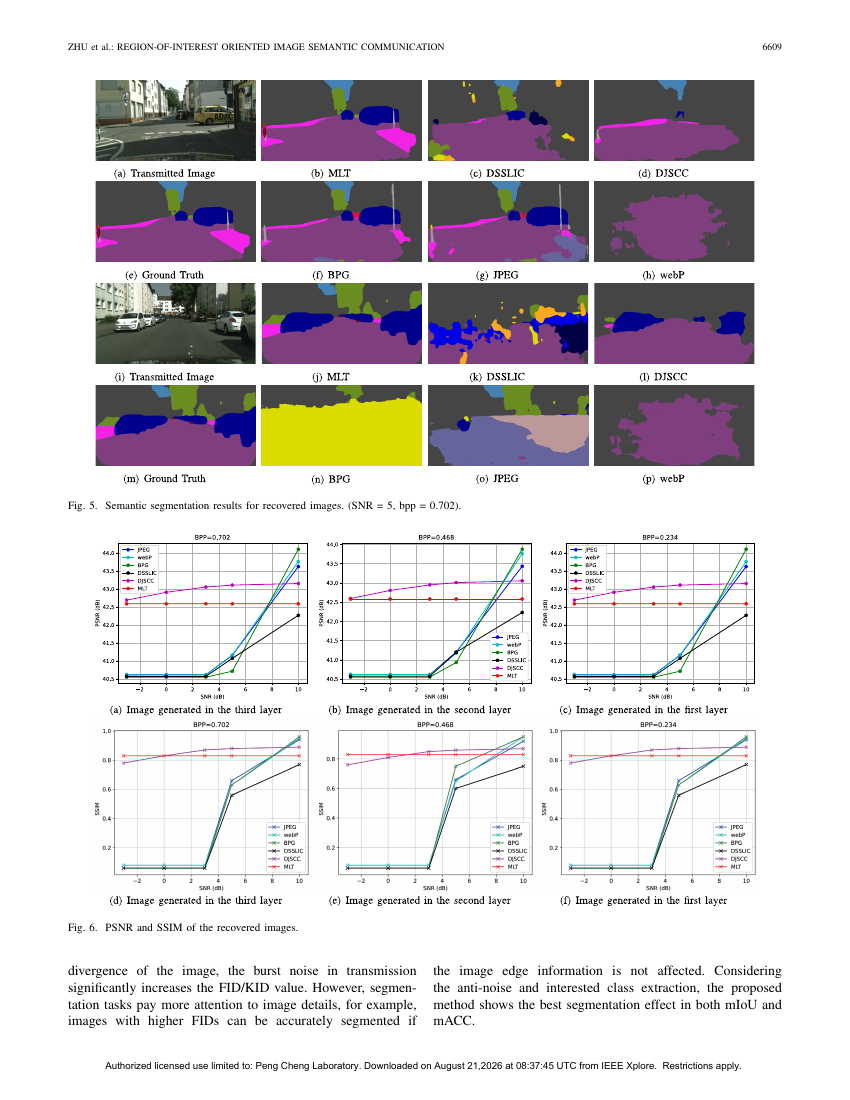
Region-of-Interest Oriented Image Semantic Communication
现有进展:非地面网络(NTN)在为即将到来的第六代(6G)技术提供广泛覆盖和无障碍连接方面至关重要。 PDF p.1
仍然存在的问题:然而,在整个语义处理和传输过程中的有效资源分配问题仍然没有得到解决。 PDF p.1
为什么已有方法解决不了:只按 bit rate、吞吐量或平均失真分配资源,无法区分不同样本和任务的语义价值;外层优化必须得到可用的语义效用—资源曲线。 PDF p.1
为什么这个问题重要:功率、带宽、算力和时延是共享资源;若调度器不知道语义效用,它可能增加吞吐量却没有改善任何用户真正关心的任务。 PDF p.1
本文提出什么:以传输过程为中心的传统通信方式已经接近香农极限;大量的数据量和大规模衰落将导致有形的通信瓶颈,例如延迟问题增加。 PDF p.1
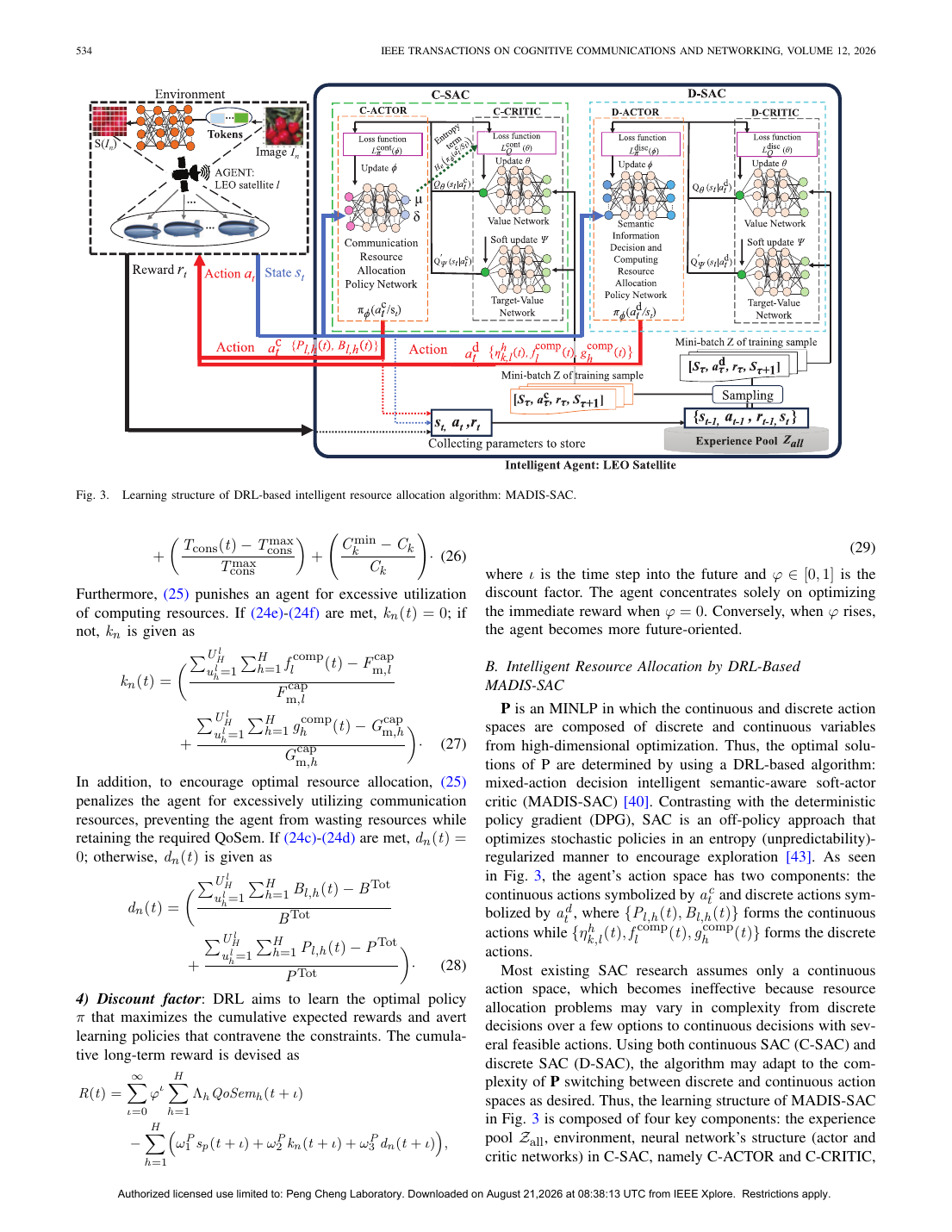
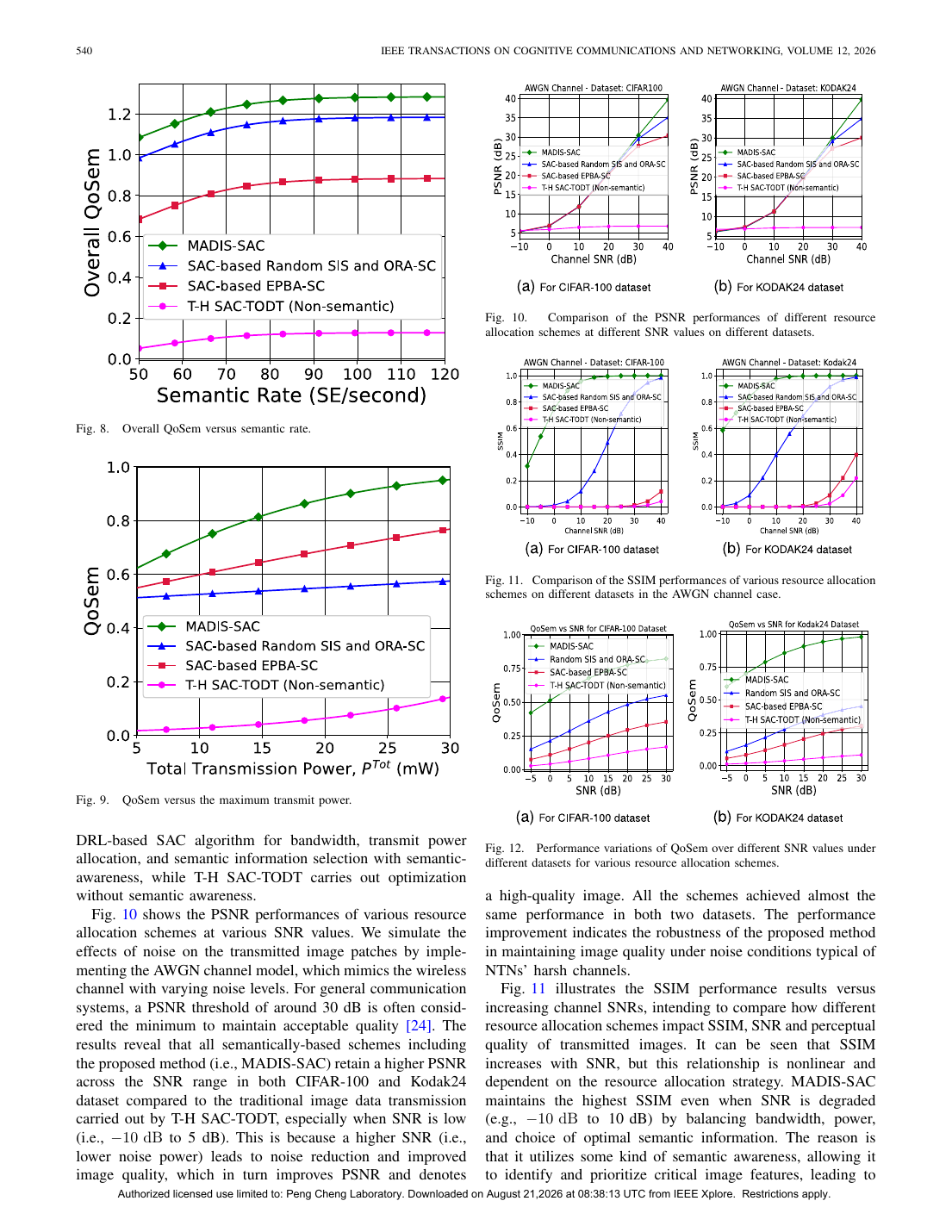
方案为何可能有效:本工作的主要目标是设计一个新的基于SemComs的NTN系统,该系统将考虑一个语义感知的资源分配框架,用于图像相关语义信息的处理和传输以及性能评估,特别是针对LEO卫星到HAP的下行传输。 PDF p.3
作者希望证明什么:如图所示,所提出的方法比T-H SAC-TODT方案获得了明显更高的回报,证明了其在更少的迭代中学习SemCom最佳策略的效率,以及在不同条件下做出决策的鲁棒性和有效性。 PDF p.15
方法与端到端信息流
以传输过程为中心的传统通信方式已经逼近香农极限;大量的数据量和大规模衰落将导致有形的通信瓶颈,贡献这项工作的主要目标是为NTN设计一个新的基于SemCom的系统,该系统联合考虑语义和该系统还提供了一种用于图像相关语义信息处理和传输以及性能评估的感知资源分配框架,特别关注LEO卫星到HAP的下行链路传输。 PDF p.1PDF p.3
架构/方法图|来源:《Resource Allocation for Semantic Communication in NTN Downlinks》,原 PDF p.11,Fig. 3 Learning structure of DRL-based intelligent resource allocation algorithm: MADIS-SAC。 核对论文关键实验结果图/表|来源:《Resource Allocation for Semantic Communication in NTN Downlinks》,原 PDF p.17,Fig. 10 Comparison of the PSNR performances of different resource allocation schemes at different SNR values on different datasets。 核对论文
核心纳入2026图像传输、压缩或生成
SADJSCC: Semantic-Aware DJSCC With Attribute Fidelity Evaluation for Channel-Adaptive Image Transmission
现有进展:传统的深度联合信源信道编码(DJSCC)方法在噪声环境中表现出语义不对准,这是由于它们依赖于像素级度量并且不能保持可解释的语义属性,特别是在变化的低信噪比(SNR)条件下。 PDF p.1
仍然存在的问题:然而,这些方法主要集中于通过感知度量来增强重构质量或提高传输效率。 PDF p.1
为什么已有方法解决不了:为固定 SNR 或带宽训练的模型具有固定瓶颈和保护方式;条件变化时重复运行同一网络,不能把码率或冗余重新分给变得脆弱的信息。 PDF p.1
为什么这个问题重要:有限信道使用迫使系统决定哪些视觉内容值得保护;低 SNR 或高压缩率下,任务/感知关键结构往往比平均像素误差更重要。 PDF p.1
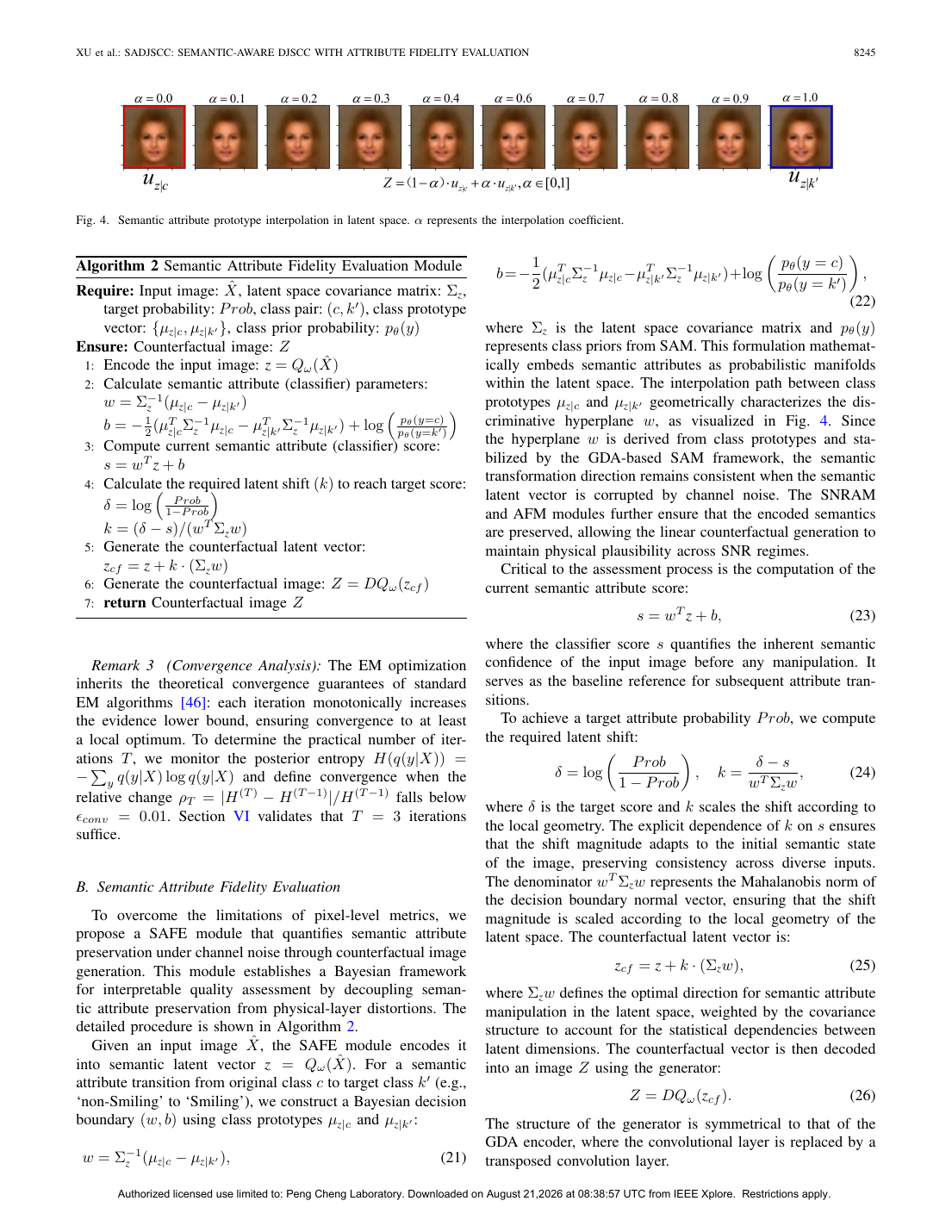
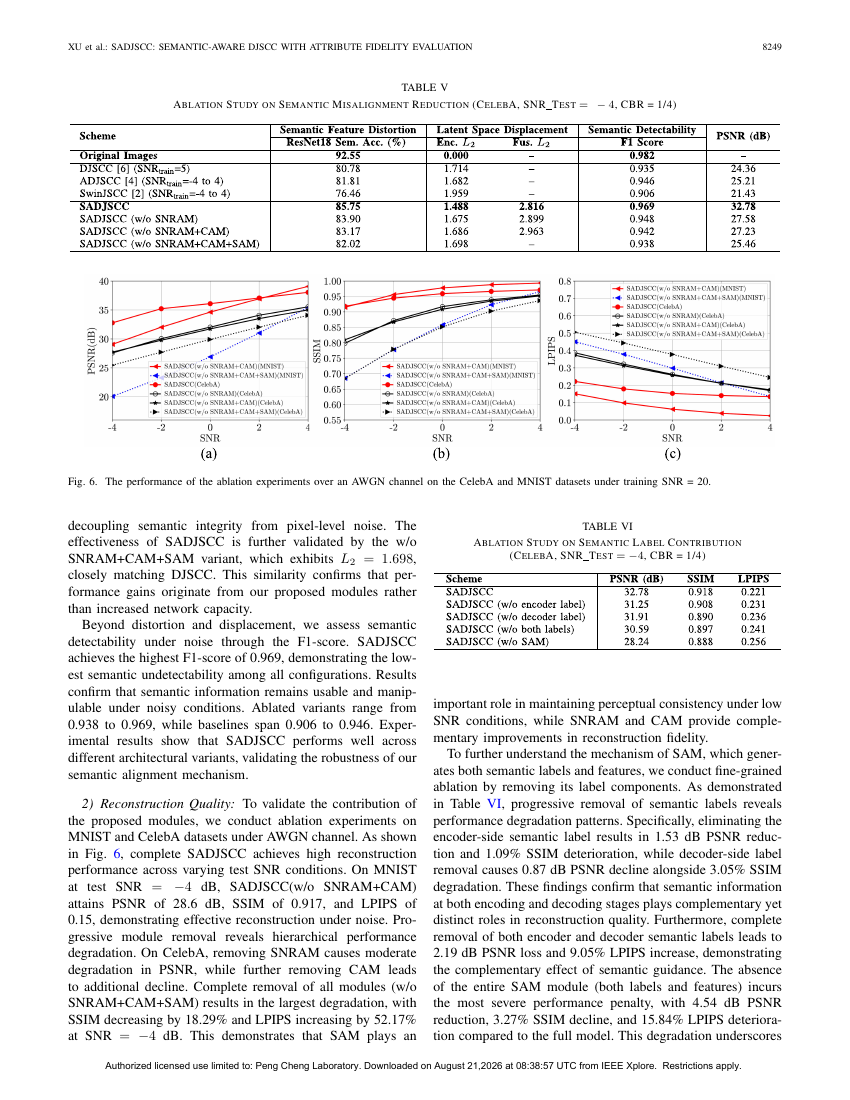
本文提出什么:为了解决这些挑战,我们提出了一个语义感知的深度联合信源信道编码与属性保真度评估的信道自适应图像传输(SADJSCC),一个统一的框架,以解决语义错位:语义特征失真,潜在的空间位移,语义不可检测性。 PDF p.1
方案为何可能有效:·提出了一种基于属性保真度评估的信道自适应图像传输的语义感知DJSCC(SADJSCC),这是第一个将语义感知指导与信道自适应编码相结合的框架。 PDF p.2
作者希望证明什么:在CelebA、CIFAR-10和MNIST数据集上的实验验证表明,SADJSCC的性能获得了一致的提高。 PDF p.1
方法与端到端信息流
为了解决这些问题,本文提出了一种面向信道自适应图像传输的语义感知深度联合信源信道编码算法(SADJSCC),该算法能够有效地解决语义错位问题,包括语义特征失真、潜在空间位移和语义不可检测性。·提出了一种用于信道自适应图像传输的带属性保真度评估的语义感知DJSCC(SADJSCC),这是第一个将语义感知指导与信道自适应编码相结合的框架。 PDF p.1PDF p.2
架构/方法图|来源:《SADJSCC: Semantic-Aware DJSCC With Attribute Fidelity Evaluation for Channel-Adaptive Image Transmission》,原 PDF p.7,Fig. 4 Semantic attribute prototype interpolation in latent space. α represents the interpolation coefficient。 核对论文关键实验结果图/表|来源:《SADJSCC: Semantic-Aware DJSCC With Attribute Fidelity Evaluation for Channel-Adaptive Image Transmission》,原 PDF p.11,Fig. 6 The performance of the ablation experiments over an AWGN channel on the CelebA and MNIST datasets under training SNR = 20。 核对论文
核心纳入2026图像传输、压缩或生成
Secure and Robust Joint Source-Channel Coding With Semantic Clustering and Adversarial Purification
数据集为Kodak、DIV2K、CIFAR-10、CIFAR10;实验小节中明确出现的比较对象包括DeepJSCC、NTSCC、SwinJSCC、ADJSCC、JSCC;指标包括PSNR、SSIM、MS-SSIM、accuracy、latency、MACs、PER;信道/链路条件包括AWGN、Rayleigh;正文可定位的代表性工作点有SNR = 7 dB、CBR of 1/6。 PDF p.8
实验结果表明,SCAPJSCC的性能优于SwinJSCC,实现了更有效的图像信息语义建模,对各种对抗性攻击具有更强的抗攻击能力。 PDF p.1
架构/方法图|来源:《Secure and Robust Joint Source-Channel Coding With Semantic Clustering and Adversarial Purification》,原 PDF p.4,Fig. 3 (a) The overall architecture of SCAPJSCC with adversarial purification (AP) modules. (b) The pipeline of vanilla SC blocks without adversarial purification modules。 核对论文关键实验结果图/表|来源:《Secure and Robust Joint Source-Channel Coding With Semantic Clustering and Adversarial Purification》,原 PDF p.9,Fig. 7 The experimental results on AWGN channels. As the SNR changes, the left subfigure depicts the PSNR metric, while the right subfigure depicts the MS-SSIM metric。 核对论文
核心纳入2026图像传输、压缩或生成
Secure Intellicise Wireless Network: Agentic AI for Coverless Semantic Steganography Communication
局限:没有完整离散接口,无法直接回答 bit/index/token 跳变问题。 未显式注入离散误码/丢包,鲁棒性结论不应外推到真实数字链路。 未报告统一可复核的 payload bit 数/CBR,跨论文带宽比较受限。
架构/方法图|来源:《Secure Intellicise Wireless Network: Agentic AI for Coverless Semantic Steganography Communication》,原 PDF p.11,Fig. 5 Visualization results of AgentSemSteCom under different classes of images, which include common steganography images, facial images and style images. The images are collected at SNR = 10 dB。 核对论文关键实验结果图/表|来源:《Secure Intellicise Wireless Network: Agentic AI for Coverless Semantic Steganography Communication》,原 PDF p.11,Fig. 5 Visualization results of AgentSemSteCom under different classes of images, which include common steganography images, facial images and style images. The images are collected at SNR = 10 dB。 核对论文
核心纳入2026任务导向推理
Semantic Communication for Cooperative Perception Using HARQ
现有进展:这种感知是通过车对车(V2V)通信实现的,允许连接的自动驾驶汽车(CAV)交换传感器数据,例如光探测和测距(LiDAR)点云,从而增强对环境的集体理解。 PDF p.1
仍然存在的问题:然而,由于建筑物和树木等障碍物的存在,自动驾驶车辆往往面临感知能力有限的问题。 PDF p.1
为什么已有方法解决不了:连续 latent 或独立设计的传统链路没有回答语义特征怎样量化、映射为有限符号,以及 bit/index 出错后为何不会跳到完全不同的语义。仅改进信源网络无法补上这一接口。 PDF p.1
为什么这个问题重要:边缘设备常需要及时决策而不是完整副本;只发送任务充分信息可以降低时延与带宽,但前提是关键证据确实能穿过信道。 PDF p.1
本文提出什么:我们开发了一种新的语义错误检测方法,以准确地识别错误的任务为导向的通信过程中,这是关键,以确定是否重传是保证在HARQ机制。 PDF p.1
方案为何可能有效:在本文中,我们研究了在通信系统设计中为了增强可靠性而采用的混合自动重传请求(HARQ)的结合,以进一步提高协作感知性能,特别是在极低信噪比(SNR)条件下。 PDF p.2
作者希望证明什么:仿真结果表明,我们提出的HARQ方法显着提高感知性能相比,没有HARQ,特别是在低信噪比制度。 PDF p.1
方法与端到端信息流
该文提出了一种新的语义错误检测方法,以准确地识别面向任务的通信过程中的错误,这是确定HARQ机制中是否允许重传的关键。文中研究了在通信系统设计中为了提高可靠性而采用的混合自动重传请求(HARQ)的结合,以进一步提高协作感知性能。特别是在极低的信噪比(SNR)条件下。本发明还提供了一种基于该方法的系统。 PDF p.1PDF p.2
架构/方法图|来源:《Semantic Communication for Cooperative Perception Using HARQ》,原 PDF p.8,Fig. 5 Structures of the cooperative perception with HARQ at the tth transmission. (a) SemHARQ-I; (b) SemHARQ-II。 核对论文关键实验结果图/表|来源:《Semantic Communication for Cooperative Perception Using HARQ》,原 PDF p.7,Fig. 2 and their subtle differences will be where the term λm is the net effect of all pair-wise compardescribed in detail below. isons involving the mth sample. Specifically, λm is given by 1) SemHARQ-I: As illustrated in 核对论文
核心纳入2026文本传输或语言任务
Semantic Communication for Machines: A Joint Transmission and Understanding Design
一句话主旨:Semantic Communication for Machines 面向文本传输或语言任务,把问题放在“生成式语义信源编码”层处理;本调研把主接口判断为“语义 feature/latent;量化到 bitstream 的接口未完整报告”。
Motivation|Introduction 怎样导出本文方案
现有进展:语义通信在多媒体传输和联合传输执行任务中表现出色,但缺乏通用的语义级设备控制架构。 PDF p.1
仍然存在的问题:在本文设定中,现有方法不能同时满足“文本传输或语言任务”的语义目标与通信、计算或资源约束;后续方案需要补齐这一具体瓶颈。 PDF p.1
为什么已有方法解决不了:把生成模型放在接收端并不等于通信开销自然降低;仍需明确发送什么条件、条件占多少资源,以及信道破坏条件时怎样约束幻觉和时延。 PDF p.1
为什么这个问题重要:一个 token 错误就可能改变整句含义,因此仅看 BER 不足以评价链路;必须追踪最终语言意义或任务输出。 PDF p.1
本文提出什么:本文介绍了一种创新的框架,使直接人/机器到设备的交互,通过自然语言表示的通用语义。 PDF p.1
方案为何可能有效:一个典型的M2M场景是无人机辅助检查,其中无人机需要与地面设备协调来完成环境诊断和农业优化等任务,但异构设备生态系统需要我们的新型语义级自然语言命令框架来绕过昂贵的协议标准化,同时保持跨设备的互操作性。 PDF p.2
作者希望证明什么:大量的实验表明,所提出的模型和技能在一对一和一对多的情况下,重点对信道噪声的鲁棒性和接收机的复杂性急剧下降的功效。 PDF p.1
方法与端到端信息流
本文介绍了一种通过通用语义的自然语言表示实现人/机到设备直接交互的创新框架,一个典型的M2M场景是无人机辅助检查,其中无人机需要与地面设备协调来完成环境诊断和农业优化等任务,然而,异构设备生态系统需要我们的新型语义级自然语言命令框架,以绕过昂贵的协议标准化,同时保持跨设备互操作性。 PDF p.1PDF p.2
输入输入是文本传输或语言任务所需的句子、token 序列或语言语义。
发送端发送端采用 Semantic Communication for Machines:本文介绍了一种通过通用语义的自然语言表示实现人/机到设备直接交互的创新框架,一个典型的M2M场景是无人机辅助检查,其中无人机需要与地面设备协调来完成环境诊断和农业优化等任务,然而,异构设备生态系统需要我们的新型语义级自然语言命令框架,以绕过昂贵的协议标准化,同时保持跨设备互操作性。
实际发送实际发送对象是语义 feature 或未完整规定 bit 映射的 latent。
信道信道作用方式按“类别 0:信道作用点不足,或由外部传统链路抽象承担”解释。
接收端接收端从论文假设已经恢复的语义特征开始,再执行语义解码、任务推理或生成。
输出最终输出为恢复文本、翻译结果或语言任务输出。
它在通信系统中的位置:利用接收端生成先验,把可预测细节从空口发送对象中移除。
数字化方案与真实传输开销
是否属于严格数字语义通信:否/不适用:主接口为连续 JSCC 或上层模型
表示判断:语义 feature/latent;量化到 bitstream 的接口未完整报告
全文没有给出可复核的 VQ/codebook/index-to-bit 接口。根据系统模型,本调研将传输表示判断为“语义 feature/latent;量化到 bitstream 的接口未完整报告”;不能把网络 latent 的每个浮点维度直接当成固定 bit。 独立判断:Semantic Communication for Machines 的主传输单位应归为“语义 feature/latent;量化到 bitstream 的接口未完整报告”。只有论文明确给出量化和映射时,才能把 token/index 数换算成总 bit;连续 channel symbol 只能按 channel uses/CBR 比较。 PDF p.2
在训练过程中,我们分别对BERT部分和体系结构中的其他部分使用了两种不同的带有线性预热调度器的Adam优化器,它们的最大学习速率分别为1 × 10⁻⁴和5 × 10⁻³。 PDF p.8
架构/方法图|来源:《Semantic Communication for Machines: A Joint Transmission and Understanding Design》,原 PDF p.2,Fig. 1 Application example of the proposed design。 核对论文关键实验结果图/表|来源:《Semantic Communication for Machines: A Joint Transmission and Understanding Design》,原 PDF p.13,Fig. 13 Performance comparison between word-level and subword-level decoding on ATIS and Snips datasets。 核对论文
核心纳入2026图像传输、压缩或生成
Semantic Feature Division Multiple Access for Digital Semantic Multiple Access Channels
信道与工作点AWGN、Rayleigh、SINR、fading channel、SNR = 5dB、SNR of 5dB、SNR of 0 dB、SNR of 10dB
数据集为MNIST;实验小节中明确出现的比较对象包括DeepJSCC、JSCC;指标包括PSNR、SSIM、MS-SSIM、MSE、accuracy、precision、classification accuracy;信道/链路条件包括AWGN、Rayleigh、SINR、fading channel;正文可定位的代表性工作点有SNR = 5dB、SNR of 5dB、SNR of 0 dB、SNR of 10dB。 PDF p.9
仿真结果表明,所提出的SFDMA方案在不同应用中具有语义特征域正交性,自适应功率分配方法在分类任务中表现出良好的性能,有效地保证了语义通信的服务质量(QoS)。 PDF p.1
架构/方法图|来源:《Semantic Feature Division Multiple Access for Digital Semantic Multiple Access Channels》,原 PDF p.11,Fig. 10 compares the image restoration accuracy performance of SFDMA, Deep JSCC with/without interference schemes for image reconstruc- 核对论文关键实验结果图/表|来源:《Semantic Feature Division Multiple Access for Digital Semantic Multiple Access Channels》,原 PDF p.11,Fig. 10 compares the image restoration accuracy performance of SFDMA, Deep JSCC with/without interference schemes for image reconstruc- 核对论文
相关但非核心2026综述、架构与研究路线
Semantic Radio Access Networks: Architecture, State-of-the-Art, and Future Directions
局限:没有完整离散接口,无法直接回答 bit/index/token 跳变问题。 未显式注入离散误码/丢包,鲁棒性结论不应外推到真实数字链路。 未报告统一可复核的 payload bit 数/CBR,跨论文带宽比较受限。 该文属于边界谱系,不能用它代表端到端语义通信主线。
架构/方法图|来源:《Semantic Radio Access Networks: Architecture, State-of-the-Art, and Future Directions》,原 PDF p.3,Fig. 1 The structure of this paper。 核对论文关键实验结果图/表|来源:《Semantic Radio Access Networks: Architecture, State-of-the-Art, and Future Directions》,原 PDF p.2,该页包含论文的关键实验结果图或表。 核对论文
核心纳入2026图像传输、压缩或生成
SemDiffShield: Agentic AI-Empowered Secure Image Semantic Communication via Cryptographic Diffusion
信道与工作点AWGN、Rayleigh、wireless channel、NOMA、fading channel、SNR from 0 dB、SNR of 18.34 dB、SNR of 26.23 dB、SNR of 21.92 dB、bandwidth ratio of 1/6
实验小节中明确出现的比较对象包括VAE、DeepSC、JSCC、CLIP、BLIP;指标包括PSNR、SSIM、LPIPS、MSE、mAP、accuracy、latency、FLOPs、PER;信道/链路条件包括AWGN、Rayleigh、wireless channel、NOMA、fading channel;正文可定位的代表性工作点有SNR from 0 dB、SNR of 18.34 dB、SNR of 26.23 dB、SNR of 21.92 dB、bandwidth ratio of 1/6。 PDF p.9
实验结果表明,SemDiffShield在保密性和恢复性之间取得了平衡,即使在传统基线失效的严重噪声条件下也能提供高保真恢复。 PDF p.1
架构/方法图|来源:《SemDiffShield: Agentic AI-Empowered Secure Image Semantic Communication via Cryptographic Diffusion》,原 PDF p.3,Fig. 2 Conventional semantic communication focuses on data manifold and to produce semantically meaningless out- 核对论文关键实验结果图/表|来源:《SemDiffShield: Agentic AI-Empowered Secure Image Semantic Communication via Cryptographic Diffusion》,原 PDF p.11,Fig. 6 Transmission Performance Comparison. The first row (a-c) and the second row (d-f) show the fidelity metrics (MSE, PSNR, and SSIM) under AWGN and Rayleigh fading channels, respectively. Our method maintains s 核对论文
核心纳入2026视频传输、生成或控制
ST-VJSCC: Spatio-Temporal Video DeepJSCC Scheme for Adaptive Wireless Transmission
信道与工作点AWGN、Rayleigh、Rician、fading channel、SNR=13 dB、SNR = 1dB、SNR of 1 dB、SNR = 13 dB、SNR of 35.26 dB、CBR=0.031、CBR of 0.019、CBR = 0.031
数据集为UCF101;实验小节中明确出现的比较对象包括DeepJSCC、H.264、H.265、LDPC、ViT、DVC、JSCC;指标包括PSNR、SSIM、MS-SSIM、MSE、latency、FPS;信道/链路条件包括AWGN、Rayleigh、Rician、fading channel;正文可定位的代表性工作点有SNR=13 dB、SNR = 1dB、SNR of 1 dB、SNR = 13 dB、SNR of 35.26 dB、CBR=0.031、CBR of 0.019、CBR = 0.031。 PDF p.10
在未来的工作中,我们将专注于视频内容自适应可变长度编码和信道自适应可伸缩视频编码,以进一步提高传输效率和鲁棒性在现实世界的信道条件下。 PDF p.15
架构/方法图|来源:《ST-VJSCC: Spatio-Temporal Video DeepJSCC Scheme for Adaptive Wireless Transmission》,原 PDF p.3,Fig. 1 The proposed ST-VJSCC scheme for the semantic communications system。 核对论文关键实验结果图/表|来源:《ST-VJSCC: Spatio-Temporal Video DeepJSCC Scheme for Adaptive Wireless Transmission》,原 PDF p.9,Fig. 5 Performance comparison of ST-VJSCC to other schemes over AWGN channel cases (CBR=0.031). (a) PSNR performance for UCF101 dataset. (b) MS-SSIM performance for UCF101 dataset. (c) PSNR performance for BVI-DVC dataset. (d) MS-SSIM perfromance for BVI-DVC dataset。 核对论文
核心纳入2026语义信息度量与理论
Task-Adaptive Semantic Communication With Feedback: A Conditional Rate-Distortion Approach
架构/方法图|来源:《Task-Adaptive Semantic Communication With Feedback: A Conditional Rate-Distortion Approach》,原 PDF p.5,Fig. 1 The framework of TASC-f. Ui is the specific semantic prompt for the i-th semantic tasks, such as classification and instance segmentation。 核对论文关键实验结果图/表|来源:《Task-Adaptive Semantic Communication With Feedback: A Conditional Rate-Distortion Approach》,原 PDF p.8,Fig. 4 Comparison of rate-distortion performance under fixed known semantic tasks。 核对论文
核心纳入2026图像传输、压缩或生成
Task-Generalizable Deep Joint Source-Channel Coding via Hierarchical Masked Autoencoders
架构/方法图|来源:《Task-Generalizable Deep Joint Source-Channel Coding via Hierarchical Masked Autoencoders》,原 PDF p.6,Fig. 4 An overall framework of the hierarchical masked autoencoder (HMAE), which learns hierarchical representation via a dual self-supervised objective: masked image reconstruction (MIR) and masked hierarchical tree prediction (MHTP)。 核对论文关键实验结果图/表|来源:《Task-Generalizable Deep Joint Source-Channel Coding via Hierarchical Masked Autoencoders》,原 PDF p.11,Fig. 9 extends our evaluation to super-resolution tasks, comparing the reconstruction performance under different scaling factors and channel conditions. The PSNR results for 2× 核对论文
核心纳入2026通用语义通信系统
Topic Enhanced Semantic Communication System for Reliable Semantic Recovery
数据集为Europarl;实验小节中明确出现的比较对象包括WITT、LDPC、VAE、VQ-VAE、DeepSC、Huffman、BERT、OFDM;指标包括mAP、accuracy、precision、FLOPs、BLEU、semantic similarity、BER、SER;信道/链路条件包括AWGN、Rayleigh、Rician、MIMO、OFDM、fading channel。 PDF p.9
与其他基准测试相比,所提出的TESC在不增加传输数据量的情况下显著提高了通信可靠性。 PDF p.1
架构/方法图|来源:《Topic Enhanced Semantic Communication System for Reliable Semantic Recovery》,原 PDF p.6,Fig. 2 The proposed two topic-semantic fusion mechanisms: (a) Word-level attention-based fusion mechanism; (b) Sentence-level attention-based fusion mechanism。 核对论文关键实验结果图/表|来源:《Topic Enhanced Semantic Communication System for Reliable Semantic Recovery》,原 PDF p.10,Fig. 5 BLEU score versus SNR for comparison of TESC with and without ensure a fair comparison. topic over various channels。 核对论文
核心纳入2026多模态检索与任务通信
Toward Intelligent IoT Services: A Generative AI-Assisted Semantic-Aware Framework
信道与工作点AWGN、Rayleigh、channel estimation、fading channel、SNR of 12 dB
实验小节中明确出现的比较对象包括JPEG、LDPC、Turbo、QAM、DeepSC、JSCC;指标包括MSE、accuracy、latency、classification accuracy、F1-score;信道/链路条件包括AWGN、Rayleigh、channel estimation、fading channel;正文可定位的代表性工作点有SNR of 12 dB。 PDF p.8
语义感知智能对于支持人工智能的物联网(IoT)服务至关重要,以实现跨异构设备的广泛覆盖和高可靠性。 PDF p.1
架构/方法图|来源:《Toward Intelligent IoT Services: A Generative AI-Assisted Semantic-Aware Framework》,原 PDF p.9,Fig. 3 Accuracy comparison of various methods in Multimodal Sentiment Recognition (MSR) tasks。 核对论文关键实验结果图/表|来源:《Toward Intelligent IoT Services: A Generative AI-Assisted Semantic-Aware Framework》,原 PDF p.10,Fig. 6 Visualization of the denoising performance of AADM on image, text, and audio signals in MSR tasks over AWGN channels。 核对论文
相关但非核心2026通用语义通信系统
Uplink-Assisted Joint Channel Estimation and CSI Feedback: An Approach Based on Deep Joint Source-Channel Coding
现有进展:在频分双工(FDD)多输入多输出(MIMO)无线通信系统中,获取下行链路信道状态信息(CSI)对于最大化空间资源利用率和提高系统频谱效率至关重要。 PDF p.1
仍然存在的问题:然而,随着天线数量的增加,传统的CSI反馈技术--例如基于信道稀疏假设的压缩感知(CS)方法和5G中使用的基于码本的方法--在有限的反馈资源约束下难以获得满意的CSI重构性能。 PDF p.1
为什么已有方法解决不了:为固定 SNR 或带宽训练的模型具有固定瓶颈和保护方式;条件变化时重复运行同一网络,不能把码率或冗余重新分给变得脆弱的信息。 PDF p.1
为什么这个问题重要:语义质量必须在真实的带宽、功率和时延预算下成立,否则模型收益不能转化为通信系统收益。 PDF p.1
本文提出什么:该文提出了一种基于深度联合信源信道编码(DJSCC)结构的上行链路辅助的信道估计和信道状态信息联合反馈方法,用于下行链路信道状态信息的获取,该方法可以有效地缓解传统模块化通信框架中由于模块间分布偏差和传统信源信道编码分离所带来的“悬崖效应”而导致的性能下降。 PDF p.1
方案为何可能有效:此外,利用FDD系统中上行信道和下行信道之间的部分互易性,将上行信道的CSI作为辅助信息,在不引入额外开销的情况下,提高了CSI重构的精度。 PDF p.1
作者希望证明什么:数值计算结果表明,采用辅助上行信道状态信息(CSI)可以显著改善系统的性能。 PDF p.14
方法与端到端信息流
本文提出了一种基于深度联合信源信道编码(DJSCC)的上行链路辅助的CE和CSI联合反馈方法,用于下行链路CSI捕获,该方法可以缓解传统模块化通信框架中由独立训练模块的分布偏差和传统独立信源信道编码中遇到的“悬崖效应”造成的性能下降。我们利用上行链路CSI作为辅助信息,通过利用FDD系统中上行链路和下行链路信道之间的部分互易性来提高CSI重构精度,而不引入额外的开销。 PDF p.1
架构/方法图|来源:《Uplink-Assisted Joint Channel Estimation and CSI Feedback: An Approach Based on Deep Joint Source-Channel Coding》,原 PDF p.5,Fig. 2 The network architecture of UJEFNet is illustrated with detailed figures of key modules. For clarity, some operations that do not involve trainable parameters are omitted from the figure, and parameter settings for certain network layers are summarized in 核对论文关键实验结果图/表|来源:《Uplink-Assisted Joint Channel Estimation and CSI Feedback: An Approach Based on Deep Joint Source-Channel Coding》,原 PDF p.12,Fig. 9 Ablation experiments: Evaluating the performance gain provided by 核对论文
核心纳入2026语义感知资源分配与网络优化
VQ-DSC-R: Robust Vector Quantized-Enabled Digital Semantic Communication With OFDM Transmission
信道与工作点wireless channel、MIMO、OFDM、channel estimation、imperfect CSI、fading channel、SNR of 25.66 dB、SNR = 9 dB、SNR of 28 dB、SNR of 29.22dB、SNR of 25.66dB
数据集为DIV2K、ImageNet;实验小节中明确出现的比较对象包括DeepJSCC、JPEG、LDPC、QAM、Swin Transformer、VAE、VQ-VAE、SwinJSCC、ADJSCC、JSCC、SSCC、OFDM;指标包括PSNR、SSIM、MS-SSIM、MSE、mAP、accuracy、latency、FLOPs、goodput、NMSE;信道/链路条件包括wireless channel、MIMO、OFDM、channel estimation、imperfect CSI、fading channel;正文可定位的代表性工作点有SNR of 25.66 dB、SNR = 9 dB、SNR of 28 dB、SNR of 29.22dB、SNR of 25.66dB。 PDF p.11
在3GPP EPA信道上的大量实验表明,VQ-DSC-R具有更优的性能,在0.02比特压缩比(BCR)下,峰值信噪比(PSNR)为29.22 dB,多尺度结构相似性(MSSSIM)为0.959。 PDF p.1
架构/方法图|来源:《VQ-DSC-R: Robust Vector Quantized-Enabled Digital Semantic Communication With OFDM Transmission》,原 PDF p.4,Fig. 1 Architecture of VQ-DSC-R system with OFDM transmission. (a) Overall system architecture; (b) Time-frequency grids of OFDM symbols。 核对论文关键实验结果图/表|来源:《VQ-DSC-R: Robust Vector Quantized-Enabled Digital Semantic Communication With OFDM Transmission》,原 PDF p.13,Fig. 6 PSNR and MS-SSIM performance of SQC update schemes under different channel estimation schemes and BCRs. (a) and (d) correspond to the STE scheme; (b) and (e) correspond to the NSVQ scheme; (c) and (f) correspond to the ANDVQ scheme。 核对论文