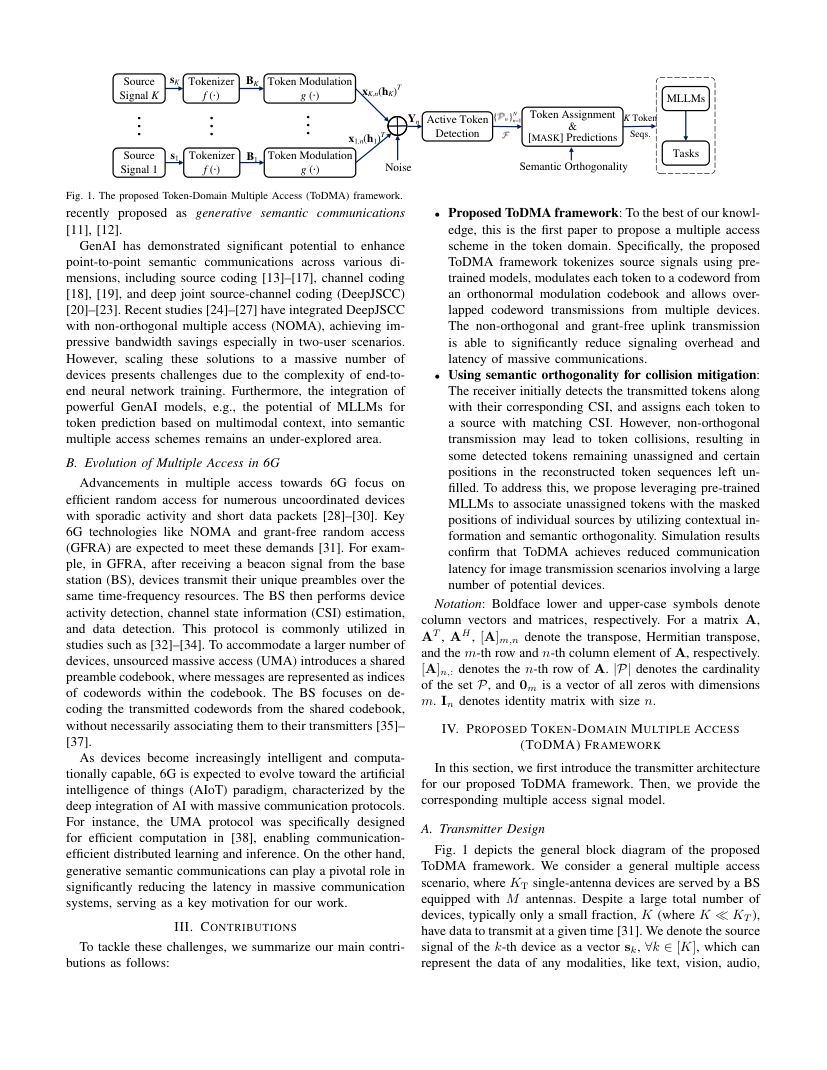
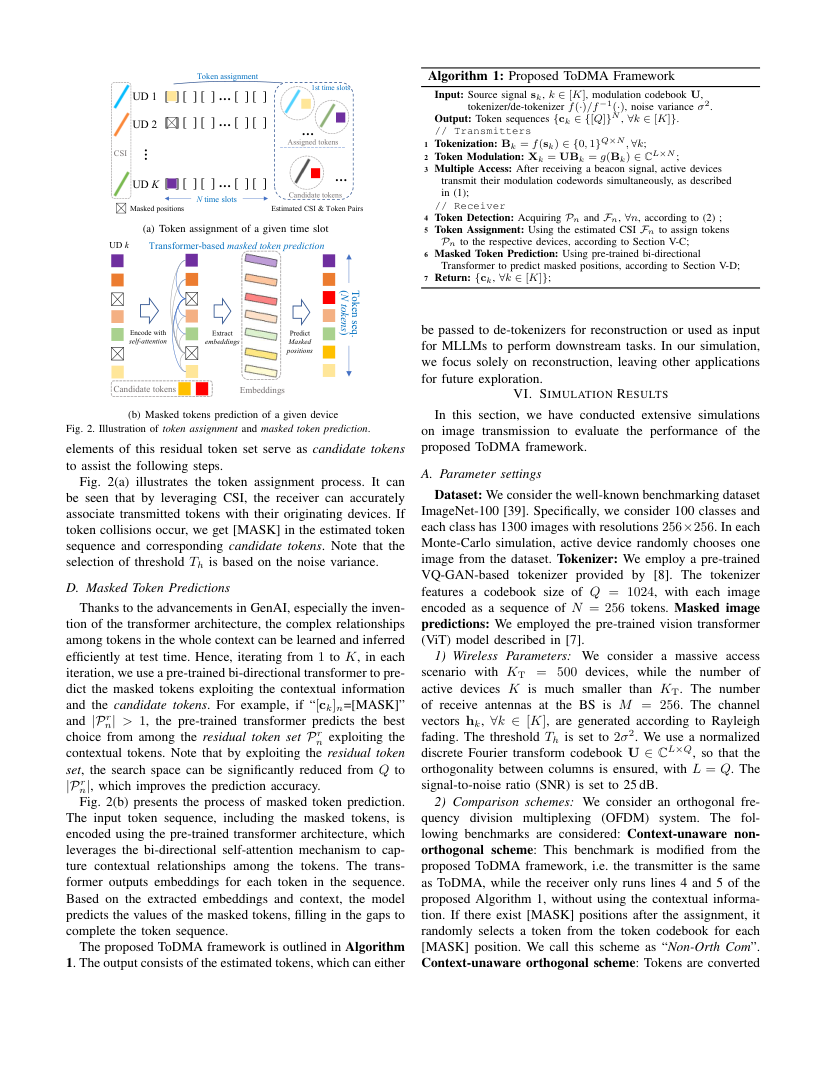
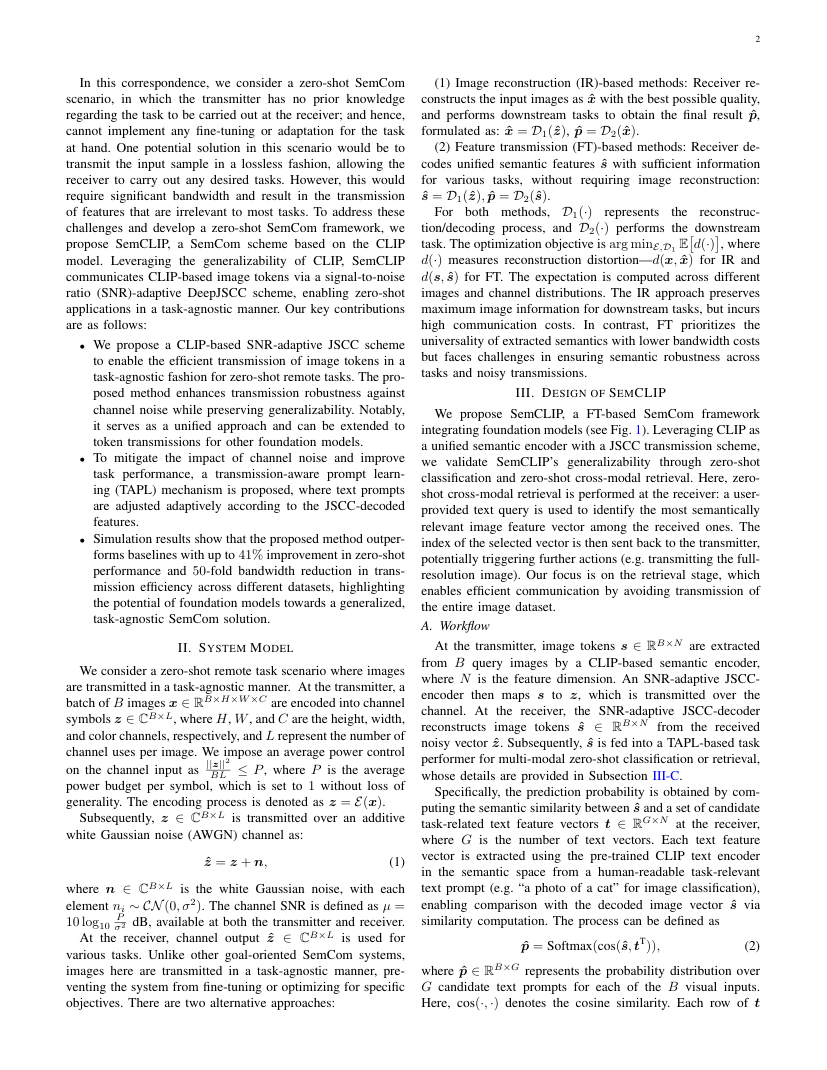
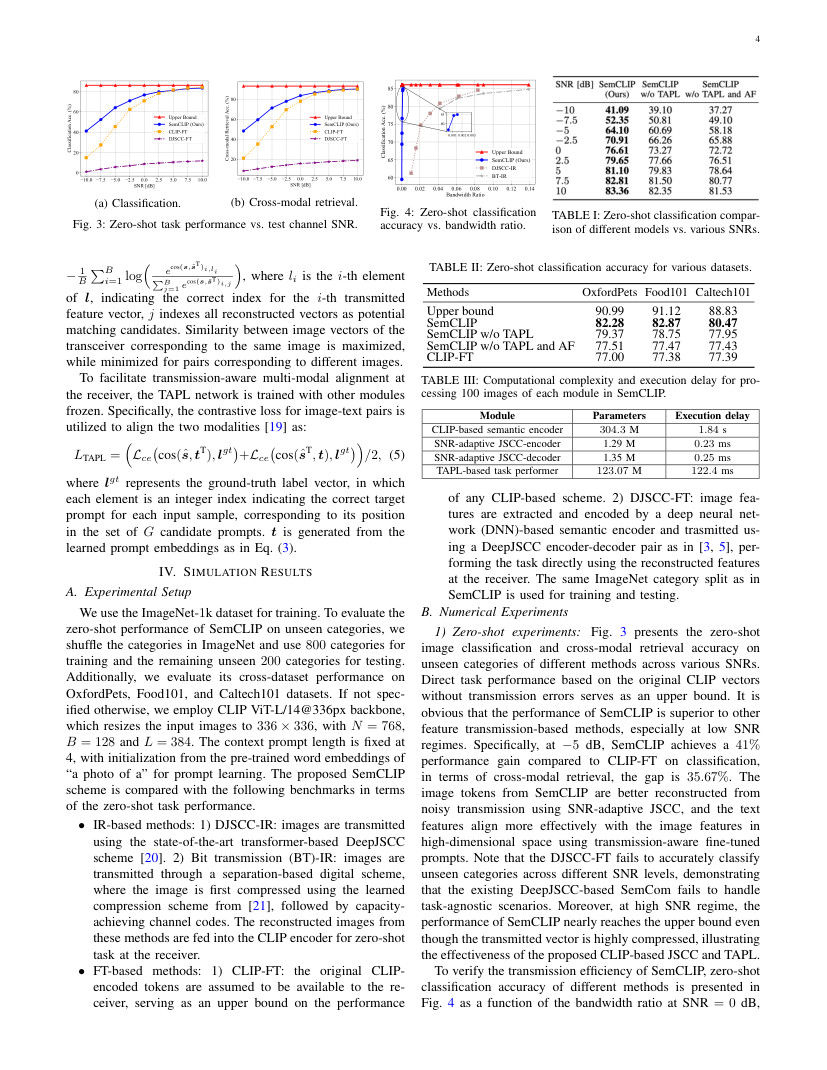
仍然存在的问题:However, an increasing number of wireless applications, such as Internet-of-things and edge intelligence [2]–[4], require the efficient transmission of large volumes of data under strict delay constraints, resulting in an increasing interest in joint source channel coding (JSCC) in recent years. PDF p.1
本文提出的方案:arXiv:2205.02417v2 [cs.IT] 8 Sep 2022 1 Channel-Adaptive Wireless Image Transmission with OFDM Haotian Wu, Graduate Student Member, IEEE, Yulin Shao, Member, IEEE, Krystian Mikolajczyk, Senior Member, IEEE, and Deniz G¨und¨uz, Fellow, IEEE Abstract—We present a learning-based channel-adaptive joint source and channel coding (CA-JSCC) scheme for wireless image transmission over multipath fading channels. PDF p.1
方案起作用的机制:Unlike the previous works, our approach is adaptive to channel-gain and noise-power varia- tions by exploiting the estimated channel state information (CSI). PDF p.1
作者希望证明的结论:However, this CA-JSCC model trained at random SNR values still outperforms the Exp-JSCC models trained at specific SNR values. PDF p.4
The proposed method is an end-to-end autoencoder architecture with a dual- attention mechanism employing orthogonal frequency division multiplexing (OFDM) transmission. PDF p.1
This approach has been pioneered in [5], where an autoencoder-based JSCC architecture is pro- posed for wireless image transmission, which outperformed conventional compression and channel coding schemes over additive white Gaussian noise (AWGN) and Rayleigh fading channels. PDF p.1
An alternative generative architecture is considered in [9]–[11]. PDF p.1
We introduce a channel-adaptive JSCC (CA-JSCC) scheme, which employs a dual-attention mechanism to adjust its fea- tures in the multi-scale intermediate layers according to the estimated CSI at the encoder and decoder. PDF p.1
中间语义表示是什么
We also observe larger gains by our dual-attention method at higher bandwidth ratios and SNRtest values, where more spatial information and better CSI adaptability benefit both feature mapping and power allocation. PDF p.4
数字化方案与实际传输开销
数字化判断:数字调制或混合数字-模拟链路 语义表示被映射到有限星座、编码 bit 或数字/模拟并行分支,已经触及可部署物理层接口。
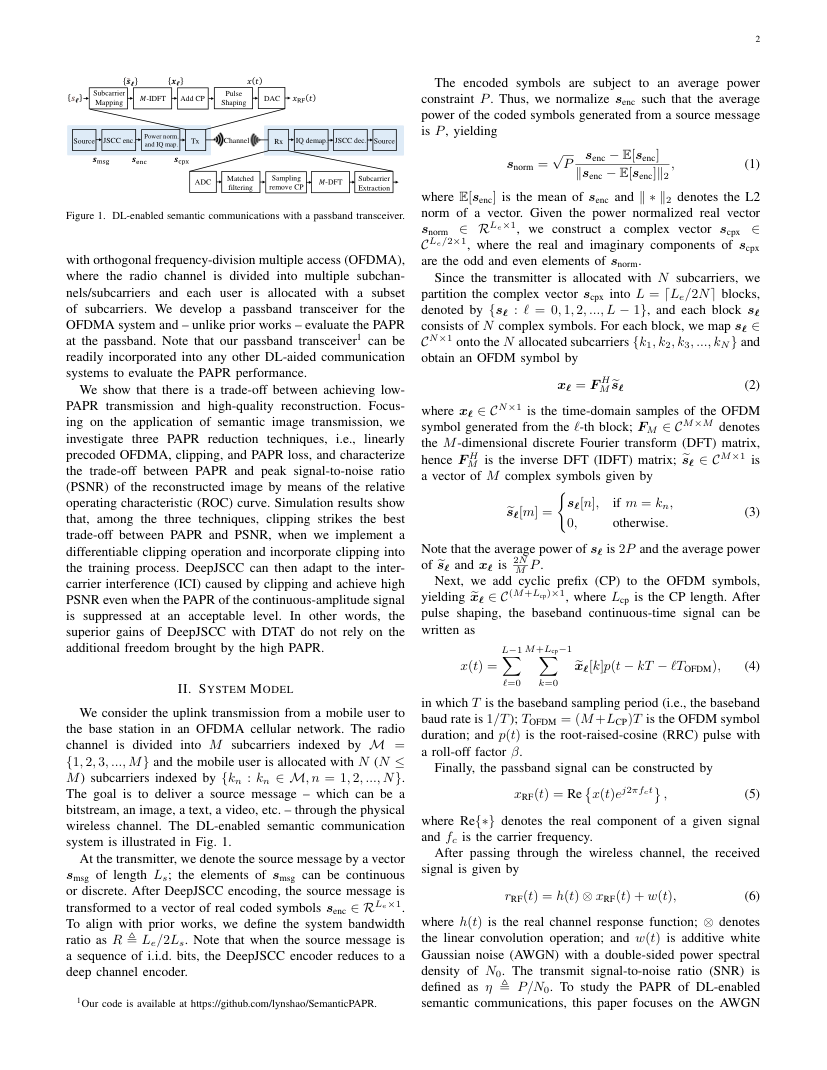
Each OFDM symbol is passed through the inverse discrete Fourier transform (IFFT) module, appended with the cyclic prefix (CP), and transmitted to the receiver over the multipath channel. PDF p.2
bit / token / channel-use / CBR 证据
Performance of our CA-JSCC model comparied with the Exp-JSCC model of different bandwidth ratios. PDF p.4
Following [6], we define the bandwidth ratio (i.e., bandwidth usage to source symbol ratio) as R ≜ NsLf c×h×w, where NsLf is the number of symbols transmitted per image. PDF p.4
Specifically, under a fixed bandwidth ratio and a given SNR, we want to see if our dual-attention mechanism can instruct the transmitter to exploit better chan- nels and allocate power to different subcarriers judiciously. PDF p.4
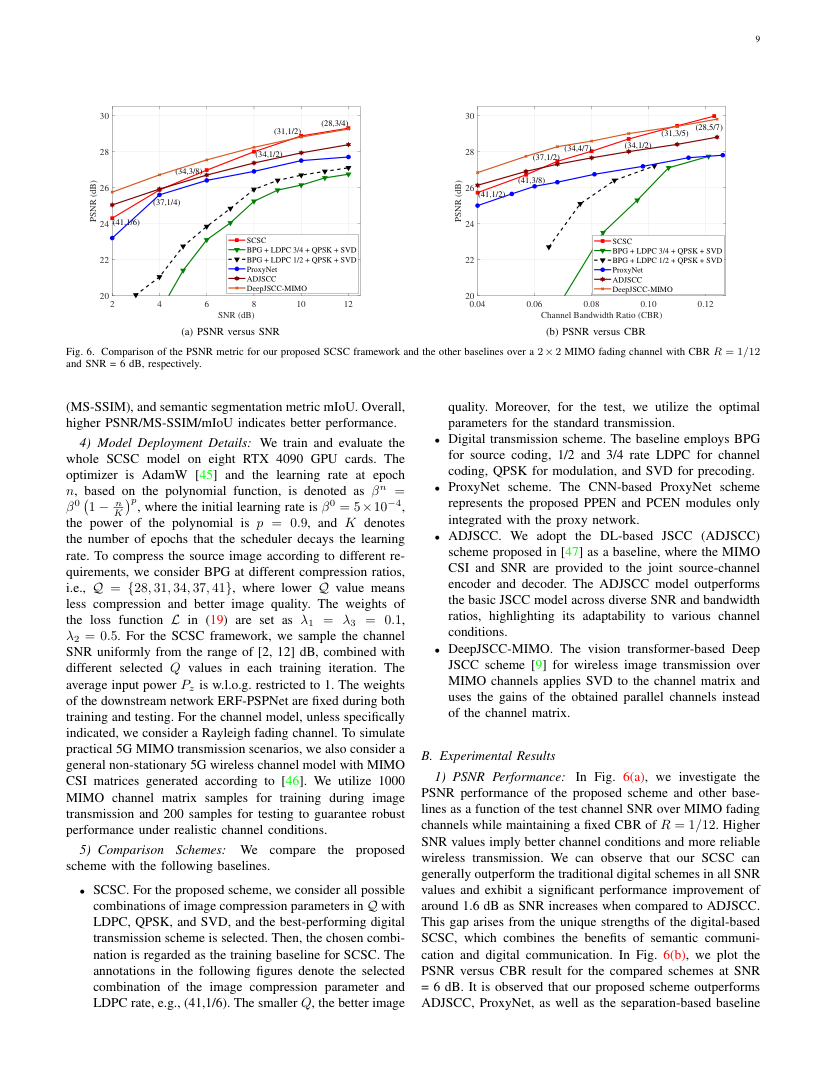
The experimental results are shown in Fig 3a, where we set the number of OFDM symbols to Ns = 8 and the bandwidth ratio to R = 1/6. PDF p.4
As shown in Fig 3b, for three different bandwidth ratios, CA-JSCC architecture outperforms CA-JSCC-CH at all SNR values, which shows that the spatial attention mechanism is essential to achieve the improved performance provided by CA-JSCC. PDF p.4
信道处理机制:decoder 实际收到什么
分类:连续 latent/信道符号联合训练 接收端拿到带噪连续特征或均衡后的复符号,而不是出错的 VQ index;能抗模拟噪声但不等价于解决数字 index error。
This approach has been pioneered in [5], where an autoencoder-based JSCC architecture is pro- posed for wireless image transmission, which outperformed conventional compression and channel coding schemes over additive white Gaussian noise (AWGN) and Rayleigh fading channels. PDF p.1
The transfer function of the multipath fading channel with Lt paths is defined as: ˆy = hc(y) = ht ∗y + w, where y and ˆy denote the input and output vectors, respectively; ∗ is the linear convolution operation, ht ∈CL is the channel impulse response, and w is the AWGN term. PDF p.2
Its operation is presented in Algorithm 1 in detail. 1) Channel-wise attention module: Our channel-wise atten- tion module is inspired by [12], which adapts to a single SNR value in an AWGN channel model. PDF p.3
实验设置与证据
数据集:CIFAR-10、ImageNet、Kodak
Baseline:DeepJSCC
信道/链路:AWGN、Rayleigh、fading channel、OFDM
指标:PSNR
SNR 条件:2 dB、1dB、1dB
主要实验结论(带全文页码)
The spatial attention module can further improve the PSNR performance by exploiting the spatial information and helping JSCC encoder to do more adaptive power allocation, which matches critical features with better channels. PDF p.3
Compared with the CA-JSCC scheme trained at specific SNRs in Fig 3a, we observe that there is a slight performance degradation when it is trained at random SNR values. PDF p.4
However, this CA-JSCC model trained at random SNR values still outperforms the Exp-JSCC models trained at specific SNR values. PDF p.4
As shown in Fig 3b, for three different bandwidth ratios, CA-JSCC architecture outperforms CA-JSCC-CH at all SNR values, which shows that the spatial attention mechanism is essential to achieve the improved performance provided by CA-JSCC. PDF p.4
Compared with Exp-JSCC, Fig. 3c shows that CA- JSCC generally allocates more power for the subcarrier with better channel conditions, as one would desire. PDF p.4
通信审稿价值与 Codex 判断
价值在于把语义质量转化为可优化的网络效用,并回答有限功率、带宽、时延应分给谁。
局限:跨数据域、未见任务和信道失配下的泛化证据有限。
Channel-Adaptive Wireless Image Transmission With OFDM,原 PDF 第 1 页(架构/方法页)。Channel-Adaptive Wireless Image Transmission With OFDM,原 PDF 第 4 页(关键结果页)。
DeepJSCC-Q: Constellation Constrained Deep Joint Source-Channel Coding
2022 · IEEE Journal on Selected Areas in Information Theory · 多用户接入与广播
作者:Tze-Yang Tung; David Burth Kurka; Mikołaj Jankowski; Denız Gündüz
仍然存在的问题:However, end-to-end training of such schemes requires a differentiable channel input representation; hence, prior works have assumed that any complex value can be transmitted over the channel. PDF p.1
本文提出的方案:Herein, we propose DeepJSCC-Q, an end-to-end optimized JSCC solution for wireless image transmission using a finite channel input alphabet. PDF p.1
Another strength of DeepJSCC is that it learns a communication scheme from scratch, optimizing all transformations in a data-driven manner using autoencoders [12] with a non- trainable differentiable channel model in the bottleneck layer. PDF p.3
In contrast, in DeepJSCC, the encoder can transmit arbitrary complex-valued channel symbols, within a power constraint. PDF p.3
中间语义表示是什么
In contrast, in DeepJSCC, the encoder can transmit arbitrary complex-valued channel symbols, within a power constraint. PDF p.3
The bandwidth compression ratio is defined as ρ = k H × W × C channel symbols/pixel, (6) which measures how much compression we apply to the images, with smaller number re- flecting more compression. PDF p.8
Rather than constraining the encoder DNN to discrete outputs, which would require a huge output space, we will allow any output vector of dimension k, and employ a “quantization” layer to map the generated latent vectors to transmitted symbols, such that each quantization level represents a point in the constellation. PDF p.9
As such, we separate the encoder f into two stages: first a DNN function fθ : {0, ..., 255}H×W×C 7→Ck maps an input image x to a complex latent representation z = fθ(x) before a quantizer qC : Ck 7→Ck maps the latent vector z to the channel input ¯z = qC(z). PDF p.10
数字化方案与实际传输开销
数字化判断:数字调制或混合数字-模拟链路 语义表示被映射到有限星座、编码 bit 或数字/模拟并行分支,已经触及可部署物理层接口。
1 DeepJSCC-Q: Constellation Constrained Deep Joint Source-Channel Coding Tze-Yang Tung, David Burth Kurka, Mikolaj Jankowski, Deniz G¨und¨uz Department of Electrical and Electronics Engineering Imperial College London Abstract Recent works have shown that modern machine learning techniques can provide an alternative approach to the long-standing joint source-channel coding (JSCC) problem. PDF p.1
This can prevent the application of these codes in scenarios where the hardware or protocol can only admit certain sets of channel inputs, prescribed by a digital constellation. PDF p.1
Part of that simplification stems from the fact that DeepJSCC not only combines source and channel coding into one single mapping, but it also removes the constellation diagrams used in digital schemes. PDF p.3
In digital communications, channel encoded bits are mapped to the elements of a two-dimensional finite constellation diagram, such as quadrature amplitude modulation (QAM), phase shift keying (PSK), or amplitude shift keying (ASK). PDF p.3
In this work, we investigate the effects of constraining the transmission either to a lim- ited number of channel input symbols, or to a predefined constellation imposed externally. PDF p.3
bit / token / channel-use / CBR 证据
For example, in [6], a general framework for matching source and channel code rates using a parametric distortion model was proposed. PDF p.4
Their approach is to match the source code rate to the channel code and channel statistics in a source-rate-based optimization approach. PDF p.4
Similarly, in [5], a cross-layer optimization of the source code rate, channel code rate and transmitter power for quality of service (QoS) is proposed. PDF p.4
The bit rate allocation between the quantizer and channel code of each layer is optimized using an end-to-end rate distortion model. PDF p.5
Problem Statement We consider the problem of wireless image transmission over a noisy channel, in which communication is performed by transmitting one out of a finite set of symbols at each channel use. PDF p.6
In digital communications, channel encoded bits are mapped to the elements of a two-dimensional finite constellation diagram, such as quadrature amplitude modulation (QAM), phase shift keying (PSK), or amplitude shift keying (ASK). PDF p.3
We note that the problem at hand is a JSCC problem over a discrete-input additive white Gaussian noise (AWGN) channel. PDF p.3
The main contributions of DeepJSCC-Q are: • Achieve performance close to that is achieved by the unconstrained DeepJSCC scheme [8] even when using a highly constrained channel input representation. • Achieve superior performance compared to separate source and channel coding using better portable graphics (BPG) codec [13] followed by low density parity check (LDPC) codes [14]. • Create a coherent mapping between the input image and constellation points, avoiding the cliff-effect present in all separation-based schemes. • Generate new constellations for a given modulation order, outperforming conventional constellation designs. PDF p.4
They demonstrated that the resultant JSCC encoder and decoder, called DeepJSCC, was able to surpass the performance of JPEG2000 [19] compression followed by LDPC codes [14] for channel coding. PDF p.5
The attention mechanism has been used in both [35] and [36] to improve the compression efficiency by focusing the neural network on regions in the image that require higher bit rate. PDF p.10
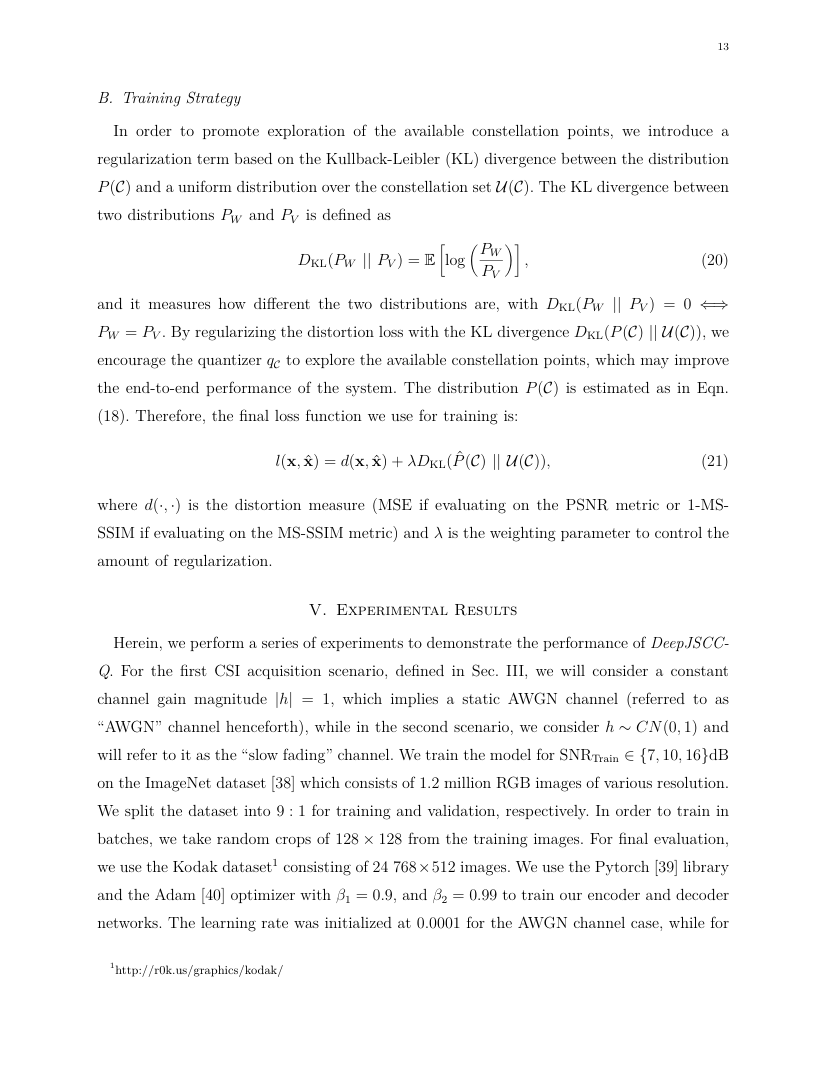
By regularizing the distortion loss with the KL divergence DKL(P(C) || U(C)), we encourage the quantizer qC to explore the available constellation points, which may improve the end-to-end performance of the system. PDF p.13
We implement learning rate scheduling, where the learning rate is reduced by a factor of 0.8 if the loss does not improve for 4 epochs consecutively. PDF p.14
Moreover, when compared with the separation-based results, the DeepJSCC-Q 4096- PDF p.14
Although the DeepJSCC-Q models trained with modulation orders M = 16, 64 did not perform as well as the separation-based schemes, increasing the modulation order at those SNRs can improve the performance of DeepJSCC-Q, as shown in Fig. 6. PDF p.15
仍然存在的问题:However, the limits of the separation-based designs are beginning to rear, with the emergence of more demanding and challenging video delivery applications, such as wireless virtual reality (VR) and drone-based surveillance systems, which have ultra-low latency requirements, suffer from highly unpredictable channel conditions, and need to be implemented on energy limited mobile devices. PDF p.1
本文提出的方案:1 DeepWiVe: Deep-Learning-Aided Wireless Video Transmission Tze-Yang Tung and Deniz G¨und¨uz Information Processing and Communications Lab (IPC-Lab), Imperial College London, UK {tze-yang.tung14, d.gunduz}@imperial.ac.uk Abstract—We present DeepWiVe, the first-ever end-to-end joint source-channel coding (JSCC) video transmission scheme that leverages the power of deep neural networks (DNNs) to directly map video signals to channel symbols, combining video compression, channel coding, and modulation steps into a single neural transform. PDF p.1
方案起作用的机制:DeepWiVe system overview. and conveying only the motion and residual information for the remaining frames, thereby exploiting temporal redundancy. PDF p.2
作者希望证明的结论:When compared to H.265, we see in Fig. 12a that H.265 outperforms DeepWiVe in terms of the PSNR metric. PDF p.9
Our DNN decoder predicts residuals without distortion feedback, which improves video quality by accounting for occlusion/disocclusion and camera movements. PDF p.1
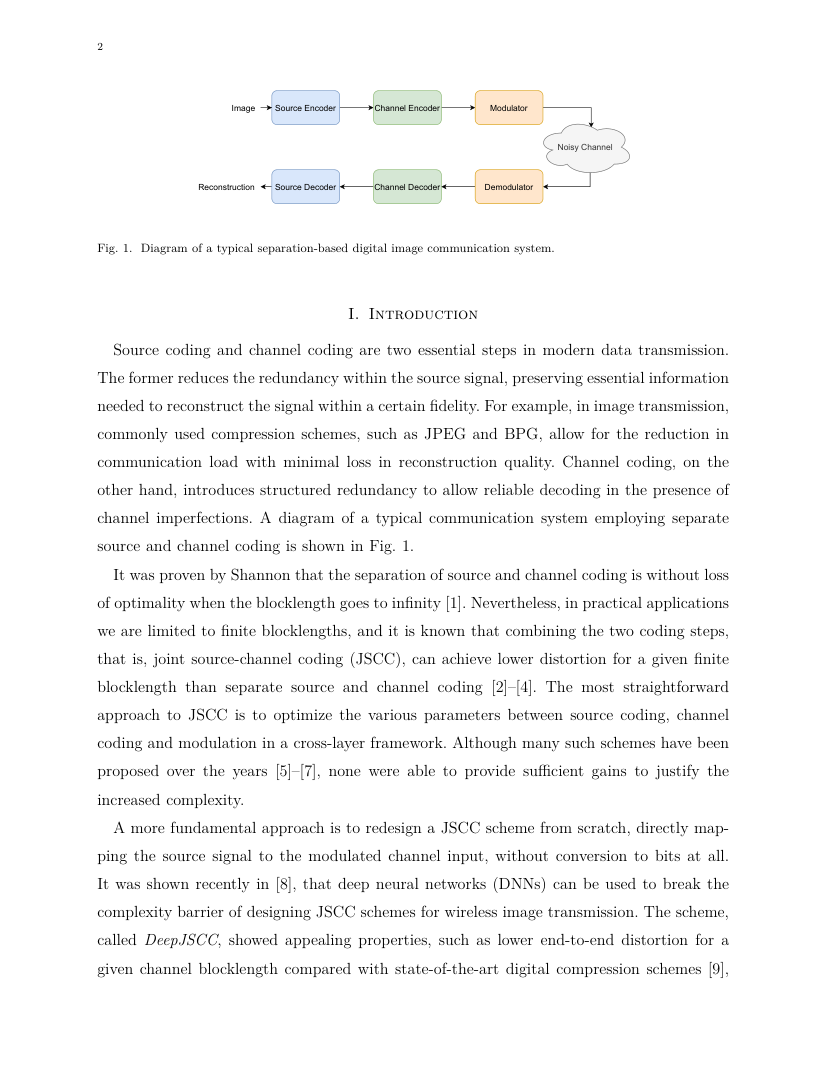
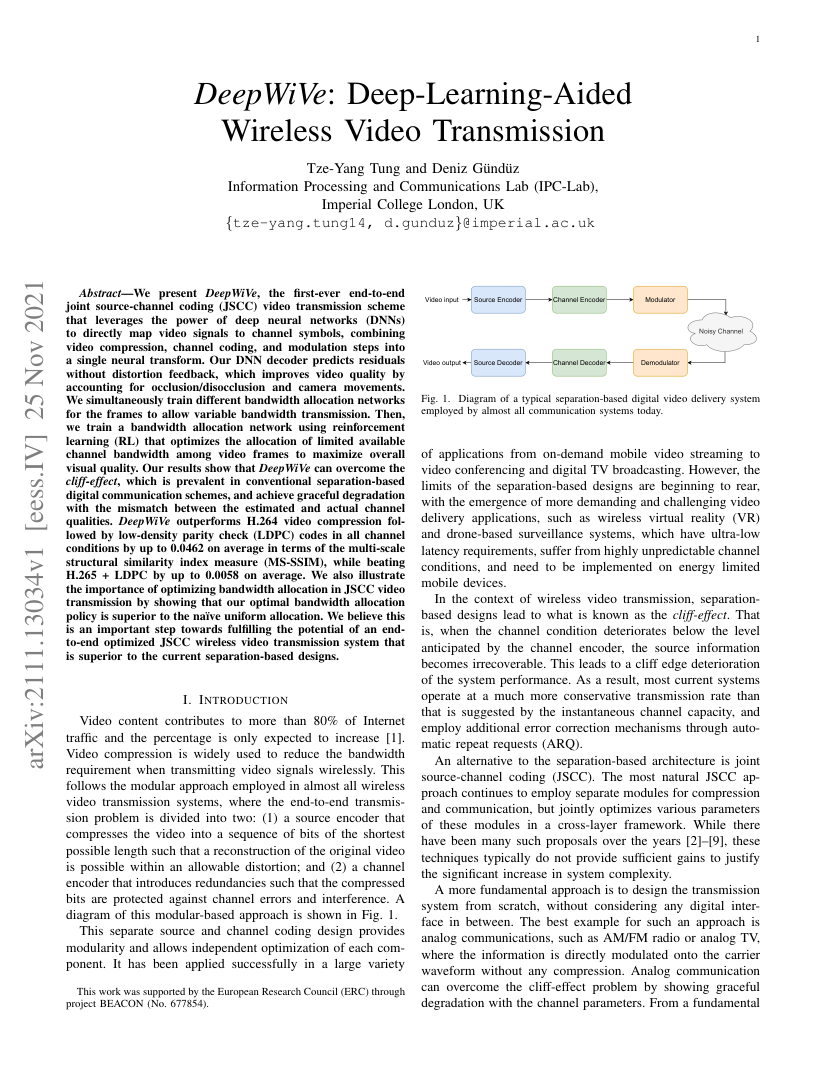
This follows the modular approach employed in almost all wireless video transmission systems, where the end-to-end transmis- sion problem is divided into two: (1) a source encoder that compresses the video into a sequence of bits of the shortest possible length such that a reconstruction of the original video is possible within an allowable distortion; and (2) a channel encoder that introduces redundancies such that the compressed bits are protected against channel errors and interference. PDF p.1
Source Encoder Channel Encoder Modulator Noisy Channel Source Decoder Channel Decoder Demodulator Video input Video output Fig. 1. PDF p.1
That is, when the channel condition deteriorates below the level anticipated by the channel encoder, the source information becomes irrecoverable. PDF p.1
中间语义表示是什么
1 DeepWiVe: Deep-Learning-Aided Wireless Video Transmission Tze-Yang Tung and Deniz G¨und¨uz Information Processing and Communications Lab (IPC-Lab), Imperial College London, UK {tze-yang.tung14, d.gunduz}@imperial.ac.uk Abstract—We present DeepWiVe, the first-ever end-to-end joint source-channel coding (JSCC) video transmission scheme that leverages the power of deep neural networks (DNNs) to directly map video signals to channel symbols, combining video compression, channel coding, and modulation steps into a single neural transform. PDF p.1
In a similar line of work, [32] uses scalable video coding (SVC), which encodes the source video into multiple bitstreams, with a base layer that represents the lowest supported quality and a set of enhancement layers representing versions of the video at different qualities. PDF p.3
A completely refreshed approach to JSCC video delivery, called SoftCast, utilizing low complexity methods to map videos or images from the pixel domain to channel symbols directly was first introduced in [13]. PDF p.3
Here, each element of zn i , denoted by zn i,j, represents the in-phase (I) and quadrature (Q) components of a complex channel symbol. PDF p.5
With digital transmission, the same performance can only be achieved by vector-quantizing an arbitrarily long sequence of source samples, followed by a capacity achieving channel code. PDF p.2
In a similar line of work, [32] uses scalable video coding (SVC), which encodes the source video into multiple bitstreams, with a base layer that represents the lowest supported quality and a set of enhancement layers representing versions of the video at different qualities. PDF p.3
This is likely due to the fact that the H.264 codec does not have a continuous range of compression rates available but rather a set of discrete levels it can compress. PDF p.9
Goblick, “A coding theorem for time-discrete analog data sources,” IEEE Transactions on Information Theory, vol. 15, pp. 401–407, May 1969. [11] I. PDF p.12
bit / token / channel-use / CBR 证据
Diagram of a typical interpolation structure used in video compression algorithm. information theoretic perspective, when transmitting inde- pendent Gaussian samples over an additive white Gaussian noise (AWGN) channel, with one sample per channel use on average, uncoded transmission, where each sample is simply scaled and transmitted, meets the theoretical Shannon bound [10]. PDF p.2
To determine the optimal channel code rate for each layer such that the average distortion is minimized, they devised a low complexity search algorithm to find the optimal choice of channel code rates among a set of available rates. PDF p.3
In this setting, we restrict the number of channel uses to k per GoP, which can be considered as a bandwidth constraint and we define the bandwidth compression ratio as ρ = k 3HWN . (1) We consider an additive white Gaussian noise (AWGN) channel n ∼CN(0, σ2I) that follows a complex Gaussian noise distribution with zero mean and covariance σ2I (I is the identity matrix). PDF p.3
The overall goal of our design is to maximize the video quality, measured by either Eqn. (4) or (5), between the input video X and its reconstruction at the decoder ˆX, under the given constraints on the available bandwidth ratio ρ and the average power P. PDF p.4
The attention mechanism has been used in both [46] and [47] to improve the compression efficiency by focusing the neural network on regions in the image that require higher bit rate. PDF p.5
信道处理机制:decoder 实际收到什么
分类:数字语义特征 + 传统信道编码 decoder 通常看到信道译码后的 bit/index;若论文只假设译码成功,则未真正学习处理残余 index 跳变。
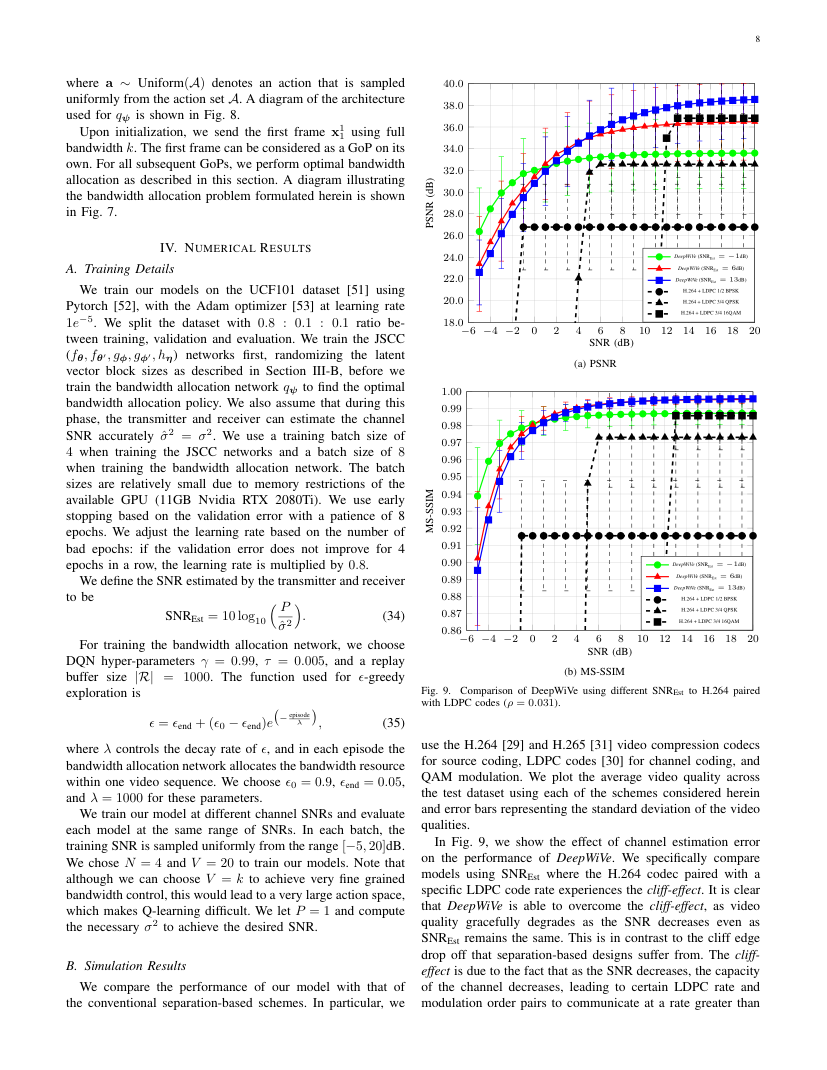
DeepWiVe outperforms H.264 video compression fol- lowed by low-density parity check (LDPC) codes in all channel conditions by up to 0.0462 on average in terms of the multi-scale structural similarity index measure (MS-SSIM), while beating H.265 + LDPC by up to 0.0058 on average. PDF p.1
Source Encoder Channel Encoder Modulator Noisy Channel Source Decoder Channel Decoder Demodulator Video input Video output Fig. 1. PDF p.1
Diagram of a typical interpolation structure used in video compression algorithm. information theoretic perspective, when transmitting inde- pendent Gaussian samples over an additive white Gaussian noise (AWGN) channel, with one sample per channel use on average, uncoded transmission, where each sample is simply scaled and transmitted, meets the theoretical Shannon bound [10]. PDF p.2
Our results show that DeepWiVe can meet or beat industry standard video com- pression codecs, such as H.264, combined with state-of-the- art channel codes, such as low density parity check (LDPC) codes, in almost all channel conditions tested, while achieving graceful degradation of video quality with respect to channel quality, thereby avoiding the cliff-effect. PDF p.2
In this work, we will focus on AWGN channels. PDF p.3
This is achieved by deliberately randomizing the channel SNR during training, and providing the AF modules with the current SNR. PDF p.5
The mapping between real network outputs and complex chan- nel inputs (or vice versa) is achieved by pairing consecutive real values at the output of the encoder DNN. PDF p.5
The attention mechanism has been used in both [46] and [47] to improve the compression efficiency by focusing the neural network on regions in the image that require higher bit rate. PDF p.5
That is, the interpolation decoder gφ′ : Ck 7→RH×W ×12 defines the mapping (ˆf n i−t,ˆf n i+t, ˆrn i , mn i ) = gφ′(ˆyn i , ˆσ2), (22) where ˆf n i±t ∈ RH×W ×3, ˆrn i ∈ RH×W ×3, and mn i ∈ RH×W ×3. mn i,c ∈RH×W , c = 1, 2, 3, a 2D matrix in the third dimension of mn i , satisfies: 3 X c=1 mn i,c = 1H×W . (23) That is, for each H and W index of the mask mn i , the sum of values along the channel dimension is equal to 1, which is achieved by using the softmax activation. PDF p.6
This is achieved by dividing the latent vectors zn i into V equal sized blocks (i.e., zn i = {zn i,1, . . . , zn i,V }, zn i,v ∈ C k V , v = 1, ..., V ), while randomly varying the number of blocks vn i of the latent code transmitted in each batch zn i (vn i ) = {zn i,1, . . . , zn i,vn i }, vn i ≤V . PDF p.7
DeepWiVe: Deep-Learning-Aided Wireless Video Transmission,原 PDF 第 1 页(架构/方法页)。DeepWiVe: Deep-Learning-Aided Wireless Video Transmission,原 PDF 第 8 页(关键结果页)。
Privacy-Aware Communication over a Wiretap Channel with Generative Networks
2022 · ICASSP 2022 - 2022 IEEE International Conference on Acoustics, Speech and Signal Processing (ICASSP) · 物理层调制、波形与 MIMO
作者:Ecenaz Erdemir; Pier Luigi Dragotti; Denız Gündüz
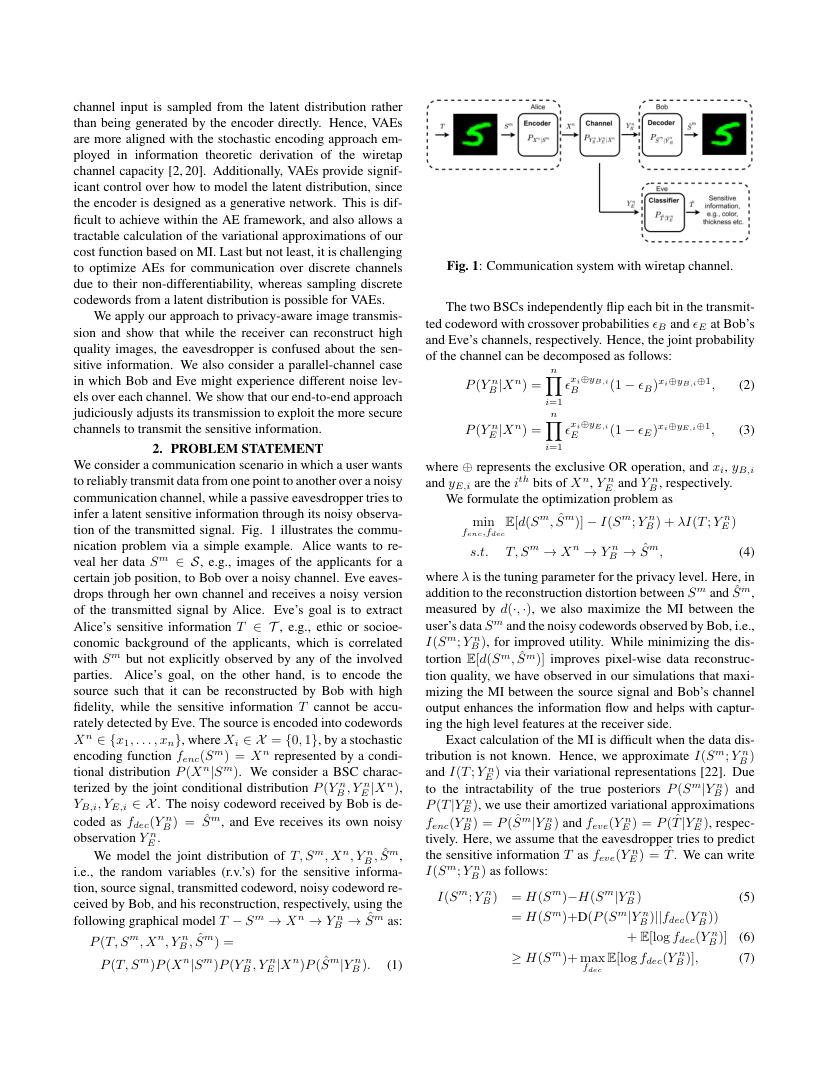
仍然存在的问题:However, (10) is not attained even if the clas- sifier representing the eavesdropper is optimum, because we minimize I(T; Y n E ) in the objective. PDF p.3
本文提出的方案:Hence, we propose a privacy-utility trade-off (PUT) for communica- tion over the wiretap channel by balancing the information leakage to the eavesdropper and the distortion at the legiti- mate receiver. PDF p.1
方案起作用的机制:We show through simulations with the colored MNIST dataset that our approach provides high reconstruction quality at the receiver while confusing the eavesdropper about the latent sensitive at- tribute, which consists of the color and thickness of the digits. PDF p.1
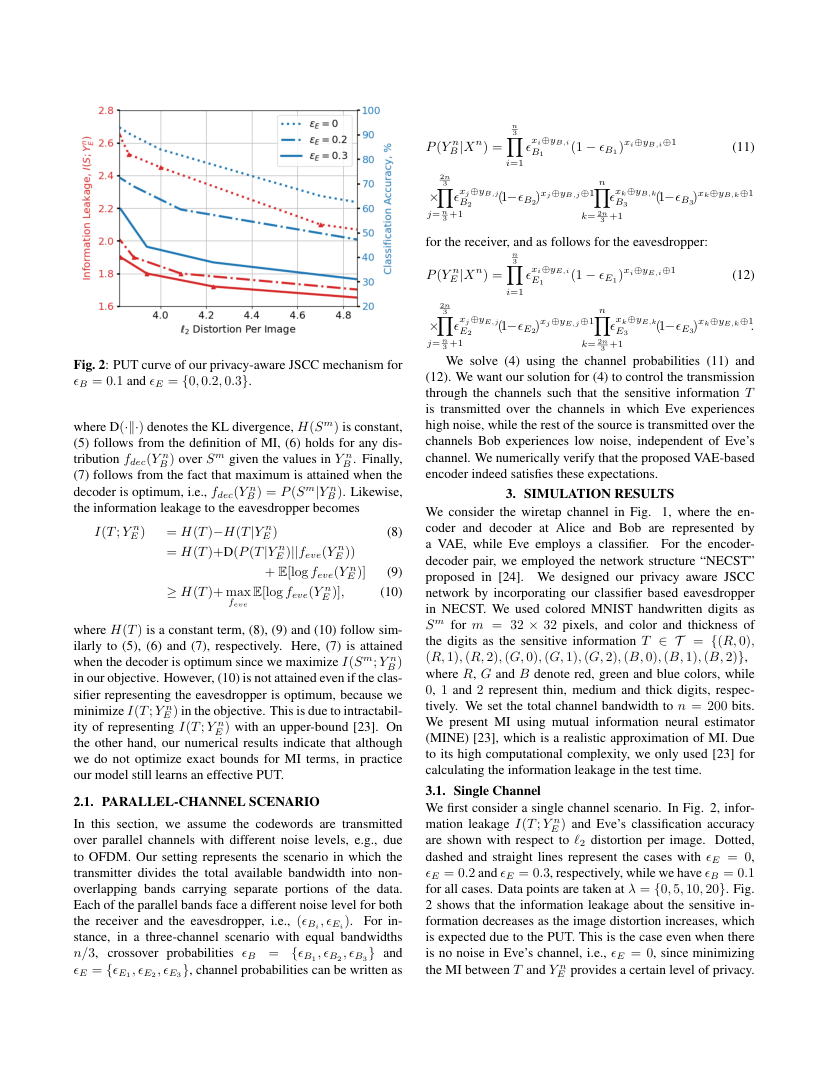
作者希望证明的结论:On the other hand, our numerical results indicate that although we do not optimize exact bounds for MI terms, in practice our model still learns an effective PUT. 2.1. PDF p.3
Since we usually do not have access to true distributions, we pro- pose a data-driven approach using variational autoencoder (VAE)-based joint source channel coding (JSCC). PDF p.1
We show through simulations with the colored MNIST dataset that our approach provides high reconstruction quality at the receiver while confusing the eavesdropper about the latent sensitive at- tribute, which consists of the color and thickness of the digits. PDF p.1
Index Terms— Privacy-utility trade-off, wiretap channel, physical layer security, generative networks, variational auto- encoders. 1. PDF p.1
The similarity between the communication systems and end-to-end learning motivates the use of autoencoder based neural network architectures, which simultaneously learn encoding and decoding [14, 15]. PDF p.1
数字化判断:数字调制或混合数字-模拟链路 语义表示被映射到有限星座、编码 bit 或数字/模拟并行分支,已经触及可部署物理层接口。
Last but not least, it is challenging to optimize AEs for communication over discrete channels due to their non-differentiability, whereas sampling discrete codewords from a latent distribution is possible for VAEs. PDF p.2
bit / token / channel-use / CBR 证据
论文未以可检索文本完整报告输入尺寸、latent/token 数、每个 index 的 bit 数与总开销;本报告不在缺少形状和码本参数时伪造压缩率。可按 $R=N_s b_s/N_{src}$ 或 $\rho=n/k$ 在取得参数后推导。
Alice wants to transmit a source signal to Bob over a binary symmetric channel, while passive eavesdropper Eve tries to infer some sensitive at- tribute of Alice’s source based on its overheard signal. PDF p.1
We assume binary symmetric channels (BSCs) from Alice to both Bob and Eve. PDF p.1
We also showed that our approach balances the information flow in a parallel-channel scenario such that the PUT is obtained according to the receiver’s and eavesdropper’s channel noises. PDF p.4
实验设置与证据
数据集:MNIST
Baseline:BERT
信道/链路:OFDM、BSC、binary symmetric channel
指标:accuracy
SNR 条件:论文文本未明确命中,需查看原表格或附录
主要实验结论(带全文页码)
This is dif- ficult to achieve within the AE framework, and also allows a tractable calculation of the variational approximations of our cost function based on MI. PDF p.2
Here, in addition to the reconstruction distortion between Sm and ˆSm, measured by d(·, ·), we also maximize the MI between the user’s data Sm and the noisy codewords observed by Bob, i.e., I(Sm; Y n B ), for improved utility. PDF p.2
While minimizing the dis- tortion E[d(Sm, ˆSm)] improves pixel-wise data reconstruc- tion quality, we have observed in our simulations that maxi- mizing the MI between the source signal and Bob’s channel output enhances the information flow and helps with captur- ing the high level features at the receiver side. PDF p.2
On the other hand, our numerical results indicate that although we do not optimize exact bounds for MI terms, in practice our model still learns an effective PUT. 2.1. PDF p.3
Privacy-Aware Communication over a Wiretap Channel with Generative Networks,原 PDF 第 2 页(架构/方法页)。Privacy-Aware Communication over a Wiretap Channel with Generative Networks,原 PDF 第 3 页(关键结果页)。
Progressive Feature Transmission for Split Classification at the Wireless Edge
2022 · IEEE Transactions on Wireless Communications · 通信安全与隐私
作者:Qiao Lan; Qunsong Zeng; Petar Popovski; Denız Gündüz; Kaibin Huang
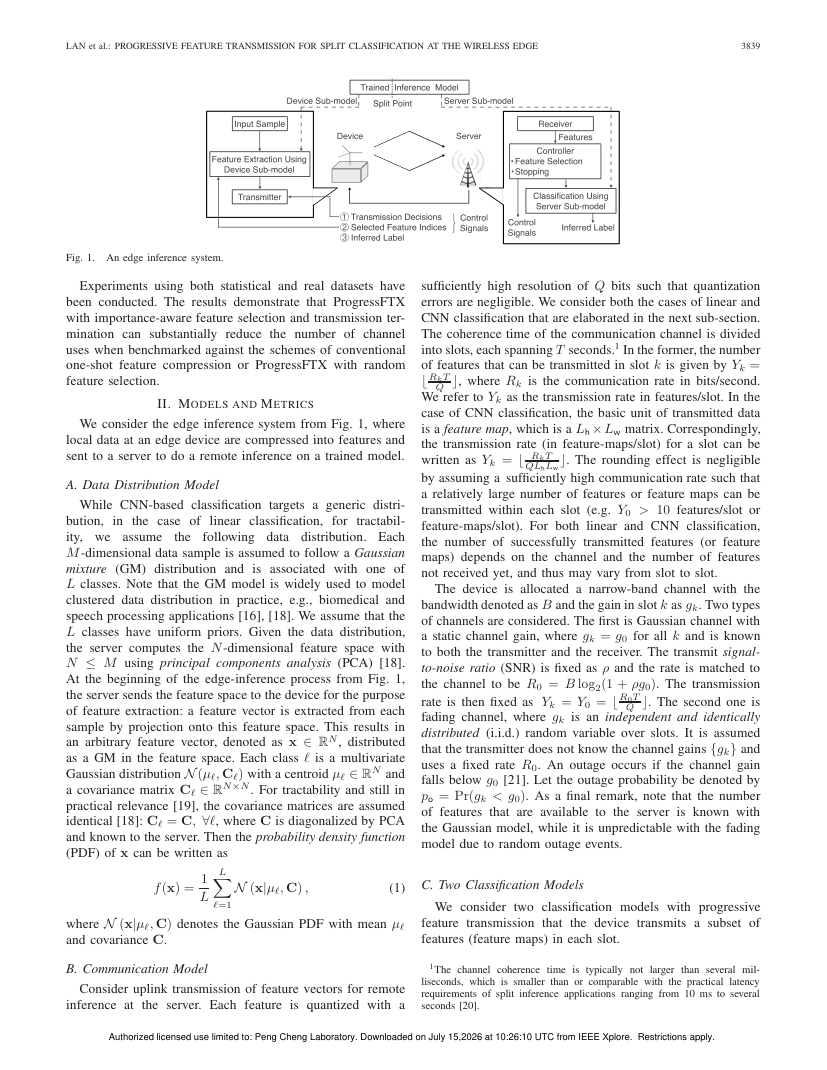
仍然存在的问题:This gives rise to two active research challenges: (1) edge learning [1], [2], where data are used to train large-scale AI models via distributed machine learning; and (2) edge inference [1], [3], which is the theme of this work and deals with operating of such models at edge servers to provide remote-inference services that enable emerging mobile appli- cations, such as e-commerce or smart cities. PDF p.1
本文提出的方案:To address this issue, we propose the progressive feature transmission (ProgressFTX) protocol, which minimizes the overhead by progressively transmitting features until a target confidence level is reached. PDF p.1
方案起作用的机制:Such a design promises to achieve a higher efficiency than the existing one-shot feature selection/pruning, by leveraging both the importance awareness in feature selection as well as stochastic control according to the channel state. PDF p.2
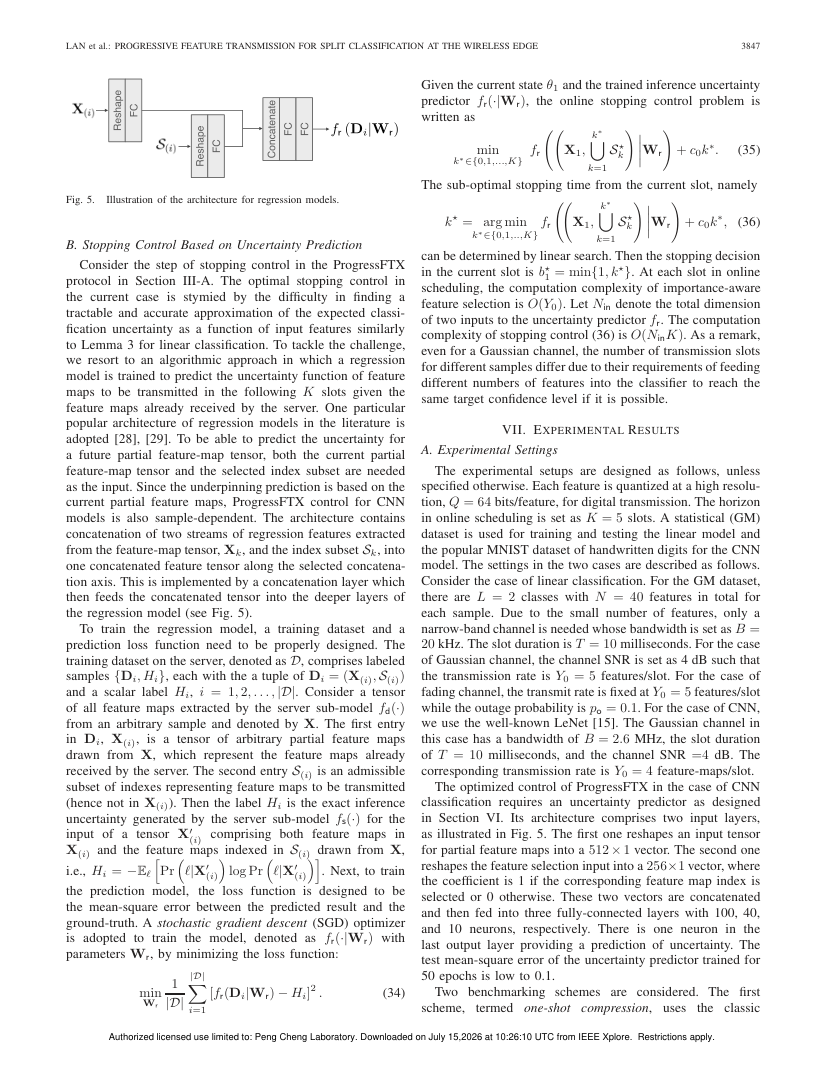
作者希望证明的结论:As observed from the figures, the proposed ProgressFTX tech- nique achieves the lowest latency based on both the criteria of achieving targeted uncertainty and accuracy. PDF p.12
To address this issue, we propose the progressive feature transmission (ProgressFTX) protocol, which minimizes the overhead by progressively transmitting features until a target confidence level is reached. PDF p.1
To improve the communication efficiency, we propose and optimize a simple protocol, termed progressive feature transmission (ProgressFTX). PDF p.1
The state-of-the-art edge learning algorithms build upon an architecture termed split inference [4], [5], [6], [7], [8], [9], [10], in which the model is partitioned into device and server sub-models [5], [7]. PDF p.1
This issue is addressed by the framework of joint source-and-channel coding developed over a series of works [7], [8], [9], [10], featuring the use of an autoencoder pair of encoder and decoder as device and server sub-models, jointly trained to simultaneously perform inference and efficient transmission. PDF p.1
中间语义表示是什么
For instance, GoogLeNet, a celebrated convolutional neural network (CNN) model, generates 256 28 × 28 feature maps at the output of a convolutional (inception) layer, resulting in a total of 2 × 10⁶ real coefficients [12]. PDF p.2
For example, using 16 feature maps from MNIST leads to an accuracy of 93% and additional 4 feature maps boost the accuracy to 98%. PDF p.2
First, we evaluate the impor- tance of a feature map using the gradients of associated model parameters generated in the process of training the inference model. PDF p.2
In the case of CNN classification, the basic unit of transmitted data is a feature map, which is a Lh ×Lw matrix. PDF p.3
数字化方案与实际传输开销
数字化判断:数字调制或混合数字-模拟链路 语义表示被映射到有限星座、编码 bit 或数字/模拟并行分支,已经触及可部署物理层接口。
Each feature is quantized with a sufficiently high resolution of Q bits such that quantization errors are negligible. PDF p.3
A discrete function d(k) is called convex if the inequality d(k −1) + d(k + 1) ≥2 d(k) holds for every k in its domain [27]. PDF p.9
Based on a standard approach in discrete convex optimization [27], the optimal solution for Problem (P4) can be derived as k⋆= min{K, ˜k}, (26) where ˜k is given by ˜k = min{k ∈{0, . . ., K −1} | ˜H (δ1, G⋆(θ1, k)) −˜H (δ1, G⋆(θ1, k + 1)) ≤c0}. (27) Combining (23), (26), and (27) leads to the following main result of the section. PDF p.9
Each feature is quantized at a high resolu- tion, Q = 64 bits/feature, for digital transmission. PDF p.11
Murota, “Discrete convex analysis,” Math. PDF p.16
bit / token / channel-use / CBR 证据
The results demonstrate that ProgressFTX with importance-aware feature selection and transmission ter- mination can substantially reduce the number of channel uses when benchmarked against the schemes of conventional one-shot feature compression or ProgressFTX with random feature selection. PDF p.3
Zhou, “Dynamic compression ratio selection for edge inference systems with hard deadlines,” IEEE Internet Things J., vol. 7, no. 9, pp. 8800–8810, Sep. 2020. [5] W. PDF p.15
Control Problem Formulation ProgressFTX has two objectives: 1) maximize the uncer- tainty reduction (or equivalently, improvement in inference accuracy), and 2) minimize the communication cost. PDF p.6
The equality is approached in the asymptotic limit when there exists an infinitely small δ(ℓ,ℓ′) k compared with other pairwise differential distances, i.e., degrades to binary classification. PDF p.7
The drawback of this scheme is that its lack of ACK/NACK feedback as for ProgressFTX makes the device inept in minimizing the number of features to achieve an exact uncertainty level. PDF p.12
As observed from the figures, the proposed ProgressFTX tech- nique achieves the lowest latency based on both the criteria of achieving targeted uncertainty and accuracy. PDF p.12
For instance, two benchmarking schemes require in average 2.2 slots to achieve an accuracy of 95% while ProgressFTX only requires 1.4. PDF p.12
Progressive Feature Transmission for Split Classification at the Wireless Edge,原 PDF 第 3 页(架构/方法页)。Progressive Feature Transmission for Split Classification at the Wireless Edge,原 PDF 第 11 页(关键结果页)。
Semantic Communications With Discrete-Time Analog Transmission: A PAPR Perspective
仍然存在的问题:The practical use of DTAT, however, faces an important challenge due to the peak-to-average power ratio (PAPR) [11], especially when used in conjunction with the prevailing or- thogonal frequency division multiplexing (OFDM) transceiver, which is now adopted in most IEEE standards. PDF p.1
本文提出的方案:We develop a passband transceiver for the OFDMA system and – unlike prior works – evaluate the PAPR at the passband. PDF p.2
方案起作用的机制:Since the transmitter is allocated with N subcarriers, we partition the complex vector scpx into L = ⌈Le/2N⌉blocks, denoted by {sℓ: ℓ= 0, 1, 2, ..., L −1}, and each block sℓ consists of N complex symbols. PDF p.2
作者希望证明的结论:As shown, the PSNR of DeepJSCC outperforms that of digital communication. PDF p.5
Specifically, deep neural network (DNN)-based en- coder and decoder are capable of exploiting discrete-time con- tinuous amplitude signals, yielding more freedom than discrete constellations. PDF p.1
One exception is [7], wherein the authors focused on semantic image transmission with OFDM and investigated the impact of clipping on the image reconstruction performance of the proposed DNN architecture. PDF p.1
Note that when the source message is a sequence of i.i.d. bits, the DeepJSCC encoder reduces to a deep channel encoder. 1Our code is available at https://github.com/lynshao/SemanticPAPR. PDF p.2
Since the transmitter is allocated with N subcarriers, we partition the complex vector scpx into L = ⌈Le/2N⌉blocks, denoted by {sℓ: ℓ= 0, 1, 2, ..., L −1}, and each block sℓ consists of N complex symbols. PDF p.2
中间语义表示是什么
The goal is to deliver a source message – which can be a bitstream, an image, a text, a video, etc. – through the physical wireless channel. PDF p.2
1 Semantic Communications with Discrete-time Analog Transmission: A PAPR Perspective Yulin Shao, Member, IEEE, Deniz G¨und¨uz, Fellow, IEEE Abstract—Recent progress in deep learning (DL)-based joint source-channel coding (DeepJSCC) has led to a new paradigm of semantic communications. PDF p.1
Two salient features of DeepJSCC- based semantic communications are the exploitation of semantic- aware features directly from the source signal, and the discrete- time analog transmission (DTAT) of these features. PDF p.1
Index Terms—Semantic communication, DeepJSCC, discrete- time analog transmission, PAPR. PDF p.1
An important ingredient of DL-enabled wireless commu- nication systems is discrete-time analog transmission (DTAT) [3]–[10]. PDF p.1
Specifically, deep neural network (DNN)-based en- coder and decoder are capable of exploiting discrete-time con- tinuous amplitude signals, yielding more freedom than discrete constellations. PDF p.1
bit / token / channel-use / CBR 证据
To align with prior works, we define the system bandwidth ratio as R ≜Le/2Ls. PDF p.2
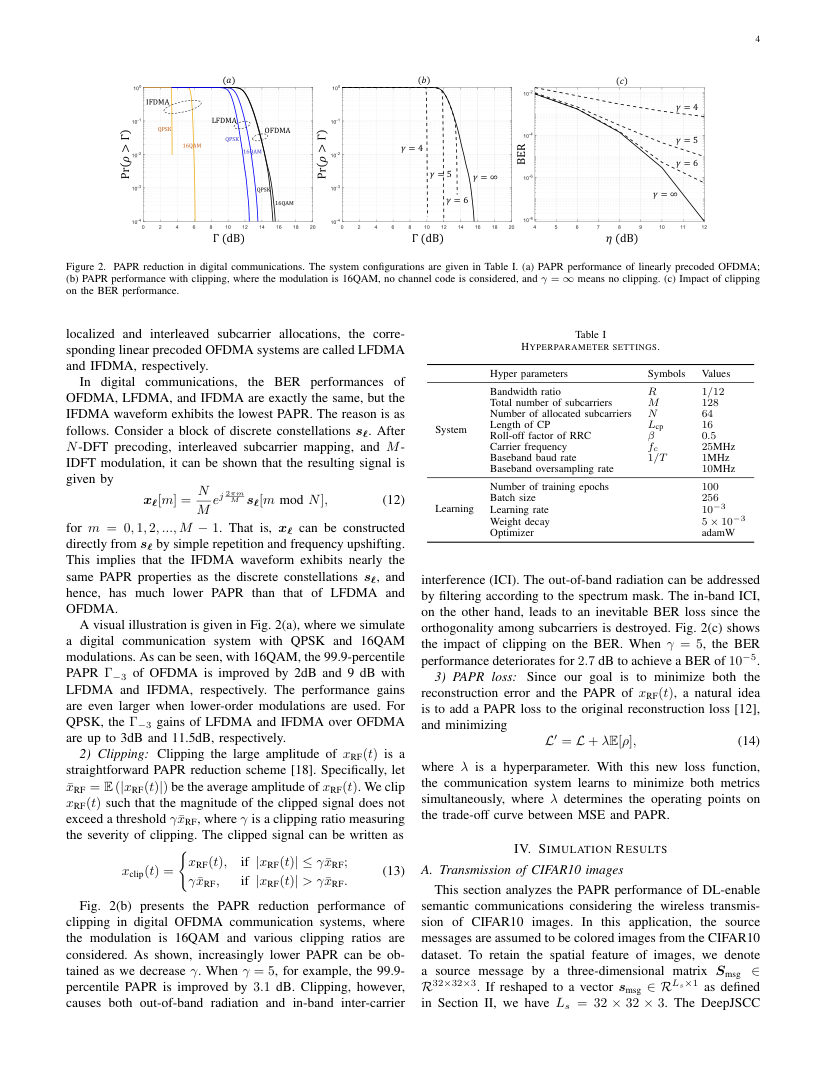
Hyper parameters Symbols Values System Bandwidth ratio R 1/12 Total number of subcarriers M 128 Number of allocated subcarriers N 64 Length of CP Lcp 16 Roll-off factor of RRC β 0.5 Carrier frequency fc 25MHz Baseband baud rate 1/T 1MHz Baseband oversampling rate 10MHz Learning Number of training epochs 100 Batch size 256 Learning rate 10−3 Weight decay 5 × 10⁻³ Optimizer adamW interference (ICI). PDF p.4
For a given compression ratio R, the source image is transformed to a feature matrix Senc ∈R8×8×96R and then reshaped to a vector senc ∈RLe×1 with Le = 8 × 8 × 96R. PDF p.5
As the experiments on CIFAR10, the bandwidth ratio is fixed to 1/12 and each transmission packet consists of 256 complex symbols (4 OFDM symbols). PDF p.7
Related work: In traditional digital communications, the OFDM signal exhibits a large PAPR since independent quadra- ture amplitude modulation (QAM)-modulated waveforms are linearly combined. PDF p.1
The OFDM system is modeled and trained in an end-to-end fashion, and the main idea is to incorporate the PAPR into the loss function in addition to the original decoding loss, e.g., bit error rate (BER). PDF p.1
After passing through the wireless channel, the received signal is given by rRF(t) = h(t) ⊗xRF(t) + w(t), (6) where h(t) is the real channel response function; ⊗denotes the linear convolution operation; and w(t) is additive white Gaussian noise (AWGN) with a double-sided power spectral density of N0. PDF p.2
To study the PAPR of DL-enabled semantic communications, this paper focuses on the AWGN PDF p.2
As can be seen, with 16QAM, the 99.9-percentile PAPR Γ−3 of OFDMA is improved by 2dB and 9 dB with LFDMA and IFDMA, respectively. PDF p.4
The performance gains are even larger when lower-order modulations are used. PDF p.4
When γ = 5, for example, the 99.9- percentile PAPR is improved by 3.1 dB. PDF p.4
When γ = 5, the BER performance deteriorates for 2.7 dB to achieve a BER of 10−5. 3) PAPR loss: Since our goal is to minimize both the reconstruction error and the PAPR of xRF(t), a natural idea is to add a PAPR loss to the original reconstruction loss [12], and minimizing L′ = L + λE[ρ], (14) where λ is a hyperparameter. PDF p.4
As shown, the PSNR of DeepJSCC outperforms that of digital communication. PDF p.5
通信审稿价值与 Codex 判断
价值在于利用用户间语义相关性或分层需求改善频谱共享,而不只是分别运行多个点到点网络。
局限:跨数据域、未见任务和信道失配下的泛化证据有限。
Semantic Communications With Discrete-Time Analog Transmission: A PAPR Perspective,原 PDF 第 2 页(架构/方法页)。Semantic Communications With Discrete-Time Analog Transmission: A PAPR Perspective,原 PDF 第 4 页(关键结果页)。
A Hybrid Wireless Image Transmission Scheme with Diffusion
现有进展:While a pretrained generative model based on GANs is employed in [20], here we will use a diffusion process, which has shown remarkable generative capability in a series of recent papers [16], [17]. PDF p.3
仍然存在的问题:INTRODUCTION The fast increasing demand for wireless transmission of high-resolution image and video signals poses a challenge to current communication systems, as emerging applications such as metaverse, augmented/virtual reality (AR/VR), Internet- of-things (IoT), vehicular-to-everything (V2X), require more robust transmission and realistic reconstruction of video in a fast-varying wireless communication environment with limited bandwidth resources. PDF p.1
本文提出的方案:Ltd., carlyle.chen@tongji.edu.cn, guohua.zhou@huawei.com Abstract—We propose a hybrid joint source-channel coding (JSCC) scheme, in which the conventional digital communication scheme is complemented with a generative refinement component to improve the perceptual quality of the reconstruction. PDF p.1
方案起作用的机制:Neural Network Architecture As shown in Fig. 2, for the diffusion model, we use the common U-net architecture [21] with adaptations [16], which consists of multiple 2D convolution layers. PDF p.4
作者希望证明的结论:Gaussian samples over an AWGN channel achieves the optimal perfor- mance despite operating over a finite block lengnth [19]. PDF p.3
Ltd., carlyle.chen@tongji.edu.cn, guohua.zhou@huawei.com Abstract—We propose a hybrid joint source-channel coding (JSCC) scheme, in which the conventional digital communication scheme is complemented with a generative refinement component to improve the perceptual quality of the reconstruction. PDF p.1
The decoder combines the two signals to produce a high quality reconstruction of the source. PDF p.1
Through end-to-end training, the encoder and decoder pair learn to operate under various channel conditions. PDF p.1
The demodulator, channel decoder, and decompressor are chosen to match the forward modules in the encoding process. PDF p.2
中间语义表示是什么
The ratio ρ = k/n is defined as the bandwidth ratio in the JSCC literature, which indicates the average number of channel symbols available for each source symbol. PDF p.2
The encoded bitstream is then mapped to some discrete input constellation, such as 16-QAM and 64-QAM, which maps the bit sequence to complex-valued channel symbols to be transmitted over the wireless channel. PDF p.2
Later, also in the discrete-time communica- tion framework, JSCC has been shown to outperform purely separate approaches in image and video transmission tasks, particularly in the limited bandwidth scenarios and to provide more resilience to channel variations [2], [5]. PDF p.1
Images are first compressed using established codecs such as JPEG and JEPG2000, which consist of sequentially applying some transform coding to the image pixels, e.g., discrete cosine transform (DCT) or discrete wavelet transform (DWT), followed by quantization and entropy coding. PDF p.2
The encoded bitstream is then mapped to some discrete input constellation, such as 16-QAM and 64-QAM, which maps the bit sequence to complex-valued channel symbols to be transmitted over the wireless channel. PDF p.2
The source and channel coding rates and the modulation scheme are chosen jointly according to the channel condition and the source characteristics to minimize the end-to-end distortion, which is caused by both the errors over the channel and the quantization in source coding. PDF p.2
When applying the JPEG compression, the input image is first divided into small tiles, then the DCT transform is applied, and the resulting coefficients are quantized with a pre-defined quantization table. PDF p.3
bit / token / channel-use / CBR 证据
The ratio ρ = k/n is defined as the bandwidth ratio in the JSCC literature, which indicates the average number of channel symbols available for each source symbol. PDF p.2
Overall, the channel input is obtained by the concatenation of the digital and diffusion-based joint encoded components, V = [VdVs], for which the bandwidth ratio is given by ρ = (kd + ks)/n. PDF p.3
In our setting, Z can be a coarse compression of X with very low number of bits per pixel. PDF p.3
From top to bottom, the rows correspond to bandwidth compression ratios 1/4, 3/8, 5/8. PDF p.4
信道处理机制:decoder 实际收到什么
分类:数字语义特征 + 传统信道编码 decoder 通常看到信道译码后的 bit/index;若论文只假设译码成功,则未真正学习处理残余 index 跳变。
Let ˆv ∈Ck denote the channel output corrupted by channel noise. PDF p.2
SOTA channel codes include Turbo, low density parity check (LDPC) and polar codes. PDF p.2
The encoded bitstream is then mapped to some discrete input constellation, such as 16-QAM and 64-QAM, which maps the bit sequence to complex-valued channel symbols to be transmitted over the wireless channel. PDF p.2
The receiver reverses these procedures by first demod- ulating and decoding the channel code, trying to mitigate any impact of the channel noise, and the decompressor is applied afterwards to reconstruct the original input image. PDF p.2
The demodulator, channel decoder, and decompressor are chosen to match the forward modules in the encoding process. PDF p.2
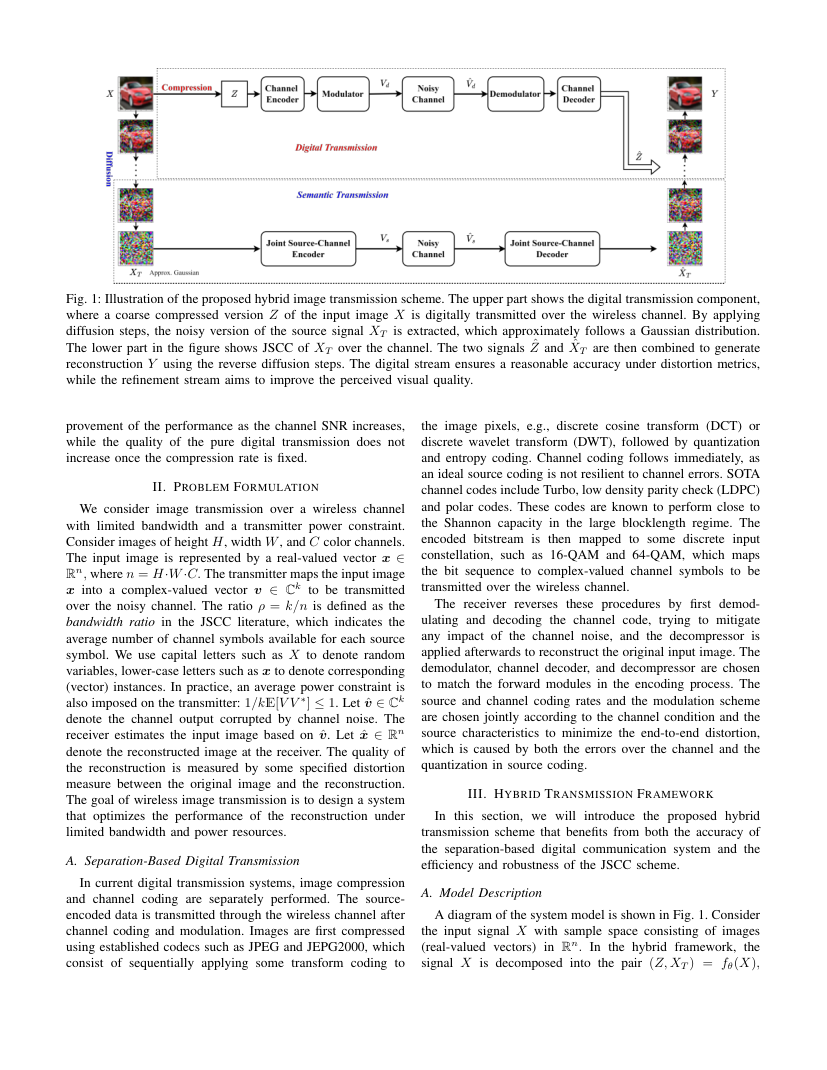
The digital stream ensures a reasonable accuracy under distortion metrics, while the refinement stream aims to improve the perceived visual quality. provement of the performance as the channel SNR increases, while the quality of the pure digital transmission does not increase once the compression rate is fixed. PDF p.2
The level of quantization can be chosen to achieve different reconstruction qualities. PDF p.3
Recent research shows that the JSCC scheme combined with a generative model for reconstruction can achieve significant bandwidth reduction, while significantly improving the per- ceptual quality of the reconstruction [20]. PDF p.3
Gaussian samples over an AWGN channel achieves the optimal perfor- mance despite operating over a finite block lengnth [19]. PDF p.3
The digital transmission stream ensures a reasonable accuracy of the reconstruction using distortion metrics, while the forward and reverse diffusion processes op- erates directly on the probability distributions, which improve the perceived visual quality of the reconstruction. PDF p.4
A Hybrid Wireless Image Transmission Scheme with Diffusion,原 PDF 第 2 页(架构/方法页)。A Hybrid Wireless Image Transmission Scheme with Diffusion,原 PDF 第 5 页(关键结果页)。
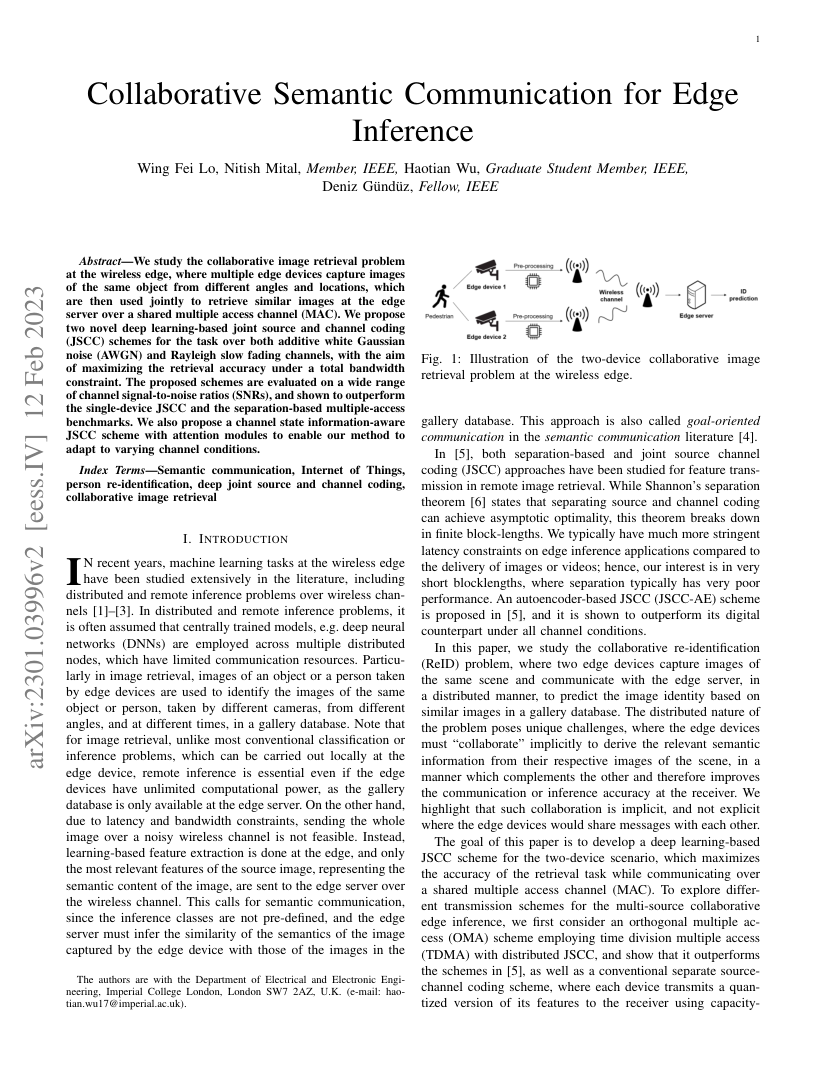
Collaborative Semantic Communication for Edge Inference
仍然存在的问题:The distributed nature of the problem poses unique challenges, where the edge devices must “collaborate” implicitly to derive the relevant semantic information from their respective images of the scene, in a manner which complements the other and therefore improves the communication or inference accuracy at the receiver. PDF p.1
本文提出的方案:We propose two novel deep learning-based joint source and channel coding (JSCC) schemes for the task over both additive white Gaussian noise (AWGN) and Rayleigh slow fading channels, with the aim of maximizing the retrieval accuracy under a total bandwidth constraint. PDF p.1
方案起作用的机制:Separate Digital Transmission Each transmitter consists of a semantic feature encoder, modeled as a ResNet50 [21] network, followed by a feature compressor, employing quantization and arithmetic coding modules, which are the same as the state-of-the-art pipeline in [5]. PDF p.3
We propose two novel deep learning-based joint source and channel coding (JSCC) schemes for the task over both additive white Gaussian noise (AWGN) and Rayleigh slow fading channels, with the aim of maximizing the retrieval accuracy under a total bandwidth constraint. PDF p.1
We also propose a channel state information-aware JSCC scheme with attention modules to enable our method to adapt to varying channel conditions. PDF p.1
An autoencoder-based JSCC (JSCC-AE) scheme is proposed in [5], and it is shown to outperform its digital counterpart under all channel conditions. PDF p.1
We propose two new collaborative JSCC schemes for OMA and NOMA transmissions, and show the superiority of the latter. • We construct and analyze DNN architectures for a chan- nel state information (CSI)-aware JSCC scheme (SNR- aware and channel fading-aware), where a single network is trained to exploit the channel state information for channel equalization and SNR-adaptation. PDF p.2
中间语义表示是什么
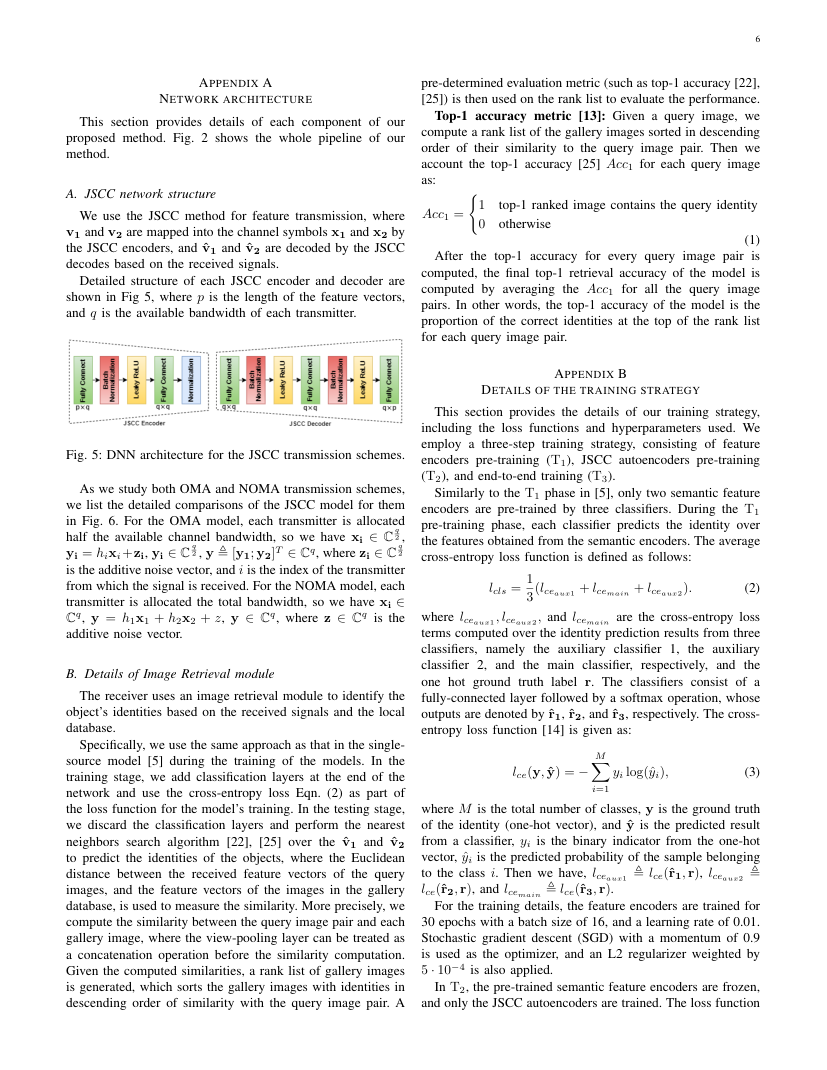
Separate Digital Transmission In the digital scheme, transmitter Ei extracts a semantic feature vector vi ∈Rr from the source si, which is quantized to ˜vi ∈Zr, and then mapped to a channel codeword xi ∈Cq. PDF p.2
The receiver first decodes the two channel codewords to recover the quantized semantic features ˜v1 and ˜v2. PDF p.2
JSCC In this scheme, source signals si ∈Rp, i = 1, 2, are first mapped to semantic feature vectors vi ∈Rr, i = 1, 2, which are then mapped to the channel codewords xi ∈Cq. PDF p.2
3 recover estimates ˆv1 and ˆv2 of the semantic features, and then performs the retrieval task using the recovered semantic features. PDF p.3
数字化方案与实际传输开销
数字化判断:数字调制或混合数字-模拟链路 语义表示被映射到有限星座、编码 bit 或数字/模拟并行分支,已经触及可部署物理层接口。
Separate Digital Transmission In the digital scheme, transmitter Ei extracts a semantic feature vector vi ∈Rr from the source si, which is quantized to ˜vi ∈Zr, and then mapped to a channel codeword xi ∈Cq. PDF p.2
The receiver first decodes the two channel codewords to recover the quantized semantic features ˜v1 and ˜v2. PDF p.2
In that case, the only source of error in the computa- tion of the desired function is quantization. PDF p.2
Separate Digital Transmission Each transmitter consists of a semantic feature encoder, modeled as a ResNet50 [21] network, followed by a feature compressor, employing quantization and arithmetic coding modules, which are the same as the state-of-the-art pipeline in [5]. PDF p.3
The receiver decodes the received signal to obtain estimates of the quantized semantic features, which are then passed to the image retrieval module. PDF p.3
bit / token / channel-use / CBR 证据
We consider two JSCC schemes: JSCC with OMA: Each transmitter is allocated half the available channel bandwidth, i.e., q 2 channel uses. PDF p.2
信道处理机制:decoder 实际收到什么
分类:数字语义特征 + 传统信道编码 decoder 通常看到信道译码后的 bit/index;若论文只假设译码成功,则未真正学习处理残余 index 跳变。
We propose two novel deep learning-based joint source and channel coding (JSCC) schemes for the task over both additive white Gaussian noise (AWGN) and Rayleigh slow fading channels, with the aim of maximizing the retrieval accuracy under a total bandwidth constraint. PDF p.1
We evaluate these schemes on the additive white Gaussian noise (AWGN) and Rayleigh slow fading channels. PDF p.2
Inspired by the attention mechanism in adap- tive JSCC [10]–[12], we also propose an SNR-aware scheme for the AWGN channel to adjust the networks depending on the SNRs. PDF p.2
For the AWGN channel, we set h1 = h2 = 1. PDF p.2
JSCC In this scheme (illustrated in Fig. 2), the feature compressor, quantizer, arithmetic coder, and channel coder at the trans- mitter, and the channel decoder and arithmetic decoder at the receiver, are replaced by a single autoencoder architecture. PDF p.3
实验设置与证据
数据集:论文文本未明确命中,需查看原表格或附录
Baseline:Polar、separation-based
信道/链路:AWGN、Rayleigh、fading channel、MIMO、OFDM
指标:accuracy、latency
SNR 条件:-6dB、15dB、18dB、0dB
主要实验结论(带全文页码)
Performance against channel SNR The proposed schemes for JSCC with OMA and NOMA are trained and tested on a pre-processed Market-1501 [22] dataset over a wide range of channel SNRs from -6dB to 15dB, and compared with the separation-based scheme and the single- device JSCC scheme in [5]. PDF p.3
The two-device JSCC schemes outperform the single-device JSCC scheme for a wide range of channel SNRs, especially higher SNRs, showing that incorporating two views of the same identity to make a collaborative decision at the edge server improves the retrieval performance. PDF p.3
It is also observed in Fig. 3a, 3b and 3c that JSCC with NOMA outperforms its orthogonal counterpart. PDF p.3
In Fig. 3a, it is shown that while the OMA JSCC scheme outperforms the single-device JSCC benchmark at most SNRs, they are surpassed by it at very low SNRs. PDF p.3
Scheme Squared cosine similarity OMA (AWGN) 0.0151 OMA (slow fading) 0.0165 NOMA (AWGN) 0.7523 NOMA (slow fading) 0.8234 TABLE I: Squared cosine similarity between input symbols of the OMA and NOMA schemes. the NOMA JSCC scheme brings the benefits of both schemes together, and outperforms both schemes at all SNRs. PDF p.4
通信审稿价值与 Codex 判断
价值在于利用用户间语义相关性或分层需求改善频谱共享,而不只是分别运行多个点到点网络。
局限:残余 bit/VQ-index 错误导致码字跳变的鲁棒性没有被充分证明。
Collaborative Semantic Communication for Edge Inference,原 PDF 第 1 页(架构/方法页)。Collaborative Semantic Communication for Edge Inference,原 PDF 第 6 页(关键结果页)。
Deep Joint Source-Channel and Encryption Coding: Secure Semantic Communications
仍然存在的问题:However, due to the inherent correlation between the source sample and channel input, DeepJSCC is vulnerable to eavesdropping at- tacks. PDF p.1
本文提出的方案:In this paper, we propose the first DeepJSCC scheme for wireless image transmission that is secure against eavesdroppers, called DeepJSCEC. PDF p.1
方案起作用的机制:全文自动定位未找到可靠句子,需回到 PDF 人工核查。
作者希望证明的结论:We see that while Bob is able to reconstruct the transmitted image with good quality, Eve achieves a result slightly worse than reconstructing an image with average pixel values. PDF p.10
In DeepJSCC, this is achieved by an autoen- coder architecture with a non-trainable channel layer between the encoder and decoder. PDF p.1
In this paper, we propose the first DeepJSCC scheme for wireless image transmission that is secure against eavesdroppers, called DeepJSCEC. PDF p.1
This modular architecture also makes incorporating encryption into the design very easy, as the compressed bits can simply be encrypted using a known encryption scheme, such as the Advanced Encryption Standard (AES) [4]. PDF p.1
In this paper, we propose a DeepJSCC scheme for wireless image transmission that is secure against eaves- arXiv:2208.09245v2 [cs.CR] 31 Aug 2022 PDF p.1
中间语义表示是什么
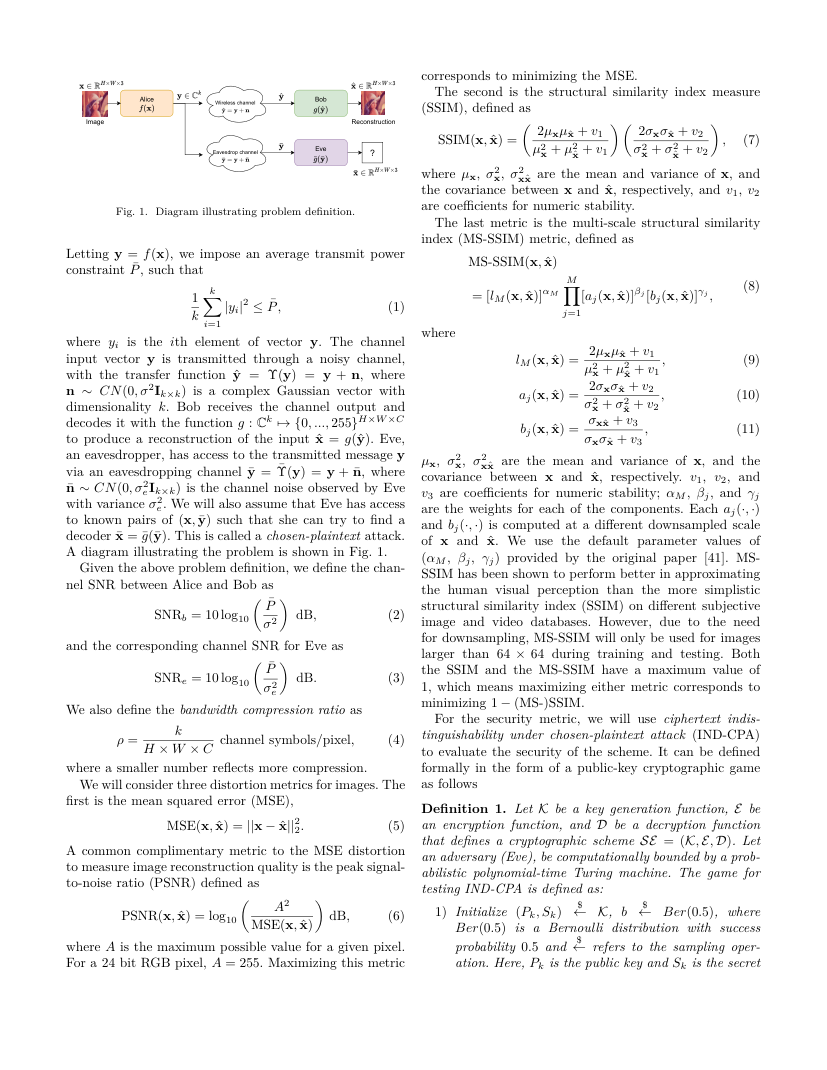
Given the above problem definition, we define the chan- nel SNR between Alice and Bob as SNRb = 10 log10 ¯P σ2 dB, (2) and the corresponding channel SNR for Eve as SNRe = 10 log10 ¯P σ2e dB. (3) We also define the bandwidth compression ratio as ρ = k H × W × C channel symbols/pixel, (4) where a smaller number reflects more compression. PDF p.3
Proposed Solution An input image x is mapped with a non-linear encoder function fθ : RH×W ×C 7→Rk, parameterized by θ, into a latent vector z = fθ(x). PDF p.4
Each value in the latent vector z is then quantized into N uniform quantization levels, with centroids Cq = {q1, ..., qN}, via the quantizer qCq : Rk 7→ Ck q , which we will define in Sec. PDF p.4
This forms the quantized latent vector ¯z. PDF p.4
数字化方案与实际传输开销
数字化判断:数字调制或混合数字-模拟链路 语义表示被映射到有限星座、编码 bit 或数字/模拟并行分支,已经触及可部署物理层接口。
The scheme, called Deep- JSCC, showed appealing properties, such as lower end- to-end distortion for a given channel blocklength com- pared to state-of-the-art digital compression schemes [9], flexibility to adapt to different source or channel models [8], [9], ability to exploit channel feedback [10], capability to produce adaptive-bandwidth transmission schemes [11], and adaptivity to channel input constellation constraints [12]. PDF p.1
Each value in the latent vector z is then quantized into N uniform quantization levels, with centroids Cq = {q1, ..., qN}, via the quantizer qCq : Rk 7→ Ck q , which we will define in Sec. PDF p.4
That is, ¯z = qCq(z), with ¯zi ∈Cq, where ¯zi is the ith element of the quantized vector ¯z. PDF p.4
The ciphertext c is then modulated using a constellation C = {c1, . . . , cp} of order p, by mapping each cj ∈Zp to the corresponding constellation point in C, producing channel input y ∈Ck. PDF p.4
To ensure that the power constraint is met, we choose the constellation points such that the average power of the constellation points assuming uniform prob- ability is ¯P = 1 p p X j=1 |cj|2. (13) The channel input y is then transmitted through an AWGN channel, producing the channel output ˆy = y + n. PDF p.4
bit / token / channel-use / CBR 证据
Given the above problem definition, we define the chan- nel SNR between Alice and Bob as SNRb = 10 log10 ¯P σ2 dB, (2) and the corresponding channel SNR for Eve as SNRe = 10 log10 ¯P σ2e dB. (3) We also define the bandwidth compression ratio as ρ = k H × W × C channel symbols/pixel, (4) where a smaller number reflects more compression. PDF p.3
As such, we compress the images to a bit rate such that it is under the rate support by the LDPC code considered and is within an integer multiple of 128 bits. PDF p.6
Comparison of DeepJSCEC trained on the CIFAR10 dataset to BPG compression for different bandwidth compression ratios ρ. and test datasets. PDF p.8
Cout refers to the number of channels in the final output tensor of the encoder fθ, which controls the number of channel uses k per image. PDF p.8
Comparison of DeepJSCEC trained on the Tiny ImageNet dataset to BPG compression for different bandwidth compression ratios ρ. malization, initially proposed in [48], and shown to be effective in density modeling and compression of images. PDF p.8
信道处理机制:decoder 实际收到什么
分类:数字语义特征 + 传统信道编码 decoder 通常看到信道译码后的 bit/index;若论文只假设译码成功,则未真正学习处理残余 index 跳变。
Numerical results show that DeepJSCEC achieves similar or better image quality than separate source coding using BPG compression, AES encryption, and LDPC codes for channel coding, while preserving the graceful degradation of image quality with respect to channel quality. PDF p.1
This makes the scheme very practical for real world use. 4) Unlike other works that focus on wiretap channel codes [18]–[23], we do not require any assumptions about the eavesdropper’s channel quality, or its in- tended use of the intercepted signal. 5) Numerical results show that DeepJSCEC achieves similar or better image quality than separation- based schemes employing BPG [3] for source coding, LDPC [24] codes for channel coding and AES [4] for encryption. 6) We also show that the proposed encryption method is problem agnostic, meaning it can be applied to other end-to-end JSCC problems, such as remote classification, without modification. PDF p.2
Problem Statement We consider the problem of wireless image transmission over an additive white Gaussian noise (AWGN) channel, where Alice wants to send an image to Bob without Eve, the eavesdropper, obtaining a good estimate of the image based on a chosen metric. PDF p.2
Eve, an eavesdropper, has access to the transmitted message y via an eavesdropping channel ¯y = ¯Υ(y) = y + ¯n, where ¯n ∼CN(0, σ2 eIk×k) is the channel noise observed by Eve with variance σ2 e. PDF p.3
To ensure that the power constraint is met, we choose the constellation points such that the average power of the constellation points assuming uniform prob- ability is ¯P = 1 p p X j=1 |cj|2. (13) The channel input y is then transmitted through an AWGN channel, producing the channel output ˆy = y + n. PDF p.4
Although increasing the number of quantization levels N would in theory improve the performance, due to the error terms from the cryptographic scheme, increasing N also increases the relative magnitude of the error terms, thus reducing the performance. PDF p.6
We also use early stopping with a patience of 10 epochs to prevent overfitting and a learning rate scheduler that multiplies the learning rate by a factor of 0.8 if the loss does not improve for 5 epochs in a row. PDF p.8
While the attention layer has been used in [49] and [50] to improve the compression efficiency by learning to focus on image regions that require higher bit rates, in our model it is used to improve the allocation of channel bandwidth and power resources. PDF p.8
We see that while Bob is able to reconstruct the transmitted image with good quality, Eve achieves a result slightly worse than reconstructing an image with average pixel values. PDF p.10
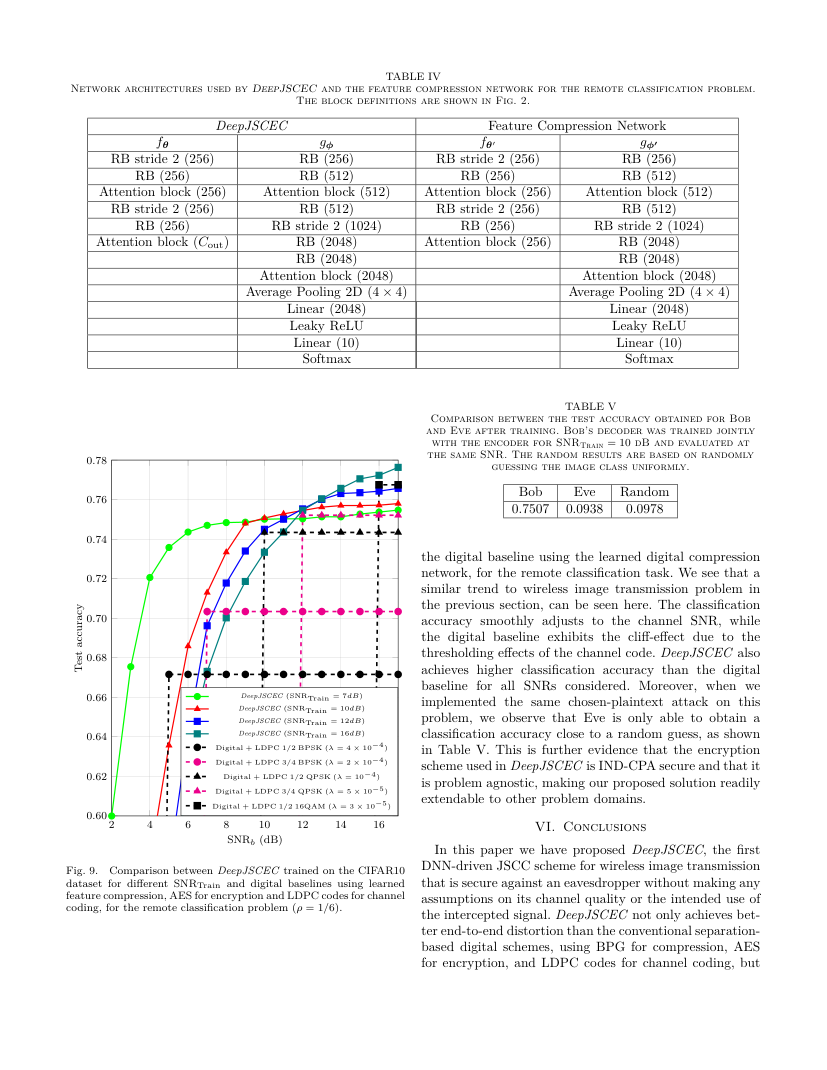
DeepJSCEC also achieves higher classification accuracy than the digital baseline for all SNRs considered. PDF p.11
Deep Joint Source-Channel and Encryption Coding: Secure Semantic Communications,原 PDF 第 3 页(架构/方法页)。Deep Joint Source-Channel and Encryption Coding: Secure Semantic Communications,原 PDF 第 11 页(关键结果页)。
DeepJSCC-1++: Robust and Bandwidth-Adaptive Wireless Image Transmission
现有进展:INTRODUCTION Thanks to recent advances in machine learning, there has been a growing interest in developing data-driven joint source- channel coding (JSCC) systems. PDF p.1
仍然存在的问题:This is a limitation for the adoption of DeepJSCC in practical systems, as it requires storing a large number of DeepJSCC encoder/decoder parameters on mobile devices to C. PDF p.1
本文提出的方案:In this paper, we propose a novel bandwidth and channel quality adaptive scheme, named DeepJSCC-l++, which can map each input image to a desired channel bandwidth - see Fig. 1b. PDF p.1
方案起作用的机制:The decoder also has I stages and each stage consists of a patch division block and Swin transformer blocks. PDF p.4
作者希望证明的结论:It also outperforms the separation-based baseline considering BPG compression with a capacity-achieving channel code, which provides an upper bound on the performance achievable by a separation-based scheme employing BPG for compression. PDF p.6
To achieve this, we treat the bandwidth ratio and the SNR as channel state information available to the encoder and decoder, which are fed to the model as side information, and train the proposed DeepJSCC-l++ model with different bandwidth ratios and SNRs. PDF p.1
On the other hand, in most existing works, the DeepJSCC encoder/decoder pairs are designed and trained for specific channel conditions, i.e., channel bandwidth and signal-to-noise ratio (SNR). PDF p.1
This is a limitation for the adoption of DeepJSCC in practical systems, as it requires storing a large number of DeepJSCC encoder/decoder parameters on mobile devices to C. PDF p.1
In this work, we will show that a single DeepJSCC encoder/decoder pair can be trained to be used in any available channel bandwidth and SNR. PDF p.1
中间语义表示是什么
Here, ρ is defined as the bandwidth ratio as it represents the average number of channel symbols available per source dimension. PDF p.2
As shown in Fig. 1a, in the successive refinement scheme studied in [8], the encoder maps the image into a latent vector ˜z ∈CρLN, which is further power normalized to z before transmission. PDF p.2
数字化方案与实际传输开销
数字化判断:数字调制或混合数字-模拟链路 语义表示被映射到有限星座、编码 bit 或数字/模拟并行分支,已经触及可部署物理层接口。
We start with the initial stage where the image S is first split into non-overlapping patches (also known as ‘tokens’) by a patch partition module followed by a linear embedding layer to project each ‘token’ into feature space with dimension c. PDF p.3
Before feeding f X into the subsequent transformer layers, we concate- nate each of its tokens with the side information, u ∈Rnu, to form a larger tensor X with dimension (c+nu)×H/2×W/2. PDF p.3
Assume that the input feature tensor Xi at stage i has dimension c × hi × wi and each window contains w × w patches/tokens, then the first Swin transformer block whose operation is denoted by W-MSA, evenly partitions Xi into (hi/w, wi/w) non-overlapping windows2 then per- forms multi-head self-attention within each window. PDF p.3
The matrix eZ contains NT tokens, each consisting of NF features for the maximum bandwidth ratio ρL. PDF p.4
To be adaptive to different ρl’s, one may either transmit a reduced number of tokens nt < NT , while keeping the dimension of features per token the same (nf = NF), which is called varying patches, or reduces the dimension of features per token (we assume the same nf for different tokens) while fixing the number of tokens (nt = NT ), which is referred to as varying features. PDF p.4
bit / token / channel-use / CBR 证据
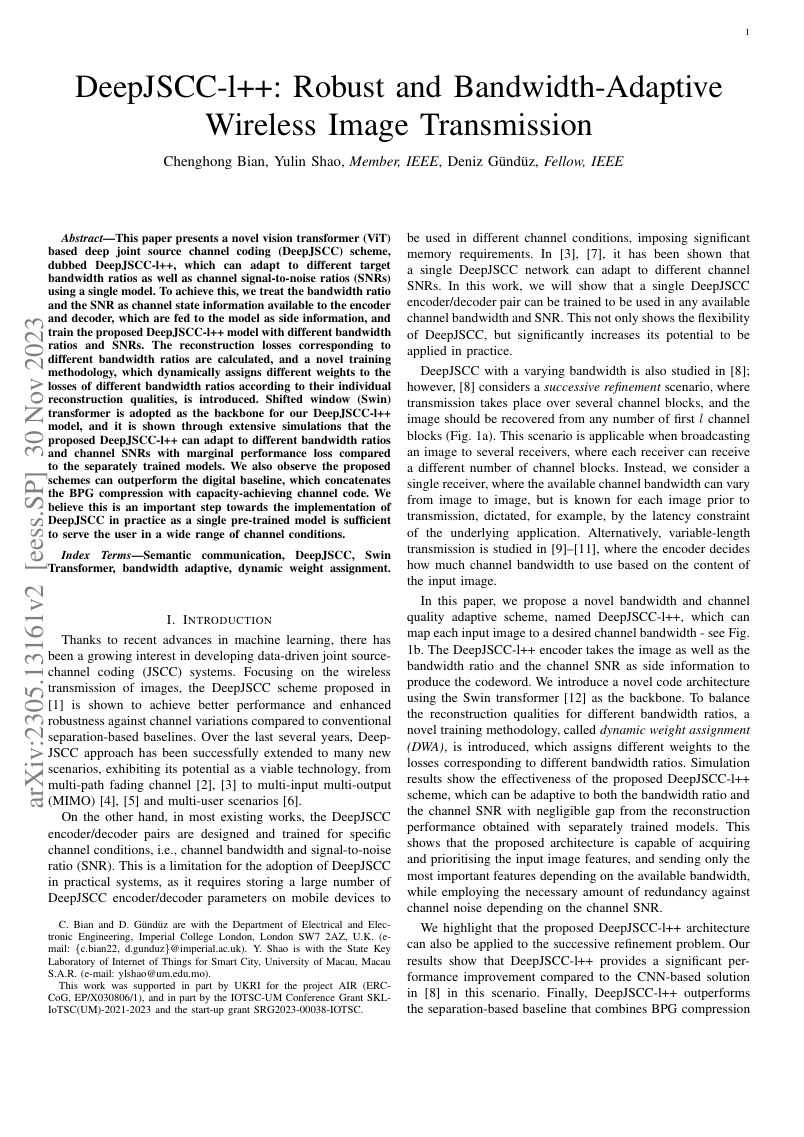
arXiv:2305.13161v2 [eess.SP] 30 Nov 2023 1 DeepJSCC-l++: Robust and Bandwidth-Adaptive Wireless Image Transmission Chenghong Bian, Yulin Shao, Member, IEEE, Deniz G¨und¨uz, Fellow, IEEE Abstract—This paper presents a novel vision transformer (ViT) based deep joint source channel coding (DeepJSCC) scheme, dubbed DeepJSCC-l++, which can adapt to different target bandwidth ratios as well as channel signal-to-noise ratios (SNRs) using a single model. PDF p.1
To achieve this, we treat the bandwidth ratio and the SNR as channel state information available to the encoder and decoder, which are fed to the model as side information, and train the proposed DeepJSCC-l++ model with different bandwidth ratios and SNRs. PDF p.1
The reconstruction losses corresponding to different bandwidth ratios are calculated, and a novel training methodology, which dynamically assigns different weights to the losses of different bandwidth ratios according to their individual reconstruction qualities, is introduced. PDF p.1
Shifted window (Swin) transformer is adopted as the backbone for our DeepJSCC-l++ model, and it is shown through extensive simulations that the proposed DeepJSCC-l++ can adapt to different bandwidth ratios and channel SNRs with marginal performance loss compared to the separately trained models. PDF p.1
The DeepJSCC-l++ encoder takes the image as well as the bandwidth ratio and the channel SNR as side information to produce the codeword. PDF p.1
This shows that the proposed architecture is capable of acquiring and prioritising the input image features, and sending only the most important features depending on the available bandwidth, while employing the necessary amount of redundancy against channel noise depending on the channel SNR. PDF p.1
SYSTEM MODEL We consider the wireless transmission of images over the AWGN channel. PDF p.2
The transmitted codeword z goes through an AWGN channel, y = z +w, where each element in w follows a complex Gaussian distribution with zero mean and variance equals to σ2, and y ∈CρN denotes the noisy channel output vector. PDF p.2
The power normalized signal is then transmitted over the complex AWGN channel. PDF p.3
Note that zl is subject to a more flexible power constraint compared with the successive refinement scheme: 1 ρlN ||zl||2 2 ≤1. PDF p.3
For small ρl, Ll is much larger compared with that of larger ρl. PDF p.4
The reconstruction for larger bandwidth ratios, however, becomes highly sub-optimal, which motivates us to explore a better training methodology to improve the reconstruction quality across all conditions. PDF p.4
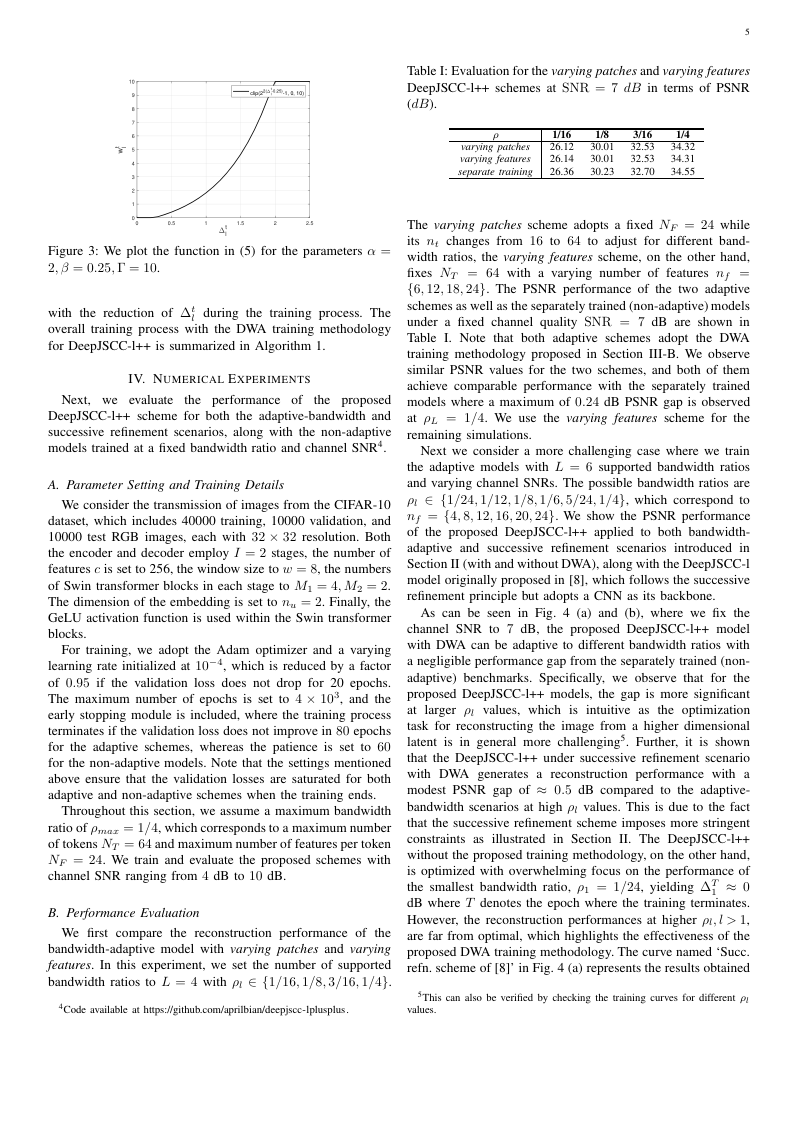
Inspired by [14], we propose the DWA scheme, which assigns different weights wt l to the loss achieved for different ρl values according to their reconstruction qualities in the validation phase at the t-th epoch. PDF p.4
The maximum number of epochs is set to 4 × 10³, and the early stopping module is included, where the training process terminates if the validation loss does not improve in 80 epochs for the adaptive schemes, whereas the patience is set to 60 for the non-adaptive models. PDF p.5
仍然存在的问题:However, we are interested in the practical finite block length regime, in which case separate source and channel coding is known to be suboptimal. PDF p.1
本文提出的方案:We introduce a novel joint image compression and transmission scheme, where the devices send their compressed image representations in a non-orthogonal manner. PDF p.1
方案起作用的机制:全文自动定位未找到可靠句子,需回到 PDF 人工核查。
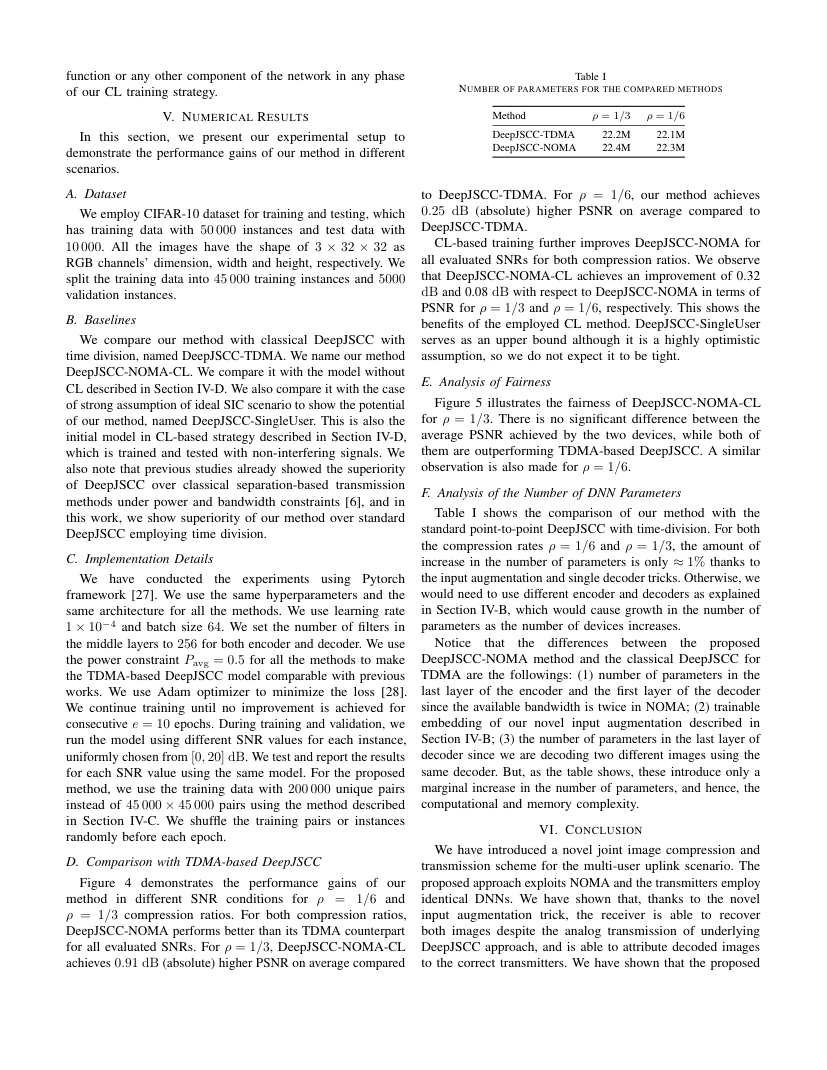
作者希望证明的结论:For ρ = 1/3, DeepJSCC-NOMA-CL achieves 0.91 dB (absolute) higher PSNR on average compared Table I NUMBER OF PARAMETERS FOR THE COMPARED METHODS Method ρ = 1/3 ρ = 1/6 DeepJSCC-TDMA 22.2M 22.1M DeepJSCC-NOMA 22.4M 22.3M to DeepJSCC-TDMA. PDF p.5
The receiver has to revert these steps by employing a channel decoder and a source decoder, respectively. PDF p.1
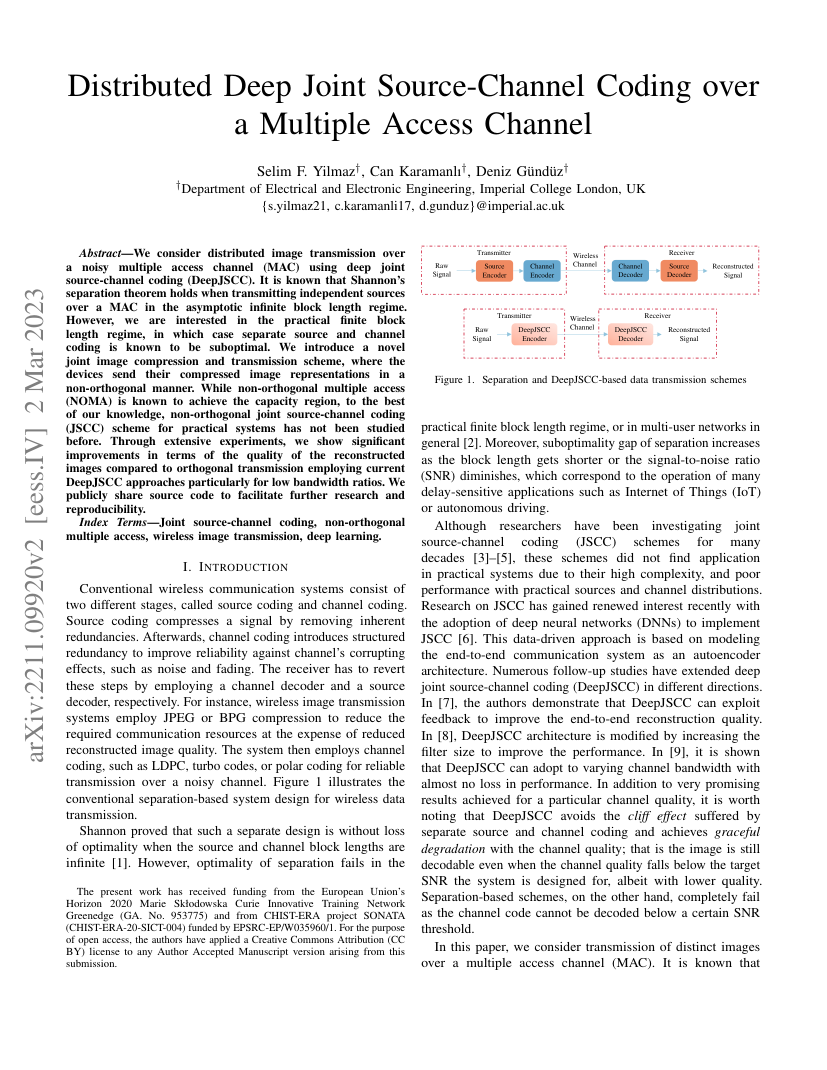
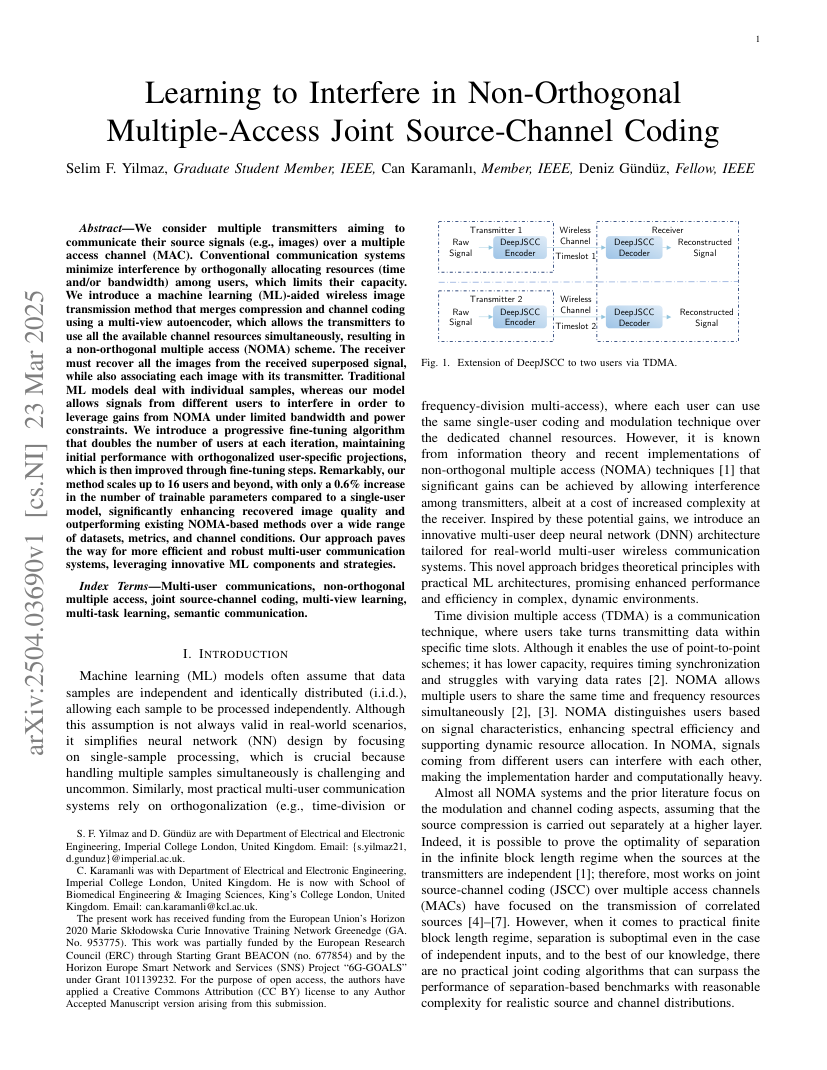
Source Encoder Raw Signal Channel Encoder Transmitter Channel Decoder Reconstructed Signal Source Decoder Receiver Wireless Channel DeepJSCC Encoder Raw Signal Transmitter Reconstructed Signal DeepJSCC Decoder Receiver Wireless Channel Figure 1. PDF p.1
This data-driven approach is based on modeling the end-to-end communication system as an autoencoder architecture. PDF p.1
In [8], DeepJSCC architecture is modified by increasing the filter size to improve the performance. PDF p.1
中间语义表示是什么
Transmitter i maps an input image xi ∈ICin×W ×H, where W and H denote the width and height of the image, while Cin represents the R, G and B channels for colored images, with a non-linear encoding function EΘi,σ : ICin×W ×H →Ck parameterized by Θi into a complex-valued latent vector zi = EΘi,σ(xi), where k corresponds to the available channel bandwidth. PDF p.3
We enforce average transmission power constraint on both transmitters: 1 k ∥zi∥2 2 ≤Pavg, i ∈{1, 2}. (1) The receiver receives the summation of latent vectors as: y = z1 + z2 + n, where n ∈Ck is independent and identically distributed (i.i.d.) complex Gaussian noise term with variance σ2, i.e., n ∼ CN(0, σ2Ik). PDF p.3
The bandwidth ratio ρ characterizes the available channel resources, and is defined as: ρ = k CinWH channel symbols/pixel. PDF p.3
数字化方案与实际传输开销
数字化判断:数字调制或混合数字-模拟链路 语义表示被映射到有限星座、编码 bit 或数字/模拟并行分支,已经触及可部署物理层接口。
On the other hand, in DeepJSCC, input signal are directly mapped to channel inputs without imposing any constellation constraints. PDF p.2
We also define the SNR at time t as: SNR = 10 log10 Pavg σ2 dB. (2) Our objective is to maximize the average peak signal to noise ratio (PSNR), on an unseen target dataset under given channel SNR and the power constraint in (1), which is defined as: PSNR = 10 log10 A2 1 CinHW ∥xi −ˆxi∥2 2 ! dB, (3) where A is the maximum possible input value, e.g., A = 255 for images with 8-bit per channel as in our case. PDF p.3
We employ the encoder and decoder architectures in [24], removing the quantization part as our method allows continuous channel inputs. PDF p.3
Whiting, “Rate-splitting multiple access for discrete memoryless channels,” IEEE Transactions on Information Theory, vol. 47, no. 3, pp. 873–890, 2001. [13] N. PDF p.6
bit / token / channel-use / CBR 证据
Through extensive experiments, we show significant improvements in terms of the quality of the reconstructed images compared to orthogonal transmission employing current DeepJSCC approaches particularly for low bandwidth ratios. PDF p.1
The bandwidth ratio ρ characterizes the available channel resources, and is defined as: ρ = k CinWH channel symbols/pixel. PDF p.3
Comparison with TDMA-based DeepJSCC Figure 4 demonstrates the performance gains of our method in different SNR conditions for ρ = 1/6 and ρ = 1/3 compression ratios. PDF p.5
For both compression ratios, DeepJSCC-NOMA performs better than its TDMA counterpart for all evaluated SNRs. PDF p.5
CL-based training further improves DeepJSCC-NOMA for all evaluated SNRs for both compression ratios. PDF p.5
信道处理机制:decoder 实际收到什么
分类:数字语义特征 + 传统信道编码 decoder 通常看到信道译码后的 bit/index;若论文只假设译码成功,则未真正学习处理残余 index 跳变。
The receiver has to revert these steps by employing a channel decoder and a source decoder, respectively. PDF p.1
The system then employs channel coding, such as LDPC, turbo codes, or polar coding for reliable transmission over a noisy channel. PDF p.1
Source Encoder Raw Signal Channel Encoder Transmitter Channel Decoder Reconstructed Signal Source Decoder Receiver Wireless Channel DeepJSCC Encoder Raw Signal Transmitter Reconstructed Signal DeepJSCC Decoder Receiver Wireless Channel Figure 1. PDF p.1
Specifically, consider additive white Gaussian noise (AWGN) channel with noise variance σ2. PDF p.3
We address this problem by first training the network without superposition (which is an easier task) by only using the signal and the AWGN noise, i.e., by computing ˆx1 via DΦ,σ(z1 + n) and ˆx2 via DΦ,σ(z2 + n), both with the power constraint Pavg as in our standard training strategy. PDF p.4
To achieve this goal, in the next section, we will introduce our framework to implement joint training of the neural network based decoder DΦ,σ and encoders EΘi,σ, i ∈{1, 2}. PDF p.3
Without significantly increasing the number of parameters and without changing the DeepJSCC architecture that is known to perform well, we introduce an input augmentation method to be able to improve separability of signals in the aggregate representation domain. PDF p.4
NUMERICAL RESULTS In this section, we present our experimental setup to demonstrate the performance gains of our method in different scenarios. PDF p.5
We continue training until no improvement is achieved for consecutive e = 10 epochs. PDF p.5
Comparison with TDMA-based DeepJSCC Figure 4 demonstrates the performance gains of our method in different SNR conditions for ρ = 1/6 and ρ = 1/3 compression ratios. PDF p.5
Distributed Deep Joint Source-Channel Coding over a Multiple Access Channel,原 PDF 第 1 页(架构/方法页)。Distributed Deep Joint Source-Channel Coding over a Multiple Access Channel,原 PDF 第 5 页(关键结果页)。
Generative Joint Source-Channel Coding for Semantic Image Transmission
2023 · IEEE Journal on Selected Areas in Communications · 物理层调制、波形与 MIMO
作者:Ecenaz Erdemir; Tze-Yang Tung; Pier Luigi Dragotti; Denız Gündüz
仍然存在的问题:However, these methods mostly focus on the distor- tion of the reconstructed signals with respect to the input image, rather than their perception by humans. PDF p.1
本文提出的方案:In this work, we propose two novel JSCC schemes that leverage the perceptual quality of deep generative models (DGMs) for wireless image transmission, namely InverseJSCC and GenerativeJSCC. PDF p.1
方案起作用的机制:Similarly, the receiver consists of source and channel decoders. PDF p.1
作者希望证明的结论:We observe that, for lower BCR, GenerativeJSCC outperforms DeepJSCC not only in terms of perceptual quality but also in terms of pixel-wise distortion. PDF p.10
In this work, we propose two novel JSCC schemes that leverage the perceptual quality of deep generative models (DGMs) for wireless image transmission, namely InverseJSCC and GenerativeJSCC. PDF p.1
In GenerativeJSCC, we carry out end-to-end training of an encoder and a StyleGAN-based decoder, and show that GenerativeJSCC significantly outperforms DeepJSCC both in terms of distortion and perceptual quality. PDF p.1
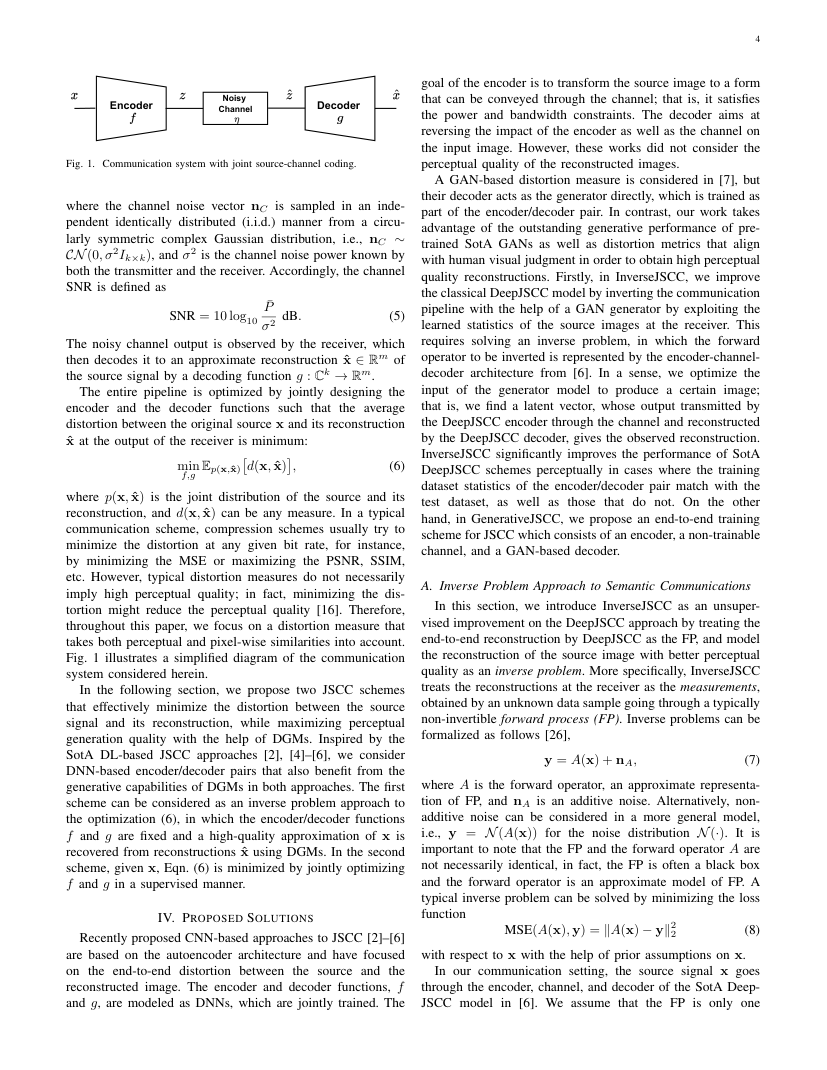
They consist of three blocks: an encoder at the transmitter, a noisy channel, and a decoder at the receiver. PDF p.1
From the first to the fifth generation of communication systems, the encoding process has followed the conventional two-step approach of Shannon’s separation theorem [1], which decomposes the transmitter into a source encoder and a channel encoder. PDF p.1
中间语义表示是什么
In a sense, we optimize the input of the generator model to produce a certain image; that is, we find a latent vector, whose output transmitted by the DeepJSCC encoder through the channel and reconstructed by the DeepJSCC decoder, gives the observed reconstruction. PDF p.4
DeepJSCC model as the forward operator A, where η is the AWGN channel function, G(·) is the generator network of a GAN, and w is the latent vector input to the generator. realization of the DeepJSCC model. PDF p.5
Here, ILO solves an inverse problem objective by adaptively changing the StyleGAN-2 layer to be optimized, moving from the initial latent vector to intermediate layers closer to the output. PDF p.5
While the latent vector controls the style parts of the generated image, the noise fed to the generator determines the high-resolution details. PDF p.5
数字化方案与实际传输开销
数字化判断:数字调制或混合数字-模拟链路 语义表示被映射到有限星座、编码 bit 或数字/模拟并行分支,已经触及可部署物理层接口。
G¨und¨uz, “DeepJSCC- Q: Constellation constrained deep joint source-channel coding,” arXiv preprint arXiv:2206.08100, 2022. [6] T.-Y. PDF p.11
bit / token / channel-use / CBR 证据
However, focusing on traditional distortion metrics alone does not necessarily result in high perceptual quality, especially in extreme physical conditions, such as very low bandwidth compression ratio (BCR) and low signal-to-noise ratio (SNR) regimes. PDF p.1
Some examples of the edge cases that can negatively affect the communication overhead are very low bandwidth compression ratio (BCR) arXiv:2211.13772v1 [eess.IV] 24 Nov 2022 PDF p.1
In a typical communication scheme, compression schemes usually try to minimize the distortion at any given bit rate, for instance, by minimizing the MSE or maximizing the PSNR, SSIM, etc. PDF p.4
信道处理机制:decoder 实际收到什么
分类:有限星座/调制符号直接过噪声信道 接收端从有噪星座或 soft symbol 恢复语义;需区分是否有显式 bit/index 译码。
Similarly, the receiver consists of source and channel decoders. PDF p.1
The authors propose a VAE- based JSCC scheme for a binary symmetric channel and a binary erasure channel system, later extended to wiretap channel scenario by [25]. PDF p.3
We consider the widely used additive white Gaussian noise (AWGN) channel model and assume it is known by both the transmitter and the receiver. PDF p.3
The transfer function of the AWGN channel is η(z, σ2) = z + nC, (4) PDF p.3
Communication system with joint source-channel coding. where the channel noise vector nC is sampled in an inde- pendent identically distributed (i.i.d.) manner from a circu- larly symmetric complex Gaussian distribution, i.e., nC ∼ CN(0, σ2Ik×k), and σ2 is the channel noise power known by both the transmitter and the receiver. PDF p.4
This is achieved by exploiting the remarkable representation quality that DGMs have achieved in the image domain in the past few years. PDF p.6
In particular, the improvements that InverseJSCC provides compared to DeepJSCC become more significant as the physical condition of the channel deteriorates. PDF p.6
End-to-end Semantic Communication InverseJSCC, presented in the previous section, improves the perceptual quality of a pre-trained DeepJSCC by exploiting the generative capability of a pre-trained GAN. PDF p.6
The second stage fine-tunes the model by training the layers learning the noise maps, which improves the details of the generated images. PDF p.7
Our goal is to achieve a better perception quality in the reconstructed images without sacrificing the distortion performance with respect to the ex- isting alternatives. PDF p.8
本文提出的方案:We propose an end-to-end (E2E) learning-based approach for secure communication against multiple eavesdroppers over complex-valued fading channels. PDF p.1
方案起作用的机制:At the output of the last PReLU layer, which consists of 2k × nT elements, we employ a flattening layer for each of the nT antennas, to reshape the encoded tensor to a data-stream. PDF p.3
作者希望证明的结论:One can infer from the figure that our proposed system outperforms the benchmarks in terms of the reconstruction performance. PDF p.5
We propose an end-to-end (E2E) learning-based approach for secure communication against multiple eavesdroppers over complex-valued fading channels. PDF p.1
In the context of wireless security, autoencoders (composed of linear layers) are exploited in [13] over the additive white Gaussian noise (AWGN) wiretap channel. PDF p.1
The data fed into the autoencoder is combined with additional non-informative random bits to confuse the eavesdropper; while, this also reduces the communication rate. PDF p.1
In this regard, [16] proposes a generative adver- sarial network (GAN)-inspired secure neural encoder-decoder pair over an AWGN wiretap channel against one eavesdropper. PDF p.1
数字化判断:数字调制或混合数字-模拟链路 语义表示被映射到有限星座、编码 bit 或数字/模拟并行分支,已经触及可部署物理层接口。
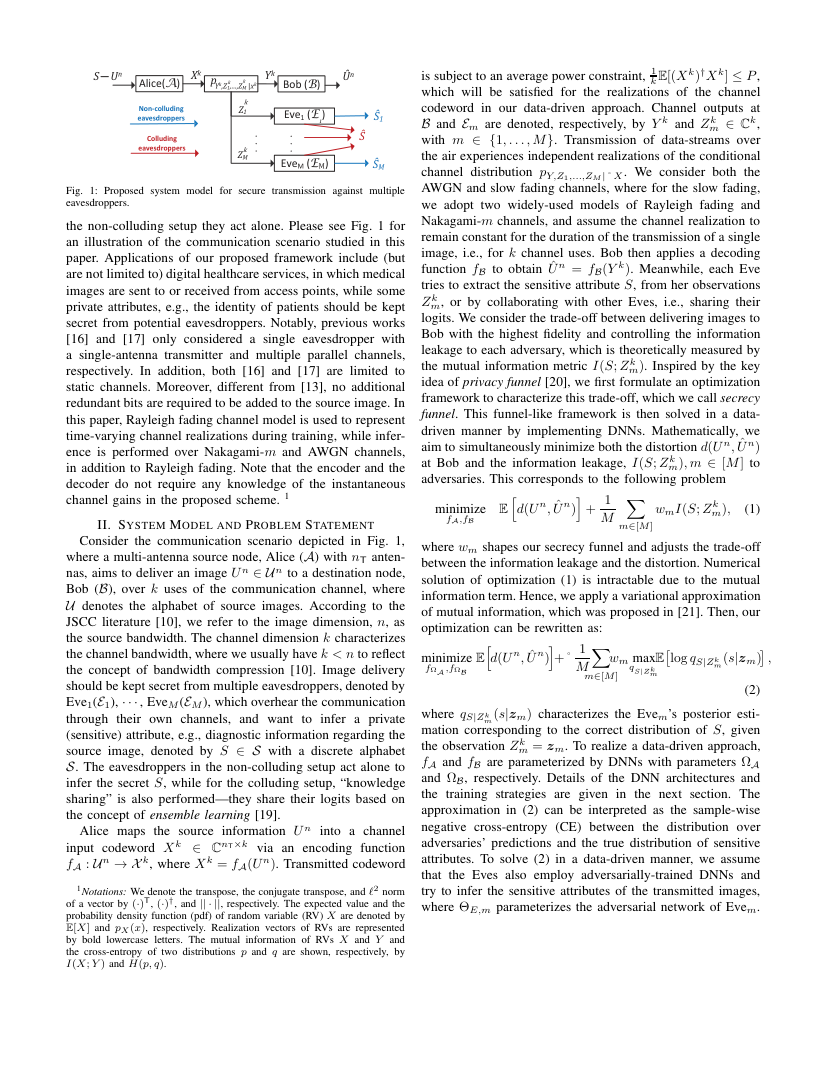
Image delivery should be kept secret from multiple eavesdroppers, denoted by Eve1(E1), · · · , EveM(EM), which overhear the communication through their own channels, and want to infer a private (sensitive) attribute, e.g., diagnostic information regarding the source image, denoted by S ∈S with a discrete alphabet S. PDF p.2
bit / token / channel-use / CBR 证据
We consider both the AWGN and slow fading channels, where for the slow fading, we adopt two widely-used models of Rayleigh fading and Nakagami-m channels, and assume the channel realization to remain constant for the duration of the transmission of a single image, i.e., for k channel uses. PDF p.2
In addition, the bandwidth compression ratio is set to k n = 1 3. PDF p.5
信道处理机制:decoder 实际收到什么
分类:连续 latent/信道符号联合训练 接收端拿到带噪连续特征或均衡后的复符号,而不是出错的 VQ index;能抗模拟噪声但不等价于解决数字 index error。
Adversarial accuracy of eavesdroppers are also studied over Rayleigh fading, Nakagami-m, and AWGN channels to verify the generalization of the proposed scheme. PDF p.1
In the context of wireless security, autoencoders (composed of linear layers) are exploited in [13] over the additive white Gaussian noise (AWGN) wiretap channel. PDF p.1
This can create vulnerabilities in terms of leakage to eavesdroppers, despite providing robustness against channel noise. PDF p.1
In this regard, [16] proposes a generative adver- sarial network (GAN)-inspired secure neural encoder-decoder pair over an AWGN wiretap channel against one eavesdropper. PDF p.1
The authors in [17] propose a variational autoencoder (VAE)- based approach for Deep-JSSC design over binary symmetric channels, again considering a single eavesdropper. PDF p.1
实验设置与证据
数据集:CIFAR-10
Baseline:DeepJSCC
信道/链路:AWGN、Rayleigh、fading channel
指标:SSIM、accuracy
SNR 条件:20dB、15dB、5 dB、20 dB
主要实验结论(带全文页码)
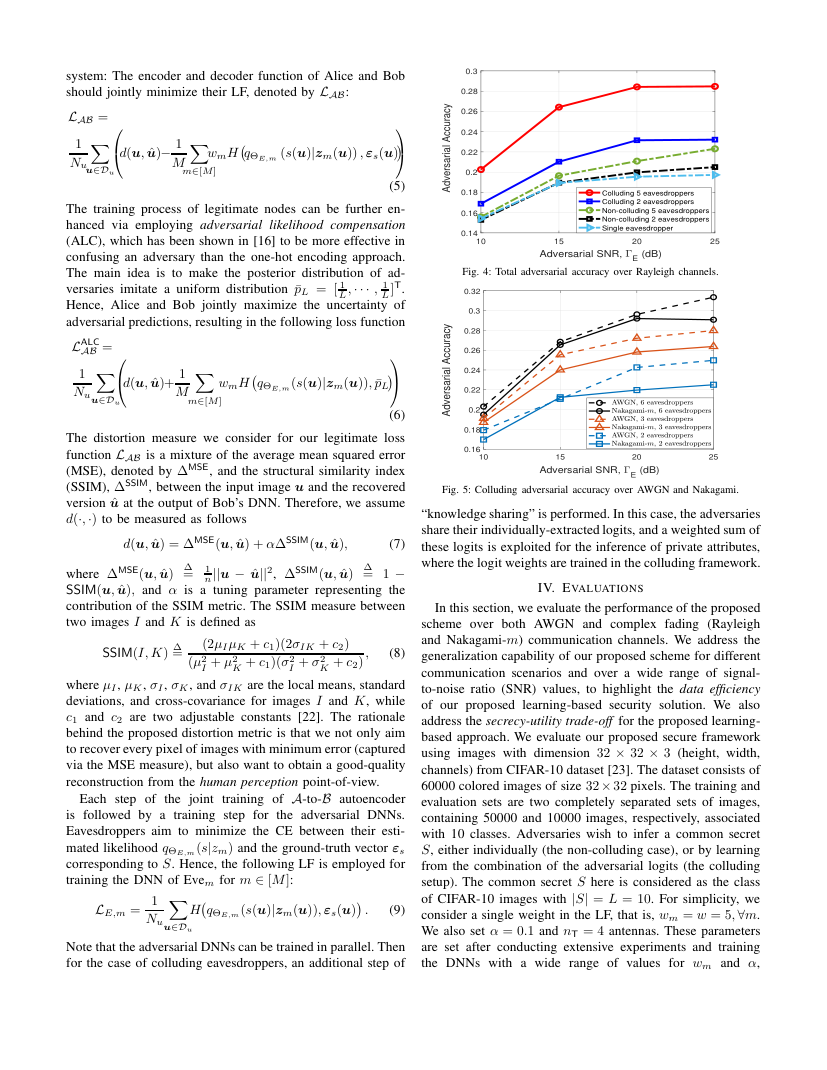
It shows that we can achieve almost similar trends in channel scenarios other than Rayleigh fading, despite training the networks with a Rayleigh channel model. PDF p.5
One can infer from the figure that our proposed system outperforms the benchmarks in terms of the reconstruction performance. PDF p.5
Accordingly, 20% and 10% per- formance gain is achieved by our proposed scheme compared with [16] and [18], respectively. PDF p.5
The ablation examinations conducted in this figure show that both the implemented DNNs and the proposed LFs for optimizing the framework contribute to the system’s performance compared with other benchmarks. PDF p.5
Data efficiency and gen- eralizability of our proposed scheme are also validated, since we have trained our DNNs with a fixed SNR ΓB = 20 dB, while the performance gain of our approach during inference holds for various SNRs. PDF p.5
通信审稿价值与 Codex 判断
价值在于说明语义特征并非天然安全,并给出可靠性、隐私和资源开销之间可测量的权衡。
局限:证据主要来自数据集与仿真信道,缺少真实射频链路/原型验证。
Secure Deep-JSCC Against Multiple Eavesdroppers,原 PDF 第 2 页(架构/方法页)。Secure Deep-JSCC Against Multiple Eavesdroppers,原 PDF 第 4 页(关键结果页)。
仍然存在的问题:Various federated/distributed learning paradigms have emerged as potential solutions to mitigate these limitations, which allow the models to be locally trained, and then aggregated in a cloud or edge server without moving local private data [2]. PDF p.1
本文提出的方案:After motivating our analysis, we propose the formal problem of communicating concepts, and provide its rate-distortion characterization, point- ing out its connection with the concepts of empirical and strong coordination in a network. PDF p.1
方案起作用的机制:However, if the environment imposes a constraint on such quantities, e.g., mutual information between the input and output of the learning rule, for example by introducing a arXiv:2305.08126v1 [cs.IT] 14 May 2023 PDF p.1
After motivating our analysis, we propose the formal problem of communicating concepts, and provide its rate-distortion characterization, point- ing out its connection with the concepts of empirical and strong coordination in a network. PDF p.1
It is also interesting to highlight the connections between this work and the study in [12], where the authors quantify the complexity of a learning algorithm output Q with its Kullback–Leibler divergence from a prior model distribution P, which, in our system model, represents the minimum achievable rate to convey Q, when P is set as the prior distribution. PDF p.2
We now briefly discuss why we are interested in learning rules A(S) that output model distributions, rather than single-point solutions: • First of all, the case in which Alice finds a point-wise estimate of the best model h∗is included as a special case Qh|S = δh∗. • Alice may want to express her uncertainty around the best choice h∗, which may be intrinsic in the learning algorithm A, through the distribution Qh|S. • Usually, optimization algorithms used to train DNNs, like stochastic gradient descent (SGD), are stochastic algorithms. • When H is the set of all DNNs hω with a specific architecture parameterized by the parameter vector ω, there exist many vectors ω performing in the same way. PDF p.2
This is the semantic aspect of communication captured by our framework, as the meaning of a concept c, i.e., the real unknown mapping, is conveyed through the model belief Qh|S, whose loss expressed in Equation (2) quantifies its fidelity with respect to the real concept c. PDF p.3
First of all, we just provide a simple scheme in which limn→∞davg(Qn, ˆQn) = 0 does not imply limn→∞dmax(Qn, ˆQn) = 0, meaning that in general a code that achieves 0 distortion on average, may not achieve 0 distortion model-wise, i.e., we cannot guarantee a single- model performance. PDF p.4
As already pointed out in [13], introducing common ran- domness does not improve the performance of empirical co- ordination schemes, meaning that any distribution achievable for empirical coordination by a (2nR, 2nR0, n) coding scheme is also achievable with R0 = 0. PDF p.4
Consequently, for scheme 2 the optimal com- pression function ρ(S) must achieve I(S; ˆS2| ˆH2) = 0, and so the only way to match the performance of scheme 1 is to account for the optimal distribution Q ˆ H|S when computing ˆS. PDF p.5
Now, we impose strong coordination between Alice and Bob, by using as target joint distribution Q∗ Sn,Hn = Qn i=1 Q∗ S,H, and by Theorem 10 of [13] the same rate I(S; H) of empirical coordination can be achieved, as long as enough common randomness is available. PDF p.7
本文提出的方案:Space-Time Design for Deep Joint Source Channel Coding of Images over MIMO Channels Chenghong Bian, Yulin Shao, Haotian Wu, and Deniz G¨und¨uz Department of Electrical and Electronic Engineering, Imperial College London, London SW7 2BT, UK Email:{c.bian22, y.shao, haotian.wu17, d.gunduz}@imperial.ac.uk Abstract—We propose novel deep joint source-channel coding (DeepJSCC) algorithms for wireless image transmission over multi-input multi-output (MIMO) Rayleigh fading channels, when channel state information (CSI) is available only at the receiver. PDF p.1
方案起作用的机制:Training and implementation details We evaluate the proposed diversity and multiplexing schemes2 for the transmission of images from the CIFAR- 10 dataset, which consists of 50000 training and 10000 test colored images, each with 32 × 32 resolution. PDF p.4
作者希望证明的结论:Note that when Nt > 2, the rate-1 space-time code that achieves full diversity does not exist, and we will adopt two OSTBC designs with rates 1/2 and 3/4, respectively. PDF p.3
Space-Time Design for Deep Joint Source Channel Coding of Images over MIMO Channels Chenghong Bian, Yulin Shao, Haotian Wu, and Deniz G¨und¨uz Department of Electrical and Electronic Engineering, Imperial College London, London SW7 2BT, UK Email:{c.bian22, y.shao, haotian.wu17, d.gunduz}@imperial.ac.uk Abstract—We propose novel deep joint source-channel coding (DeepJSCC) algorithms for wireless image transmission over multi-input multi-output (MIMO) Rayleigh fading channels, when channel state information (CSI) is available only at the receiver. PDF p.1
The encoder first applies a non-linear transform on the input image through a DNN architecture to extract the most important features for the recovery of the input image. PDF p.1
In the second, so-called multiplexing scheme, the encoder directly maps the latent vector to the antennas. PDF p.1
Note that the latter scheme is more general, and in principle, the DeepJSCC encoder/decoder pair, trained in an end-to-end fashion, can learn to introduce redundancy against channel variations when necessary (e.g., in the low SNR regime). PDF p.1
中间语义表示是什么
In the second, so-called multiplexing scheme, the encoder directly maps the latent vector to the antennas. PDF p.1
DEEPJSCC OVER A MIMO CHANNEL For the proposed DeepJSCC methods, the user first encodes X by a DeepJSCC encoder, denoted by f, and obtain the latent vector z ∈Cl, which is normalized as: E||z||2 2 ≤l, (3) where l denotes the number of complex symbols employed to encode the image before mapping to the antennas. PDF p.2
After passing the channel as in (1), an estimate of the latent vector, denoted by ez, is generated based on the received signal Y and the CSI, H. PDF p.2
To begin with, the latent vector z is grouped into pairs: z = {{z1, z2}, ..., {zk−1, zk}}, and without loss of generality, the OSTBC design G for the elements z1, z2 of the first pair z(1) is given as: G(z(1)) = z1 −z∗ 2 z2 z∗ 1 , (6) and accordingly, we arrange the first antenna to transmit √ Pz1 and − √ Pz∗ 2 in the first and second time slots, while the second antenna to transmit √ Pz2 and √ Pz∗ 1, respectively. PDF p.3
数字化方案与实际传输开销
数字化判断:数字调制或混合数字-模拟链路 语义表示被映射到有限星座、编码 bit 或数字/模拟并行分支,已经触及可部署物理层接口。
We do not constrain the transmitted symbols to a finite constellation; thus, we adopt MMSE equalization to first generate a coarse estimation, which is expressed as: ZMMSE[i] = H† HH† + σ2 P INr −1 Y [i]. (13) Motivated by [17], we add a residual connection layer, denoted by Res, to calibrate the estimation error of (13) as shown in Fig. 1 (b). PDF p.4
bit / token / channel-use / CBR 证据
The transmitter transforms X into a matrix S ∈CNt×k with ||S||2 F ≤Ntk, where k denotes the number of channel uses. PDF p.2
We define the bandwidth ratio, ρ, as the number of channel uses per pixel, i.e., ρ ≜k/(CHW). PDF p.2
Following [20], an OSTBC design is denoted by an STM matrix G ∈CNt×Nu, where Nu represents the number of channel uses. PDF p.3
The number of distinct elements in G is denoted by m, and the code rate is given by R = m/Nu. PDF p.3
Multiplexing Scheme The previous scheme exploits the diversity of the MIMO system to increase the reliability; however, the orthogonal designs transmit m symbols using Nu ≥m channel uses PDF p.3
信道处理机制:decoder 实际收到什么
分类:有限星座/调制符号直接过噪声信道 接收端从有噪星座或 soft symbol 恢复语义;需区分是否有显式 bit/index 译码。
Space-Time Design for Deep Joint Source Channel Coding of Images over MIMO Channels Chenghong Bian, Yulin Shao, Haotian Wu, and Deniz G¨und¨uz Department of Electrical and Electronic Engineering, Imperial College London, London SW7 2BT, UK Email:{c.bian22, y.shao, haotian.wu17, d.gunduz}@imperial.ac.uk Abstract—We propose novel deep joint source-channel coding (DeepJSCC) algorithms for wireless image transmission over multi-input multi-output (MIMO) Rayleigh fading channels, when channel state information (CSI) is available only at the receiver. PDF p.1
PROBLEM FORMULATION We consider the transmission of images over a Rayleigh fading MIMO channel with Nt transmit and Nr receive antennas. PDF p.2
We assume a block Rayleigh fading channel, which remains constant during the transmission of one image, and changes to an independent state for the next. PDF p.2
The received signal can be written as Y = √ PHS + N, (1) where Y ∈CNr×k, and N ∈CNr×k denotes the complex additive white Gaussian noise (AWGN), Nij ∼CN(0, σ2). PDF p.2
In traditional digital systems, the latent vector Z[i] is comprised of QAM symbols, and sphere decoding can be used [23]. PDF p.4
实验设置与证据
数据集:论文文本未明确命中,需查看原表格或附录
Baseline:DeepJSCC、BPG、separation-based
信道/链路:AWGN、Rayleigh、fading channel、MIMO、OFDM、QAM
指标:PSNR、latency
SNR 条件:9 dB、17 dB、16 dB
主要实验结论(带全文页码)
The former employs the Alamouti scheme to achieve full diversity. low SNR regime, which highlights the importance of domain knowledge and model-based design when incorporating DNNs into the design of future communication systems. PDF p.2
Before transmission, the transmitter applies a space-time mapping (STM) to the normalized vector, which can be either a space-time coding scheme in order to achieve diversity gain, or an identical mapping to achieve multiplexing gain. PDF p.2
We will introduce two distinct transmis- sion strategies to achieve this, and explore whether an explicit diversity scheme can be beneficial to achieve a more robust DeepJSCC performance, especially in the low SNR regime. PDF p.3
Full Diversity Transmission The first scheme aims to achieve full diversity via OSTBC [20]. PDF p.3
Note that when Nt > 2, the rate-1 space-time code that achieves full diversity does not exist, and we will adopt two OSTBC designs with rates 1/2 and 3/4, respectively. PDF p.3
Space-Time Design for Deep Joint Source Channel Coding of Images over MIMO Channels,原 PDF 第 2 页(架构/方法页)。Space-Time Design for Deep Joint Source Channel Coding of Images over MIMO Channels,原 PDF 第 5 页(关键结果页)。
A Theory of Semantic Communication
2024 · IEEE Transactions on Mobile Computing · 任务导向边缘推理
仍然存在的问题:Our contention is that the challenge of language design can be effectively situated within the broader framework of joint source-channel coding theory, underpinned by a comprehensive end-to-end distortion metric. PDF p.1
本文提出的方案:Moreover, we introduce the semantic distortion-cost region as a pivotal metric for assessing semantic communication performance. PDF p.3
方案起作用的机制:8 As illustrated in Fig. 6, the distortion-cost function of se- mantic encoding consists of three segments in general, and we denote them by (P1, P2), (P2, P3), and (P3, P4), respectively. PDF p.8
作者希望证明的结论:In this case, semantic decoding with the inaccurate prior achieves the optimal distortion, i.e., DP ,V ∗ q ≈0.3158, as shown in Fig. 11(b). PDF p.15
When the training is done, the agreed language, manifested as the neural encoder PDF p.2
In contrast, the language exploitation problem addresses the nuanced challenges arising from discrepancies between the transmitter and receiver, extending beyond the traditional communication framework. and decoder, is used in the evaluation phase for semantic transmission. PDF p.3
We emphasize that the core of semantic communication lies in what we term the “semantic language”, which encompasses the semantic encoder of the transmitter, the semantic decoder of the receiver, and the collective knowledge base shared by all communication parties. PDF p.3
In this context, the semantic decoder of LLMs remains unchangeable, and the goal is carefully engineer the semantic encoder of human beings to effectively interact with the LLM [15]. • Language Design, on the other hand, ventures into the op- timal crafting of the semantic language, striking a balance between data transmission efficiency – often quantified in terms of bits per sample or channel uses per sample – and a versatile distortion metric. PDF p.3
中间语义表示是什么
Symbols refer to the coded channel symbols to be transmitted to the receiver via the physical channel. PDF p.1
As shown in Fig. 1, effective/pragmatic communication deals with the problem of generating the right meaning for achieving the ultimate goal, considering the current states of the transmitter, receiver, and the progress of the task; semantic communication deals with the problem of how to construct the right message to accurately convey the meaning based on the agreed language; technical communication studies how to design channel symbols for different messages such that the messages can be reconstructed at the receiver as accurately as possible. PDF p.1
In channel coding, structured redundancies are added to the source-coded bit sequences to combat physical channel impairments, yielding channel symbols to be transmitted to the receiver. PDF p.2
The second fundamental problem concerns how to design common languages or codebooks between the transmitter and receiver to efficiently convey the meaning. PDF p.2
In this context, the semantic decoder of LLMs remains unchangeable, and the goal is carefully engineer the semantic encoder of human beings to effectively interact with the LLM [15]. • Language Design, on the other hand, ventures into the op- timal crafting of the semantic language, striking a balance between data transmission efficiency – often quantified in terms of bits per sample or channel uses per sample – and a versatile distortion metric. PDF p.3
For now, the problem that receives wide attention is the joint design of semantic and technical languages using DL techniques. 1) Joint semantic and technical language design via DL: In the basic form, the objective of DL-based semantic com- munication is transmitting a specific kind of source beyond a simple bitstream (e.g., text [5], image [6], video [7]), for which DL techniques are utilized to design a common language. PDF p.4
To this end, various schemes, such as DeepJSCC [5], [6], discrete-time analog transmission [14], the information bottleneck approach [11], the goal-oriented principle [23], the nonlinear transform [24], etc., have been proposed. PDF p.4
The authors designed the technical language (codebook) to strike a balance between the two distortions using techniques from indirect rate-distortion theory and rate-distortion under multiple distortion measures. PDF p.4
bit / token / channel-use / CBR 证据
In this context, the semantic decoder of LLMs remains unchangeable, and the goal is carefully engineer the semantic encoder of human beings to effectively interact with the LLM [15]. • Language Design, on the other hand, ventures into the op- timal crafting of the semantic language, striking a balance between data transmission efficiency – often quantified in terms of bits per sample or channel uses per sample – and a versatile distortion metric. PDF p.3
The authors characterized the trade-off between the two distortions under a given code rate. PDF p.4
Alternatively, varying the encoding scheme across different channel uses may enhance robustness against noise and interference. PDF p.16
The effectiveness of each decoding approach will depend on factors such as channel reliability and the correlation between channel uses. 2) Transmission of infinite meanings. PDF p.16
信道处理机制:decoder 实际收到什么
分类:连续 latent/信道符号联合训练 接收端拿到带噪连续特征或均衡后的复符号,而不是出错的 VQ index;能抗模拟噪声但不等价于解决数字 index error。
The vertices of the boundary can be achieved by the deterministic encoding schemes constructed in Algorithm 2. PDF p.9
Semantic decoding In semantic decoding, the semantic encoder at the transmit- ter is dictated by the expression of the agreed language P and the receiver varies the mapping V to optimize the semantic distortion DP,V = X ˆs, ˆ w v( ˆw|ˆs)ψp( ˆw, ˆs), (20) where ψp( ˆw, ˆs) ≜ X w,s p(w)p(s|w)c(ˆs|s)d(w, ˆw). (21) We first characterize the semantic distortion-cost region that can be achieved by semantic decoding. PDF p.10
The achieved distortion of V ∗ q can be written as DP ,V ∗ q = X ˆs ψp( ˆwq(ˆs), ˆs). (27) On the other hand, if the true prior p(w) is available at the receiver, the optimal decoding scheme is V ∗ p = e∆n′ 1,n′ 2,...,n′ M and the minimum distortion is DP ,V ∗ p = X ˆs ψp( ˆwp(ˆs), ˆs). (28) The condition under which semantic decoding achieves the optimal distortion DP ,V ∗ p is non-trivial to establish for a general distortion function. PDF p.10
Semantic decoding achieves the optimal distortion, i.e., DP ,V ∗ q = DP ,V ∗ p , if and only if arg max w q(w)p(ˆs|w) ⊆arg max w p(w)p(ˆs|w), ∀ˆs, (30) where p(ˆs|w) ≜P s p(s|w)c(ˆs|s). PDF p.11
Proposition 5.3 suggests that the condition that semantic de- coding achieves the optimal distortion can be very demanding. PDF p.11
通信审稿价值与 Codex 判断
价值在于用更少上行数据完成相同任务,从而降低端到端时延、能耗和无线负载。
局限:。
A Theory of Semantic Communication,原 PDF 第 1 页(架构/方法页)。A Theory of Semantic Communication,原 PDF 第 23 页(关键结果页)。
AirNet: Neural Network Transmission Over the Air
2024 · IEEE Transactions on Wireless Communications · 资源分配与跨层优化
仍然存在的问题:However, given the increasing prominence of DNNs employed for a large number and variety of tasks, we cannot expect every user to have all possible DNN parameters always available locally. PDF p.2
本文提出的方案:In this paper, we introduce AirNet, a family of novel training and transmission methods that allow DNNs to be efficiently delivered over wireless channels under stringent transmit power and latency constraints. PDF p.1
方案起作用的机制:In the DeepCABAC method [30], quantized DNN parameters are further compressed by utilizing context-adaptive binary arithmetic coding. PDF p.6
作者希望证明的结论:Results presented in Fig. 5b show that our strategy consistently outperforms digital alternatives at a wide range of channel bandwidths 𝑏for a fixed SNR of 5dB. PDF p.21
In AirNet, we propose the direct mapping of the DNN parameters to transmitted channel symbols, while the network is trained to meet the channel constraints, and exhibit robustness against channel noise. PDF p.1
We typically evaluate the performance of a DNN architecture with the accuracy it achieves on new samples. PDF p.2
To resolve this critical limitation, we propose an ensemble learning approach, where we obtain a spectrum of networks simultaneously for a whole range of channel SNRs. • We present extensive evaluations of AirNet, including different datasets, channel models, training and pruning strategies, channel conditions, and power allocation methods. PDF p.5
We show that the proposed AirNet architecture and training strategies achieve superior accuracy com- pared to separation-based methods, which employ DNN compression followed by separate channel coding. PDF p.5
中间语义表示是什么
In AirNet, we propose the direct mapping of the DNN parameters to transmitted channel symbols, while the network is trained to meet the channel constraints, and exhibit robustness against channel noise. PDF p.1
The authors propose to directly map input image pixel values to real or complex- valued channel symbols, and show that JSCC outperforms standard compressive codecs (BPG, JPEG2000) concatenated with state-of-the-art channel codes (LDPC). PDF p.7
9 duration of a block of 𝑏channel symbols, but takes i.i.d. values drawn from CN (0, 𝜎2 ℎ) across different blocks. PDF p.9
For example, instead of pruning the network down to 𝑏parameters, we can prune it to, say, 𝑏/2 parameters, and use two channel symbols to transmit each network parameter. PDF p.11
数字化方案与实际传输开销
数字化判断:数字调制或混合数字-模拟链路 语义表示被映射到有限星座、编码 bit 或数字/模拟并行分支,已经触及可部署物理层接口。
Another method of reducing the complexity of DNNs is quantiza- tion. PDF p.6
Many works have studied network quantization in recent years [23]–[29]. PDF p.6
These works study different aspects of quantization, e.g., evaluation of the sensitivity of the DNN parameters, training strategies that benefit quantization, etc. PDF p.6
Authors of [25] estimate the statistics of the Hessian matrix corresponding to each layer of the network, in order to derive a layer- dependent sensitivity metric for a mixed-precision quantization process. PDF p.6
In the DeepCABAC method [30], quantized DNN parameters are further compressed by utilizing context-adaptive binary arithmetic coding. PDF p.6
bit / token / channel-use / CBR 证据
For the static AWGN channel, we have y = x + z, where x ∈C𝑏is the channel input with the channel bandwidth 𝑏, defined as the number of channel uses, y ∈C𝑏is the channel output, and z ∈C𝑏 is a vector containing independent and identically distributed (i.i.d.) noise samples drawn from circularly-symmetric complex Gaussian distribution CN (0, 𝜎2) with variance 𝜎2. PDF p.8
With this, we can implement a bandwidth ratio of 1 : 2𝑛, where 𝑛is the number of expansion steps applied. PDF p.12
In Fig. 4a we fix the bandwidth 𝑏to approximately 1.2×10⁶ channel uses and vary the SNR of an AWGN channel. PDF p.19
In Fig. 5a, we first fix the available bandwidth 𝑏to approximately 4.5 × 10⁶ channel uses and train a separate network for a variety of different SNR values. PDF p.21
In Fig. 7, we present the accuracy comparison between the three methods as we increase SNR for a fixed bandwidth 𝑏= 0.65×10⁶ channel uses. PDF p.23
信道处理机制:decoder 实际收到什么
分类:数字语义特征 + 传统信道编码 decoder 通常看到信道译码后的 bit/index;若论文只假设译码成功,则未真正学习处理残余 index 跳变。
In AirNet, we propose the direct mapping of the DNN parameters to transmitted channel symbols, while the network is trained to meet the channel constraints, and exhibit robustness against channel noise. PDF p.1
3 Deep Neural Network Prediction Edge Server Edge Device Deep Neural Network (recovered) Training Dataset Local data Wireless channel Noise injection Knowledge distillation Pruning DNN interpolation Bandwidth expansion Local inference Fig. 1: System model. PDF p.3
In AirNet, DNN is transmitted over a wireless channel in an uncoded fashion, and it employs various training techniques aimed at bandwidth reduction and enabling robustness against channel noise. performance can be achieved by the user despite wireless channel imperfections. PDF p.3
5 robustness to adverse wireless channel conditions, we employ noise injection during training and carefully study its effect on performance. • In order to provide unequal error protection (UEP) to different network layers, we employ bandwidth expansion; that is, we prune the network to a size smaller than the available bandwidth, and expand some of the layers to provide extra protection against channel noise. PDF p.5
Analog storage of network parameters is studied in [31], where the authors also consider applying channel noise to DNN parameters during training, pruning, and KD. PDF p.6
SNR 条件:5dB、5dB、5 dB、5 dB、5 dB、5dB、15dB、35dB、5dB、20dB、5dB、5 dB
主要实验结论(带全文页码)
In order to achieve higher orders of expansion, one may consider re-applying the same expansion to 𝑥1 and 𝑥2, by simply replacing 𝑤in Eq. (2) and Eq. (3) by 𝑥1 and 𝑥2. PDF p.12
In order to achieve more flexibility in the overall expansion rates, we propose two methods, which allow to achieve intermediate expansion levels by applying different expansion rates to each layer of the network, depending on the available bandwidth. PDF p.12
We note that channel repetition can effectively achieve rates of expansion of 1 : 𝑛; thus, it is inherently more flexible than SK expansion; however, it does not exploit the higher-dimensional space as effectively as SK expansion, which leads to a sub-optimal performance as we will observe in Section VII. PDF p.13
In this section, we aim at providing methods that achieve intermediate levels of network expansion, and better accommodate the available bandwidth. PDF p.13
A proper selection of the layers that should be expanded is extremely important in order to achieve satisfactory performance, thus a sensitivity metric is necessary to specify which layers should be protected more than the others. PDF p.13
仍然存在的问题:However, these methods usually focus only on the distortion of the recon- structed signal at the receiver side with respect to the source at the transmitter side, rather than the perceptual quality of the reconstruction which carries more semantic information. PDF p.1
本文提出的方案:In this work, we propose CommIN, which views the recovery of high-quality source images from degraded re- constructions as an inverse problem. PDF p.1
方案起作用的机制:In a typical point-to-point transmission, the transmitter that performs the encoding pro- cess usually consists of two steps, the source encoder that removes redundant information from the source to achieve compression, and the channel encoder that adds redundancy to the compressed information to correct for errors caused by noisy communication channels. PDF p.1
作者希望证明的结论:For all the settings, our approach achieves the lowest LPIPS, while maintaining the similar PSNR with DeepJSCC. PDF p.4
In this work, we propose CommIN, which views the recovery of high-quality source images from degraded re- constructions as an inverse problem. PDF p.1
In a typical point-to-point transmission, the transmitter that performs the encoding pro- cess usually consists of two steps, the source encoder that removes redundant information from the source to achieve compression, and the channel encoder that adds redundancy to the compressed information to correct for errors caused by noisy communication channels. PDF p.1
However, the theoretical opti- mality of designing the source encoder and channel encoder separately can only be guaranteed if there exists an infinite code length, which is not achievable in practice [2], in partic- ular under extreme bandwidth and delay constraints. PDF p.1
Examples include variational autoencoder (VAE), generative adversarial network (GAN) and the cutting-edge diffusion models. PDF p.1
中间语义表示是什么
The papers [13] and [14] perform noise reduction by placing the diffusion model on the noisy channel symbols of JSCC to improve the reconstruction arXiv:2310.01130v1 [eess.IV] 2 Oct 2023 PDF p.1
数字化方案与实际传输开销
数字化判断:数字调制或混合数字-模拟链路 语义表示被映射到有限星座、编码 bit 或数字/模拟并行分支,已经触及可部署物理层接口。
Gündüz, “Deepjscc-q: Constellation constrained deep joint source- channel coding,” IEEE Journal on Selected Areas in Information Theory, 2022. [6] T.-Y. PDF p.5
bit / token / channel-use / CBR 证据
In such cases, a Joint Source-Channel Coding (JSCC) approach can potentially lead to better performance by integrating source compression and channel encoding into a single step. †Equal contribution DeepJSCC InverseJSCC Ours Ground Truth Fig. 1: Visual comparison examples of CelebA-HQ images under complex AWGN channel at SNR = -5dB and bandwidth compression ratio ρ = 0.0013. PDF p.1
We define the bandwidth compression ratio (BCR) as ρ = k/m. PDF p.2
信道处理机制:decoder 实际收到什么
分类:有限星座/调制符号直接过噪声信道 接收端从有噪星座或 soft symbol 恢复语义;需区分是否有显式 bit/index 译码。
In such cases, a Joint Source-Channel Coding (JSCC) approach can potentially lead to better performance by integrating source compression and channel encoding into a single step. †Equal contribution DeepJSCC InverseJSCC Ours Ground Truth Fig. 1: Visual comparison examples of CelebA-HQ images under complex AWGN channel at SNR = -5dB and bandwidth compression ratio ρ = 0.0013. PDF p.1
In this paper we treat the communication process composed of the transmission, corruption with channel noise and reconstruction as the degradation process and mimic it using an INN (see Fig. 2). PDF p.2
We consider a complex AWGN channel so that the received signal can be expressed as follows: ˆz = η z, σ2 = z + nC, (3) where nC is sampled in an independent identically distributed (i.i.d.) way from a complex Gaussian distribution with variance σ2: nC ∼CN 0, σ2Ik×k . PDF p.2
More precisely, we can express the forward operator as y = A(x, η) = gϕ η fθ(x), σ2 = ˆx, (7) which is a non-linear process with AWGN η. PDF p.3
实验设置与证据
数据集:论文文本未明确命中,需查看原表格或附录
Baseline:DeepJSCC
信道/链路:AWGN、OFDM
指标:PSNR、LPIPS
SNR 条件:-5dB、2 dB、1dB
主要实验结论(带全文页码)
More- over, they have not fully utilised the strong prior of pretrained GANs such as StyleGAN-2, which has potential to improve the perceptual quality of the reconstruction significantly. PDF p.2
Outstand- ing performance in single-image super-resolution is achieved in [16] through the utilization of generative models, highlight- ing its efficacy in addressing practical inverse problems. PDF p.2
The inverse problem is solved by a pre-trained StyleGAN-2 generator and combined with the ILO [19] method, which uses the state-of-the-art GAN prior to achieve a never-before- attained reconstructed perceptual quality under very extreme channel conditions. PDF p.2
We treat the reconstructed image ˆx after transmission over a noisy channel using DeepJSCC as the degraded image in an inverse problem and apply variations of the approach in [20] using diffusion models to further improve the reconstruction. PDF p.2
Our overall proposed approach achieves state-of-the-art performance and has the advantage of being computationally efficient. PDF p.2
CommIN: Semantic Image Communications as an Inverse Problem with INN-Guided Diffusion Models,原 PDF 第 1 页(架构/方法页)。CommIN: Semantic Image Communications as an Inverse Problem with INN-Guided Diffusion Models,原 PDF 第 3 页(关键结果页)。
Deep Joint Source-Channel Coding for Adaptive Image Transmission Over MIMO Channels
2024 · IEEE Transactions on Wireless Communications · 资源分配与跨层优化
仍然存在的问题:However, the separation-based approach is known to be sub- optimal in the practical finite block length regime, which is becoming increasingly relevant in emerging applications involving Internet-of-things and edge intelligence. PDF p.1
本文提出的方案:1 Deep Joint Source-Channel Coding for Adaptive Image Transmission over MIMO Channels Haotian Wu, Graduate Student Member, IEEE, Yulin Shao, Member, IEEE, Chenghong Bian, Krystian Mikolajczyk, Senior Member, IEEE, Deniz Gündüz, Fellow, IEEE Abstract—We introduce a vision transformer (ViT)-based deep joint source and channel coding (DeepJSCC) scheme for wireless image transmission over multiple-input multiple- output (MIMO) channels, called DeepJSCC-MIMO. PDF p.1
方案起作用的机制:The objective is to improve the end-to-end per- formance of DL-based JSCC approach by exploiting domain knowledge from conventional MIMO design. PDF p.5
作者希望证明的结论:In terms of the PSNR performance, DeepJSCC-MIMO outperforms the separation-based benchmark in all SNR and bandwidth-ratio scenarios. PDF p.12
The novel DeepJSCC-MIMO architecture surpasses the classical separation-based benchmarks, exhibiting robustness to channel estimation errors, and flexibility in adapting to diverse channel conditions and antenna configurations without requiring retraining. PDF p.1
On the other hand, significant progress has been made in the recent years in designing deep learning-based JSCC (DeepJSCC) schemes thanks to the introduction of deep neural networks (DNNs) [1]–[4], which allow to directly map the input source signal to channel symbols, and vice versa at the decoder. PDF p.1
The first deep autoencoder (DAE) based end-to-end MIMO communication method was introduced in [30]. PDF p.2
Another important aspect of the performance is the memory and computational complexity, which further motivates competitive and practical end-to-end architectures. • Model generalizability: Most of the proposed schemes [32], [36] have been designed specifically for open-loop or closed-loop systems. PDF p.2
中间语义表示是什么
Specifically, by harnessing the self-attention mechanism of the ViT, DeepJSCC-MIMO intelligently learns feature mapping and power allocation strategies tailored to the unique characteristics of the source image and prevailing channel conditions. PDF p.1
On the other hand, significant progress has been made in the recent years in designing deep learning-based JSCC (DeepJSCC) schemes thanks to the introduction of deep neural networks (DNNs) [1]–[4], which allow to directly map the input source signal to channel symbols, and vice versa at the decoder. PDF p.1
Instead, the DeepJSCC approach is optimized to directly generate channel symbols with the goal of enhancing the overall transmission quality across diverse source and channel distributions. PDF p.1
Advantages of DeepJSCC and end-to-end MIMO schemes in practical MIMO transmission scenarios have prompted the investigation of DeepJSCC over MIMO systems. PDF p.2
数字化方案与实际传输开销
数字化判断:数字调制或混合数字-模拟链路 语义表示被映射到有限星座、编码 bit 或数字/模拟并行分支,已经触及可部署物理层接口。
We note that, due to the lack of CSI, the transmitter has to choose the compression and channel coding rates and the constellation independently of the current channel realization. PDF p.4
Closed-loop MIMO with CSIT Within a closed-loop MIMO system, the CSI is accessible to both the transmitter and receiver, which allows them to apply pre-coding and power allocation at the transmitter, and MIMO equalization at the receiver, thereby improving the image transmission quality. 1) Separate source and channel coding scheme: The trans- mitter sequentially performs source coding, channel coding, and modulation to generate the channel input matrix X, the elements of which are constellations with average power normalized to 1. PDF p.4
For channel coding, we consider LDPC codes at rates (1/2, 2/3, 3/4, 5/6) and various constellation sizes. PDF p.8
In particular, we adopt WiFi (IEEE 802.11n) LDPC code construction, featuring block lengths of 648, 1296, and 1944 bits and 4-QAM, 16- QAM, and 64-QAM constellations. PDF p.8
Although exploring a larger set of code rate and constellation combinations could potentially enhance per- formance, the improvement is not expected to be significant and the overall performance is inherently constrained by the capacity-achieving separation-based scheme, as elaborated subsequently. PDF p.8
bit / token / channel-use / CBR 证据
JSCC over MIMO channels was studied in [29] from a theoretical perspective, providing theoretical bounds for the distortion exponent as a function of the bandwidth ratio considering Gaussian sources. PDF p.2
Furthermore, the DeepJSCC-MIMO scheme exhibits significant resilience to channel estimation errors. • Extensive numerical evaluations validate the superiority of the proposed model, showcasing significant enhance- ments in both distortion quality and perceptual quality across a wide range of channel conditions and bandwidth ratios when compared to traditional separate source and channel coding schemes. PDF p.3
The transmitter encodes the image into a vector of channel symbols X ∈CM×k, where k denotes the number of channel uses dedicated to transmitting one image. PDF p.3
We define the bandwidth ratio as R ≜k/n, representing the average number of available channel symbols per source dimension, where n = 3hw is the number of source symbols. PDF p.3
We consider a block-fading channel model, in which the channel matrix H remains constant for k channel uses, corresponding to the transmission of one image, and takes an independent realization in the next block. PDF p.3
The first DeepJSCC scheme for image transmission was presented in [1], which was shown to outperform the con- catenation of the better portable graphics (BPG) image com- pression codec with low-density parity-check (LDPC) codes. PDF p.1
The channel model can be written as: Y = HX + W , (2) where X ∈CM×k and Y ∈CM×k denote the channel input and output matrices, respectively, while W ∈CM×k is the additive white Gaussian noise (AWGN) term, whose entries W[i, j] ∼CN(0, σ2 w) follow an independent and identically distributed (i.i.d.) complex Gaussian distribution with zero mean and variance σ2 w. PDF p.3
Joint Source-Channel Decoder Source Encoder (a) (b) Transmitter Receiver 𝑿 Power allocation Modulator Channel Decoder Demodulator MIMO detection 𝒀 𝐕𝑿 𝐕𝚲𝑿 𝑺 𝑿 𝐕𝑿 𝒀 MIMO equalization Precoder Precoder Channel Encoder Source Decoder Channel Decoder Fig. 1. PDF p.4
In summary, the proposed DeepJSCC-MIMO scheme ob- tains disentangled channel output X′ via channel equalization procedures, which is shown to improve decoding performance, as demonstrated in [46]. PDF p.7
A lower LDPC coding rate can yield improved channel coding results but at the cost of a reduced compression rate with notable performance reduction, especially in very low coding rate regimes and short block length scenarios. PDF p.8
Although exploring a larger set of code rate and constellation combinations could potentially enhance per- formance, the improvement is not expected to be significant and the overall performance is inherently constrained by the capacity-achieving separation-based scheme, as elaborated subsequently. PDF p.8
We can observe that our DeepJSCC-MIMO can generally outperform the BPG-Capacity and BPG-LDPC schemes in all SNR values. PDF p.9
We observe that DeepJSCC-MIMO provides significant improvements (at least TABLE II COMPARISON OF DEEPJSCC-MIMO WITH SEPARATION-BASED BASELINES EMPLOYING DIFFERENT COMPRESSION ALGORITHMS, LDPC CODE AND SPHERE DECODING FOR THE OPEN-LOOP MIMO SYSTEM ON THE KODAK DATASET WHEN SNR = 5 DB. PDF p.9
通信审稿价值与 Codex 判断
价值在于把语义质量转化为可优化的网络效用,并回答有限功率、带宽、时延应分给谁。
局限:。
Deep Joint Source-Channel Coding for Adaptive Image Transmission Over MIMO Channels,原 PDF 第 3 页(架构/方法页)。Deep Joint Source-Channel Coding for Adaptive Image Transmission Over MIMO Channels,原 PDF 第 17 页(关键结果页)。
Distributed Deep Joint Source-Channel Coding with Decoder-Only Side Information
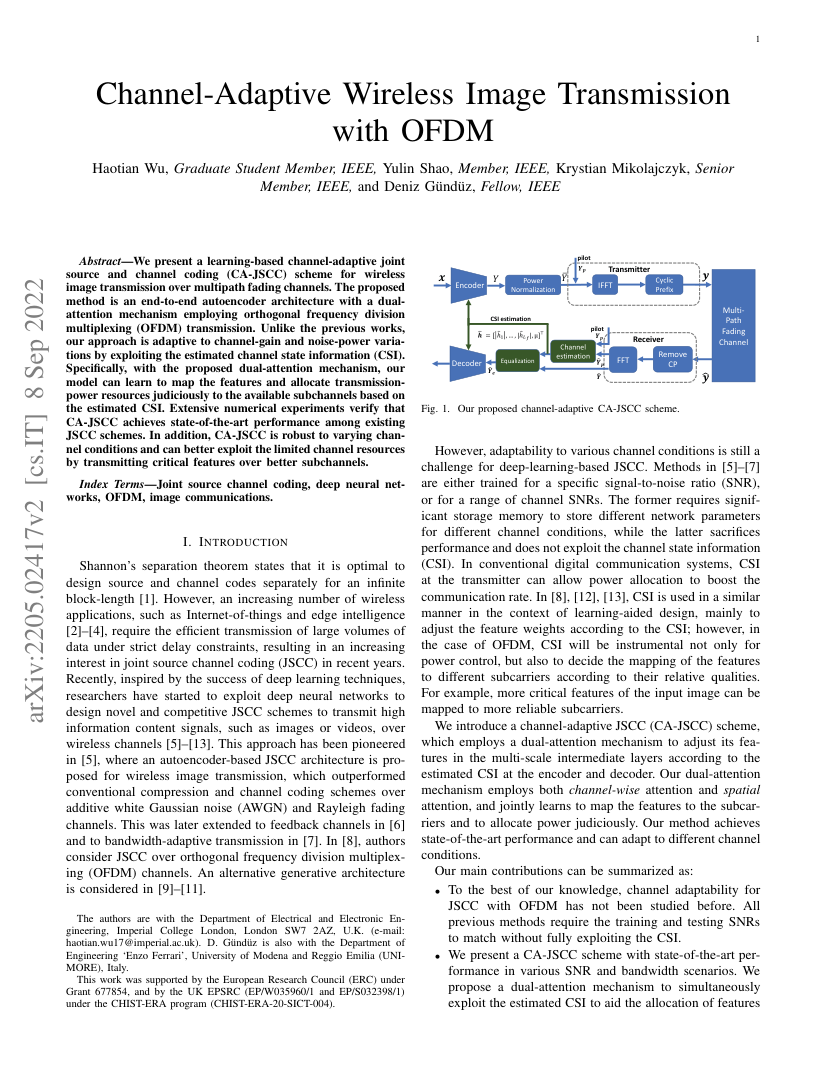
2024 · · 多用户接入与广播
作者:Selim F. Yilmaz; Ezgi Özyılkan; Denız Gündüz; Elza Erkip
现有进展:Recently, a deep neural network (DNN)-based JSCC scheme [4], namely deep joint source-channel coding (DeepJSCC), has achieved remarkable results and rekindled research interest in this direction. PDF p.1
仍然存在的问题:However, the price to pay for near-optimal performance is high complexity and delay since achieving the channel capacity and the Wyner-Ziv rate–distortion function necessitates large blocklengths. PDF p.2
本文提出的方案:We propose a novel neural network architecture that incorporates the decoder-only side information at multiple stages at the receiver side. PDF p.1
方案起作用的机制:CNNs allow parameter-efficient extraction of high-level features by exploiting spatial structures within the images, and has been known to perform well for various vision-related tasks, including DeepJSCC for image transmission [4]. PDF p.3
作者希望证明的结论:For both BR values, DeepJSCC-WZ outperforms its point-to-point counterpart, that is DeepJSCC, as well as its separation-based analogue, that is DeepNIC+Capacity, at all the evaluated SNRs in terms of the distortion criteria considered. PDF p.5
Distributed Deep Joint Source-Channel Coding with Decoder-Only Side Information Selim F. PDF p.1
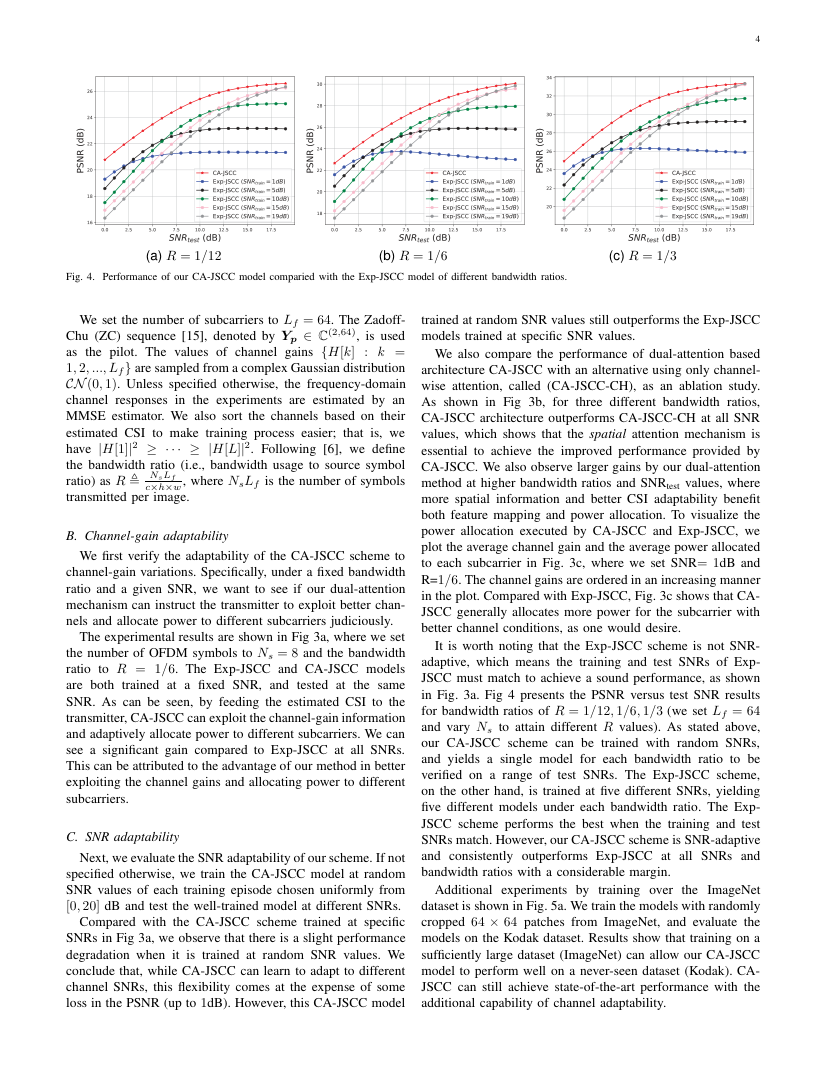
We propose a novel neural network architecture that incorporates the decoder-only side information at multiple stages at the receiver side. PDF p.1
Source Encoder x Source Decoder ̂ x xside Channel Decoder Channel Encoder Transmitter Receiver Wireless Channel x̂ x JSCC Decoder JSCC Encoder Transmitter Receiver Wireless Channel xside Figure 1: Separation-based (top) vs. PDF p.1
JSCC-based (bottom) communication schemes, having decoder-only side information. difficulty in designing such codes. PDF p.1
中间语义表示是什么
The transmitter maps the input image into a complex-valued latent vector z = EΘ(x, σ2), where EΘ : ICin×W ×H →Ck is a nonlınear encoding function parameterized by Θ, and k is the available channel bandwidth. PDF p.2
We impose an average transmission power constraint Pavg on the transmitted signal z ∈Ck: 1 k ∥z∥2 2 ≤Pavg. (1) The receiver subsequently receives the noisy latent vector y ∈Ck as y = z + n, where n ∈Ck represents the i.i.d. complex Gaussian noise term i.e., n ∼CN(0, σ2Ik). PDF p.2
We define the bandwidth ratio ρ, which characterizes the available channel resources, as: ρ ≜ k CinWH channel symbols/pixel. PDF p.3
数字化方案与实际传输开销
数字化判断:数字调制或混合数字-模拟链路 语义表示被映射到有限星座、编码 bit 或数字/模拟并行分支,已经触及可部署物理层接口。
Vaishampayan, “Optimal quantizer design for noisy channels: An approach to combined source - channel coding,” IEEE Transactions on Information Theory, vol. 33, no. 6, pp. 827–838, 1987. [3] E. PDF p.6
Gündüz, “Deepjscc-q: Constellation constrained deep joint source-channel coding,” IEEE Journal on Selected Areas in Information Theory, vol. 3, no. 4, pp. 720–731, 2022. [26] Z. PDF p.6
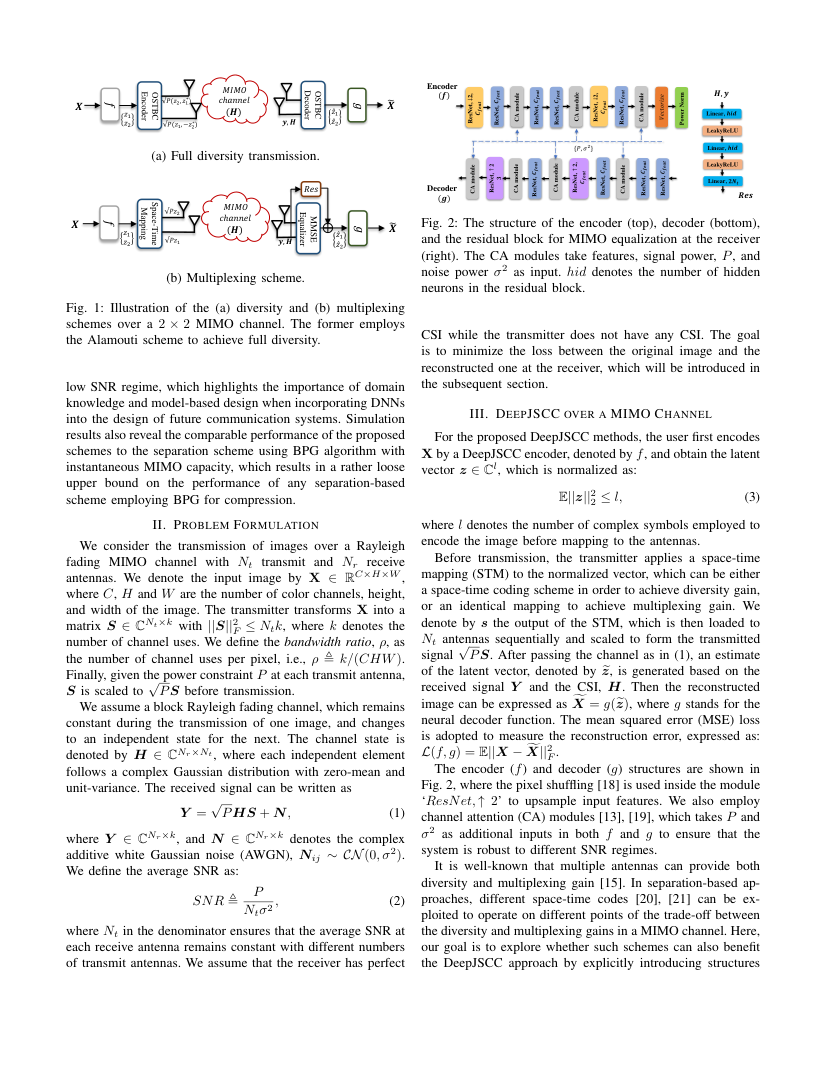
bit / token / channel-use / CBR 证据
Our results demonstrate that the proposed method succeeds in integrating the side information, yielding improved performance at all channel conditions in terms of the various quality measures considered here, especially at low channel signal-to-noise ratios (SNRs) and small bandwidth ratios (BRs). PDF p.1
The proposed transmission scheme is an important building block towards fully distributed practical DeepJSCC schemes for correlated image/video signals. • We demonstrate that our method significantly outperforms both the point-to-point DeepJSCC scheme (with no side information) and the separation-based scheme with side information, in terms of both traditional and perception-oriented fidelity metrics for all the considered channel SNR and bandwidth ratio (BR) values. • As an upper bound, we also provide a solution for the scenario in which the side information is available at both the encoder and decoder. PDF p.2
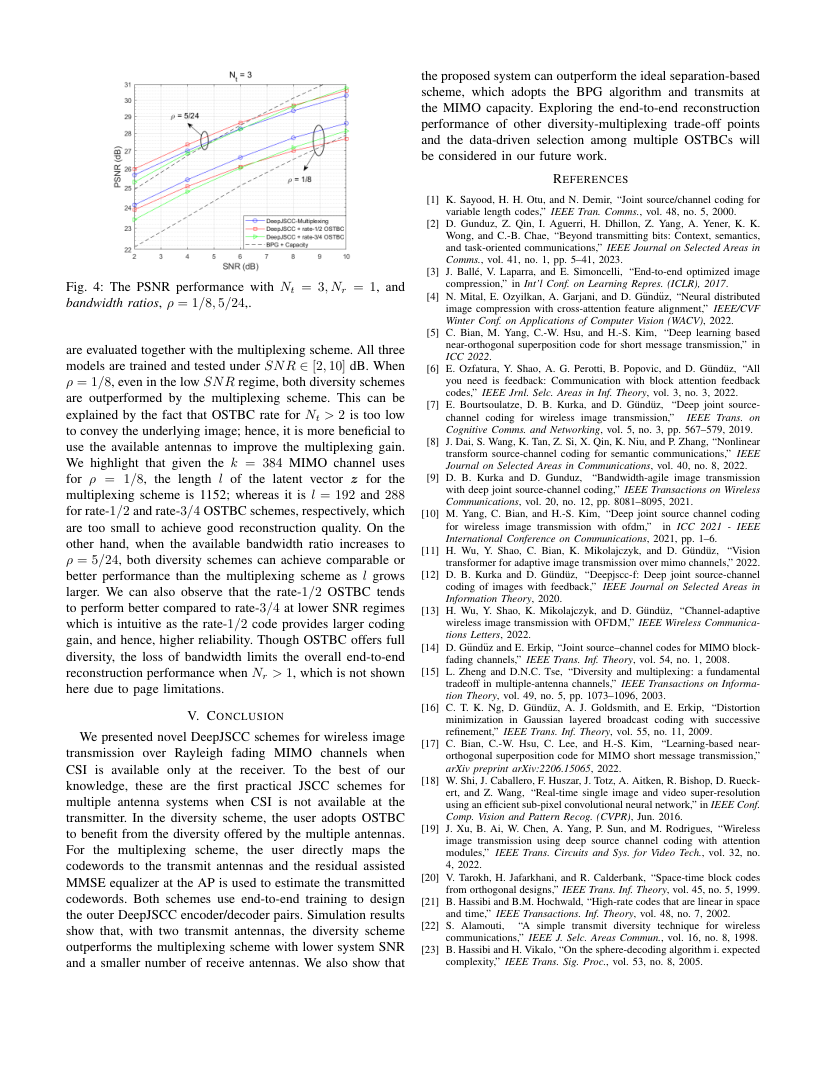
We define the bandwidth ratio ρ, which characterizes the available channel resources, as: ρ ≜ k CinWH channel symbols/pixel. PDF p.3
信道处理机制:decoder 实际收到什么
分类:有限星座/调制符号直接过噪声信道 接收端从有噪星座或 soft symbol 恢复语义;需区分是否有显式 bit/index 译码。
Source Encoder x Source Decoder ̂ x xside Channel Decoder Channel Encoder Transmitter Receiver Wireless Channel x̂ x JSCC Decoder JSCC Encoder Transmitter Receiver Wireless Channel xside Figure 1: Separation-based (top) vs. PDF p.1
PROBLEM FORMULATION We consider the wireless image transmission problem over an additive white Gaussian noise (AWGN) channel, where the receiver has access to correlated side information. PDF p.2
We also define the channel SNR as: SNR ≜10 log10 Pavg σ2 dB. (2) Our learning objective is to minimize the average distortion between the original input image x at the transmitter and the reconstructed image ˆx at the receiver, i.e., arg min Θ,Φ E [d (x, ˆx)] , where the expectation is over the source and side information statistics, (x, xside) ∼p(x, xside), as well as the channel noise distribution. PDF p.3
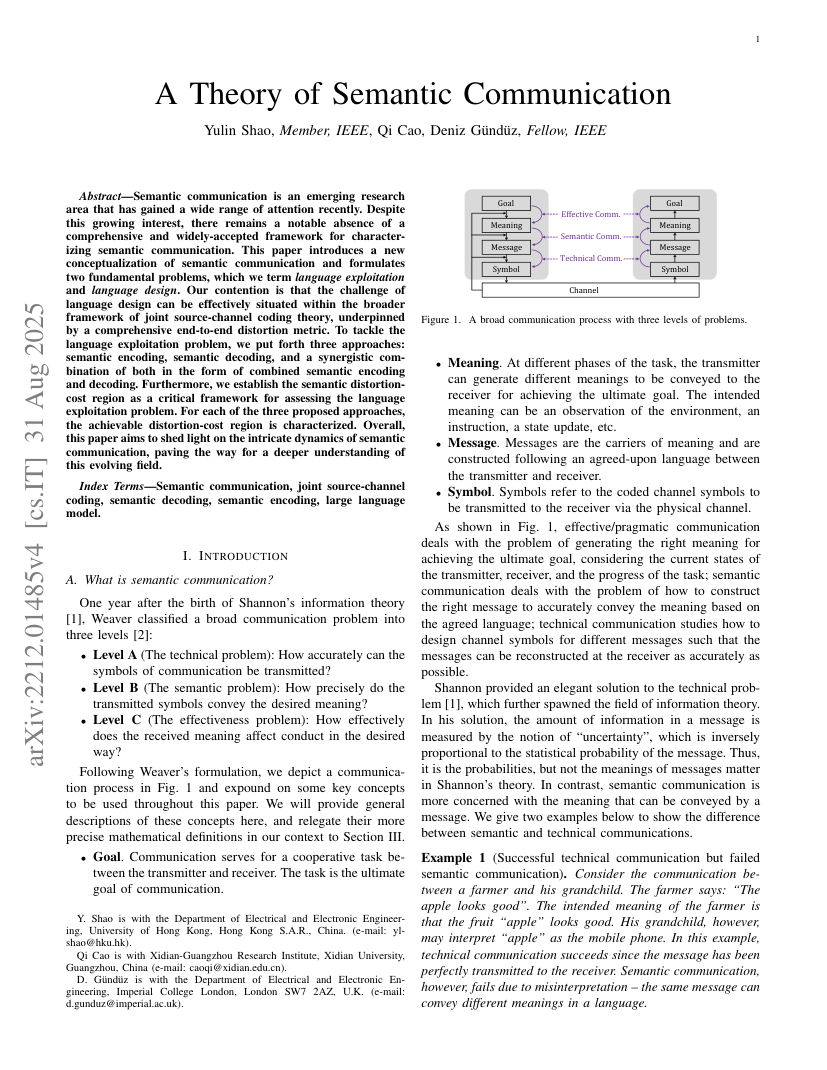
For the performance of DeepNIC+Capacity, we use the results from the original paper [10] and adopt an upper bound for this scheme by equating the reported average rate values in [10] to the capacity of a complex AWGN channel multiplied by the BR value. PDF p.4
We train the network with channel noise n determined by the uniformly sampled SNR between −5 and 5 dB. PDF p.4
实验设置与证据
数据集:Cityscapes、KITTI
Baseline:DeepJSCC、separation-based
信道/链路:AWGN、OFDM
指标:PSNR、SSIM、MS-SSIM、LPIPS、latency、SER
SNR 条件:4 dB、5 dB
主要实验结论(带全文页码)
NUMERICAL RESULTS AND DISCUSSION In this section, we present our experimental setup to show the performance gains of our method in different scenarios. PDF p.4
Comparison with the Baselines Fig. 4 demonstrates the performance gains of our proposed method under different SNR conditions and BR values of ρ = {1/16; 1/32}, on KITTIStereo and Cityscape datasets. PDF p.5
For both BR values, DeepJSCC-WZ outperforms its point-to-point counterpart, that is DeepJSCC, as well as its separation-based analogue, that is DeepNIC+Capacity, at all the evaluated SNRs in terms of the distortion criteria considered. PDF p.5
Notably, we observe a stark performance improvement in the LPIPS distortion metric, which is widely accepted to be more aligned with human perception of image quality (see Fig. 3 for some visual examples). PDF p.5
We also remark that DeepJSCC-WZ achieves a comparable performance with the model DeepJSCC-Joint, whose performance is expected to serve as an upper limit bound on the DeepJSCC-WZ model, considering perceptual distortion criteria such as MS-SSIM and LPIPS. PDF p.5
通信审稿价值与 Codex 判断
价值在于利用用户间语义相关性或分层需求改善频谱共享,而不只是分别运行多个点到点网络。
局限:证据主要来自数据集与仿真信道,缺少真实射频链路/原型验证。
Distributed Deep Joint Source-Channel Coding with Decoder-Only Side Information,原 PDF 第 1 页(架构/方法页)。Distributed Deep Joint Source-Channel Coding with Decoder-Only Side Information,原 PDF 第 4 页(关键结果页)。
Evolving Semantic Communication with Generative Modelling
仍然存在的问题:However, existing works have yet to fully explore the advantages of the evolving nature of learning-based systems, where knowledge accumulates during transmission have the potential to enhance system performance. PDF p.1
本文提出的方案:Moreover, we introduce a semantic caching mechanism that dynamically stores the transmitted semantic vectors in the local caching memory of both the transmitter and receiver. PDF p.1
方案起作用的机制:CONCLUSION In this paper, we explored an evolving SemCom system designed to continuously improve its transmission efficiency by utilizing cache memory at both the transmitter and receiver and a pretrained generative model. PDF p.6
作者希望证明的结论:We note that the proposed model achieves a BCR of 1/110 if z is directly transmitted after real-to-complex value transformation mentioned earlier. PDF p.5
The system features a novel channel-aware semantic encoder that utilizes a pre- trained Semantic StyleGAN to extract the channel-correlated latent variables consisting of serval semantic vectors from the input images, which can be directly transmitted over a noisy channel without further channel coding. PDF p.1
DeepJSCC, the joint source-channel encoder and decoder are modeled as neural networks, and trained jointly to optimize the mean square error (MSE) or the structural similarity (SSIM) between the transmitted and reconstructed images. PDF p.1
The transmitter uses a GAN-based semantic encoder to extract the latent variable z ∈RNS×NL from x through the GAN inversion method [7], which can be expressed as z = G−1(x), (1) where there are NS distinct semantic vectors in z, and NL is the length for each semantic vector. PDF p.2
Then, the pre-trained GAN acts as the semantic decoder to reconstruct the image ˆx using the generative function, given by ˆx = G(ˆz). (5) B. PDF p.2
中间语义表示是什么
The approach presented in [6] employs the generative adversarial network (GAN) inversion method [7] to acquire a low-dimensional latent representation of images. PDF p.1
We have k = 1 2 × ns × NL, where 1 2 comes from combining two real values to form a single complex channel symbol. PDF p.2
We also use the learned perceptual image patch similarity (LPIPS) [14] to assess the reconstruc- tion performance, which is a metric that has been shown to closely capture the human perceptual similarity between two images through a pre-trained VGG network, given by LPIPS(x, ˆx) = X l 1 NHlNWl NHl,NWl X h,w ||ωl ⊙(yl h,w −ˆyl h,w)||2 2 (7) where yl h,w and ˆyl h,w are the (h, w)-th element in the output feature map of the l-th VGG layer for x and ˆx, respectively. PDF p.2
Besides, NHl and NWl denote the height and width of the output feature map, and ωl > 0 is the weight to control the importance for the outputs of different layers. PDF p.2
数字化方案与实际传输开销
数字化判断:数字调制或混合数字-模拟链路 语义表示被映射到有限星座、编码 bit 或数字/模拟并行分支,已经触及可部署物理层接口。
G¨und¨uz, “DeepJSCC- Q: Constellation constrained deep joint source-channel coding,” IEEE J. PDF p.6
bit / token / channel-use / CBR 证据
Simulation results highlight the evolving performance of the proposed system in terms of transmission efficiency, achieving superior perceptual quality with an average bandwidth compression ratio (BCR) of 1/192 for a sequence of 100 testing images compared to DeepJSCC and Inverse JSCC with the same BCR. PDF p.1
Therefore, we are moti- vated to design a SemCom approach that can evolve based on the accumulated transmission experience, aiming to further reduce the transmission overhead. PDF p.1
We define the bandwidth compression ratio (BCR) as k/(3 × NH × NW ). PDF p.2
Therefore, the channel use for each index is 1 p × 2 × (log2 NS + log2 NC). 1https://bellard.org/bpg/ B. PDF p.5
信道处理机制:decoder 实际收到什么
分类:有限星座/调制符号直接过噪声信道 接收端从有噪星座或 soft symbol 恢复语义;需区分是否有显式 bit/index 译码。
We consider an additive white Gaussian noise (AWGN) channel, where the received signal at the receiver is given by ˆzc = zc + n, (3) where n is the additive channel noise, consisting of indepen- dent complex Gaussian components CN(0, σ2). PDF p.2
Moreover, when it gets corrupted by the channel noise, the reconstruction performance may deteriorate significantly. PDF p.3
Therefore, we introduce a novel channel-aware GAN inversion method, which incorporates the characteristics of the AWGN channel into the GAN inversion process. PDF p.3
Next, AWGN n is added to z to simulate corruption from the noisy channel. PDF p.3
We note that here it is assumed that the transmitter has the knowledge of the current noise power in AWGN channel. PDF p.3
Compared with the previous work [6], which applies a channel encoder with normalizing flow to encode z, the proposed method eliminates the need for training additional channel encoder and decoder. PDF p.3
We note that the proposed model achieves a BCR of 1/110 if z is directly transmitted after real-to-complex value transformation mentioned earlier. PDF p.5
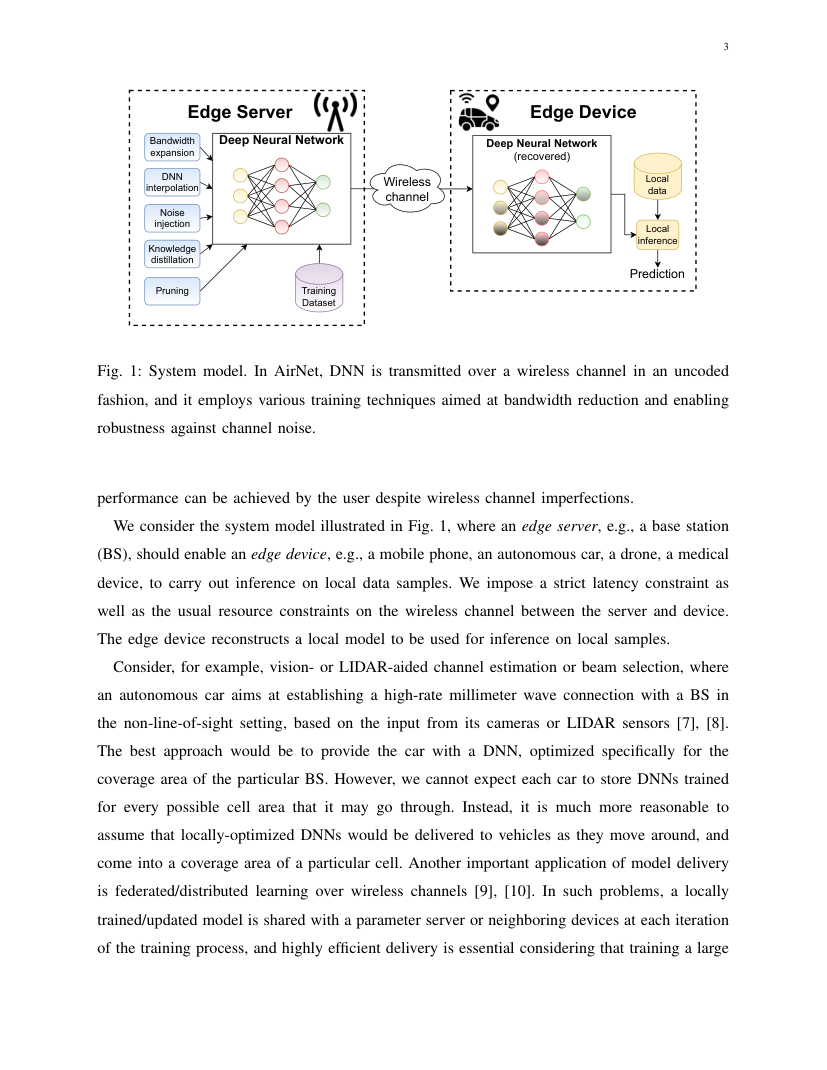
In particular, we use channel coding with a rate of 1/2 and binary phase-shift keying (BPSK), which can achieve a successful transmission rate of p = 0.9 per block under an SNR of 0dB when the block length is more than 128 according to [16]. PDF p.5
These results demonstrate the evolving characteristics of ESemCom and emphasize the effectiveness of the proposed semantic caching mechanism. PDF p.5
From these figures, the proposed ESemCom and Inverse-JSCC achieve a lower PSNR than DeepJSCC, but outperform DeepJSCCC and BPG+Capcailty in terms of LPIPS. PDF p.5
Evolving Semantic Communication with Generative Modelling,原 PDF 第 2 页(架构/方法页)。Evolving Semantic Communication with Generative Modelling,原 PDF 第 4 页(关键结果页)。
Transformer-Aided Wireless Image Transmission With Channel Feedback
2024 · IEEE Transactions on Wireless Communications · 多用户接入与广播
本文提出的方案:Our main contributions can be summarized as follows: • We present a new feedback-aided JSCC architecture, JSCCformer-f, for wireless image transmission with channel feedback. PDF p.2
方案起作用的机制:Alternatively, a JSCC scheme can achieve adaptability to channel conditions by leveraging the attention mechanism and training at random SNRs [32]–[34]. PDF p.2
作者希望证明的结论:As shown in Fig. 13, JSCCformer-f achieves the best per- ceptual performance across a spectrum of channel conditions, bandwidth ratios, and datasets. PDF p.11
The proposed scheme employs a single encoder to facilitate transmission over multiple blocks, refining the receiver’s estimation at each block. PDF p.1
Specifically, the unified encoder of JSCCformer-f can leverage the semantic information from the source image, and acquire channel state information and the decoder’s current belief about the source image from the feedback signal to generate coded symbols at each block. PDF p.1
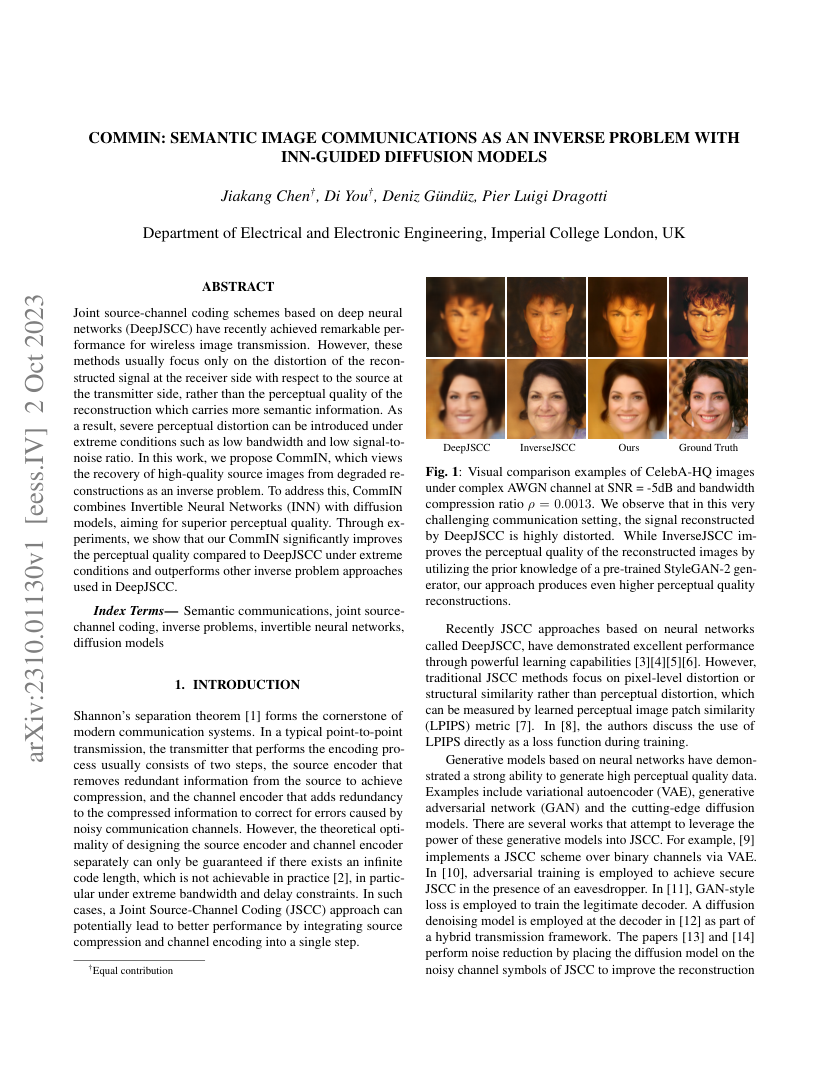
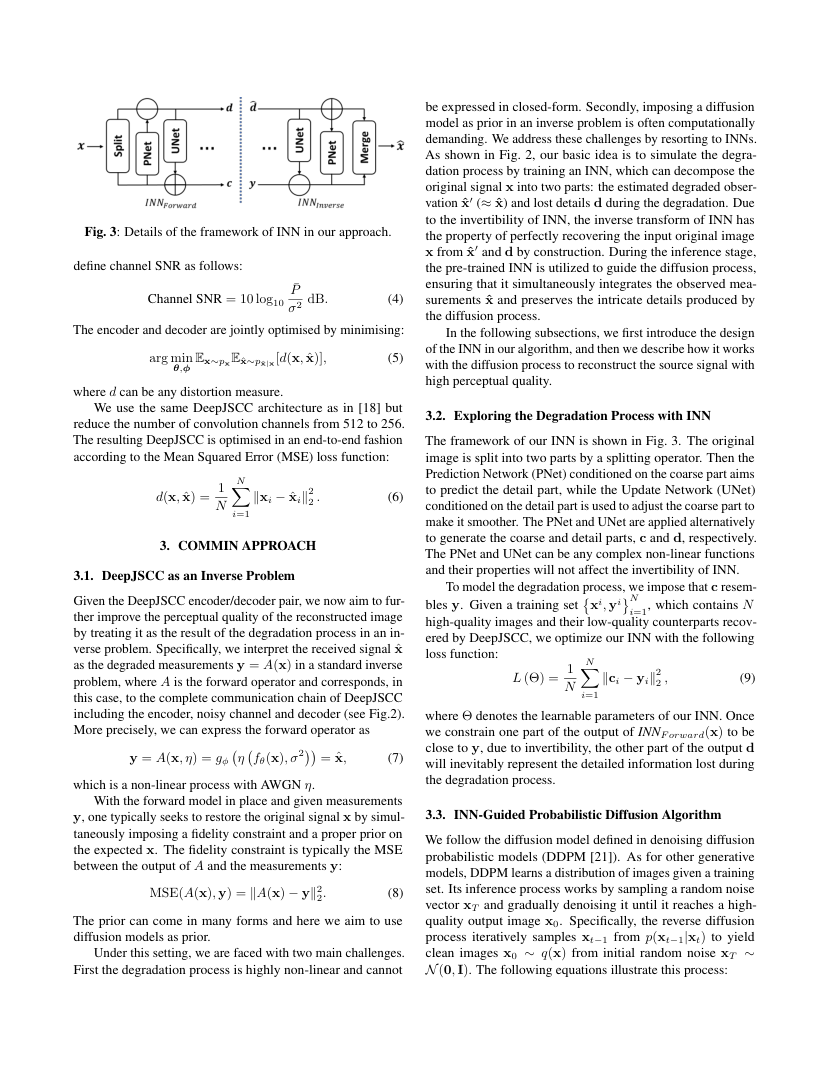
The authors presented a stacked autoencoder structure, called DeepJSCC-f, to transmit the image in multiple blocks. PDF p.2
As illustrated in Fig. 1, DeepJSCC-f utilizes a set of encoders and decoders in the transmitter and receiver, respectively, and a dif- ferent pair of encoder and decoder is used at each iteration. PDF p.2
中间语义表示是什么
The success of DeepJSCC schemes also extends to other downstream tasks beyond signal reconstructions, such as im- age retrieval [1], [15], visual question answering [16], edge inference [17], or channel state information feedback [18], where the transmitter only transmits the relevant semantic features instead of all the source information, saving much bandwidth. PDF p.1
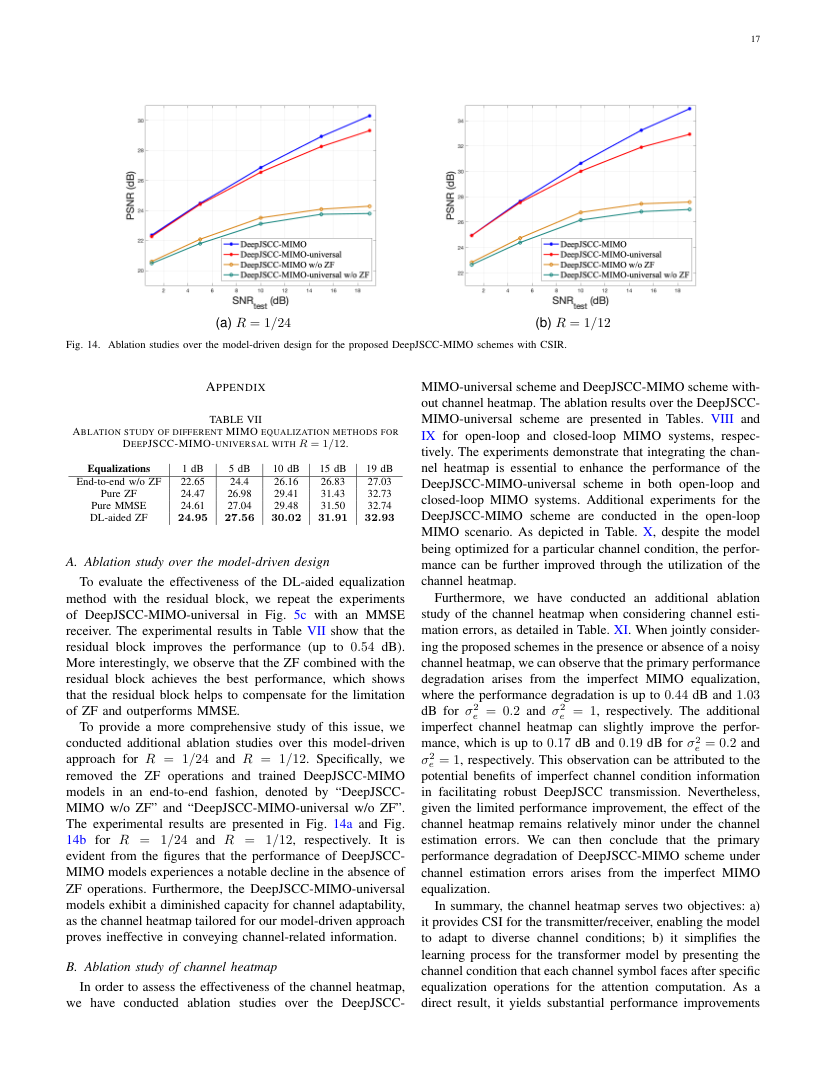
Unlike CNNs that learn the semantic features of images from a local to global context with a limited receptive field, ViTs employ a global self-attention (SA) mechanism for a more discriminative representation of semantic features. PDF p.2
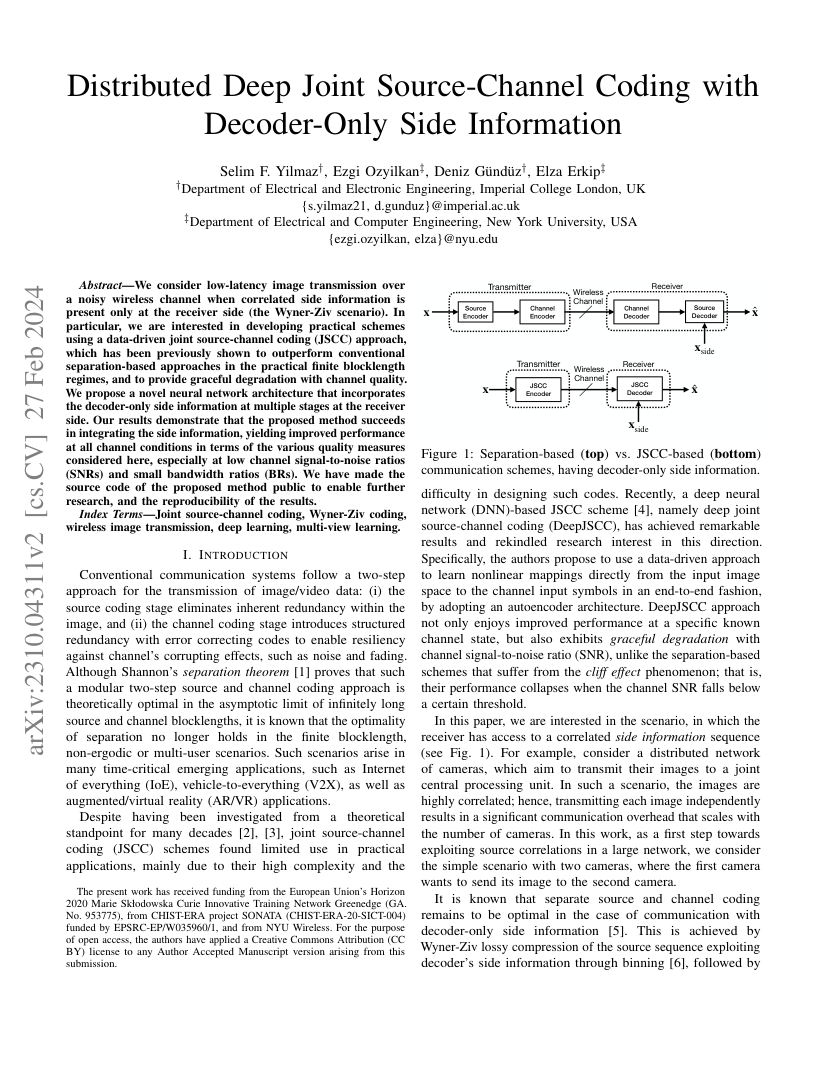
Accordingly, for a fixed total bandwidth allocation, a JSCC code that transmits an image of n pixel intensities in m blocks, each consisting of k channel symbols, is denoted by the triplet (n, m, k). PDF p.3
Following [7], we define the bandwidth ratio as R = mk/n, representing the average number of available channel symbols per source dimension. PDF p.3
数字化方案与实际传输开销
数字化判断:数字调制或混合数字-模拟链路 语义表示被映射到有限星座、编码 bit 或数字/模拟并行分支,已经触及可部署物理层接口。
Li, “Robust semantic communications with masked VQ-VAE enabled codebook,” IEEE Transactions on Wireless Communications, 2023. [9] Y. PDF p.14
Gunduz, “Semantic communications with discrete-time analog transmission: A PAPR perspective,” IEEE Wireless Communica- tions Letters, vol. 12, no. 3, pp. 510–514, 2022. [10] D. PDF p.14
bit / token / channel-use / CBR 证据
For instance, [25] and [26] exploit one- bit acknowledgment/negative acknowledgment (ACK/NACK) feedback to adjust the channel code rate. PDF p.1
We note that, for a fixed bandwidth ratio R, an increase in the number of blocks leads to a reduction in the number of channel uses per block. PDF p.3
Following [7], we define the bandwidth ratio as R = mk/n, representing the average number of available channel symbols per source dimension. PDF p.3
Performance of different schemes at various SNR values and bandwidth ratios with noiseless feedback, where models in subfigures (a) and (b) undergo assessment within the AWGN channel, and models in subfigure (c) are evaluated in a Rayleigh Fading channel. scheme is practically unattainable and requires perfect CSI at both the transmitter and receiver ends. PDF p.7
Transmission performance 1) General performance: Considering AWGN channels, Figs. 4a and 4b present the PSNR performance versus different forward channel SNR values from −2dB to 13dB, where the bandwidth ratio is set to R = 1/6 and R = 1/3, respectively. PDF p.7
信道处理机制:decoder 实际收到什么
分类:数字语义特征 + 传统信道编码 decoder 通常看到信道译码后的 bit/index;若论文只假设译码成功,则未真正学习处理残余 index 跳变。
These coded symbols are then transmitted to the receiver to refine its belief and mitigate the impact of channel noise in subsequent interactions. PDF p.2
We also show its robustness to feedback channel noise. • To demonstrate the generalizability of the proposed scheme, we extend the JSCCformer-f framework to a broadcast channel with two receivers, where the encoder at the transmitter has to attend to the feedback from both receivers and generate coded symbols accordingly. PDF p.3
The forward channel in the i-th transmission block is modeled as an additive white Gaussian noise (AWGN) channel with fading as: Y i = H(Xi) = ( hXi + Wi, slow fading channel Xi + Wi, AWGN channel, (2) where Y i ∈Ck is the channel output in i-th forward trans- mission block, h ∈C is the channel gain, and Wi ∈Ck is the AWGN term. PDF p.3
For the static AWGN scenario, we set h = 1. PDF p.3
After each block, the channel output vector Yi is then fed back to the transmitter through a feedback link, which can be either perfect or noisy, modeled as: ˆYi = Hf(Yi) = ( Yi, perfect feedback link Yi + Wf, AWGN feedback link, (3) where Wf ∈Ck is the AWGN term sampled from an i.i.d. ad- ditive complex Gaussian distribution, i.e., Wf[i] ∼CN(0, σ2 f). PDF p.3
To achieve the optimal result, models of JSCCformer-f and DeepJSCC-f are all trained at a fixed average channel SNR value and tested at the same SNR value. PDF p.7
As shown in Figs. 4a and 4b, JSCCformer-f with m = 1 significantly outperforms the BPG-Capacity scheme in all SNRs and bandwidth ratios. PDF p.7
As shown in Fig. 4a, JSCCformer-f (m = 1) can surprisingly outperform DeepJSCC-f (m = 2) (up to 0.97dB) at all SNR values, even though DeepJSCC-f utilizes additional feedback from the receiver. PDF p.7
JSCCformer-f (m > 1) improves the performance of JSCCformer-f (m = 1) in all SNR values (up to 1.06 dB for m = 2 and 2.11 dB for m = 4). PDF p.7
We also observe that with the same number of block, JSCCformer-f significantly outperforms DeepJSCC-f at all test SNRs. PDF p.7
通信审稿价值与 Codex 判断
价值在于利用用户间语义相关性或分层需求改善频谱共享,而不只是分别运行多个点到点网络。
局限:残余 bit/VQ-index 错误导致码字跳变的鲁棒性没有被充分证明。
Transformer-Aided Wireless Image Transmission With Channel Feedback,原 PDF 第 2 页(架构/方法页)。Transformer-Aided Wireless Image Transmission With Channel Feedback,原 PDF 第 16 页(关键结果页)。
A Deep Joint Source-Channel Coding Scheme for Hybrid Mobile Multi-Hop Networks
2025 · IEEE Journal on Selected Areas in Communications · 多用户接入与广播
仍然存在的问题:A Deep Joint Source-Channel Coding Scheme for Hybrid Mobile Multi-hop Networks Chenghong Bian, Graduate Student Member, IEEE, Yulin Shao, Member, IEEE, Deniz G¨und¨uz,Fellow, IEEE Abstract—Efficient data transmission across mobile multi-hop networks that connect edge devices to core servers presents significant challenges, particularly due to the variability in link qualities between wireless and wired segments. PDF p.1
本文提出的方案:In this paper, we introduces a novel DeepJSCC framework, h-DJSCC, tailored for efficient image transmission across hybrid mobile multi-hop networks. PDF p.2
方案起作用的机制:Learned Image Compression Learned image compression leverages neural networks to optimize the image compression process, often outperforming traditional methods by jointly learning efficient representa- tions and entropy models. PDF p.3
作者希望证明的结论:For each η value, a specific code rate and modulation order which achieves the best R-D performance is adopted whose performance is shown in Fig. 10. PDF p.11
Addressing this need, this paper introduces a novel hybrid DeepJSCC framework, h-DJSCC, tailored for effective image transmission from edge devices through a network architecture that includes initial wireless transmission followed by multiple wired hops. PDF p.1
We also introduce a fully adaptive h-DJSCC architecture with both SNR-adaptive (SA) and rate-adaptive (RA) modules capable of adjusting to different network conditions and achieving diverse rate-distortion objectives, thereby reducing the memory requirements on network nodes. PDF p.1
In this architecture, data transmitted from the mobile user to the RRH node via wireless access links and then relayed through a wired C- RAN network to the center network, introduces an interplay between different transmission characteristics. PDF p.2
Consequently, the performance of DeepJSCC tends to decline as the network complexity increases, calling for innovative solutions tailored for hybrid multi-hop network architectures. PDF p.2
中间语义表示是什么
A key factor underpinning the success of DeepJSCC is its reliance on discrete-time analog transmission (DTAT) [15], which introduces a greater degree of flexibility for channel symbols and ensures that the reception quality at the receiver is closely tied to fluctuations in channel quality. PDF p.2
In particular, ga(·), ha(·) are the non-linear transform blocks to generate the latent vectors z, v, whereas gs(·), hs(·) are adopted to facilitate the synthesis of ˆS, ˆz. PDF p.3
In the deployment phase, we round each element of the two latent vectors, zi and vi, to the nearest integers, ˆzi and ˆvi: ˆzi, ˆvi = Q(zi), Q(vi), (2) where Q(·) denotes the quantization operation. PDF p.3
The image decompressor employs an arithmetic decoder (AD) to first generate the rounded latent vector ˆv, which is then fed to hs(·) to obtain ˆµ, ˆσ. PDF p.3
A key factor underpinning the success of DeepJSCC is its reliance on discrete-time analog transmission (DTAT) [15], which introduces a greater degree of flexibility for channel symbols and ensures that the reception quality at the receiver is closely tied to fluctuations in channel quality. PDF p.2
This aspect underscores the robustness of the h-DJSCC framework, showing notable performance improvements over traditional methods where relays directly quantize the received signals into bit sequences. • We propose a fully adaptive h-DJSCC scheme suitable for scenarios where the initial wireless link experiences fluctuations. PDF p.2
In the deployment phase, we round each element of the two latent vectors, zi and vi, to the nearest integers, ˆzi and ˆvi: ˆzi, ˆvi = Q(zi), Q(vi), (2) where Q(·) denotes the quantization operation. PDF p.3
We then arithmetically encode the quantized vectors according to their own probability distributions. PDF p.3
In the training phase, however, quantization does not allow back propagation. PDF p.3
bit / token / channel-use / CBR 证据
To achieve different trade-off points on the rate-distortion curve, we introduce a variable λ and the loss function is written as: L = λ∥S −ˆS∥2 F + I, (5) where I = Iz +Iv is the summation of the bit per pixel (bpp) for compressing ˜z and ˜v, respectively, which is defined by the number of bits divided by the height H and width W of the image. PDF p.3
The SSIM is defined as: SSIM = (2µsµˆs + c1)(2σsˆs + c2) (µ2s + µ2 ˆs + c1)(σ2s + σ2 ˆs + c2), (13) 4We note that k refers to the expected number of channel uses if variable length source encoder is adopted. PDF p.4
We consider the state-of-the-art source encoders (e.g., BPG) which output variable-length codewords, thus, the number of complex channel uses k refers to the expected length of xs. PDF p.5
To better illustrate the processing of the fully digital transmission scheme, we provide a concrete example where the number of channel uses, k = 768 and η = 2 dB which corresponds to the channel capacity Cs = 1.37. PDF p.5
The proposed fully adaptive h-DJSCC framework can adapt to continuous η values. 0.2 0.4 0.6 0.8 1 1.2 1.4 1.6 bits per pixel (bpp) 26 28 30 32 34 36 38 PSNR (dB) = 1 dB = 5 dB = 9 dB Fig. 7: The R-D performance achieved by compressing the output of the SNR-adaptive DeepJSCC decoder, Sη, for different η values. 40 60 percentile (%) 0.00 0.02 0.04 0.06 0.08 0.10 pdf Method 1 40 60 percentile (%) 0.00 0.01 0.02 0.03 0.04 0.05 0.06 0.07 0.08 Method 2 = 1 dB = 9 dB Fig. 8: The comparison of the empirical distribution, ˆP˜xη, obtained by the h-DJSCC models that is randomly initialized (left) and initialized using a pre-trained SNR-adaptive Deep- JSCC model (right). PDF p.7
信道处理机制:decoder 实际收到什么
分类:数字语义特征 + 传统信道编码 decoder 通常看到信道译码后的 bit/index;若论文只假设译码成功,则未真正学习处理残余 index 跳变。
This scheme is robust across both additive white Gaussian noise (AWGN) and Rayleigh fading channels, demonstrating the model’s capability to adjust to various signal-to-noise ratio (SNR) levels and achieve multiple rate-distortion (R-D) points. PDF p.2
Note that the notation ˜z, ˜v indicate the training phase2 and the rate can be further expressed as: I = 1 HW E˜z,˜v∼q −log2(p˜z|˜v(˜z|˜v)) −log2(p˜v(˜v)) , (6) 1Note that the ˜σ here is different from the σ2 in (10) which represents the power of the channel noise. 2Definition of I is the same for the deployment phase obtained by replacing ˜z and ˜v with ˆz and ˆv. PDF p.3
Note that different channels of Zl may contain different features, and by multiplying the SNR-aware weight, w, with Zl, a different balance between the information content of the conveyed features and level of protection against channel noise is achieved for different η values. PDF p.4
As illustrated in Fig. 1, the transmission over the backhaul links within the core network can be abstracted as a single hop with an achievable rate RN.3 Initially, we base our analysis on the premise that the wireless channel in the first hop operates as AWGN channel. PDF p.4
This assumption lays the groundwork for our foundational model, which we will subsequently extend to encompass Rayleigh fading channels in the later sections. 3This is valid for full-duplex relays. PDF p.4
Oblivious Relaying As shown in Fig. 4, the first relay R1 utilizes the DeepJSCC decoder gd(·) which is jointly optimized with fs(·), fc(·) and gc(·) to achieve the best reconstruction performance at the destination. PDF p.6
However, instead of directly adopting the pre-trained models, we find by experiments that fine-tuning f t s(·), gt d(·) helps to improve the overall performance. PDF p.6
ADAPTIVE H-DJSCC TRANSMISSION In the previous section, for a given η value, different models are trained to achieve different points on the R-D trade-off by choosing different λ values from a pre-defined set, denoted as Λ. PDF p.7
Since the channel quality between S and R1 is assumed to change over time, |Λ||H| different models would be required7 to achieve satisfactory R-D performance causing severe storage problem. PDF p.7
R-D Properties of the SNR-adaptive DeepJSCC As illustrated in Section II-B, the DeepJSCC model with SNR-adaptive (SA) module proposed in [17] achieves sat- isfactory reconstruction performance by assigning different levels of protection of the information content given the SNR value. PDF p.7
通信审稿价值与 Codex 判断
价值在于利用用户间语义相关性或分层需求改善频谱共享,而不只是分别运行多个点到点网络。
局限:残余 bit/VQ-index 错误导致码字跳变的鲁棒性没有被充分证明。
A Deep Joint Source-Channel Coding Scheme for Hybrid Mobile Multi-Hop Networks,原 PDF 第 1 页(架构/方法页)。A Deep Joint Source-Channel Coding Scheme for Hybrid Mobile Multi-Hop Networks,原 PDF 第 11 页(关键结果页)。
Compression Beyond Pixels: Semantic Compression with Multimodal Foundation Models
2025 · 2025 IEEE 35th International Workshop on Machine Learning for Signal Processing (MLSP) · 通信安全与隐私
作者:Ruiqi Shen; Haotian Wu; Wenjing Zhang; Jiangjing Hu; Deniz Gunduz
团队归属:补充数据库轮次核验:指定负责人直接署名(Deniz Gunduz, Deniz Gündüz);Crossref/DBLP 正式 DOI 元数据。
仍然存在的问题:However, emerging applications increasingly pri- oritize semantic preservation over pixel-level reconstruc- tion and demand robust performance across diverse data distributions and downstream tasks. PDF p.1
本文提出的方案:Motivated by the zero-shot and representational capabilities of mul- timodal foundation models, we propose a novel semantic compression method based on the contrastive language- image pretraining (CLIP) model. PDF p.1
方案起作用的机制:INTRODUCTION Deep learning has revolutionized lossy image compression by introducing data-driven codecs that replace classical analysis and synthesis transforms with neural networks. PDF p.1
作者希望证明的结论:As shown in Fig. 6, on OxfordPets, our method achieves accura- cies of 83.56% at 2.29×10⁻³ bpp and 87.33% at 3.43×10⁻³ bpp, using less than 3% of the bpp required by learned im- age compression methods like Cheng2020-anchor [2], which achieves 86.28% accuracy with 96.1 × 10⁻³ bpp. PDF p.4
Motivated by the zero-shot and representational capabilities of mul- timodal foundation models, we propose a novel semantic compression method based on the contrastive language- image pretraining (CLIP) model. PDF p.1
Rather than compress- ing images for reconstruction, we propose compressing the CLIP features into minimal bits while preserving seman- tic information across different tasks. PDF p.1
Experiments show that our method maintains semantic integrity across bench- mark datasets, achieving an average bit rate of approximately 2–3 × 10−3 bits per pixel. PDF p.1
Starting with the adoption of autoencoders and convolutional neural net- works, neural image compression has progressed through sev- eral key innovations, including the integration of hyperpriors [1], attention mechanisms [2], and advanced overfitted cod- ing [3]. PDF p.1
中间语义表示是什么
To enable this, we in- troduce a product-quantization-based variational autoencoder with a shared codebook (PQVAE-shared), which compresses CLIP features into the minimum number of bits required to retain semantic information. PDF p.1
Our key contributions can be summarized as follows: • We propose CLIP-driven semantic compression, a novel paradigm that preserves essential semantic information at extremely low bit rates. • We introduce PQVAE-shared, a product-quantization- based variational autoencoder with a shared codebook to compress CLIP features. PDF p.1
Let x = F(I), to compress x ∈Rk, we first transform it into a latent representation xc ∈Rh×w×c via an encoder network C(·) : Rk →Rh×w×c, given as: xc = C(x), (1) where h and w correspond to the spatial dimensions, while c represents the fixed channel dimension at each spatial location. PDF p.2
Experiments show that our method maintains semantic integrity across bench- mark datasets, achieving an average bit rate of approximately 2–3 × 10−3 bits per pixel. PDF p.1
Index Terms— Semantic compression, multimodal foun- dation models, product quantization. 1. PDF p.1
Leveraging recent breakthroughs in multimodal foundation models (MFMs) [10, 11], we pro- pose a reconstruction-free semantic compression paradigm that directly compresses MFM-generated token embeddings, robustly preserving essential semantics for downstream tasks. PDF p.1
To enable this, we in- troduce a product-quantization-based variational autoencoder with a shared codebook (PQVAE-shared), which compresses CLIP features into the minimum number of bits required to retain semantic information. PDF p.1
Our key contributions can be summarized as follows: • We propose CLIP-driven semantic compression, a novel paradigm that preserves essential semantic information at extremely low bit rates. • We introduce PQVAE-shared, a product-quantization- based variational autoencoder with a shared codebook to compress CLIP features. PDF p.1
bit / token / channel-use / CBR 证据
Experiments show that our method maintains semantic integrity across bench- mark datasets, achieving an average bit rate of approximately 2–3 × 10−3 bits per pixel. PDF p.1
This task-agnostic approach achieves superior compression ratios while maintaining robust generalization across diverse data distributions and down- stream tasks, outperforming both pixel-level image compres- sion and task-specific semantic compression techniques. PDF p.1
Our key contributions can be summarized as follows: • We propose CLIP-driven semantic compression, a novel paradigm that preserves essential semantic information at extremely low bit rates. • We introduce PQVAE-shared, a product-quantization- based variational autoencoder with a shared codebook to compress CLIP features. PDF p.1
For fair comparison, compression levels here are measured in bits per pixel (bpp), and semantic preservation is evaluated using zero-shot image classification accuracy. PDF p.4
General performance As shown in Fig. 4, PQVAE-shared consistently outperforms all baselines in zero-shot classification across every bpd. PDF p.3
Even at 0.52 bpd (400 bits/image), our method achieves 81.81 %, over 30× compression with only a small accuracy drop. PDF p.3
As shown in Fig. 5, finer subspace decomposition obtained by reducing dsub consistently improves performance at all bpd levels by pre- serving more semantic details and using the codebook more efficiently. PDF p.4
As shown in Fig. 6, on OxfordPets, our method achieves accura- cies of 83.56% at 2.29×10⁻³ bpp and 87.33% at 3.43×10⁻³ bpp, using less than 3% of the bpp required by learned im- age compression methods like Cheng2020-anchor [2], which achieves 86.28% accuracy with 96.1 × 10⁻³ bpp. PDF p.4
Simi- larly, on Food101, our method achieves 78.47% accuracy at 1.723 × 10⁻³ bpp, surpassing [2] for 74.11% accuracy under 87.5 × 10⁻³ bpp. PDF p.4
Compression Beyond Pixels: Semantic Compression with Multimodal Foundation Models,原 PDF 第 2 页(架构/方法页)。Compression Beyond Pixels: Semantic Compression with Multimodal Foundation Models,原 PDF 第 4 页(关键结果页)。
Deep Joint Source Channel Coding for Privacy-Aware End-to-End Image Transmission
2025 · IEEE Transactions on Machine Learning in Communications and Networking · 通信安全与隐私
仍然存在的问题:However, these works only focused on learning secure channel coding via DNNs rather than taking the source and channel coding jointly into account, i.e., undifferentiated with respect to the content of the message being delivered. PDF p.2
本文提出的方案:Our Contributions We propose a DeepJSCC-based solution for secure E2E wireless image transmission against multiple eavesdroppers. PDF p.2
方案起作用的机制:A and B employ DNNs and perform secure Depp-JSCC by leveraging the concept of autoencoders. PDF p.3
作者希望证明的结论:One can infer from this figure and Fig. 6-(a) that our pro- posed system outperforms the benchmarks in terms of both information leakage and utility. PDF p.10
It is becoming increasingly evident that conventional separate network architectures struggle to meet real-world performance demands, often overlooking signal processing complexities like compression, which can dominate end-to-end latency. PDF p.1
While this benefits the legitimate encoder by providing robustness against channel noise, it also creates additional vulnerability in terms of leakage to eavesdroppers. PDF p.1
Prior Arts In the context of secure end-to-end (E2E) communications, autoencoders were proposed in [19]–[21] for communication over AWGN wiretap channel. PDF p.2
Feedforward neural networks composed of linear layers were employed as the encoder- decoder pair, and a weighted sum of block error rate and ap- proximated information leakage was used as the loss function. PDF p.2
数字化判断:数字调制或混合数字-模拟链路 语义表示被映射到有限星座、编码 bit 或数字/模拟并行分支,已经触及可部署物理层接口。
Alice aims to convey the source information U n to Bob with minimum distortion, while preventing the information of sensitive part Si ∈Si, with a discrete alphabet Si, to be leaked to the i-th eavesdropper, i = 1, · · · , M, where M denotes the number of eavesdroppers. PDF p.3
bit / token / channel-use / CBR 证据
The bandwidth compression ratio is set to k n = 1 3. PDF p.8
信道处理机制:decoder 实际收到什么
分类:连续 latent/信道符号联合训练 接收端拿到带噪连续特征或均衡后的复符号,而不是出错的 VQ index;能抗模拟噪声但不等价于解决数字 index error。
While this benefits the legitimate encoder by providing robustness against channel noise, it also creates additional vulnerability in terms of leakage to eavesdroppers. PDF p.1
Inspired by [16] and [17], this paper studies a generalization of the DeepJSCC approach for privacy-aware end-to-end image transmission against multiple eavesdroppers, with both colluding and non-colluding eavesdropping strate- gies, and over AWGN as well as fading channels. arXiv:2412.17110v2 [cs.IT] 4 Apr 2025 PDF p.1
Prior Arts In the context of secure end-to-end (E2E) communications, autoencoders were proposed in [19]–[21] for communication over AWGN wiretap channel. PDF p.2
That is, our proposed scheme is trained over complex-valued Rayleigh fading channels, and tested over Nakagami-m and AWGN channels in addition to Rayleigh-fading. PDF p.2
Finally, we would like to highlight the main differences between our paper and the prior work of [16]. 1) Our proposed scheme considers both AWGN and fading channels, while [16] only considers an AWGN channel. 2) Our model is designed for privacy-aware transmission against multiple eavesdroppers, with different eavesdropping strategies, while [16] simply considers one Eve. 3) Our neural architecture differs from [16]. PDF p.2
After that, we can achieve higher SSIMs without any significant increase in the leakage. PDF p.9
In this case, 15 dB increase in channel SNR can improve the SSIM about 56%. PDF p.9
Therefore, such trade-off curves can help network designers adjust the system parameters to achieve desired levels of privacy and utility. PDF p.9
This experiment verifies that we can achieve almost similar performance in other channel scenarios, despite being trained for the Rayleigh fading case, which highlights the robustness and generalizability of our proposed scheme. PDF p.10
Fig. 6-(a) demonstrates the information leakage for our pro- posed scheme compared with different benchmarks. PDF p.10
通信审稿价值与 Codex 判断
价值在于说明语义特征并非天然安全,并给出可靠性、隐私和资源开销之间可测量的权衡。
局限:证据主要来自数据集与仿真信道,缺少真实射频链路/原型验证。
Deep Joint Source Channel Coding for Privacy-Aware End-to-End Image Transmission,原 PDF 第 3 页(架构/方法页)。Deep Joint Source Channel Coding for Privacy-Aware End-to-End Image Transmission,原 PDF 第 10 页(关键结果页)。
仍然存在的问题:However, the main limitation of JSCC lies in the lack of a sys- tematic design procedure for encoder and decoder mappings covering general source-channel pairs. PDF p.1
本文提出的方案:NUMERICAL RESULTS In this section, we present numerical results that validate the theoretical analysis and illustrate the trade-off between distortion, PDF p.3
Assuming a Gaussian scalar source and constraining the encoder to piecewise linear mappings, we derive tractable design rules and explicitly characterize the trade-offs between distortion, classification error, and transmission power. PDF p.1
However, the main limitation of JSCC lies in the lack of a sys- tematic design procedure for encoder and decoder mappings covering general source-channel pairs. PDF p.1
Later results highlighted their suboptimality when there is a mismatch between the source and channel bandwidths, as well as provided necessary conditions for optimal nonlinear encoder and decoder mappings under a power constraint [4]. PDF p.1
Unlike conventional classification, which assumes that all classes are known a priori, AD involves only a single nominal class 1 k C π1 πk πC Encoder Y = g(X) + Z ∼fZ Decoder ˆ X = h(W) Classifier ˆC = γ(W) X ∼fX|C=c Y W ˆ X ˆC Fig. 1: JSCC scheme for a source corrupted by additive noise to be recon- structed and classified at the receiver. representative of normal behavior. PDF p.1
Earlier studies [10], [11], [12] focused on tailoring vector quantizers by integrating classification-related terms in the distortion measure to explicitly manage the distortion–classification trade-off. PDF p.1
PROBLEM SETUP We consider a source pair (X, C), where X ∈R is modeled as a mixture of C distributions, C is the discrete class: C ∈Z+ <C, so that fX(x) = PC−1 c=0 πcfX|C=c(x), where πc is the weight of each class c. PDF p.1
The two notable corner cases are: i) β = 0 (linear encoding, optimal for reconstruction) resulting in the well-known optimal decoder hα,0( ˜w) = α ˜w/(1 + α2); ii) α = 0 (BPSK modulation, optimal for discrete information transmission) leading to h0,β( ˜w) = p 2/π tanh (β ˜w). PDF p.2
Gray, “Combining image compression and classification using vector quantization,” IEEE Transactions on Pattern Analysis and Machine Intelligence, vol. 17, no. 5, pp. 461–473, 1995. [11] J.S. PDF p.5
Dey, “Combined compression and classification with learning vector quantization,” IEEE Transactions on Information Theory, vol. 45, no. 6, pp. 1911–1920, 1999. [12] R. PDF p.5
bit / token / channel-use / CBR 证据
论文未以可检索文本完整报告输入尺寸、latent/token 数、每个 index 的 bit 数与总开销;本报告不在缺少形状和码本参数时伪造压缩率。可按 $R=N_s b_s/N_{src}$ 或 $\rho=n/k$ 在取得参数后推导。
信道处理机制:decoder 实际收到什么
分类:有限星座/调制符号直接过噪声信道 接收端从有噪星座或 soft symbol 恢复语义;需区分是否有显式 bit/index 译码。
Nevertheless, closed-form optimal mappings remain known only for specific cases, such as scalar Gaussian sources over additive white Gaussian noise (AWGN) channels. PDF p.1
The source is to be transmitted through a single AWGN channel with zero delay. PDF p.1
As channel noise, we consider additive Gaussian white noise (AWGN): Z ∼N(0, σ2 Z). PDF p.2
In Fig. 3a, we illustrate the DCP Pareto fronts for two channel noise levels, as defined by Theorem 1. PDF p.4
Similarly, for AD, in Fig. 3b, we plot the DCP curves defined by Proposition 1 for two levels of channel noise. PDF p.4
实验设置与证据
数据集:论文文本未明确命中,需查看原表格或附录
Baseline:JPEG
信道/链路:AWGN、MIMO
指标:accuracy、latency
SNR 条件:论文文本未明确命中,需查看原表格或附录
主要实验结论(带全文页码)
Our results show that, even though the optimality of the piecewise-linear scheme does not hold, unlike the corner cases of pure reconstruction or pure classification, it provides a low-complexity near-optimal alternative for zero-delay transmission. PDF p.5
In contrast, Pe should not exceed the one achieved for β = 0, otherwise the optimization is trivial, i.e. α = √ SNR and β = 0. PDF p.7
Hence, according to (72) and (73), the Pareto frontier is defined for Pe such that Q √ SNR ≤Pe ≤1 π arccot √ SNR (80) Now, the constraint on Pe in (78) is active at the solution; otherwise, the budget on P could be used to improve MSE by reducing β and increasing α. PDF p.7
通信审稿价值与 Codex 判断
价值在于利用用户间语义相关性或分层需求改善频谱共享,而不只是分别运行多个点到点网络。
局限:证据主要来自数据集与仿真信道,缺少真实射频链路/原型验证。
Goal-Oriented Joint Source–Channel Coding: Distortion–Classification–Power Trade-off,原 PDF 第 1 页(架构/方法页)。Goal-Oriented Joint Source–Channel Coding: Distortion–Classification–Power Trade-off,原 PDF 第 11 页(关键结果页)。
Multi-Hop Deep Joint Source-Channel Coding With Deep Hash Distillation for Semantically Aligned Image Recovery
2025 · ICASSP 2026 - 2026 IEEE International Conference on Acoustics, Speech and Signal Processing (ICASSP) · 多用户接入与广播
作者:Didrik Bergstrom; Deniz Gunduz; Onur Gunlu
团队归属:补充数据库轮次核验:指定负责人直接署名(Deniz Gunduz, Deniz Gündüz);Crossref/DBLP 正式 DOI 元数据。
现有进展:Benefiting from recent advances in deep learning methods, DeepJSCC [3] outperforms state-of-the-art separation-based baselines. PDF p.1
仍然存在的问题:An important limitation of DeepJSCC is noise accumula- tion in multi-hop relaying settings, where consecutive trans- missions through noisy channels significantly degrade the quality of the reconstructed image, in terms of both distortion and perceptual quality [7]. PDF p.1
本文提出的方案:In this paper, we propose a new architecture that incor- porates DHD into the DeepJSCC framework, which can be considered a form of “semantic clustering” that allows relays to mitigate semantic shifts caused by channel noise. PDF p.1
方案起作用的机制:Deep Hash Distillation (DHD) A DHD module H(·) ≜Hθ(Eθ(·)) consists of two parts Eθ(S) : S ∈[0, 1]C×H×W →z ∈RNE, Hθ(z) : z ∈RNE →h ∈(−1, 1)NH where Eθ(·) is a pre-trained encoder that takes a source image S and outputs a feature vector z, and Hθ(·) is a fully connected (FC) hash function with tanh activation that takes z as input and outputs a hash vector h of length NH. PDF p.2
作者希望证明的结论:Our results show that our system con- sistently reconstructs images with higher perceptual similarity compared to the baseline. PDF p.4
In this paper, we propose a new architecture that incor- porates DHD into the DeepJSCC framework, which can be considered a form of “semantic clustering” that allows relays to mitigate semantic shifts caused by channel noise. PDF p.1
Here, an encoder fi transforms a source image S to the channel input xi ∈Ck with an aver- age power constraint 1 k∥xi∥2 ≤Pavg := 1. PDF p.2
The first relay R1 receives the channel output yi = xi +ni, and decodes yi to an intermediary representation eSi ∈RC×H×W using a decoder di. PDF p.2
It then re-encodes eSi to xi+1 using an encoder fi+1 which is transmitted to Ri+1, and so on. 2.2. PDF p.2
中间语义表示是什么
The AWGN components ni are considered to be mutually in- dependent and identically distributed, i.e., we have n1 ∼n2 ∼ . . .∼nr+1 ∼CN(0, σ2Ik) for r+1 hops, where k denotes the number of complex channel symbols. PDF p.2
We define the bandwidth ratio as ρ ≜ k CHW channel symbols/pixel, and denote the signal-to-noise ratio (SNR) as SNR ≜10 log10(1/σ2) dB. PDF p.2
We compute the centers of the 2NQb codewords with the K-means algorithm [14], and assume that the codebook is available at the relay R1 and the destination. PDF p.2
We also investigate the impact of channel output quantization on semantic alignment in multi-hop quantize- and-forward (QF) relaying. PDF p.1
Quantize-and-Forward (QF) Protocol Quantization operations are less complex than decoding oper- ations, which in principle means simpler circuitry and lower total energy consumption [13, Chapter 14.5]. PDF p.2
These properties make a QF relaying protocol well-suited for, e.g., relays in re- mote locations on the edges of core networks or low-latency satellite communications, as they will mainly quantize the re- ceived signal and relay it forward through noiseless pipelines obtained by using error correcting codes for each hop, akin to the setup in [7]. PDF p.2
We want to quantize the channel output y observed at relay R1 to a bit sequence b and forward it through a noiseless pipeline (e.g., perfect channel coding) to the destination decoder (R2 → · · · →Rr). PDF p.2
The sequence b is then dequantized (mapped) to by, which is finally used by the decoder dQ to reconstruct the quantized image bS. PDF p.2
bit / token / channel-use / CBR 证据
We define the bandwidth ratio as ρ ≜ k CHW channel symbols/pixel, and denote the signal-to-noise ratio (SNR) as SNR ≜10 log10(1/σ2) dB. PDF p.2
The rate of the vector quantizer is expressed as bits per pixel (bpp), and we compute this rate as I = 2kNQb NQHW . 3. PDF p.2
We set the bandwidth ratio to ρ = 1 3, corresponding to Cout = 32 and k = CW H 3 = 65, 536, and set λ = 0.06 [11] in (8). PDF p.3
Thus, our architecture significantly improves semantic- alignment performance when trained with LPIPS, with similar perceptual quality to the baseline. 1.5 2 2.5 3 3.5 4 0.1 0.2 0.3 0.4 0.5 0.55 SNR= −5 dB SNR= −10 dB SNR= −15 dB bits per pixel (bpp) LPIPS LPIPS for QF multi-hop relay Our QF QF Baseline 1.5 2 2.5 3 3.5 4 17 19 21 23 25 27 SNR= −5 dB SNR= −10 dB SNR= −15 dB bits per pixel (bpp) PSNR [dB] PSNR for QF multi-hop relay Our QF QF Baseline Fig. 3. PDF p.4
信道处理机制:decoder 实际收到什么
分类:连续 latent/信道符号联合训练 接收端拿到带噪连续特征或均衡后的复符号,而不是出错的 VQ index;能抗模拟噪声但不等价于解决数字 index error。
INTRODUCTION Conventional communication systems work by first removing redundancy in data (source coding) and then adding struc- tured redundancy against channel noise (channel coding). PDF p.1
In this paper, we propose a new architecture that incor- porates DHD into the DeepJSCC framework, which can be considered a form of “semantic clustering” that allows relays to mitigate semantic shifts caused by channel noise. PDF p.1
We aim to wirelessly transmit S to its destina- tion via r relay nodes {R1, . . . , Rr}, where adjacent nodes are connected by complex additive white Gaussian noise (AWGN) channels with additive noise terms ni, where i = 1,. . . , r+1. PDF p.2
The AWGN components ni are considered to be mutually in- dependent and identically distributed, i.e., we have n1 ∼n2 ∼ . . .∼nr+1 ∼CN(0, σ2Ik) for r+1 hops, where k denotes the number of complex channel symbols. PDF p.2
Consider an encoder-decoder pair (fQ, dQ) that is adapted to transmit through an AWGN channel with a fixed SNR. PDF p.2
Our proposed DeepJSCC encoder-decoder structures are identical to the baselines’, except we train DeepJSCC with DHD to achieve semantic alignment between the source and reconstructed images S and bS. PDF p.3
The objectives of minimizing LMSE and (2), i.e., minimizing the pixel-wise error and simul- taneously aligning the hash outputs h = H(S) and bh = H(bS), provides the DeepJSCC module with semantic guidance that also improves the perceptual quality of bS. PDF p.3
Our results show that our system con- sistently reconstructs images with higher perceptual similarity compared to the baseline. PDF p.4
However, our system achieves a lower PSNR than the baseline, which is likely due to the recon- struction process sacrificing pixel-wise accuracy for the benefit of aligning semantic hashes. PDF p.4
Training all architectures in −10 dB DF scenario using LPIPS with weight α ∈[0.01, 1] as an additional loss term, we observe that for all α our proposed architecture improves semantic alignment, measured by (2), compared to the base- line. PDF p.4
Multi-Hop Deep Joint Source-Channel Coding With Deep Hash Distillation for Semantically Aligned Image Recovery,原 PDF 第 3 页(架构/方法页)。Multi-Hop Deep Joint Source-Channel Coding With Deep Hash Distillation for Semantically Aligned Image Recovery,原 PDF 第 4 页(关键结果页)。
Pragmatic Communication for Remote Control of Finite-State Markov Processes
2025 · IEEE Journal on Selected Areas in Communications · 资源分配与跨层优化
作者:Pietro Maria Talli; Edoardo David Santi; Federico Chiariotti; Touraj Soleymani; Federico Mason; Andréa Zanella; Denız Gündüz
仍然存在的问题:However, modeling, design, and optimization of CPSs in terms of control and communication policies can be quite challenging when control quality indices and communication constraints are simultaneously taken into account [9], [10]. PDF p.1
本文提出的方案:In this paper, we develop a general theoretical framework for the remote control of finite- state Markov processes, using pragmatic communication over a costly zero-delay communication channel. PDF p.1
方案起作用的机制:This model, in general, consists of an encoder and a decoder, which can exchange information and should cooperatively accomplish a goal. PDF p.2
作者希望证明的结论:The optimal communication policy maximizes the value function Ve(st, ∆t, st−∆t) = πe(st, ∆t, st−k)(Ve(st, 0, st) −β) + (1 −πe(st, ∆t, st−∆t)) X st+1∈S γP πd(∆t,st−∆t) stst+1 × rst,st+1(πd(∆t, st−∆t)) γ + Ve(st+1, ∆t+1, st−∆t) . (17) In particular, the superiority of the push-based approach over the pull-based one is proved by Theorem 2, where we write π ⪰β π′ to denote that the joint policy π outperforms the joint policy π′, i.e., that Rπ β ≥Rπ′ β . PDF p.7
To that end, we model a cyber-physical system composed of an encoder, which observes and transmits the states of a process in real-time, and a decoder, which receives that information and controls the behavior of the process. PDF p.1
The encoder and the decoder should cooperatively optimize the trade-off between the control perfor- mance (i.e., reward) and the communication cost (i.e., channel use). PDF p.1
This scenario underscores a pragmatic (i.e., goal-oriented) communication problem, where the purpose is to convey only the data that is most valuable for the underlying task, taking into account the state of the decoder (hence, the pragmatic aspect). PDF p.1
We investigate two different decision-making architectures: in pull- based remote control, the decoder is the only decision-maker, while in push-based remote control, the encoder and the decoder constitute two independent decision-makers, leading to a multi- agent scenario. PDF p.1
The optimality of these strategies in the case of an infinite time horizon is proven in [20], along with the ε-optimality of finite-memory quantizers. PDF p.2
At each time step, the encoder observes the state of a discrete-time Markov process and should transmit this information to the decoder, whose task is to control the behavior of the process. PDF p.3
This problem can be expressed mathematically as a two-agent Dec-POMDP [36] characterized by the tuple M = ⟨S, O, A, C, P, o, r, γ⟩2, where • S is the discrete and finite set of states of the underlying Markov chain; the state at time t is denoted by st; 2In this work, we consider an infinite-horizon discounted formulation, but the theoretical and practical considerations can be adapted to related problems which aim at maximizing the average reward over a finite or infinite horizon. • O = S ∪{χ} is the discrete and finite set of possible observations of the decoder, where the symbol χ rep- resents the absence of transmission; the observation of the decoder at time t is denoted by ot. PDF p.3
bit / token / channel-use / CBR 证据
The encoder and the decoder should cooperatively optimize the trade-off between the control perfor- mance (i.e., reward) and the communication cost (i.e., channel use). PDF p.1
Our objective is to design the encoder’s and the decoder’s strategies in order to optimize the trade-off between the control performance (i.e., reward) and the communication cost (i.e., channel use) over an infinite time horizon. PDF p.3
To jointly optimize performance under a communication constraint, one needs to solve the following problem: maximize E ∞ X t=0 γtrt , subject to E ∞ X t=0 γtct ≤C, (2) where C is value specifying a constraint on the cumulative channel use. PDF p.3
0 0.4 0.8 1.2 1.6 2 0.9 0.7 0.5 0.3 0.1 β d 0 0.5 1 1.5 (a) Reward (MPI). 0 0.4 0.8 1.2 1.6 2 0.9 0.7 0.5 0.3 0.1 β d 0 0.2 0.4 0.6 0.8 1 (b) Channel use (MPI). 0 10 20 2 4 6 8 State s Peak AoI 0 0.2 0.4 0.6 0.8 1 (c) PAoI (MPI, d = 0.1, β = 1). 0 0.4 0.8 1.2 1.6 2 0.9 0.7 0.5 0.3 0.1 β d π0 enc Equal π1 enc (d) Best API starting point. 0 0.4 0.8 1.2 1.6 2 0.9 0.7 0.5 0.3 0.1 β d 0.5 1 1.5 (e) Reward (API, best NE). 0 0.4 0.8 1.2 1.6 2 0.9 0.7 0.5 0.3 0.1 β d 0 0.2 0.4 0.6 0.8 1 (f) Channel use (API, best NE). 0 10 20 2 4 6 8 State s Peak AoI 0 0.2 0.4 0.6 0.8 1 (g) PAoI (API, d = 0.1, β = 1). 0 0.4 0.8 1.2 1.6 2 0.9 0.7 0.5 0.3 0.1 β d 0 0.2 0.4 (h) API potential gap. PDF p.10
While the channel use is monotonically decreasing in β, the trade-off between the reward and the channel use is more complex when we consider it as a function of the density d. PDF p.10
In [26], the authors introduce the channel noise and design an encoding policy for monitoring a PDF p.2
These might include more complex scenarios involving communication im- pairments such as time delay, packet loss, and channel noise. PDF p.12
实验设置与证据
数据集:论文文本未明确命中,需查看原表格或附录
Baseline:论文文本未明确命中,需查看原表格或附录
信道/链路:论文文本未明确命中,需查看原表格或附录
指标:throughput
SNR 条件:论文文本未明确命中,需查看原表格或附录
主要实验结论(带全文页码)
Algorithm 1 Pull-Based Modified Policy Iteration (MPI) Require: P, r, β 1: Initialize Vd(∆t, st−∆t) ←0, randomize πd(∆t, st−∆t), τ 2: while true do 3: for (∆t, st−∆t) ∈S × {0, ..., Tmax} do 4: V ′ d (∆t, st−∆t) ←Update using (6) 5: Vd ←V′ d ▷Value update step 6: for ∆t ∈{0, . . . , Tmax} do ▷Iterative step 7: for st−∆t ∈S do 8: π′ d(∆t, st−∆t) ←Update using (7) 9: τ ′(s) ←Update using (9) 10: if π′ d = πd ∧τ ′ = τ then 11: return πd, τ ▷Convergence 12: else 13: πd, τ ←π′ d, τ ′ ▷Policy improvement step The above model for the communication policy τ is more compact than a mapping from ⟨∆t, st−∆t⟩to a binary pull decision, as the decoder will pull only after τ(st−∆t) steps. PDF p.5
This solution, which is com- mon in CPSs, sets a fixed update period τ ∈{0, . . . , Tmax}, which is the same for each state in the system: π∗ per(β) = arg max τ∈{0,...,Tmax}, πd:{0,...,Tmax}×S7→A Rτ,πd β . (15) To improve the performance, we can consider an adaptive pull- based policy, where each communicated message is associated with a different inter-transmission period, with a strategy τ ∈ {0, . . . , Tmax}|S|. PDF p.7
To further improve the performance we can consider the push-based architecture, where the communication policy πe(st, ∆t, st−∆t) depends on the current state st as well as the last state update st−∆t and the elapsed time ∆t. PDF p.7
The optimal communication policy maximizes the value function Ve(st, ∆t, st−∆t) = πe(st, ∆t, st−k)(Ve(st, 0, st) −β) + (1 −πe(st, ∆t, st−∆t)) X st+1∈S γP πd(∆t,st−∆t) stst+1 × rst,st+1(πd(∆t, st−∆t)) γ + Ve(st+1, ∆t+1, st−∆t) . (17) In particular, the superiority of the push-based approach over the pull-based one is proved by Theorem 2, where we write π ⪰β π′ to denote that the joint policy π outperforms the joint policy π′, i.e., that Rπ β ≥Rπ′ β . PDF p.7
The optimal joint policy in the push-based setting always outperforms the optimal joint policy in the pull-based setting, which outperforms any periodic policy: π∗ push(β) ⪰β π∗ pull(β) ⪰β π∗ per(β), ∀⟨S, A, P, r, γ, β⟩. (18) Proof: We can first prove that the optimal pull-based pol- icy outperforms any periodic policy by reductio ad absurdum: we consider a hypothetical optimal interval π∗ per(β), which performs better than the pull-based policy for a given value of β. PDF p.7
Pragmatic Communication for Remote Control of Finite-State Markov Processes,原 PDF 第 2 页(架构/方法页)。Pragmatic Communication for Remote Control of Finite-State Markov Processes,原 PDF 第 9 页(关键结果页)。
Process-and-Forward: Deep Joint Source-Channel Coding Over Cooperative Relay Networks
2025 · IEEE Journal on Selected Areas in Communications · 资源分配与跨层优化
现有进展:The DeepJSCC scheme introduced in [13] has demonstrated superiority over conventional digital approaches, combining state-of-the-art compression techniques with nearly optimal channel codes for image transmission across AWGN and Rayleigh fading channels. PDF p.1
仍然存在的问题:While DF mitigates the noise forwarding issue, it faces limitations when the source-to-relay channel quality is poor. PDF p.1
本文提出的方案:Process-and-Forward: Deep Joint Source-Channel Coding Over Cooperative Relay Networks Chenghong Bian, Graduate Student Member, IEEE, Yulin Shao, Member, IEEE, Haotian Wu, Graduate Student Member, IEEE, Emre Ozfatura, Member, IEEE, Deniz G¨und¨uz, Fellow, IEEE Abstract—We introduce deep joint source-channel coding (DeepJSCC) schemes for image transmission over cooperative relay channels. PDF p.1
方案起作用的机制:We evenly partition the input image S into a sequence of p × p tokens along its spatial dimensions3, where each token consists of Nt ≜M/p2 elements. PDF p.4
作者希望证明的结论:Moreover, the DeepJSCC-PF outperforms the DeepJSCC-AF protocol in all the considered scenarios, which is intuitive as the DNNs at the relay should perform at least as well as linear scaling of the DeepJSCC-AF. PDF p.11
While the initial studies [13], [14] relied mainly on convolutional architectures, recent studies have shown that vision transformers (ViTs) [15] can achieve superior results [16]–[19]. PDF p.1
In the DeepJSCC-AF protocol, the relay simply amplifies its received signal while adhering to power constraints, while the encoder and decoder networks are trained jointly to benefit from the signal forwarded by the relay. PDF p.2
In- stead, we propose a single adaptive transformer-based encoder that refines its knowledge of the source after each block, and leverages link conditions as side information to attain reconstruction performance on par with individually trained models over different network states. PDF p.2
Central to our framework is a transformer- based coding architecture, inspired by the ViT, which parameterizes the encoding and decoding functions across the source, relay, and destination nodes. PDF p.2
数字化判断:数字调制或混合数字-模拟链路 语义表示被映射到有限星座、编码 bit 或数字/模拟并行分支,已经触及可部署物理层接口。
We evenly partition the input image S into a sequence of p × p tokens along its spatial dimensions3, where each token consists of Nt ≜M/p2 elements. PDF p.4
The tokens are further processed by a multilayer per- ceptron (MLP) layer with Gaussian error linear unit (GeLU) activation function with an output of dimension c. PDF p.4
After obtaining the p2 tokens, the same positional embedding technique in [15] is adopted to provide additional positional information, and organize the positionally embedded tokens into a matrix Se ∈Rp2×c. PDF p.4
If we denote the noisy channel output by Y ∈Rp2×c∗, which is fed into the ViT decoder, the linear projection module maps each token of Y to a c-dimensional vector, which will be positionally embedded to form a matrix Sd ∈Rp2×c and further processed by the subsequent Nd transformer layers. PDF p.4
A linear projection layer maps each token of Yr to a c-dimensional vector followed by a positional embedding layer to form a new matrix that will be fed to Nr consecutive transformer layers. PDF p.5
bit / token / channel-use / CBR 证据
For both half- and full-duplex relays, we adopt the ‘bandwidth ratio’ to quantify the available (complex) channel uses per pixel (CPP), defined as ρ ≜ k M . PDF p.4
After passing Ne transformer layers, we apply a linear layer to the output matrix eSe (or eS′ e if LA module is adopted for adaptive transmission introduced in Section IV-C) with dimensions p2×c, and map it to the output matrix X ∈Rp2×c∗, where p2c∗= 2k and k is the number of complex channel uses. 2) ViT decoder: The ViT decoding process mirrors ViT encoding. PDF p.4
Both DeepJSCC-AF and DeepJSCC-PF protocols for the full-duplex relay channel use the MSE between S and ˆS as the loss function as in the case of half-duplex relaying. PDF p.7
The first MLP layer requires O(p2Ntc) = O(Mc) and the final MLP layer requires O(p2cc∗) = O(Mcρ) where c is the dimension of the hidden MLP layer, c∗= 2ρM p2 and ρ denotes the bandwidth ratio. PDF p.15
信道处理机制:decoder 实际收到什么
分类:有限星座/调制符号直接过噪声信道 接收端从有噪星座或 soft symbol 恢复语义;需区分是否有显式 bit/index 译码。
Simulation results demonstrate the superior performance of DeepJSCC-PF compared to the state- of-the-art BPG image compression algorithm operating at the maximum achievable rate of conventional decode-and-forward and compress-and-forward protocols, in both half- and full- duplex relay scenarios over AWGN and Rayleigh fading channels. PDF p.1
The DeepJSCC scheme introduced in [13] has demonstrated superiority over conventional digital approaches, combining state-of-the-art compression techniques with nearly optimal channel codes for image transmission across AWGN and Rayleigh fading channels. PDF p.1
3 trained for specific conditions, significantly enhancing operational efficiency. • Through rigorous numerical experiments in both half- duplex and full-duplex relay configurations and over both static and Rayleigh fading channels, we demonstrate the superior performance of the proposed DeepJSCC schemes over existing digital baselines, which employ the BPG image compression algorithm and communicate at the maximum rate achievable by the DF or CF schemes. PDF p.3
The signals received at R and D in the relay-receive period are denoted by yr and y(1) d , respectively, and given by yr = csrx(1) s + nr, (3) y(1) d = csdx(1) s + n(1) d , (4) where csr, csd are real constants governed by the transmission distances of the S-R and S-D links, respectively; nr and n(1) d denote the independent complex additive white Gaussian noise (AWGN) terms, and without loss of generalizability, we assume nr, n(1) d ∼CN(0, Iαk), where Iαk denotes an identity matrix with dimension αk × αk. PDF p.3
Note that [33], [34] have shown that SNR-adaptive transmission can be achieved over the AWGN channel by introducing self-attention module. PDF p.8
Taking all the (available) signals as input at the relay will improve the final performance, which is verified via numerical experiments in Section V. PDF p.7
Note that [33], [34] have shown that SNR-adaptive transmission can be achieved over the AWGN channel by introducing self-attention module. PDF p.8
We will show in the simula- tion section that with the adaptive transmission model, our scheme can achieve comparable reconstruction performance with respect to the separately trained models for each tuple of (csr, crd, Ps, Pr). PDF p.9
In the training phase, Adam optimizer is adopted with a varying learning rate, initialized to 10−4 and reduced by a factor of 0.9 if the validation loss does not improve in 20 consecutive training epochs. PDF p.9
To avoid potential waste of computing resources during training, early stopping is used where the training process terminates if the validation loss does not improve over 60 epochs. PDF p.9
通信审稿价值与 Codex 判断
价值在于把语义质量转化为可优化的网络效用,并回答有限功率、带宽、时延应分给谁。
局限:跨数据域、未见任务和信道失配下的泛化证据有限。
Process-and-Forward: Deep Joint Source-Channel Coding Over Cooperative Relay Networks,原 PDF 第 1 页(架构/方法页)。Process-and-Forward: Deep Joint Source-Channel Coding Over Cooperative Relay Networks,原 PDF 第 10 页(关键结果页)。
SCSC: A Novel Standards-Compatible Semantic Communication Framework for Image Transmission
2025 · IEEE Transactions on Communications · 物理层调制、波形与 MIMO
现有进展:Semantic communication integrated with end-to-end JSCC designs for image transmission has demonstrated more sat- isfying performance; however, they have several limitations in front of their adoption in practical systems. PDF p.2
仍然存在的问题:INTRODUCTION A S the development towards the sixth-generation (6G) of mobile communication networks are at full speed, a widely accepted challenge is the explosive growth in multime- dia transmission, which finds applications in many emerging verticals and services, e.g., augmented reality/virtual real- ity (AR/VR), autonomous driving, and intelligent transporta- tion/factory [1]. PDF p.1
本文提出的方案:In this paper, we propose a novel standard-compatible JSCC framework for the transmission of images over multiple-input multiple-output (MIMO) channels. PDF p.1
方案起作用的机制:Different from the existing end-to-end AI- based DeepJSCC schemes, our framework consists of learnable modules that enable communication using conventional separate source and channel codes (SSCC), which makes it amenable for easy deployment on legacy systems. PDF p.1
作者希望证明的结论:The ADJSCC model outperforms the basic JSCC model across diverse SNR and bandwidth ratios, highlighting its adaptability to various channel conditions. • DeepJSCC-MIMO. PDF p.9
In this paper, we propose a novel standard-compatible JSCC framework for the transmission of images over multiple-input multiple-output (MIMO) channels. PDF p.1
Different from the existing end-to-end AI- based DeepJSCC schemes, our framework consists of learnable modules that enable communication using conventional separate source and channel codes (SSCC), which makes it amenable for easy deployment on legacy systems. PDF p.1
Numerical results demonstrate that our scheme can save more than 29% of the channel bandwidth, and requires lower complexity compared to the constrained baselines. PDF p.1
This requires a joint source-channel coding (JSCC) approach, where the encoder maps the input signal directly to a channel input signal. PDF p.1
中间语义表示是什么
Dai et al. [7] proposed nonlin- ear transform source-channel coding (NTSCC), and achieved content-aware variable-length JSCC via introducing an entropy model on the semantic latent representations. PDF p.1
The proposed framework has the following advantages: first, the semantic features related to downstream tasks are ex- ploited to improve the transmission performance; second, it can adapt to stochastic fading in complex MIMO channels with finite alphabet signals [23]. PDF p.2
To support the transmission of Ns streams in a MIMO system, where Ns is the number of data streams supported by the Rx, a precoder Sp(·) : ML 7→CNt×k is employed to transform the channel symbol vector xe to codeword xp ∈CNt×k via linear or nonlinear precoding techniques. PDF p.4
5 Conv 1灤1, 512 Conv 3灤3, 512 ReLu Conv 3灤3, 18 Strip Pooling Strip Pooling Conv 1灤1, 512 Conv 1灤1, 512 Conv 1灤1, 512 ReLu Deformable Convolution Strip Pooling Batch Norm Batch Norm Offset Standard Convolution np D F r ˆr t 0p np Input Feature Map t Sampling Grid Conv Conv Output Feature Map F Position D np Offset ¡ ( )× w Fig. 3. PDF p.5
Hu et al. [12] designed the masked vector quantized variational autoencoder (VQ-VAE) for combating the semantic noise. PDF p.1
Huang et al. [15] considered data transmission simultaneously with semantic communication using low density parity check (LDPC) code and quantization in a separate source-channel coding system. PDF p.1
Note that the training process involves non-differentiable components due to the discrete operation within the conventional SSCC components. PDF p.2
Specifically, a distortion-aware compensation (DAC) module combined with quantization adaptive (QA) layers is designed to output a preprocessed image, which can be effectively integrated into standard codecs with different combinations of compression ratios and channel coding rates. • High-speed Wireless Transmission: We consider practical MIMO fading communication channels with discrete con- stellations. PDF p.2
Next, let L, Nt, and k denote the numbers of modulation symbols, antennas at the Tx, and the channel uses, respectively. PDF p.4
Finally, to further improve the end-to-end performance, we propose a precoder-enhancement network (PEN), denoted by Pθ(·) : CNt×k 7→CNt×k, parameterized by θ, to refine xp to z ∈CNt×k, which should obey the power constraint 1 Ntk ∥z∥2 F ≤Pz. (1) We define the channel bandwidth ratio (CBR) R ≜k/n as the number of channel uses per pixel [30], where n = 3hw is the number of source symbols. PDF p.4
Con- sidering that the standard source compression, such as BPG, has different compression ratios, i.e., quantization parameters Q = {Q0, Q1, . . . , Qq−1} with q = |Q|, we introduce the quantization adaptive (QA) layer in the preprocessing module to generate the filtered image x for each specific compression ratio in practical applications. PDF p.6
We train the proxy network for different SNRs and CBRs to minimize the distortion, so that we can obtain the proxy network to mimic the traditional codec. PDF p.8
信道处理机制:decoder 实际收到什么
分类:数字语义特征 + 传统信道编码 decoder 通常看到信道译码后的 bit/index;若论文只假设译码成功,则未真正学习处理残余 index 跳变。
Huang et al. [15] considered data transmission simultaneously with semantic communication using low density parity check (LDPC) code and quantization in a separate source-channel coding system. PDF p.1
The proposed learnable modules are connected with the standard SSCC components, e.g., BPG and LDPC codes, which enhances the framework’s applicability in real-world commercial systems. PDF p.2
This facilitates gradient backpropagation when training the parameters of the PPEN and PCEN. • Performance Validation: To demonstrate the superiority of our SCSC framework, we perform extensive experi- ments on the semantic segmentation task over Rayleigh fading channels. PDF p.2
The Tx encodes the filtered image x into a sequence of discrete constellation symbols xe ∈ML via the function Se(·) : Rh×w×3 7→ML, which incorporates standard source coding (e.g., better portable graphics (BPG [25]), joint photographic experts group (JPEG [26]) or JPEG2000 [27]), followed by channel coding (e.g., low-density parity-check (LDPC) codes [28] or polar codes [29]), and a modulator. PDF p.4
The modulation process maps encoded bits to symbols, which take values over a finite set M = {M0, M1, . . . , MM−1} with M = |M|, e.g., we have M = 2 for binary phase-shift keying (BPSK) and M = 4 for quadrature-amplitude modulation (QAM). PDF p.4
Data augmentation is adopted to increase sample diversity, and improve model generalization ability and robustness, which encompass random horizontal flips, vertical flips, and random cropping to dimensions of 256 × 256. 2) Downstream Task Module: We consider semantic seg- mentation as the task to be completed at the receiver and leverage ERF-PSPNet [44] to implement it. PDF p.8
The ADJSCC model outperforms the basic JSCC model across diverse SNR and bandwidth ratios, highlighting its adaptability to various channel conditions. • DeepJSCC-MIMO. PDF p.9
We can observe that our SCSC can generally outperform the traditional digital schemes in all SNR values and exhibit a significant performance improvement of around 1.6 dB as SNR increases when compared to ADJSCC. PDF p.9
It is observed that our proposed scheme outperforms ADJSCC, ProxyNet, as well as the separation-based baseline PDF p.9
Overall, our framework exhibits strong adaptability to varying channel conditions with different SNRs and CBRs, resulting in comparable or superior performance to the other baselines. 2) MS-SSIM Performance: Fig. 7(a) indicates that in terms of the MS-SSIM performance, SCSC achieves better perfor- mance for all SNR regions compared with digital baselines under the same conditions. PDF p.10
SCSC: A Novel Standards-Compatible Semantic Communication Framework for Image Transmission,原 PDF 第 2 页(架构/方法页)。SCSC: A Novel Standards-Compatible Semantic Communication Framework for Image Transmission,原 PDF 第 9 页(关键结果页)。
Semantics-Guided Diffusion for Deep Joint Source-Channel Coding in Wireless Image Transmission
2025 · IEEE Transactions on Wireless Communications · 多用户接入与广播
现有进展:Among various generative models, DM has demonstrated remarkable results, particularly in visual generation tasks. PDF p.2
仍然存在的问题:Existing schemes that integrate diffusion models (DMs) with JSCC face challenges in transforming random generation into accurate reconstruction and adapting to varying channel conditions. PDF p.1
本文提出的方案:In a fast fading channel, we introduce a training-free denoising strategy, allowing SGD-JSCC to effectively adjust to fluctuations in channel gains. PDF p.1
方案起作用的机制:Semantics-Guided Diffusion for Deep Joint Source-Channel Coding in Wireless Image Transmission Maojun Zhang, Student Member, IEEE, Haotian Wu, Member, IEEE, Guangxu Zhu, Member, IEEE, Richeng Jin, Member, IEEE, Xiaoming Chen, Senior Member, IEEE, Deniz G¨und¨uz, Fellow, IEEE Abstract—Joint source-channel coding (JSCC) offers a promis- ing avenue for enhancing transmission efficiency by jointly incorporating source and channel statistics into the system design. PDF p.1
作者希望证明的结论:Second, in terms of LPIPS metric, the proposed SGD-JSCC scheme outperforms both the AD- JSCC and JSCCformer schemes. PDF p.11
Numerical results demonstrate that, guided by semantic information and leveraging the powerful DM, our method outperforms existing DeepJSCC schemes, delivering satisfactory reconstruction performance even at extremely poor channel conditions. PDF p.1
Deep Joint Source and Channel Coding (DeepJSCC) One of the most promising advancements for SemCom is the DeepJSCC approach [2], which combines source compres- sion and error correction into a unified encoder parameterized by a neural network. PDF p.1
DeepJSCC for wireless image transmission was initially proposed in [2], where a convolutional neural network (CNN)-based JSCC architecture is proposed, outperforming standard separation-based schemes over additive white Gaus- sian noise (AWGN) and Rayleigh fading channels. PDF p.1
Subsequent works, such as [4], [5], have enhanced DeepJSCC approach by incorporating advanced vision transformer architectures. PDF p.1
中间语义表示是什么
A key advancement in this area is the deep joint source and channel coding (DeepJSCC) technique that designs a direct mapping of input signals to channel symbols parameterized by a neural network, which can be trained for arbitrary channel models and semantic quality metrics. PDF p.1
DeepJSCC maps the original data directly to a latent feature vector as channel symbols. PDF p.1
The global distribution of the image itself or its latent features constitutes a new dimension of prior knowledge in DeepJSCC. PDF p.1
Specifically, we propose transmitting some underlying semantics as side in- formation alongside JSCC latent features. PDF p.2
DeepJSCC has also been extended to various channel models and scenarios with superior performance, including multiple- input multiple-output (MIMO) channels [6], orthogonal fre- quency division multiplexing (OFDM) [7], [8], relay channels [9], multi-user transmission [10], [11], and transmission using a finite constellation [12], [13]. PDF p.1
A continuous timestep matching approach is proposed to mitigate matching errors common in previ- ous discrete-timestep DM-DeepJSCC methods [15]. PDF p.2
Note that in most DMs, t takes discrete values ranging from 0 to T. PDF p.6
However, the wireless channel noise can take continuous values, which means that a discrete noise schedule cannot accurately characterize its state. PDF p.6
While the original approach in [15] maps SNR values to a discrete timestep, it introduce a matching error because the SNR typically spans a continuous range. PDF p.7
bit / token / channel-use / CBR 证据
The transmission objective is to minimize the distortion between the source and the reconstructed image, measured by various semantic quality metrics, subject to a given bandwidth compression ratio (BCR). PDF p.4
All schemes set their hyperparameters to ensure a CBR of R = 1 20, and trained with the loss function in (14) for a fair comparison 5. PDF p.10
For the proposed SGD-JSCC scheme, the transmission cost of the edge map and JSCC features in terms of CBR are set as 1 24, 1 120, respectively, resulting in a total CBR of R = 1 20. PDF p.10
信道处理机制:decoder 实际收到什么
分类:数字语义特征 + 传统信道编码 decoder 通常看到信道译码后的 bit/index;若论文只假设译码成功,则未真正学习处理残余 index 跳变。
Advanced coding techniques, such as polar codes and low- density parity-check (LDPC) codes, have pushed performance closer to theoretical limits. PDF p.1
DeepJSCC for wireless image transmission was initially proposed in [2], where a convolutional neural network (CNN)-based JSCC architecture is proposed, outperforming standard separation-based schemes over additive white Gaus- sian noise (AWGN) and Rayleigh fading channels. PDF p.1
As discussed earlier, while randomly denoising the chan- nel output can generate realistic data, it risks compromising key semantics, especially under high channel noise. PDF p.2
Thanks to the similarity between the diffusion process and the noise added over the wireless channel, DM can naturally serve as denoisers for removing channel noise. PDF p.3
Under this scenario, the received channel output can be equivalently treated as the channel output of an additive white Gaussian noise (AWGN) channel with SNR = |h|2 σ2 . PDF p.5
实验设置与证据
数据集:ImageNet、Kodak、COCO
Baseline:DeepJSCC、LDPC、Polar、separation-based
信道/链路:AWGN、Rayleigh、fading channel、MIMO、OFDM、QAM
指标:PSNR、LPIPS、FID、accuracy、latency、CLIP
SNR 条件:15
dB、15dB、10dB、10dB、2.5dB、5 dB、5 dB、5 dB、15 dB、5 dB、5 dB、15 dB
主要实验结论(带全文页码)
Based on (15), it can be found that the conditional distribution q(ft|fs) for any t > s is Gaussian distribution as well, which is given by ft = s 1 −¯βt 1 −¯βs fs + s ¯βt −¯βs 1 −¯βt 1 −¯βs n. (16) 3Note that, the adaptability to various SNRs can be achieved by DM module as detailed in Section V-B, thereby we consider a fixed SNR setting for the training of the JSCC model. PDF p.6
To achieve this, a DM is introduced to learn the conditional distribution, i.e., pΩ(fs|ft), s < t. PDF p.6
Moreover, compared to the existing preprocessing methods [15], we in- troduce semantics guidance for denoising and address the step- matching errors by adopting a continuous timestep setting, which further improves its applicability in DeepJSCC. 3) Network Design: We employ the diffusion transformer (DiT) model as the main architecture, which has been widely adopted in visual generation tasks and demonstrated its su- perior scalability and training efficiency compared to CNNs [41]. PDF p.7
Specifically, we begin by initializing φ to 0 and then alternate between phase removal, signal-to-noise ratio estimation, and phase estimation until convergence is achieved or the maximum number of iterations is exceeded. PDF p.9
Additionally, we also compare our method with DeepJSCC- Diff [28] and JSCCDiff [30], which are two diffusion-based Table II: Dataset and model parameters used in the second and third stage of training of SGD-JSCC. (a) Dataset composition training dataset samples SA-1B 7M JourneyDB 3M CC3M 2M Datacomp 2M Celeba-HQ 30K (b) Training parameters Parameters value number of channels c 16 batch size 64 embedding size 256 CFG scalar 4.5 Guidance scalar 0.3 schemes that aim to improve the perceptual performance of DeepJSCC through post-processing. PDF p.10
Semantics-Guided Diffusion for Deep Joint Source-Channel Coding in Wireless Image Transmission,原 PDF 第 3 页(架构/方法页)。Semantics-Guided Diffusion for Deep Joint Source-Channel Coding in Wireless Image Transmission,原 PDF 第 10 页(关键结果页)。
Token-Domain Multiple Access: Exploiting Semantic Orthogonality for Collision Mitigation
现有进展:Similarly, masked image modeling, e.g., MaskGIT [7], has shown success in vi- sion tasks. PDF p.1
仍然存在的问题:However, as the number of devices and the dimension of their signals increase, the prediction space for MLLMs grows exponentially, making the complexity of relying solely on MLLMs impractical. PDF p.1
本文提出的方案:In this paper, we propose a semantic multiple access scheme in the token domain, referred to as ToDMA, where a large number of devices share a tokenizer and a modulation codebook for source and channel coding, respectively. PDF p.1
方案起作用的机制:The receiver detects the transmitted tokens, assigns them to their respective sources, and mitigates token collisions by leveraging context and se- mantic orthogonality across the devices’ messages. PDF p.1
作者希望证明的结论:Simulation results demonstrate that ToDMA outperforms context-unaware or- thogonal and non-orthogonal communication schemes in both communication latency and image transmission quality. PDF p.6
In this paper, we propose a semantic multiple access scheme in the token domain, referred to as ToDMA, where a large number of devices share a tokenizer and a modulation codebook for source and channel coding, respectively. PDF p.1
At the heart of MLLMs is the transformer architecture, which processes tokens using self-attention [4]. PDF p.1
In this paper, we propose token communications (TokCom), a framework that uses tokens as semantic content for future wireless networks. PDF p.1
Building upon this idea, we explore the following key questions: What does the multi-access architecture of TokCom look like, and how can contextual information be effectively utilized to enhance communications? PDF p.1
中间语义表示是什么
In this paper, we propose a semantic multiple access scheme in the token domain, referred to as ToDMA, where a large number of devices share a tokenizer and a modulation codebook for source and channel coding, respectively. PDF p.1
The transfor- mation of signals into tokens, known as tokenization, uses a tokenizer, typically a learned codebook, to map input segments into discrete tokens. PDF p.1
To accommodate a larger number of devices, unsourced massive access (UMA) introduces a shared preamble codebook, where messages are represented as indices of codewords within the codebook. PDF p.2
The BS focuses on de- coding the transmitted codewords from the shared codebook, without necessarily associating them to their transmitters [35]– [37]. PDF p.2
Token-Domain Multiple Access: Exploiting Semantic Orthogonality for Collision Mitigation Li Qiao∗‡, Mahdi Boloursaz Mashhadi‡, Zhen Gao†∗, and Deniz G¨und¨uz§ ∗School of Information and Electronics, Beijing Institute of Technology, Beijing 100081, China †Advanced Technology Research Institute, Beijing Institute of Technology (Jinan), Jinan 250307, China ‡5GIC & 6GIC, Institute for Communication Systems (ICS), University of Surrey, GU2 7XH Guildford, U. PDF p.1
Email: {qiaoli, gaozhen16}@bit.edu.cn, m.boloursazmashhadi@surrey.ac.uk, d.gunduz@imperial.ac.uk Abstract—Token communications is an emerging generative semantic communication concept that reduces transmission rates by using context and transformer-based token processing, with tokens serving as universal semantic units. PDF p.1
In this paper, we propose a semantic multiple access scheme in the token domain, referred to as ToDMA, where a large number of devices share a tokenizer and a modulation codebook for source and channel coding, respectively. PDF p.1
Specifically, the source signal is tokenized into sequences, with each token modulated into a codeword. PDF p.1
The receiver detects the transmitted tokens, assigns them to their respective sources, and mitigates token collisions by leveraging context and se- mantic orthogonality across the devices’ messages. PDF p.1
bit / token / channel-use / CBR 证据
论文未以可检索文本完整报告输入尺寸、latent/token 数、每个 index 的 bit 数与总开销;本报告不在缺少形状和码本参数时伪造压缩率。可按 $R=N_s b_s/N_{src}$ 或 $\rho=n/k$ 在取得参数后推导。
信道处理机制:decoder 实际收到什么
分类:有限星座/调制符号直接过噪声信道 接收端从有噪星座或 soft symbol 恢复语义;需区分是否有显式 bit/index 译码。
The channel vectors hk, ∀k ∈[K], are generated according to Rayleigh fading. PDF p.4
From top to bottom: Original images; reconstructed images using “Orth- Com”; reconstructed images using “ToDMA”; reconstructed images using “Non-Orth Com”; token error visualization for “ToDMA”; and token error visualization for “Non-Orth Com”. to bits and transmitted using an uncoded adaptive quadrature amplitude modulation (QAM) scheme [40] with desired bit error rate (BER). PDF p.5
Latency compared to adaptive QAM with various target BERs. PDF p.5
Goldsmith et al., “Variable-rate variable-power MQAM for fading channels,” IEEE Trans. PDF p.6
实验设置与证据
数据集:ImageNet
Baseline:DeepJSCC、BERT
信道/链路:Rayleigh、MIMO、OFDM、QAM
指标:PSNR、LPIPS、accuracy、latency、BER
SNR 条件:25 dB、25 dB、25 dB、25 dB
主要实验结论(带全文页码)
Note that by exploiting the residual token set, the search space can be significantly reduced from Q to |Pr n|, which improves the prediction accuracy. PDF p.4
It can be seen that the visual quality achieved by “ToDMA” is quite similar to that achieved by “Orth-Com”, while there are obvious visible distortions in the images recovered by “Non-Orth Com”. PDF p.5
Simulation results demonstrate that ToDMA outperforms context-unaware or- thogonal and non-orthogonal communication schemes in both communication latency and image transmission quality. PDF p.6
通信审稿价值与 Codex 判断
价值在于利用用户间语义相关性或分层需求改善频谱共享,而不只是分别运行多个点到点网络。
局限:跨数据域、未见任务和信道失配下的泛化证据有限。
Token-Domain Multiple Access: Exploiting Semantic Orthogonality for Collision Mitigation,原 PDF 第 2 页(架构/方法页)。Token-Domain Multiple Access: Exploiting Semantic Orthogonality for Collision Mitigation,原 PDF 第 4 页(关键结果页)。
Zero-Shot Semantic Communication With Multimodal Foundation Models
2025 · IEEE Transactions on Vehicular Technology · 任务导向边缘推理
仍然存在的问题:However, their reliance on predefined tasks and datasets significantly limits their flexibility and generalizability in practical deployments. PDF p.1
本文提出的方案:Inspired by this, we introduce SemCLIP, a zero-shot SemCom framework leveraging the contrastive language-image pre-training (CLIP) model. PDF p.1
方案起作用的机制:全文自动定位未找到可靠句子,需回到 PDF 人工核查。
作者希望证明的结论:Specifically, at −5 dB, SemCLIP achieves a 41% performance gain compared to CLIP-FT on classification, in terms of cross-modal retrieval, the gap is 35.67%. PDF p.4
Specifically, we propose a DeepJSCC scheme for efficient CLIP token encoding. PDF p.1
In [9], a semantic encoder is pre-trained for image classification, and subsequently fine-tuned using a few labels for image object detection. PDF p.1
To address these challenges and develop a zero-shot SemCom framework, we propose SemCLIP, a SemCom scheme based on the CLIP model. PDF p.2
Our key contributions are as follows: • We propose a CLIP-based SNR-adaptive JSCC scheme to enable the efficient transmission of image tokens in a task-agnostic fashion for zero-shot remote tasks. PDF p.2
中间语义表示是什么
Multi-modal foundation models provide a promising solution by generating universal semantic tokens. PDF p.1
To mitigate potential degradation caused by compression and channel noise, a multi-modal transmission-aware prompt learning mechanism is designed at the receiver, which adapts prompts based on transmission quality, enhancing system robustness and chan- nel adaptability. PDF p.1
Index Terms—Deep joint source-channel coding, semantic communications, prompt optimization, token communications. PDF p.1
Particularly, a DeepJSCC scheme is proposed in [3] to communicate retrieval-oriented semantic features. PDF p.1
数字化方案与实际传输开销
数字化判断:数字调制或混合数字-模拟链路 语义表示被映射到有限星座、编码 bit 或数字/模拟并行分支,已经触及可部署物理层接口。
Multi-modal foundation models provide a promising solution by generating universal semantic tokens. PDF p.1
By transmitting CLIP-generated image tokens instead of raw images, SemCLIP enables efficient SemCom under low bandwidth and challenging channel conditions, facilitating diverse downstream tasks and zero-shot applications. PDF p.1
Specifically, we propose a DeepJSCC scheme for efficient CLIP token encoding. PDF p.1
Index Terms—Deep joint source-channel coding, semantic communications, prompt optimization, token communications. PDF p.1
Leveraging the generalizability of CLIP, SemCLIP communicates CLIP-based image tokens via a signal-to-noise ratio (SNR)-adaptive DeepJSCC scheme, enabling zero-shot applications in a task-agnostic manner. PDF p.2
bit / token / channel-use / CBR 证据
At the transmitter, a batch of B images x ∈RB×H×W ×C are encoded into channel symbols z ∈CB×L, where H, W, and C are the height, width, and color channels, respectively, and L represent the number of channel uses per image. PDF p.2
Fig. 3: Zero-shot task performance vs. test channel SNR. 0.00 0.02 0.04 0.06 0.08 0.10 0.12 0.14 Bandwidth Ratio 60 65 70 75 80 85 Classification Acc. (%) Upper Bound SemCLIP (Ours) DJSCC-IR BT-IR 0.001 0.002 0.003 80 85 Fig. 4: Zero-shot classification accuracy vs. bandwidth ratio. PDF p.4
To verify the transmission efficiency of SemCLIP, zero-shot classification accuracy of different methods is presented in Fig. 4 as a function of the bandwidth ratio at SNR = 0 dB, PDF p.4
5 where the bandwidth ratio is defined as R ≜ L C×W ×H . PDF p.5
The DJSCC-IR and BT-IR methods can only work at very high bandwidth ratios, while SemCLIP achieves close-to-optimal performance at extremely low bandwidth ratios. PDF p.5
To mitigate potential degradation caused by compression and channel noise, a multi-modal transmission-aware prompt learning mechanism is designed at the receiver, which adapts prompts based on transmission quality, enhancing system robustness and chan- nel adaptability. PDF p.1
However, these works ignore channel noise-aware design, degrading transmission efficiency. PDF p.1
The pro- posed method enhances transmission robustness against channel noise while preserving generalizability. PDF p.2
Notably, it serves as a unified approach and can be extended to token transmissions for other foundation models. • To mitigate the impact of channel noise and improve task performance, a transmission-aware prompt learn- ing (TAPL) mechanism is proposed, where text prompts are adjusted adaptively according to the JSCC-decoded features. • Simulation results show that the proposed method outper- forms baselines with up to 41% improvement in zero-shot performance and 50-fold bandwidth reduction in trans- mission efficiency across different datasets, highlighting the potential of foundation models towards a generalized, task-agnostic SemCom solution. PDF p.2
Subsequently, z ∈CB×L is transmitted over an additive white Gaussian noise (AWGN) channel as: ˆz = z + n, (1) where n ∈CB×L is the white Gaussian noise, with each element ni ∼CN(0, σ2). PDF p.2
实验设置与证据
数据集:ImageNet
Baseline:DeepJSCC、separation-based
信道/链路:AWGN、OFDM
指标:accuracy、semantic similarity、latency、CLIP
SNR 条件:2 dB、5 dB、0 dB、10 dB、0
dB
主要实验结论(带全文页码)
Notably, it serves as a unified approach and can be extended to token transmissions for other foundation models. • To mitigate the impact of channel noise and improve task performance, a transmission-aware prompt learn- ing (TAPL) mechanism is proposed, where text prompts are adjusted adaptively according to the JSCC-decoded features. • Simulation results show that the proposed method outper- forms baselines with up to 41% improvement in zero-shot performance and 50-fold bandwidth reduction in trans- mission efficiency across different datasets, highlighting the potential of foundation models towards a generalized, task-agnostic SemCom solution. PDF p.2
To improve the efficiency of the multi-modal alignment of the task performer, a transmission- aware prompt learning method is proposed at the receiver. PDF p.3
In the first stage, the SNR-adaptive JSCC encoder/decoder pair is trained while keeping other modules frozen to improve the reconstruction performance of image token transmission. PDF p.3
The proposed SemCLIP scheme is compared with the following benchmarks in terms of the zero-shot task performance. • IR-based methods: 1) DJSCC-IR: images are transmitted using the state-of-the-art transformer-based DeepJSCC scheme [20]. 2) Bit transmission (BT)-IR: images are transmitted through a separation-based digital scheme, where the image is first compressed using the learned compression scheme from [21], followed by capacity- achieving channel codes. PDF p.4
Specifically, at −5 dB, SemCLIP achieves a 41% performance gain compared to CLIP-FT on classification, in terms of cross-modal retrieval, the gap is 35.67%. PDF p.4
Zero-Shot Semantic Communication With Multimodal Foundation Models,原 PDF 第 2 页(架构/方法页)。Zero-Shot Semantic Communication With Multimodal Foundation Models,原 PDF 第 4 页(关键结果页)。
Diffusion Posterior Sampling with Channel Feedback for Adaptive Semantic Communication
2026 · ICC 2026 - IEEE International Conference on Communications · 联合信源信道编码(JSCC)
作者:Bingxuan Xu; Haotian Wu; Xiaodong Xu; Deniz Gunduz
团队归属:补充数据库轮次核验:指定负责人直接署名(Deniz Gunduz, Deniz Gündüz);Crossref/DBLP 正式 DOI 元数据。
现有进展:Diffusion Posterior Sampling with Channel Feedback for Adaptive Semantic Communication Bingxuan Xu∗, Haotian Wu†, Xiaodong Xu∗, Deniz Gunduz† ∗State Key Laboratory of Networking and Switching Technology, BUPT, Beijing, China † Imperial College London, London, UK {xubingxuan,xuxiaodong}@bupt.edu.cn, {haotian.wu17,d.gunduz}@imperial.ac.uk Abstract—Diffusion-aided deep joint source–channel coding (DeepJSCC) has shown strong potential for semantic communica- tion (SemCom) under challenging wireless conditions. PDF p.1
仍然存在的问题:However, existing diffusion-based JSCC schemes lack adaptivity in three key aspects: (i) task-specific fine-tuning, (ii) channel and rate adaptation, and (iii) instance-level generalization. PDF p.1
本文提出的方案:We propose FPS-SemCom, a feedback-guided diffusion posterior sampling framework that unifies posterior-based decoding and feedback- driven progressive encoding. PDF p.1
方案起作用的机制:Although DM-based DeepJSCC frameworks have made significant progress by leveraging the strong generative priors to enhance perceptual quality, several key challenges remain: • Costly fine-tuning and semantic inconsistency. PDF p.2
作者希望证明的结论:In our implementation, we adopt DDRM and Netsed diffusion models [16] as our posterior sam- pling decoder: the Nested Diffusion–driven decoder achieves better perceptual quality, whereas the DDRM–based decoder offers superior distortion performance. PDF p.5
We propose FPS-SemCom, a feedback-guided diffusion posterior sampling framework that unifies posterior-based decoding and feedback- driven progressive encoding. PDF p.1
FPS-SemCom achieves instance-, channel-, and rate-adaptive image transmission via a training- free sampler and a lightweight feedback-guided linear encoder. PDF p.1
Remarkably, our results reveal that under strong generative priors, even a simple linear encoder can achieve com- petitive performance, underscoring the representational power of diffusion priors for SemCom. PDF p.1
Top: Existing DeepJSCC schemes with channel feedback, where encoder–decoder pairs are trained across various source samples and must be retrained for varying block settings. PDF p.1
中间语义表示是什么
In this framework, the encoder directly maps the source data to channel symbols, while the decoder reconstructs its output directly from noisy channel symbols. PDF p.1
This underscores the need for a more flexible training-free solution that aligns latent representations with noisy channel outputs without re- training across diverse wireless scenarios. • Channel and rate adaptability. PDF p.2
In the i-th block, x is mapped to channel symbols zi = Eθi(x, yf,1:i−1) ∈Rm, (1) where Eθi is the encoding function parameterized by θi taking as input the source sample and past feedback sig- nals yf,1:i−1 ≜[yf,1, ..., yf,i−1]. PDF p.2
Specifically, the input image s is encoded into a latent representation x = Eγ(s), on which the FPS-JSCC process operates. PDF p.5
数字化方案与实际传输开销
数字化判断:数字调制或混合数字-模拟链路 语义表示被映射到有限星座、编码 bit 或数字/模拟并行分支,已经触及可部署物理层接口。
The channel bandwidth ratio (CBR) is defined as R ≜Nm/2hwc. PDF p.2
Decoding function Dϕ, parameterized by ϕ, reconstructs the source image from all received channel outputs as: ˆx = Dϕ(y1:N). (3) Given the number of transmission blocks N and the number of channel uses m, our objective is to jointly optimize the encoder parameters {θ1, . . . , θN} and decoder parameters ϕ to maximize the reconstruction quality at the receiver. PDF p.3
Performance comparison across various SNRs for CBR = 1/32. requiring model retraining. PDF p.5
TABLE I EFFECT OF BLOCK NUMBER N ON LPIPS FOR CBR = 5 8192 . PDF p.5
For a CBR of 1/32, 1024 transmission blocks are used. PDF p.5
信道处理机制:decoder 实际收到什么
分类:连续 latent/信道符号联合训练 接收端拿到带噪连续特征或均衡后的复符号,而不是出错的 VQ index;能抗模拟噪声但不等价于解决数字 index error。
The normalized ˜zi is then transmitted over an additive white Gaussian noise (AWGN) channel: ˜yi = ˜zi + ˜ni, (2) 1This setup is adopted for simplicity; a learning-based estimator can also infer the receiver’s belief from a noisy feedback link [19]. PDF p.2
arg min H,g E " g HX α + W −X 2# , (5) where X is the random variable representing the input signal, g is the reconstruction function that recovers ˆX from Y = HX α + W, α = q ||X||2 m/2P is the power control factor, W ∼ N(0, σ2 wIm×m) is the real-valued channel noise. PDF p.4
The received y1:N guides the sampling process, implicitly eliminating channel noise without Hi+1 = arg min U, B, Hi+1 E U1 U2 · · · Ui+1 H1 α1 ... PDF p.4
This is expected because a smaller m means exploiting more feedback knowledge and better adaptation to the channel noise. 3) Visual Results: As shown in Fig. 5, our method pro- duces progressively better reconstructions as the transmission proceeds, demonstrating both effective intermediate recovery Authorized licensed use limited to: Peng Cheng Laboratory. PDF p.5
We remark that transmission can continue up to the N- th block, achieving a different quality reconstruction for each input image, depending on its difficulty; or be terminated after the i-th block once the desired quality is achieved, resulting in a variable-length coding scheme. PDF p.3
In our implementation, we adopt DDRM and Netsed diffusion models [16] as our posterior sam- pling decoder: the Nested Diffusion–driven decoder achieves better perceptual quality, whereas the DDRM–based decoder offers superior distortion performance. PDF p.5
This design exploits the strong generative prior of Stable Diffusion to achieve perceptually enhanced reconstructions while improving the sampling ef- ficiency, making it feasible for real-world deployment. PDF p.5
Across all SNR levels, Nested diffusion sampler achieves a 23.2%–33.3% improvement in LPIPS, while the DDRM- based method provides a 0.66–1.56 dB gain in MS-SSIM compared with EDNSC. PDF p.5
Although our scheme performs worse than DeepJSCC-f in terms of MS-SSIM, the LPIPS quality has improved by 35.5% to 66%. PDF p.5
Diffusion Posterior Sampling with Channel Feedback for Adaptive Semantic Communication,原 PDF 第 1 页(架构/方法页)。Diffusion Posterior Sampling with Channel Feedback for Adaptive Semantic Communication,原 PDF 第 5 页(关键结果页)。
Diffusion-Aided Extreme Video Compression with Lightweight Semantics Guidance
2026 · ICASSP 2026 - 2026 IEEE International Conference on Acoustics, Speech and Signal Processing (ICASSP) · 物理层调制、波形与 MIMO
作者:Maojun Zhang; Haotian Wu; Richeng Jin; Deniz Gunduz; K. Mikolajczyk
团队归属:补充数据库轮次核验:指定负责人直接署名(Deniz Gunduz, Deniz Gündüz);Crossref/DBLP 正式 DOI 元数据。
现有进展:Over the past decades, a series of standard- ized codecs have been developed, evolving from H.264/AVC [1] to H.265/HEVC [2] and most recently H.266/VVC [3]. PDF p.1
仍然存在的问题:To overcome these limitations, deep learning–based approaches have emerged, initially improving isolated components [4] (e.g., residual prediction) and later advancing to fully end- to-end frameworks that directly optimize the rate-distortion trade-off [5, 6, 7]. PDF p.1
本文提出的方案:In this work, we propose a semantics- driven video compression framework that explicitly extracts and compresses motion semantics to enable extreme com- pression. PDF p.2
方案起作用的机制:Generative models, especially diffusion models, offer a new paradigm for video compression by leveraging high-level semantic understanding and powerful visual synthesis. PDF p.1
作者希望证明的结论:H.265 consistently outperforms H.264 and remains com- petitive with learning-based methods at moderate bit-rates (BPP≥0.01). PDF p.4
Specifically, our method compresses high-level semantic representations of the video, then uses a conditional diffusion model to reconstruct frames from these semantics. PDF p.1
With continuous progress in architectures and training strategies, recent models such as DCVC-FM [8] are beginning to surpass traditional codecs, highlighting the potential of learning-based video compression. PDF p.1
Transform Encoder Spatial codes Image Caption Entropy Coding Entropy Coding Text codes Image Generation Moving Object Segmentation (Section 2.1.1) Camera Pose Extraction (Section 2.1.1) Camera Coding Motion Encoding Motion Codes Camera Codes Image Generation Decoding Decoding Two horses are on the grass. PDF p.2
In this work, we propose a semantics- driven video compression framework that explicitly extracts and compresses motion semantics to enable extreme com- pression. PDF p.2
中间语义表示是什么
Specifically, our method compresses high-level semantic representations of the video, then uses a conditional diffusion model to reconstruct frames from these semantics. PDF p.1
Prediction Entropy Coding Enc Dec Latent feature extraction Explicit semantics extraction Compression Decompression VGM HEVC DCVC-FM Proposed Raw Video A horse with a brown nose walks from left to right, while another horse with a white nose stands still. PDF p.1
Background motion is compactly parameterized via estimated camera- pose trajectories [16], while foreground motion is captured at finer granularity through temporally consistent segmentation maps. (2) We propose an in-context prompting pipeline that leverages video captions to identify moving objects, which are then used as prompts to the SAM2 model [17] to gen- erate accurate foreground masks. PDF p.2
Unlike traditional approaches that directly infer motion with neural networks, our framework first extracts explicit semantic representations from the raw sequence. PDF p.2
Prediction Entropy Coding Enc Dec Latent feature extraction Explicit semantics extraction Compression Decompression VGM HEVC DCVC-FM Proposed Raw Video A horse with a brown nose walks from left to right, while another horse with a white nose stands still. PDF p.1
Transform Encoder Spatial codes Image Caption Entropy Coding Entropy Coding Text codes Image Generation Moving Object Segmentation (Section 2.1.1) Camera Pose Extraction (Section 2.1.1) Camera Coding Motion Encoding Motion Codes Camera Codes Image Generation Decoding Decoding Two horses are on the grass. PDF p.2
Finally, we apply element-wise quantization: ei,j = si ∗Bj + ni, (1) where Bj ∈{0, ..., 255} is the stored 8-bit integer, and si, ni are per-parameter scale and bias stored as 16-bit floats. PDF p.3
The scale and bias are optimized over the set of extrinsic entries to minimize total quantization error. PDF p.3
Then, we apply Huffman coding to the resulting bitstream. PDF p.3
bit / token / channel-use / CBR 证据
论文未以可检索文本完整报告输入尺寸、latent/token 数、每个 index 的 bit 数与总开销;本报告不在缺少形状和码本参数时伪造压缩率。可按 $R=N_s b_s/N_{src}$ 或 $\rho=n/k$ 在取得参数后推导。
We choose segmentation maps because they deliver the most salient semantic motion infor- mation (what moves and how) while remaining highly com- pressible compared with richer geometric or contour-based modalities. PDF p.3
To achieve this, a video diffusion model is required to generate the video based on the guidance from both the camera pose and foreground segmentation. PDF p.3
H.265 consistently outperforms H.264 and remains com- petitive with learning-based methods at moderate bit-rates (BPP≥0.01). PDF p.4
These results demonstrate that generative, learning-based approaches offer substantial advantages under extreme compression constraints. PDF p.4
This separation enables compact, semantically meaningful coding that improves reconstruction quality un- der extreme bit-rate constraints. PDF p.4
Diffusion-Aided Extreme Video Compression with Lightweight Semantics Guidance,原 PDF 第 1 页(架构/方法页)。Diffusion-Aided Extreme Video Compression with Lightweight Semantics Guidance,原 PDF 第 3 页(关键结果页)。
In-Context Learning for Deep Joint Source-Channel Coding Over MIMO Channels
2026 · IEEE Transactions on Wireless Communications · 多用户接入与广播
现有进展:As demonstrated in [28], the decoder-only transformer architecture has shown the capability to perform ICL for inverse linear models: given a prompt comprising context information and a query output, the decoder-only transformer can infer the corresponding input. PDF p.4
仍然存在的问题:Nevertheless, the aforementioned works assume perfect knowledge of CSI, which is overly idealistic and impractical in real-world sce- narios. PDF p.1
本文提出的方案:For both open-loop and closed-loop scenarios, we propose two MIMO transceiver architectures that leverage context information, i.e., pilot sequences and their outputs, as additional inputs, enabling the DeepJSCC encoder, DeepJSCC decoder, and the ICL denoiser to jointly learn encoding, decoding, and estimation strategies tailored to each channel realization. PDF p.1
方案起作用的机制:Note that each pilot pair (yp,n, xp,n) , ∀n, is independently and identically distributed given task τ. (3) Prompt: A prompt for task τ is defined as prompt = Cτ p, yquery , (10) which consists of the context information Cτ p and the query signal yquery, which is the received channel output. PDF p.4
作者希望证明的结论:Experimental results demonstrate that the ICAR- enhanced ICL denoiser offers superior robustness and adapt- ability, particularly in nonlinear and imperfect CSI regimes, making it a viable alternative to traditional closed-loop meth- ods. PDF p.8
For both open-loop and closed-loop scenarios, we propose two MIMO transceiver architectures that leverage context information, i.e., pilot sequences and their outputs, as additional inputs, enabling the DeepJSCC encoder, DeepJSCC decoder, and the ICL denoiser to jointly learn encoding, decoding, and estimation strategies tailored to each channel realization. PDF p.1
In this case, the context information is also exploited, facilitating joint learning across the DeepJSCC encoder, decoder, and the ICL denoiser under hardware impair- ments and varying channel conditions. PDF p.1
Zhang is with the Beijing Laboratory of Advanced Information Network, Beijing University of Posts and Telecommunications, Beijing 100876, China (e-mail: zhangwenjing@bupt.edu.cn). eliminates the need for explicit source compression and error correction, instead relying on a unified encoder parameterized by neural networks. PDF p.1
The seminal work in [9] proposed a convolutional neural network (CNN)-based end-to-end JSCC architecture for image transmission, demonstrating that DeepJSCC can outperform conventional separate schemes, especially by avoiding the so- called “cliff effect”, where the performance sharply degrades once the channel conditions fall below a certain threshold. PDF p.1
中间语义表示是什么
Subsequently, [11] introduced a vision transformer (ViT)- based end-to-end DeepJSCC architecture, leveraging global self-attention mechanisms for a more discriminative semantic feature representation compared to CNN-based approaches. PDF p.1
ICL refers to a model’s ability to learn and adapt to a task based on the information provided in the prompt, without any changes to its underlying parameters [26]–[28]. PDF p.2
The model learns from the examples given in the prompt and predicts the next output, even if it has not been explicitly trained to memorize that specific example. PDF p.2
The core principle of ICL is to leverage the transformer architecture, where the model uses attention mechanisms to focus on relevant parts of the prompt and generalize from them during inference. PDF p.2
For example, the authors in [32] applied a decoder-only transformer for MIMO detection, where the discrete transmit symbol is detected based on the context. PDF p.4
In these works, the input signals belong to a finite constellation diagram, and the corresponding tasks are essentially symbol-detection problems. PDF p.4
The compressed bitstream is then encoded at a rate that matches the channel capacity. PDF p.10
bit / token / channel-use / CBR 证据
The transmitter encodes the input image S into a latent feature matrix denoted by Se ∈Rp2× 2ML p2 via an encoder, where p2 denotes the number of patches of one image and L represents the number of channel uses. PDF p.3
Then, the signal received at the receiver during one block of L channel uses is given by Y = HX + W, (3) Decoder Only Transformer p,1 y p,1 x p,N y p,N x query y p,1 ˆx p, ˆ N x query ˆx Context Fig. 2. PDF p.3
According to (11), the estimate of X, denoted by ˆX, can be expressed as ˆX = hω Cτ p, Y . (14) We remind that channel H is assumed to remain constant throughout the transmission of one image, corresponding to L channel uses. PDF p.5
The number of channel uses is set to L = 256, resulting in a bandwidth ratio of L CHW = 1 12. PDF p.8
信道处理机制:decoder 实际收到什么
分类:有限星座/调制符号直接过噪声信道 接收端从有噪星座或 soft symbol 恢复语义;需区分是否有显式 bit/index 译码。
Before providing the formulation of the ICL-based symbol estimation problem, we first introduce some definitions for clarity. (1) Channel equalization task: Each ICL estimation task τ is represented by a tuple τ = H, σ2 consisting of CSI H and channel noise variance σ2. PDF p.4
Experimental results demonstrate that the ICAR- enhanced ICL denoiser offers superior robustness and adapt- ability, particularly in nonlinear and imperfect CSI regimes, making it a viable alternative to traditional closed-loop meth- ods. PDF p.8
It is observed that the MSE achieved by the ICL denoiser monotonically decreases with increasing SNR, confirming its ability to effectively learn the underlying linear function. PDF p.9
Furthermore, the ICL denoiser consistently achieves a lower MSE than the LS scheme. PDF p.9
This performance gain can be attributed to two main reasons. PDF p.9
Notably, across all values of N, the ICL denoiser consistently outperforms the LS scheme, further demonstrating its superior estimation capability. 2) ICL Denoiser for Inverse Non-Linear Problem: Next, we consider a more practical scenario where both the transmitter and receiver suffer from hardware imperfections, resulting in an inverse non-linear problem. PDF p.9
通信审稿价值与 Codex 判断
价值在于利用用户间语义相关性或分层需求改善频谱共享,而不只是分别运行多个点到点网络。
局限:证据主要来自数据集与仿真信道,缺少真实射频链路/原型验证。
In-Context Learning for Deep Joint Source-Channel Coding Over MIMO Channels,原 PDF 第 2 页(架构/方法页)。In-Context Learning for Deep Joint Source-Channel Coding Over MIMO Channels,原 PDF 第 8 页(关键结果页)。
Learning to Interfere in Non-Orthogonal Multiple-Access Joint Source-Channel Coding
2026 · IEEE Transactions on Wireless Communications · 资源分配与跨层优化
仍然存在的问题:However, it is known from information theory and recent implementations of non-orthogonal multiple access (NOMA) techniques [1] that significant gains can be achieved by allowing interference among transmitters, albeit at a cost of increased complexity at the receiver. PDF p.1
本文提出的方案:We introduce a machine learning (ML)-aided wireless image transmission method that merges compression and channel coding using a multi-view autoencoder, which allows the transmitters to use all the available channel resources simultaneously, resulting in a non-orthogonal multiple access (NOMA) scheme. PDF p.1
方案起作用的机制:Cheng et al. [33] introduce a goal-oriented semantic information transmission framework with message-sharing NOMA, improving efficiency by leveraging common messages among users. PDF p.3
作者希望证明的结论:Our DeepJSCC-PNOMA scheme outperforms digital and DeepJSCC-based point-to-point alternatives. PDF p.11
We introduce a machine learning (ML)-aided wireless image transmission method that merges compression and channel coding using a multi-view autoencoder, which allows the transmitters to use all the available channel resources simultaneously, resulting in a non-orthogonal multiple access (NOMA) scheme. PDF p.1
Remarkably, our method scales up to 16 users and beyond, with only a 0.6% increase in the number of trainable parameters compared to a single-user model, significantly enhancing recovered image quality and outperforming existing NOMA-based methods over a wide range of datasets, metrics, and channel conditions. PDF p.1
DeepJSCC Encoder Raw Signal Transmitter 1 Reconstructed Signal DeepJSCC Decoder Receiver Wireless Channel Reconstructed Signal DeepJSCC Decoder DeepJSCC Encoder Raw Signal Transmitter 2 Wireless Channel Timeslot 1 Timeslot 2 Fig. 1. PDF p.1
Inspired by these potential gains, we introduce an innovative multi-user deep neural network (DNN) architecture tailored for real-world multi-user wireless communication systems. PDF p.1
中间语义表示是什么
One key advantage of DeepJSCC is its ability to extract semantic information from data and map it directly to the channel input, without being limited to a finite constellation or a fixed codebook. PDF p.2
The proposed coding scheme is inspired by code division multiple access (CDMA) technique in digital communications, but we apply it to a continuous-amplitude modulation scheme in the context of JSCC, and learn the orthogonalization codebook employed by the users rather than using fixed chip sequences. PDF p.2
The bandwidth ratio ρ characterizes the available channel resources per-user, and is defined as ρ≜ k CinW H channel symbols/pixel. PDF p.4
Therefore, the ith user employs a non-linear encoding function EΘi, parameterized by Θi, to map its image into a complex-valued latent vector zi = EΘi(xi, h, σ) ∈Ck, where k is the available channel bandwidth and h is the vector of channel gains. PDF p.4
数字化方案与实际传输开销
数字化判断:数字调制或混合数字-模拟链路 语义表示被映射到有限星座、编码 bit 或数字/模拟并行分支,已经触及可部署物理层接口。
One key advantage of DeepJSCC is its ability to extract semantic information from data and map it directly to the channel input, without being limited to a finite constellation or a fixed codebook. PDF p.2
The proposed coding scheme is inspired by code division multiple access (CDMA) technique in digital communications, but we apply it to a continuous-amplitude modulation scheme in the context of JSCC, and learn the orthogonalization codebook employed by the users rather than using fixed chip sequences. PDF p.2
Conversely, in DeepJSCC, input signals are directly mapped to channel inputs without imposing any constellation constraints. PDF p.2
Bo et al. [22] present a digital semantic communication framework leveraging the hierarchical structure of semantic information for BCs with varying channel conditions. PDF p.3
The goal is to maximize the average peak signal to noise ratio (PSNR), on an unseen target dataset defined as PSNR(x,ˆx) = 10log10 A2 1 CinHW ∥x−ˆx∥2 2 dB, where A is the maximum possible input value, e.g., A=255 for images with 8-bit per channel. PDF p.4
bit / token / channel-use / CBR 证据
The bandwidth ratio ρ characterizes the available channel resources per-user, and is defined as ρ≜ k CinW H channel symbols/pixel. PDF p.4
For fair comparison among methods with different number of users, we define the per-user bandwidth ratio as ¯ρ ≜ρ/n and per-user average power constraint as ¯Pavg ≜Pavg/n. PDF p.4
Due to the design of the user-specific projection matrices in DeepJSCC-PNOMA—which preserve the power of each encoded signal and enforce mutual orthogonality among signals—the system with n users initially behaves as if it were time-sharing among n 2 users under fixed per-user average power ¯Pavg and per-user bandwidth ratio ¯ρ. PDF p.7
Hence, we fix the per-user bandwidth ratio, ¯ρ. PDF p.8
This would mean that if we increase the number of users and apply TDMA, we would still have the same bandwidth ratio for each image. PDF p.8
信道处理机制:decoder 实际收到什么
分类:数字语义特征 + 传统信道编码 decoder 通常看到信道译码后的 bit/index;若论文只假设译码成功,则未真正学习处理残余 index 跳变。
It maintains performance at the start of each stage thanks to orthogonalized user-specific projections. 3) Comprehensive Performance Evaluation: Extensive experiments show our method outperforms TDMA-based DeepJSCC, NOMA alternatives, and separation-based methods with BPG, neural codecs, and LDPC across all signal-to-noise ratio (SNR) conditions for both independent and correlated source samples, ensuring fair performance among users. PDF p.2
We set hi = 1, ∀i, for the additive white Gaussian noise (AWGN) channel and hi ∼CN(0,1) for the Rayleigh fading channel, ∀i ∈[n]. PDF p.4
As benchmark digital coding schemes for comparison, we employ BPG [47] and a variety of neural image compression codecs [43], [48], [49] in conjunction with 5G LDPC codes for channel encoding. PDF p.8
After experimenting with different coding rates and QAM schemes using 5G LDPC codes with a block length of 6144 bits, we chose the optimal configuration. PDF p.8
We continue training until no more than ∆= 1e−3 improvement is achieved for consecutive e=10 epochs. PDF p.8
Our method achieves significantly better reconstruction performance in terms of PSNR for all the SNR values. PDF p.9
DeepJSCC-PNOMA outperforms DeepJSCC-NOMA and DeepJSCC-NOMA-CL over all SNR values. PDF p.9
DeepJSCC-PNOMA surprisingly outperforms even the Perfect SIC method when SNR < 5 dB for ¯ρ = 1/6 and SNR < 3 dB for ¯ρ = 1/12; implying that orthogonal initialization, training sample subsampling and progressive fine-tuning-based training components are highly effective. PDF p.9
The results demonstrate that DeepJSCC-PNOMA consistently outperforms DeepJSCC-TDMA across all evaluated metrics, SNRs, and bandwidth ratios. PDF p.9
Learning to Interfere in Non-Orthogonal Multiple-Access Joint Source-Channel Coding,原 PDF 第 1 页(架构/方法页)。Learning to Interfere in Non-Orthogonal Multiple-Access Joint Source-Channel Coding,原 PDF 第 16 页(关键结果页)。
排除与边界记录
这些条目在检索中出现,但因预印本、综述/愿景、MDPI、主题边界或被期刊扩展版取代而未进入核心表。
年份
标题
原因
2021
AirNet: Neural Network Transmission over the Air
非正式期刊/会议技术论文类型:preprint
2021
Bandwidth-Agile Image Transmission With Deep Joint Source-Channel Coding
非正式期刊/会议技术论文类型:preprint
2021
DeepJSCC-Q: Channel Input Constrained Deep Joint Source-Channel Coding
非正式期刊/会议技术论文类型:preprint
2021
DeepWiVe: Deep-Learning-Aided Wireless Video Transmission
非正式期刊/会议技术论文类型:preprint
2021
Privacy-Aware Communication Over a Wiretap Channel with Generative Networks
非正式期刊/会议技术论文类型:preprint
2021
Progressive Feature Transmission for Split Inference at the Wireless Edge
非正式期刊/会议技术论文类型:preprint
2022
A Theory of Semantic Communication
非正式期刊/会议技术论文类型:preprint
2022
Beyond Transmitting Bits: Context, Semantics, and Task-Oriented Communications
综述、教程、愿景或编者按,非正式技术研究论文
2022
Beyond Transmitting Bits: Context, Semantics, and Task-Oriented Communications
非正式期刊/会议技术论文类型:preprint
2022
Deep Joint Source-Channel and Encryption Coding: Secure Semantic Communications
非正式期刊/会议技术论文类型:preprint
2022
Deep Joint Source-Channel Coding for Semantic Communications
非正式期刊/会议技术论文类型:preprint
2022
Deep Joint Source-Channel Coding Over Cooperative Relay Networks
非正式期刊/会议技术论文类型:preprint
2022
Deep Neural Networks for Joint Source-Channel Coding
非正式期刊/会议技术论文类型:book-chapter
2022
DeepJSCC-Q: Constellation Constrained Deep Joint Source-Channel Coding
非正式期刊/会议技术论文类型:preprint
2022
Distributed Deep Joint Source-Channel Coding over a Multiple Access Channel
非正式期刊/会议技术论文类型:preprint
2022
Generative Joint Source-Channel Coding for Semantic Image Transmission
非正式期刊/会议技术论文类型:preprint
2022
Guest Editorial Special Issue on Beyond Transmitting Bits: Context, Semantics, and Task-Oriented Communications
非正式期刊/会议技术论文类型:editorial
2022
Semantic Communications with Discrete-time Analog Transmission: A PAPR Perspective
非正式期刊/会议技术论文类型:preprint
2022
Space-time design for deep joint source channel coding of images Over MIMO channels
非正式期刊/会议技术论文类型:preprint
2022
Timely Wireless Edge Inference
非正式期刊/会议技术论文类型:book-chapter
2022
Transformer-Empowered 6G Intelligent Networks: From Massive MIMO Processing to Semantic Communication
非正式期刊/会议技术论文类型:preprint
2022
Vision Transformer for Adaptive Image Transmission over MIMO Channels
非正式期刊/会议技术论文类型:preprint
2023
A Hybrid Joint Source-Channel Coding Scheme for Mobile Multi-hop Networks
非正式期刊/会议技术论文类型:preprint
2023
A Hybrid Wireless Image Transmission Scheme with Diffusion
非正式期刊/会议技术论文类型:preprint
2023
Collaborative Semantic Communication for Edge Inference
非正式期刊/会议技术论文类型:preprint
2023
CommIN: Semantic Image Communications as an Inverse Problem with INN-Guided Diffusion Models
非正式期刊/会议技术论文类型:preprint
2023
Deep Joint Source-Channel Coding for Adaptive Image Transmission over MIMO Channels
非正式期刊/会议技术论文类型:preprint
2023
DeepJSCC-l++: Robust and Bandwidth-Adaptive Wireless Image Transmission
非正式期刊/会议技术论文类型:preprint
2023
Distributed Deep Joint Source-Channel Coding with Decoder-Only Side Information