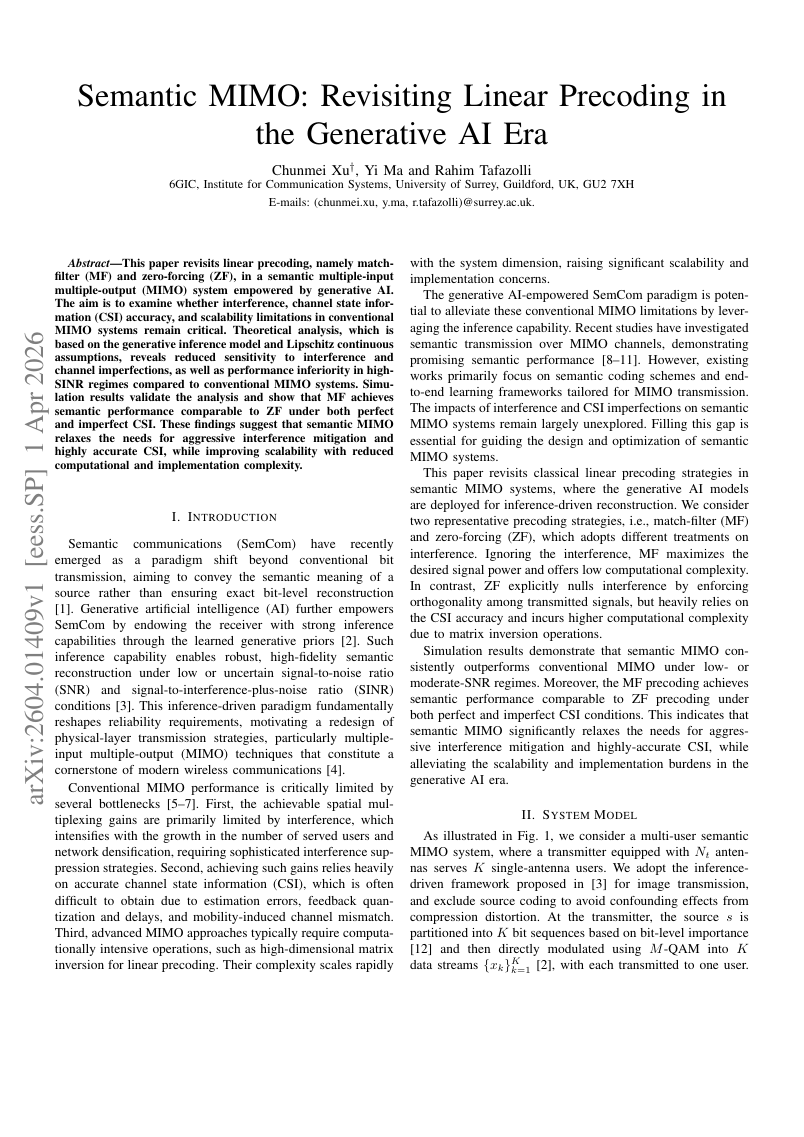
仍然存在的问题:However, for other semantic modalities we use state-of-the- art Deep Neural Network (DNN)-based techniques for lossy compression as will be discussed in Section III. PDF p.2
本文提出的方案:In this paper, we develop a latency-aware semantic communications framework with pre-trained generative models. PDF p.1
方案起作用的机制:全文自动定位未找到可靠句子,需回到 PDF 人工核查。
作者希望证明的结论:These results demonstrate a good semantic quality for the proposed framework for ultra-low-rate transmission at bit per pixel (bpp) values as low as 0.0024 and 0.017 for the prompt and the edge map, respectively. PDF p.4
Secondly, the adoption of pre-trained models allows a separation-based SemCom architecture, alle- viating the need for end-to-end joint training of the transmitter and receiver, which is required in many SemCom frameworks [13]–[16]. PDF p.1
Such a separation-based architecture offers better compatibility with the existing design of wireless communi- cation networks in comparison with the end-to-end methods. PDF p.1
Multi-modal Semantic Decomposition and Synthesis At the transmitter, a pre-trained textual transform encoder performs ultra-low-rate source-to-text transformation, extract- ing the textual message which acts as a prompt for the GenAI process at the receiver. PDF p.2
Thereby, our framework uses re-transmissions if the prompt is received with any error. PDF p.2
中间语义表示是什么
1 Latency-Aware Generative Semantic Communications with Pre-Trained Diffusion Models Li Qiao, Mahdi Boloursaz Mashhadi, Senior Member, IEEE, Zhen Gao, Member, IEEE, Chuan Heng Foh, Senior Member, IEEE, Pei Xiao, Senior Member, IEEE, and Mehdi Bennis, Fellow, IEEE Abstract—Generative foundation AI models have recently shown great success in synthesizing natural signals with high perceptual quality using only textual prompts and conditioning signals to guide the generation process. PDF p.1
For the prompt, we adopt a re-transmission-based scheme to ensure reliable transmission, and for the other semantic modalities we use an adaptive modulation/coding scheme to achieve robustness to the changing wireless channel. PDF p.1
The ultra low rate transmission can be achieved by transmitting data semantics in compressed format as a textual message or prompt. PDF p.1
For instance, the prompt “Teddy bear surfer rides the wave in the tropics” can be used to generate a short video with its semantic content matching with the prompt. PDF p.1
数字化方案与实际传输开销
数字化判断:数字调制或混合数字-模拟链路 语义表示被映射到有限星座、编码 bit 或数字/模拟并行分支,已经触及可部署物理层接口。
These results demonstrate a good semantic quality for the proposed framework for ultra-low-rate transmission at bit per pixel (bpp) values as low as 0.0024 and 0.017 for the prompt and the edge map, respectively. PDF p.4
5 5 10 15 20 25 30 0 10 20 30 40 50 60 70 80 Pecentage of Power for Prompt (a) 5 10 15 20 25 30 0 2 4 6 8 10 12 Transmission Latency (ms) (b) 5 10 15 20 25 30 0 1 2 3 4 5 6 7 8 Modulation Order for Edge Map (bits per symbol) (c) 5 10 15 20 25 30 1 2 3 4 5 6 7 8 9 10 11 Number of Re-transmissions for Prompt (d) Fig. 4. PDF p.5
Optimal wireless parameters versus average SNR γ at various target BERs: (a) Percentage of power for prompt; (b) Transmission Latency; (c) Modulation order (bits per symbol) for the edge map; (d) Average numbers of prompt re-transmissions. PDF p.5
bit / token / channel-use / CBR 证据
These results demonstrate a good semantic quality for the proposed framework for ultra-low-rate transmission at bit per pixel (bpp) values as low as 0.0024 and 0.017 for the prompt and the edge map, respectively. PDF p.4
5 5 10 15 20 25 30 0 10 20 30 40 50 60 70 80 Pecentage of Power for Prompt (a) 5 10 15 20 25 30 0 2 4 6 8 10 12 Transmission Latency (ms) (b) 5 10 15 20 25 30 0 1 2 3 4 5 6 7 8 Modulation Order for Edge Map (bits per symbol) (c) 5 10 15 20 25 30 1 2 3 4 5 6 7 8 9 10 11 Number of Re-transmissions for Prompt (d) Fig. 4. PDF p.5
Optimal wireless parameters versus average SNR γ at various target BERs: (a) Percentage of power for prompt; (b) Transmission Latency; (c) Modulation order (bits per symbol) for the edge map; (d) Average numbers of prompt re-transmissions. PDF p.5
We consider the Rayleigh fading channel and assume that the channels experience block fading within the transmit duration of each semantic modality. PDF p.2
Even a single bit error can change a character/word causing a significant semantic error. PDF p.2
Hence, the expected total transmission delay for the prompt is given by T0(p0) = ηP · ηR · ηT = |v0| rL · 1 1 −PER(p0) · L log2(M0)B0 , (3) where ηP = |v0| rL , ηR = 1 1−PER(p0), ηT = L log2(M0)B0 denote the number of packets, the number of re-transmissions, and the transmission delay of each packet, respectively. 2) Adaptive Modulation and Coding for other Semantic Modalities: For the transmission of the other semantic modal- ities, we adopt an adaptive MQAM modulation and coding scheme to cope with varying wireless channel. PDF p.3
Denote the bit error rate (BER) of the i-th, i ∈[I], conditioning signal as BERi = 1 |vi| P|vi| n=1 Pr{[ˆvi]n , [vi]n}, where ˆvi denotes the corresponding received data stream of the conditioning signal. PDF p.3
Specifically, through intensive simulations in presence of random bit errors in the proposed framework, we demonstrate that the normalized CLIP/MS-SSIM metrics are monotonically non-increasing functions of the BER of the edge map, as depicted in Fig. 2. PDF p.4
The Proposed Framework for Latency-aware Multi-stream Semantic Communication with Multi-Modal Generative Models. the most important semantic contents as a compact textual message or prompt, along with multiple other modalities that act as conditioning signals to guide the synthesis process at the generative foundation model at the receiver. • To achieve semantic-aware communication, we design a multi-stream scheme that transmits each extracted seman- tic modality with appropriate coding and communica- tion techniques based on communication intent. PDF p.2
The conditioning signals improve the semantic fidelity as well as distortion at additional communication costs. PDF p.2
The semantic quality constraints represent 1It is assumed that a larger value of the metric represents improved semantic quality. PDF p.3
The optimal solution can be achieved if and only if p0 + p1 = PT, T0(p0) = T1(p1, BER1), and BER1 = min n Φ−1 j (ε1), j ∈[J] o , where Φ−1 j denotes the generalized inverse function of Φ j, ∀j ∈[J]. PDF p.3
The absolute CLIP values achieved with GPT-4 and BLIP, under error-free transmission of the edge map, are 0.918 and 0.896, respectively, while the resulting MS-SSIM values are similar. PDF p.4
仍然存在的问题:However, the innate complexity and high data volume of point clouds pose substantial challenges for current network capabilities such as 5G [3]. PDF p.1
本文提出的方案:By taking into account the common content delivery requirements of low bandwidth consumptions and low latency, while maintaining high resolutions, we present in this paper a novel framework called Spatial-Temporal Semantic Point Cloud Transmission (ST- SPCT). PDF p.1
方案起作用的机制:As shown in Fig. 2(b), this module consists of two parts, hierarchical spatial feature extraction, and feature refinement and transform. • Hierarchical spatial feature extraction. PDF p.3
Compared to the existing point cloud compression and semantic communication methods that extract and reconstruct features only in the spatial dimension, the ST-SPCT simul- taneously extracts and reconstructs spatial-temporal semantic features more deeply, thus significantly reducing computational time and data volume, while ensuring negligible compromises in peak signal-to-noise ratio (PSNR), chamfer distance (CD) metrics, and frame continuity according to our systematic experiment results. PDF p.1
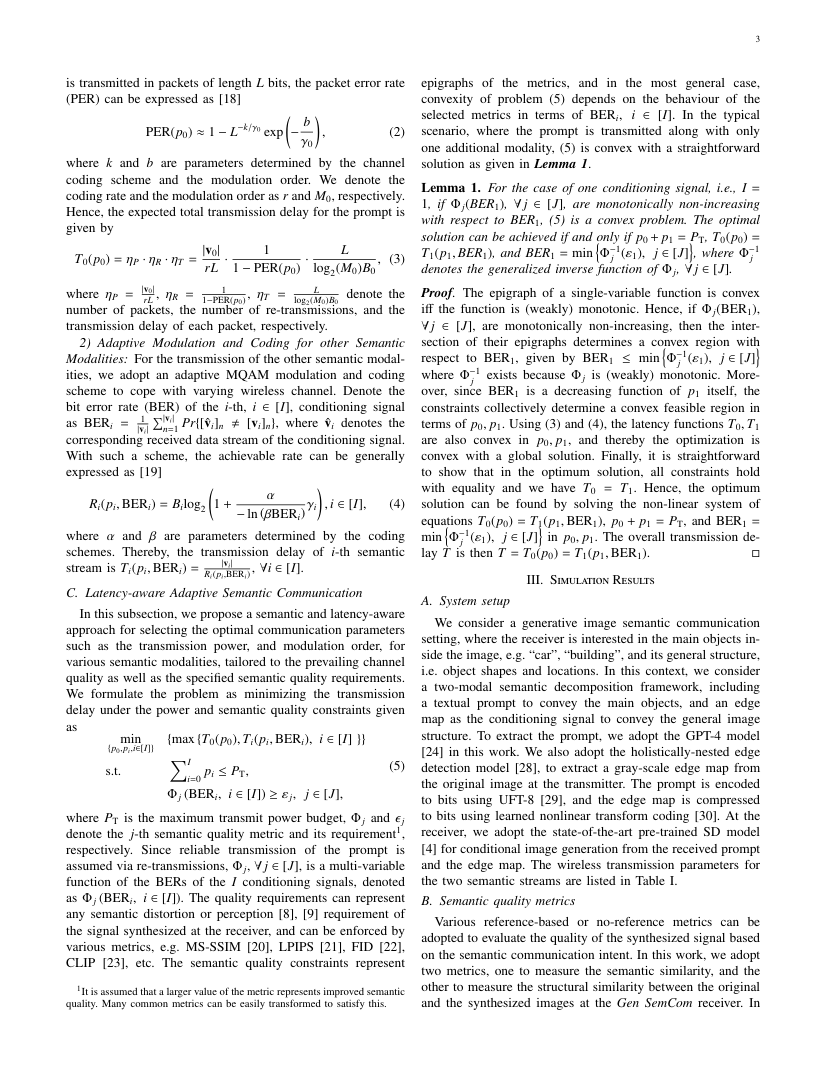
Fig. 1: The overall architecture of Spatial-Temporal Semantic Point Cloud Transmission (ST-SPCT) system. jectory streaming during transmission and used to assist in the reconstruction of spatial semantic features. PDF p.2
System Architecture To enhance the transmission efficiency of point cloud streaming through semantic communication, we intro- duced the ST-SPCT framework. PDF p.2
In the encoder, in order to significantly reduce data vol- ume for transmission and to optimize computing and transmission speeds, we adopt the temporal dimension feature extraction module to extract the temporal features of the original point cloud streaming before extracting spatial features. PDF p.2
中间语义表示是什么
Compared to the conventional bit-to-bit communication principle, the design of semantic communication ingeniously utilizes joint source and channel coding to transmit semantic features instead. PDF p.1
Compared to the existing point cloud compression and semantic communication methods that extract and reconstruct features only in the spatial dimension, the ST-SPCT simul- taneously extracts and reconstructs spatial-temporal semantic features more deeply, thus significantly reducing computational time and data volume, while ensuring negligible compromises in peak signal-to-noise ratio (PSNR), chamfer distance (CD) metrics, and frame continuity according to our systematic experiment results. PDF p.1
Fig. 1: The overall architecture of Spatial-Temporal Semantic Point Cloud Transmission (ST-SPCT) system. jectory streaming during transmission and used to assist in the reconstruction of spatial semantic features. PDF p.2
The robustness of the Deep-JSCC approach ensures resistance against both the cliff and leveling effects caused by fixed source and channel coding rates, yielding improved reconstruction outcomes. • Due to its new feature of simultaneously extracting and reconstructing semantic features from point cloud data in both time and space, this framework helps to extract deeper-level feature information. PDF p.2
数字化方案与实际传输开销
数字化判断:数字调制或混合数字-模拟链路 语义表示被映射到有限星座、编码 bit 或数字/模拟并行分支,已经触及可部署物理层接口。
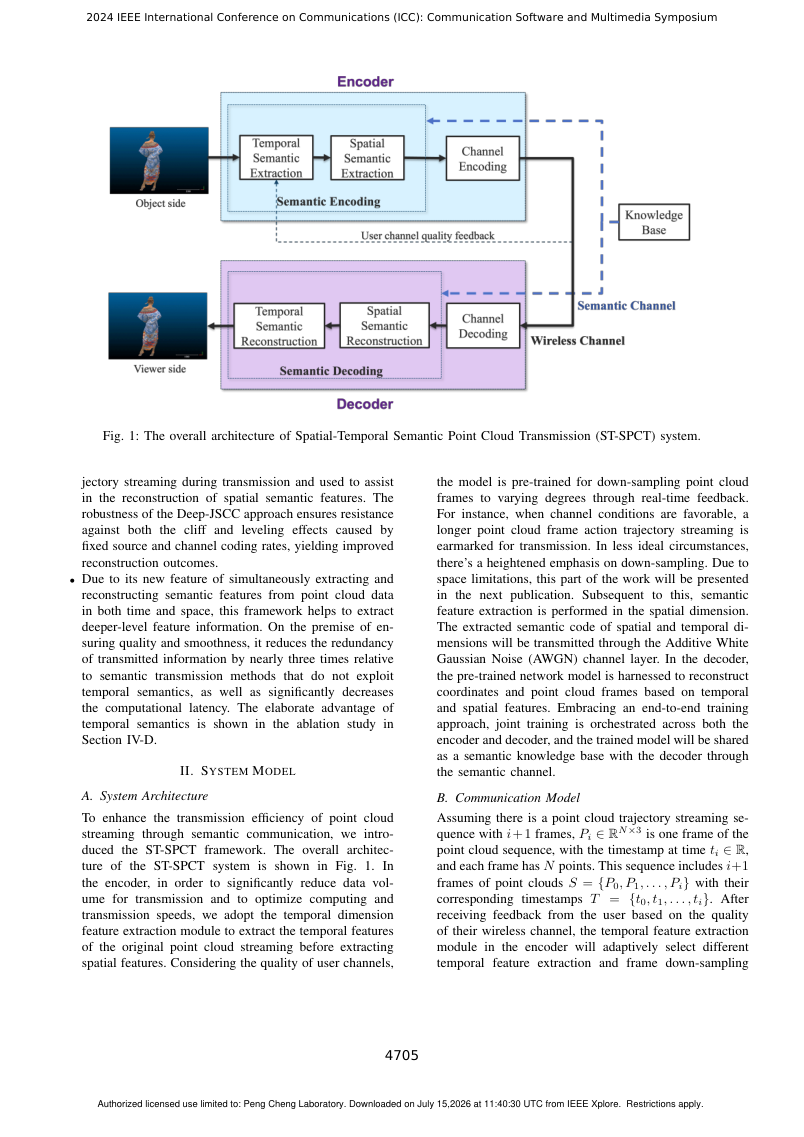
Performance Comparison To demonstrate the efficacy of SP-SPCT, we carried out a quantitative comparison of this method with digital transmis- sion schemes that employ discrete source and channel coding but lack temporal feature extraction, namely PCGCv2 [27] and PCT-PCC [28]. PDF p.5
From the horizontal axis, it’s evident that by harnessing temporal semantic feature extraction, the size of transmitted semantic features, represented in bits per trajectory sequence (bpt), has been significantly reduced. PDF p.6
bit / token / channel-use / CBR 证据
However, the compression ratio of this method is rather limited. PDF p.1
This not only minimizes the transmission overhead while maintaining top-notch reconstruction fidelity but also adeptly avoids the cliff effects. PDF p.3
信道处理机制:decoder 实际收到什么
分类:数字语义特征 + 传统信道编码 decoder 通常看到信道译码后的 bit/index;若论文只假设译码成功,则未真正学习处理残余 index 跳变。
The extracted semantic code of spatial and temporal di- mensions will be transmitted through the Additive White Gaussian Noise (AWGN) channel layer. PDF p.2
After the power normalization, the semantic code Z will be converted to codeword Z′ and transmitted to the AWGN channel. PDF p.3
At the decoder, the received signal Z′′ is a noisy version of Z′: Z′′ = Z′ + W, (1) where W represents an AWGN vector with independent and identical distribution elements, W ∼CN(0, σ2). PDF p.3
After source encoding, both methods were safeguarded by Polar codes and modulated using BPSK, 16-QAM, and 64-QAM before transmission. PDF p.5
实验设置与证据
数据集:论文文本未明确命中,需查看原表格或附录
Baseline:JPEG、Polar
信道/链路:AWGN、QAM
指标:PSNR、latency
SNR 条件:10 dB、15
dB、0 dB
主要实验结论(带全文页码)
Despite lowering the volume of transmitted feature data and reducing transmission latency via spatial and temporal encoding, compared with other compression methods that separate source and channel coding, we significantly observed an improvement in PSNR and a decrease in CD at low SNR values. PDF p.5
As shown in Fig. 3(d), the model trained with SNR train = 10 dB demonstrates robustness against channel variations, and its performance improves with the enhancement of channel quality. PDF p.6
Spatial-temporal Semantic Communications for Point Cloud-based Volumetric Media,原 PDF 第 2 页(架构/方法页)。Spatial-temporal Semantic Communications for Point Cloud-based Volumetric Media,原 PDF 第 5 页(关键结果页)。
A Physical Layer Security Framework for IRS-Assisted Integrated Sensing and Semantic Communication Systems
2025 · IEEE Transactions on Cognitive Communications and Networking · 资源分配与跨层优化
作者:Hamid Amiriara; Mahtab Mirmohseni; Ahmed Elzanaty; Yi Ma; Rahim Tafazolli
团队归属:补充数据库轮次核验:指定负责人直接署名(Yi Ma);Crossref/DBLP 正式 DOI 元数据。
现有进展:To address these threats, physical layer security (PLS) techniques, including techniques based on using artificial noise (AN) [5]–[8], [10], dedicated sensing signal (DSS) [4], [9], [13]–[16], [22], and intelligent reflecting surface (IRS) [9]– [17], [21] have been developed. PDF p.1
仍然存在的问题:INTRODUCTION E Merging applications such as connected cars and smart factories expose the limitations of 5G infrastructure, de- manding precise sensing, reliable and secure communication, and enhanced data processing. PDF p.1
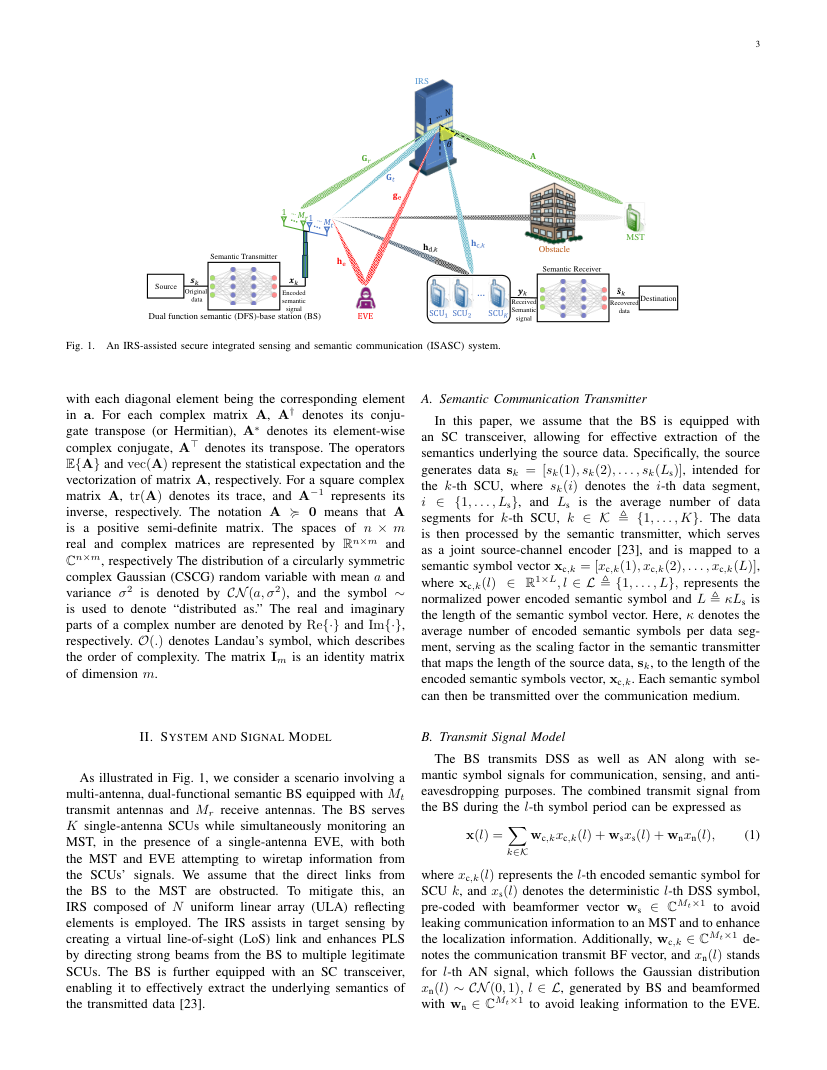
本文提出的方案:1 A Physical Layer Security Framework for IRS-Assisted Integrated Sensing and Semantic Communication Systems Hamid Amiriara, Mahtab Mirmohseni, Senior Member, IEEE, Ahmed Elzanaty, Senior Member, IEEE, Yi Ma, Senior Member, IEEE, and Rahim Tafazolli, Fellow, IEEE Abstract—In this paper, we propose a physical layer security (PLS) framework for an intelligent reflecting surface (IRS)- assisted integrated sensing and semantic communication (ISASC) system, where a multi-antenna dual-functional semantic base sta- tion (BS) serves multiple semantic communication users (SCUs) and monitors a potentially malicious sensing target (MST) in the presence of an eavesdropper (EVE). PDF p.1
方案起作用的机制:Next, by introducing the slack variable rth, we can refor- mulate the problem (P.2) to an equivalent problem as (P.3) : Minimize w,v, rth∈R1×1 CRBθ(w, v), (24a) s.t. PDF p.6
作者希望证明的结论:Convergence and Computational Complexity Analysis In this section, we analyze the convergence and complexity of the overall algorithm. 1) Convergence Analysis: The convergence of the proposed algorithm is guaranteed for the following reasons: • Sub-problem (SP1) and (SP2) are solved optimally during each iteration, ensuring that the objective function value does not decrease. • With a sufficient number of GRM, the SDR approach achieves at least a π/4-approximation of the optimal objective value [38].7 This ensures that the objective func- tion value generally increases or remains constant. PDF p.8
1 A Physical Layer Security Framework for IRS-Assisted Integrated Sensing and Semantic Communication Systems Hamid Amiriara, Mahtab Mirmohseni, Senior Member, IEEE, Ahmed Elzanaty, Senior Member, IEEE, Yi Ma, Senior Member, IEEE, and Rahim Tafazolli, Fellow, IEEE Abstract—In this paper, we propose a physical layer security (PLS) framework for an intelligent reflecting surface (IRS)- assisted integrated sensing and semantic communication (ISASC) system, where a multi-antenna dual-functional semantic base sta- tion (BS) serves multiple semantic communication users (SCUs) and monitors a potentially malicious sensing target (MST) in the presence of an eavesdropper (EVE). PDF p.1
This work is supported by the UK Department for Science, Innovation and Technology under the Future Open Networks Research Challenge project TUDOR (Towards Ubiquitous 3D Open Resilient Network). mental services within a unified network architecture will be crucial for meeting these demands in beyond 5G and 6G [2]. PDF p.1
Our Contributions: In this paper, to gain a better under- standing of the interwoven sensing quality and communication confidentiality in the IRS-assisted ISASC system, we propose a multi-objective optimization problem (MOOP) framework that sheds light on the trade-off between the CRB and SSR, two KPIs at the core of estimation theory and information theory. PDF p.2
Subsequently, we propose an algorithm to solve it based on alternating optimization, semi-definite programming (SDP), and the Gaussian randomization method (GRM) methods. • Through numerical simulations, we validate that the pro- posed scheme achieves a larger trade-off region compared to baseline schemes. PDF p.2
中间语义表示是什么
Initially, due to the highly compressed nature of SC, even minor data leaks can expose critical content, particularly when illegitimate users possess full background knowledge of the semantic communication users (SCUs) for semantic feature extraction. PDF p.1
The data is then processed by the semantic transmitter, which serves as a joint source-channel encoder [23], and is mapped to a semantic symbol vector xc,k = [xc,k(1), xc,k(2), . . . , xc,k(L)], where xc,k(l) ∈R1×L, l ∈L ≜{1, . . . , L}, represents the normalized power encoded semantic symbol and L ≜κLs is the length of the semantic symbol vector. PDF p.3
Here, κ denotes the average number of encoded semantic symbols per data seg- ment, serving as the scaling factor in the semantic transmitter that maps the length of the source data, sk, to the length of the encoded semantic symbols vector, xc,k. PDF p.3
Each semantic symbol can then be transmitted over the communication medium. PDF p.3
数字化方案与实际传输开销
数字化判断:数字调制或混合数字-模拟链路 语义表示被映射到有限星座、编码 bit 或数字/模拟并行分支,已经触及可部署物理层接口。
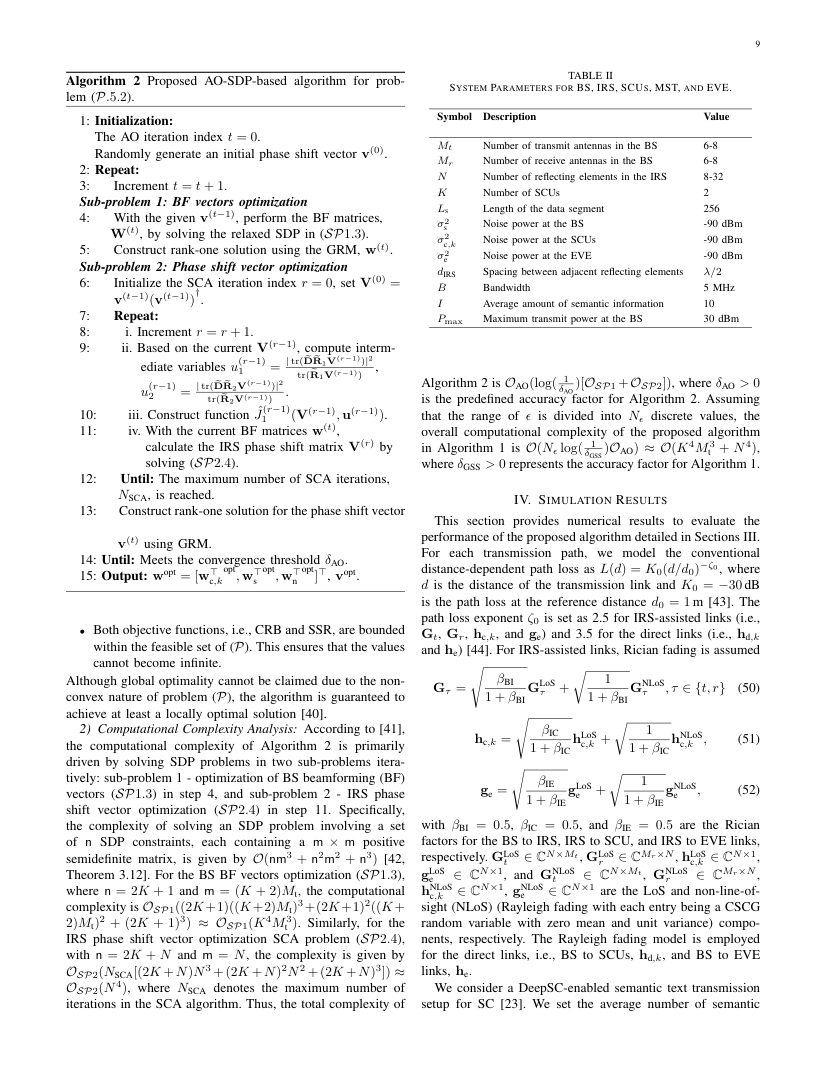
Assuming that the range of ϵ is divided into Nϵ discrete values, the overall computational complexity of the proposed algorithm in Algorithm 1 is O(Nϵ log( 1 δGSS )OAO) ≈O(K4M 3 t + N 4), where δGSS > 0 represents the accuracy factor for Algorithm 1. PDF p.9
bit / token / channel-use / CBR 证据
论文未以可检索文本完整报告输入尺寸、latent/token 数、每个 index 的 bit 数与总开销;本报告不在缺少形状和码本参数时伪造压缩率。可按 $R=N_s b_s/N_{src}$ 或 $\rho=n/k$ 在取得参数后推导。
For IRS-assisted links, Rician fading is assumed Gτ = s βBI 1 + βBI GLoS τ + r 1 1 + βBI GNLoS τ , τ ∈{t, r} (50) hc,k = s βIC 1 + βIC hLoS c,k + r 1 1 + βIC hNLoS c,k , (51) ge = s βIE 1 + βIE gLoS e + r 1 1 + βIE gNLoS e , (52) with βBI = 0.5, βIC = 0.5, and βIE = 0.5 are the Rician factors for the BS to IRS, IRS to SCU, and IRS to EVE links, respectively. PDF p.9
GLoS t ∈CN×Mt, GLoS r ∈CMr×N, hLoS c,k ∈CN×1, gLoS e ∈CN×1, and GNLoS t ∈CN×Mt, GNLoS r ∈CMr×N, hNLoS c,k ∈CN×1, gNLoS e ∈CN×1 are the LoS and non-line-of- sight (NLoS) (Rayleigh fading with each entry being a CSCG random variable with zero mean and unit variance) compo- nents, respectively. PDF p.9
The Rayleigh fading model is employed for the direct links, i.e., BS to SCUs, hd,k, and BS to EVE links, he. PDF p.9
Convergence and Computational Complexity Analysis In this section, we analyze the convergence and complexity of the overall algorithm. 1) Convergence Analysis: The convergence of the proposed algorithm is guaranteed for the following reasons: • Sub-problem (SP1) and (SP2) are solved optimally during each iteration, ensuring that the objective function value does not decrease. • With a sufficient number of GRM, the SDR approach achieves at least a π/4-approximation of the optimal objective value [38].7 This ensures that the objective func- tion value generally increases or remains constant. PDF p.8
Although global optimality cannot be claimed due to the non- convex nature of problem (P), the algorithm is guaranteed to achieve at least a locally optimal solution [40]. 2) Computational Complexity Analysis: According to [41], the computational complexity of Algorithm 2 is primarily driven by solving SDP problems in two sub-problems itera- tively: sub-problem 1 - optimization of BS beamforming (BF) vectors (SP1.3) in step 4, and sub-problem 2 - IRS phase shift vector optimization (SP2.4) in step 11. PDF p.9
Specifically, in Case I, the CRB achieves the saturation value within 2 iterations, while Case IV requires 5 iterations to converge. PDF p.10
Additionally, the proposed approach outperforms BL I, where the BS uses a single signal. PDF p.11
Furthermore, compared to the BL II, our approach achieves approximately 5 dB lower CRB at an SSR of 2.4 × 10⁴, emphasizing the joint optimization of the communication transmit BF vectors, the sensing BF vector, and the AN BF vector are essential to fully reap the gains. PDF p.11
A Physical Layer Security Framework for IRS-Assisted Integrated Sensing and Semantic Communication Systems,原 PDF 第 3 页(架构/方法页)。A Physical Layer Security Framework for IRS-Assisted Integrated Sensing and Semantic Communication Systems,原 PDF 第 9 页(关键结果页)。
Generative Semantic Communication via Textual Prompts: Latency Performance Tradeoffs
2025 · IEEE Transactions on Vehicular Technology · 资源分配与跨层优化
作者:Mengmeng Ren; Li Qiao; Long Yang; Zhen Gao; Jian Chen; Mahdi Boloursaz Mashhadi; Pei Xiao; Rahim Tafazolli; Mehdi Bennis
仍然存在的问题:However, permission to use this material for any other purposes must be obtained from the IEEE by sending a request to pubs-permissions@ieee.org. PDF p.1
本文提出的方案:Specifically, we develop a multi-user Gen SemCom framework using pre-trained M/VLMs, and formulate a joint optimiza- tion problem of prompt generation offloading, communication and computation resource allocation to minimize the latency and maximize the resulting semantic quality. PDF p.1
方案起作用的机制:Semantic-Aware Generation Offloading Problem Considering fairness among the transmitters, we focus on minimization of the maximal CCQ among T-R pairs by jointly optimizing the M/VLM prompt generation offloading strategy, as well as the transmit powers and computation frequencies of the transmitters and edge servers. PDF p.3
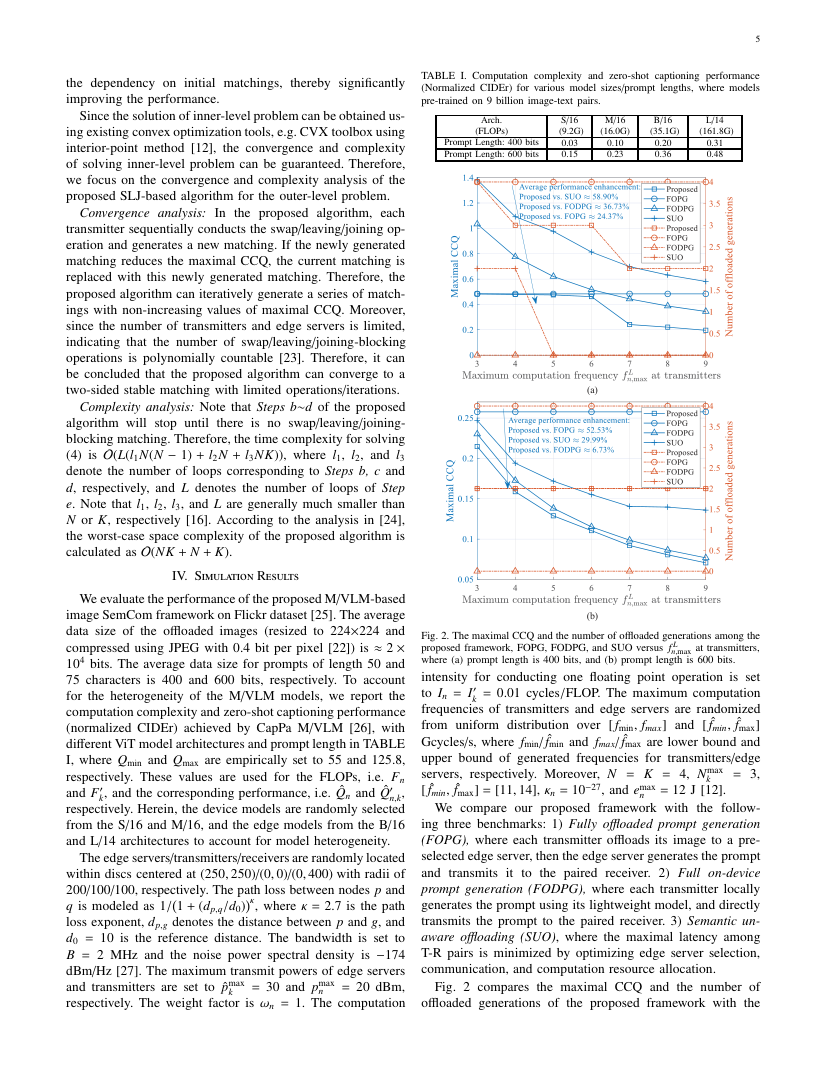
作者希望证明的结论:It can be seen from this figure that our proposed framework outperforms other bench- marks in terms of the maximal CCQ, on average reducing the maximal CCQ by 38.45%, 21.73%, and 44.45% in com- parison with FOPG, FODPG, and SUO schemes over the range of local computation frequency [3, 9] Gcycles/s and prompt length X′ n/X′ n,k ∈{400, 600} bits4. PDF p.6
Unlike existing SemCom studies [13], [14] that employ end-to-end training of the transmitter/receiver, our framework adopts pre-training and generation offloading to avoid the computationally intensive end-to-end training on edge/device, utilizing the zero/few-shot performance [15] of the M/VLMs pre-trained on large data corpora. PDF p.1
2 lem, we first equivalently decompose it into a two-level problem that iteratively solves the discrete and continuous variables. • For the formulated two-level problem, we propose a low-complexity swap/leaving/joining (SLJ)-based match- ing algorithm. PDF p.2
The architecture2 of these M/VLMs for prompt generation follows an encoder-decoder structure, e.g., a Vision Transformer (ViT) encoder is com- bined with a Transformer-based text decoder, where different cross/self-attention mechanisms are utilized for inter/intra- modal features. PDF p.2
Moreover, each receiver is equipped with a generative decoder, e.g., stable diffusion [7], denoted by FD,n(·|ξ∗ n), where ξ∗ n is the pre-trained parameters. 2) M/VLMs-integrated SemCom service provisioning stage: Once M/VLMs are successfully deployed, Gen SemCom transmission is conducted based on network optimization results. PDF p.2
中间语义表示是什么
arXiv:2409.09715v3 [cs.IT] 2 May 2025 1 Generative Semantic Communication via Textual Prompts: Latency Performance Tradeoffs Mengmeng Ren, Li Qiao, Long Yang, Zhen Gao, Jian Chen, Mahdi Boloursaz Mashhadi, Pei Xiao, Rahim Tafazolli, and Mehdi Bennis Abstract—This paper develops an edge-device collaborative Generative Semantic Communications (Gen SemCom) frame- work leveraging pre-trained Multi-modal/Vision Language Mod- els (M/VLMs) for ultra-low-rate semantic communication via textual prompts. PDF p.1
The proposed framework optimizes the use of M/VLMs on the wireless edge/device to generate high-fidelity textual prompts through visual captioning/question answering, which are then transmitted over a wireless channel for SemCom. PDF p.1
Specifically, we develop a multi-user Gen SemCom framework using pre-trained M/VLMs, and formulate a joint optimiza- tion problem of prompt generation offloading, communication and computation resource allocation to minimize the latency and maximize the resulting semantic quality. PDF p.1
Bennis is with the Centre for Wireless Communications, University of Oulu, 90014 Oulu, Finland (e-mail: mehdi.bennis@oulu.fi). prompts has recently emerged as an efficient Gen SemCom scheme to convey the most important semantics of the source signal to the receiver in a compressed format as compact as a textual prompt, thereby achieving ultra-low-rate semantic communication [7]–[9]. PDF p.1
Due to the non- convex nature of the problem with highly coupled discrete and continuous variables, we decompose it as a two-level problem and propose a low-complexity swap/leaving/joining (SLJ)-based matching algorithm. PDF p.1
2 lem, we first equivalently decompose it into a two-level problem that iteratively solves the discrete and continuous variables. • For the formulated two-level problem, we propose a low-complexity swap/leaving/joining (SLJ)-based match- ing algorithm. PDF p.2
The extracted prompt sn is then encoded into bitstream X′ n using a text encoding method ¯Bt, e.g., UTF-8 [21], represented by X′ n = ¯Bt(sn). PDF p.2
For offloaded prompt generation, transmitter tn directly encodes ¯Xn into bitstream Xn, given by Xn = ¯Bi( ¯Xn), where ¯Bi denotes the encoding method, e.g., JPEG algorithm [22] for image encoding. PDF p.2
The extracted prompt s′ n,k is then encoded into bitstream X′ n,k = ¯Bt(s′ n,k), and is modulated and transmitted to the receiver. PDF p.2
bit / token / channel-use / CBR 证据
The average data size of the offloaded images (resized to 224×224 and compressed using JPEG with 0.4 bit per pixel [22]) is ≈2 × 104 bits. PDF p.5
All the wireless channels experience independent but non-identically distributed Rayleigh block-fading, indicating the channel gains remain unchanged within one transmission block but may change independently over different blocks. PDF p.3
After locally generating the prompt, transmitter tn will send it to its paired receiver with the transmission rate RT−R n = B log2(1 + pn|hn|2 σ2n ), where pn is the transmit power of tn, σ2 n is the additive white Gaussian noise (AWGN) power received at rn, and B is the bandwidth. PDF p.3
Ak, the trans- mission rate for tn to offload the compressed source signal to the server is Ru n,k = B log2(1 + pn|hu n,k|2 σ2 n,k ), and the corresponding communication latency is τu n,k = |Xn| Ru n,k , where σ2 n,k is the AWGN power received at edge server Ak, and the corresponding energy consumption is eu n,k = pnτu n,k. PDF p.3
Next, when Ak generates the textual prompt, it will directly transmit it to the corresponding paired receiver 3For the proposed framework, the role of semantic communications is not only assigning values to Qn and Q′ n,k, but also leveraging high-quality pre-trained M/VLMs to extract semantic information from raw data, thereby enabling universal intent- and task-aware transmissions. rn with transmission rate Rd k,n = B log2(1 + pk,n|hd k,n|2 ˆσ2 k,n ), where pk,n is the allocated transmit power of Ak and ˆσ2 k,n denotes the AWGN power received at rn. PDF p.3
实验设置与证据
数据集:论文文本未明确命中,需查看原表格或附录
Baseline:JPEG
信道/链路:AWGN、Rayleigh
指标:BLEU、accuracy、latency
SNR 条件:174
dB、20 dB
主要实验结论(带全文页码)
To account for the heterogeneity of the M/VLM models, we report the computation complexity and zero-shot captioning performance (normalized CIDEr) achieved by CapPa M/VLM [26], with different ViT model architectures and prompt length in TABLE I, where Qmin and Qmax are empirically set to 55 and 125.8, respectively. PDF p.5
It can be seen from this figure that our proposed framework outperforms other bench- marks in terms of the maximal CCQ, on average reducing the maximal CCQ by 38.45%, 21.73%, and 44.45% in com- parison with FOPG, FODPG, and SUO schemes over the range of local computation frequency [3, 9] Gcycles/s and prompt length X′ n/X′ n,k ∈{400, 600} bits4. PDF p.6
This is because for sufficiently large prompt length, the semantic quality for on-device generation becomes sufficiently good and thereby it is not worth to tolerate the additional communication/computation latency for the small improvement in CIDEr by offloading. PDF p.6
This means that a better semantic performance is achieved at the cost of longer com- munication/computation latency. PDF p.6
Fig. 3(b) compares the maximal CCQ of the proposed framework, the convention swap-based algorithm (CSA) [16], and the exhaustive search (ES), where the normalized gap is defined as the ratio of the maximal CCQ achieved by proposed/CSA to that achieved by ES. PDF p.6
Generative Semantic Communication via Textual Prompts: Latency Performance Tradeoffs,原 PDF 第 1 页(架构/方法页)。Generative Semantic Communication via Textual Prompts: Latency Performance Tradeoffs,原 PDF 第 5 页(关键结果页)。
Generative Semantic Communications With Foundation Models: Perception-Error Analysis and Semantic-Aware Power Allocation
2025 · IEEE Journal on Selected Areas in Communications · 资源分配与跨层优化
作者:Chunmei Xu; Mahdi Boloursaz Mashhadi; Yi Ma; Rahim Tafazolli; Jiangzhou Wang
现有进展:INTRODUCTION Communication systems have been developed and optimized based on Shannon information theory over the past decades, achieving remarkable success. PDF p.1
仍然存在的问题:However, the focus is primarily on the accurate reconstruction of a source signal rather than the underlying meaning of the source content. PDF p.1
本文提出的方案:In this work, we propose a generative SemCom framework that uses pre-trained foundation models for semantic encoding and decoding. PDF p.2
方案起作用的机制:Two semantic-aware power allocation methods are proposed by leveraging the non-decreasing property of the perception- error relationship. PDF p.1
作者希望证明的结论:The results demonstrate that our approach achieves significantly lower compression rates (0.0303 bpp and 0.0260 bpp) in the two example images, outperforming both JPEG (0.2719 bpp and 0.2265 bpp) and Cheng2020 (0.2724 bpp and 0.2004 bpp) by approximately a factor of 10. PDF p.8
In this work, a generative SemCom framework utilizing pre-trained foundation models is proposed, where both uncoded forward-with-error and coded discard-with-error schemes are developed for the semantic decoder. PDF p.1
The deep learning-enabled SemCom typically employs an end-to-end architecture to jointly learn the neural network (NN)- based semantic encoder and decoder, establishing a shared knowledge base between transceivers. PDF p.1
The deep joint source and channel coding (JSCC) proposed in [11] adopted auto- encoder NN networks for image tasks, sparking numerous deep JSCC variants for various types of sources and channel models [12–15]. PDF p.1
Generative SemCom systems, utilizing deep generative AI models such as variational autoencoder (VAE), generative adversarial network (GAN), and diffusion model, show promise in preserving semantics while reducing data traffic [16]. PDF p.2
中间语义表示是什么
Based on this, semantic values are defined to quantify the semantic similarity between multimodal semantic features and the original source. PDF p.1
Particularly promising are the generative foundation models based on diffusion models, such as DALL·E and Sora, which can synthesize high perceptual quality signals by exchanging extremely compressed textual prompts. PDF p.2
Semantic Encoder The semantic encoder employs I semantic extractors to extract semantic features from the inputted source signal X using the pre-trained foundation models Fenc,i. PDF p.2
The i-th semantic feature can be expressed by Si = Fenc,i(X | θ∗ i ), (1) where θ∗ i is the NN parameters of the i-th foundation model. PDF p.2
数字化方案与实际传输开销
数字化判断:数字调制或混合数字-模拟链路 语义表示被映射到有限星座、编码 bit 或数字/模拟并行分支,已经触及可部署物理层接口。
The proposed generative semantic communication framework with pre-trained foundation models. sequence, termed a semantic data stream Ki, through the operation Ki = B(Si), where B(·) is the binary mapping function such as ASCII, Unicode, and quantization. PDF p.3
The compression rate is measured by bit per pixel (bpp). PDF p.8
Goldstein, “Hard prompts made easy: Gradient-based discrete optimization for prompt tuning and discovery,” 2023. [Online]. PDF p.14
bit / token / channel-use / CBR 证据
The compression rate is measured by bit per pixel (bpp). PDF p.8
The probability of receiving ˆKi is denoted as P( ˆKi | Ki; T ), which depends on the bit error rate (BER) ψi (≤0.5) in the channel-uncoded case. PDF p.3
Here, the path loss is given by PLoss = PLoss,0(d/d0)−α, with distance d = 100 m, reference path loss PLoss,0 = −30 dB at d0 = 1 m, and path loss exponent α = −3.4. ˜hi is Rayleigh fading channel with a variance of 1. PDF p.8
Given that I(Kij; ˆKij) = H(ϕij) −H(ψij) for a Bernoulli source transmitted over binary symmetric channels, we obtain: I(Ki; ˆKi) = Ki X j=1 H(ϕij) −H(ψij), (33) which decreases in BER ψij with ψij ≤0.5. PDF p.12
However, simply combining conventional adaptive techniques with the generative SemCom might not offer additional semantic performance gains. PDF p.5
Consequently, the optimal solutions to (P1-1) and (P2-1) are achieved when constraints (25b) and (26b) are satisfied with equality, establishing the following theorem. PDF p.7
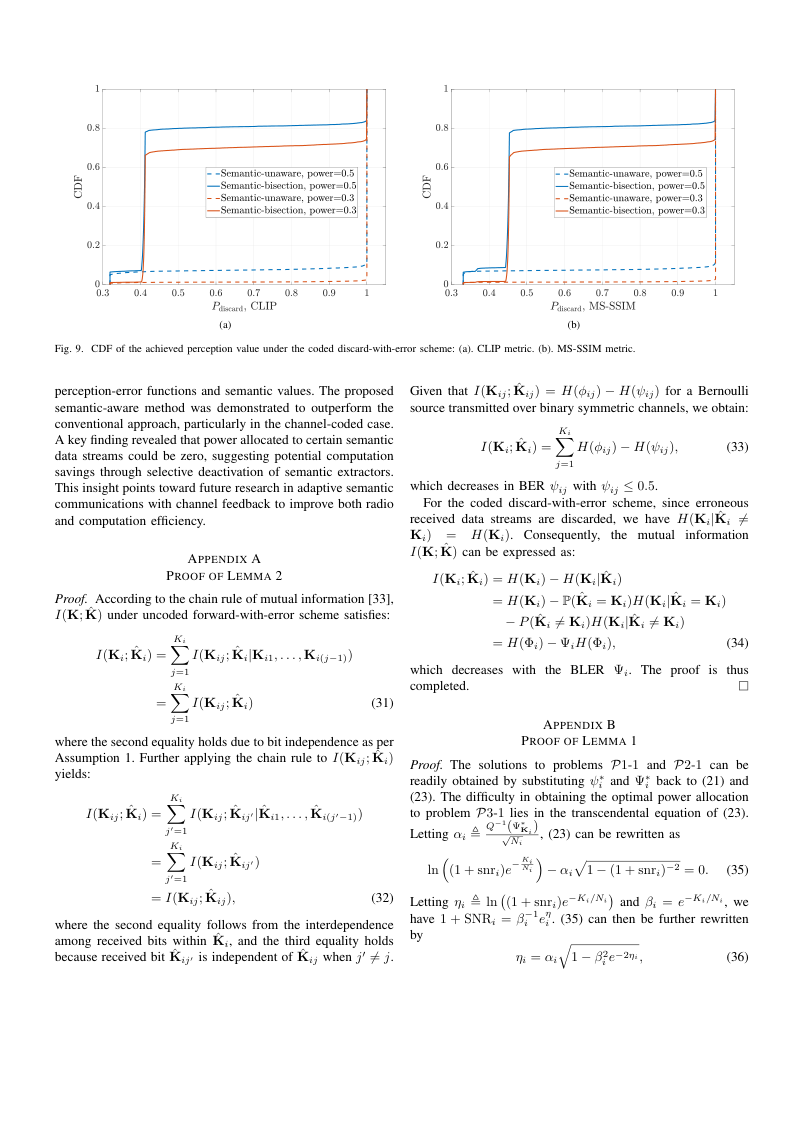
The results demonstrate that our approach achieves significantly lower compression rates (0.0303 bpp and 0.0260 bpp) in the two example images, outperforming both JPEG (0.2719 bpp and 0.2265 bpp) and Cheng2020 (0.2724 bpp and 0.2004 bpp) by approximately a factor of 10. PDF p.8
This significant compression improvement maintains comparable perceptual quality, particularly when evaluated using the CLIP metric. PDF p.8
Without transmission errors, both schemes achieve the best-case perception values (Pbest), which are 0.3191 and 0.3313 for CLIP, and MS-SSIM metrics, respectively. PDF p.8
通信审稿价值与 Codex 判断
价值在于把语义质量转化为可优化的网络效用,并回答有限功率、带宽、时延应分给谁。
局限:证据主要来自数据集与仿真信道,缺少真实射频链路/原型验证。
Generative Semantic Communications With Foundation Models: Perception-Error Analysis and Semantic-Aware Power Allocation,原 PDF 第 2 页(架构/方法页)。Generative Semantic Communications With Foundation Models: Perception-Error Analysis and Semantic-Aware Power Allocation,原 PDF 第 12 页(关键结果页)。
Importance-Aware Source-Channel Coding for Multi-Modal Task-Oriented Semantic Communication
2025 · 2025 IEEE International Conference on Machine Learning for Communication and Networking (ICMLCN) · 资源分配与跨层优化
作者:Yi Ma; Chunmei Xu; Zhenyu Liu; Siqi Zhang; Rahim Tafazolli
团队归属:补充数据库轮次核验:指定负责人直接署名(Yi Ma);Crossref/DBLP 正式 DOI 元数据。
仍然存在的问题:Furthermore, we address the source-channel coding challenge in semantic multiuser systems, particularly in multicast scenarios, where segment importance varies among receivers. PDF p.1
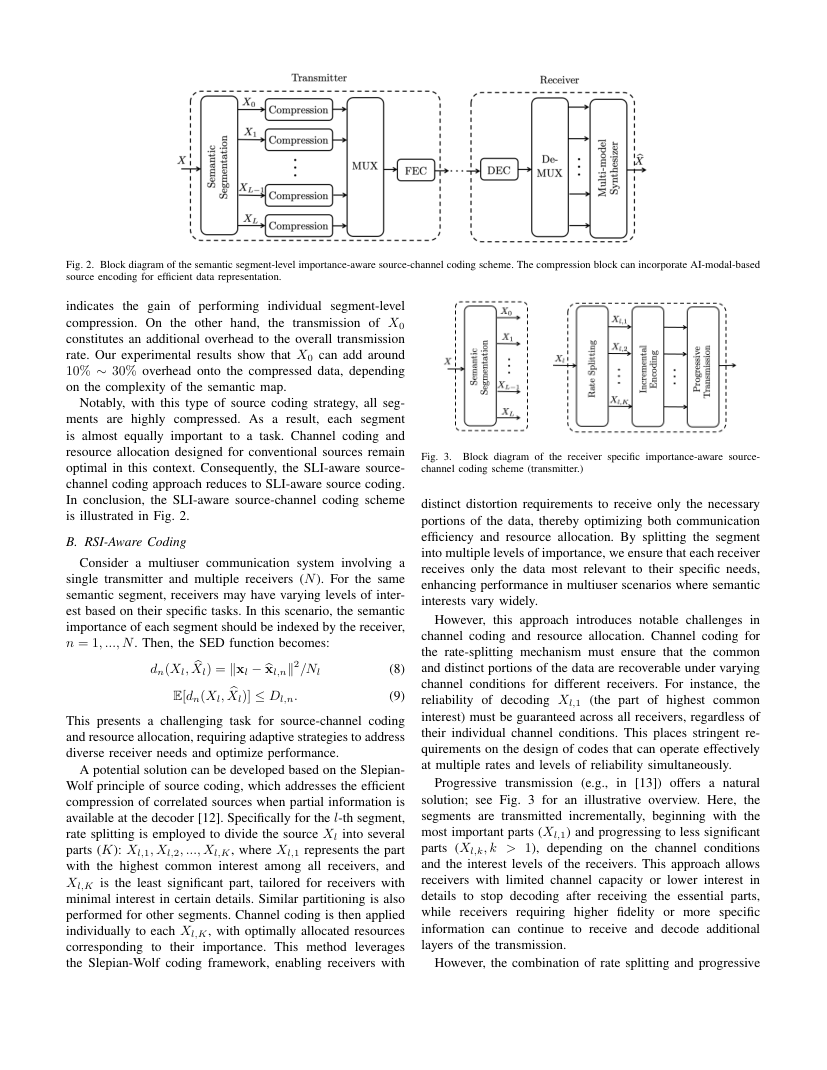
本文提出的方案:Building on this frame- work, we present importance-aware source and channel coding strategies that dynamically adjust to varying levels of significance at the segment, token, and bit levels. PDF p.1
方案起作用的机制:By exploiting the structure or semantics of the transmitted data, GenAI-based coding can adapt to channel conditions in real time. PDF p.1
作者希望证明的结论:Our experimental results show that X0 can add around 10% ∼30% overhead onto the compressed data, depending on the complexity of the semantic map. PDF p.4
To tackle these challenges, we propose solutions such as rate-splitting coded progressive transmission, ensuring flexibility and robustness in task-specific semantic communication. PDF p.1
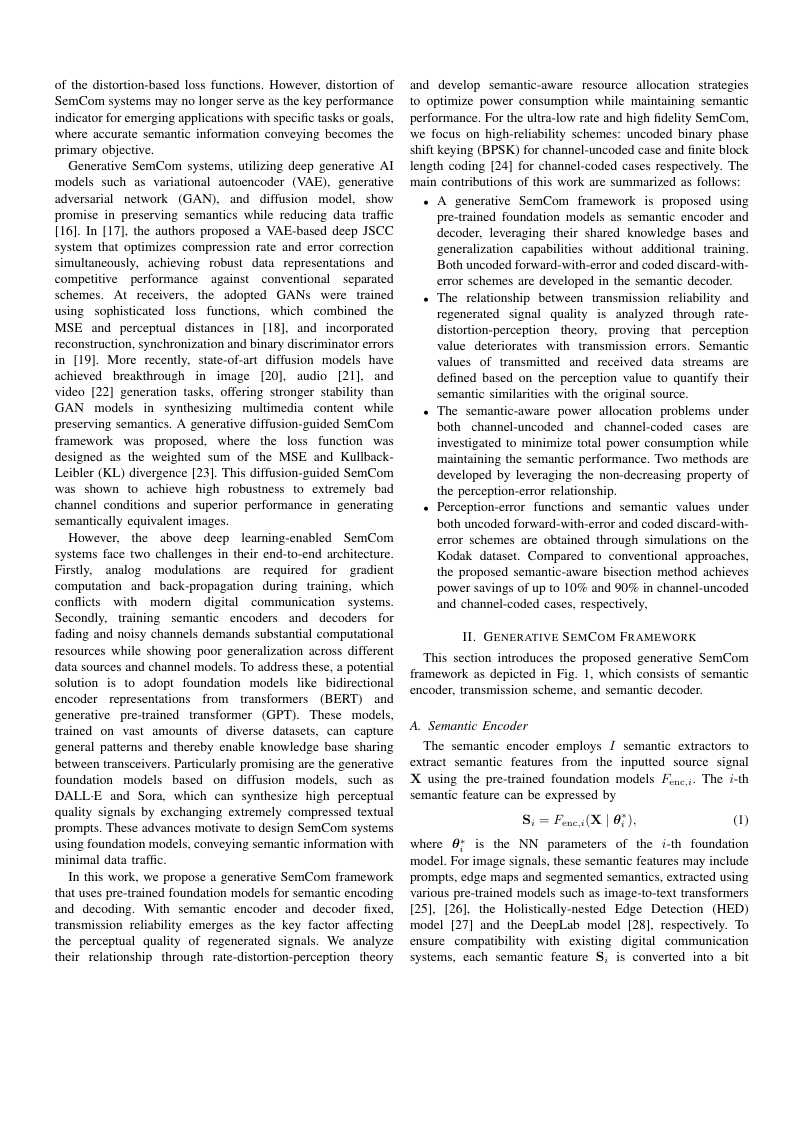
In short, RoIs are not de- signed and optimized for semantic, task-oriented applications. 2) Semantic segments in our system are compressed in a manner distinct from the RoIs used in JPEG2000. PDF p.2
Its relationship with other tokens enables the semantic decoder to achieve a certain degree of error detection. PDF p.2
For example, if ’a’ were mistakenly altered to ’b’, the semantic decoder would fail to execute the program, prompting a retransmission request. PDF p.2
中间语义表示是什么
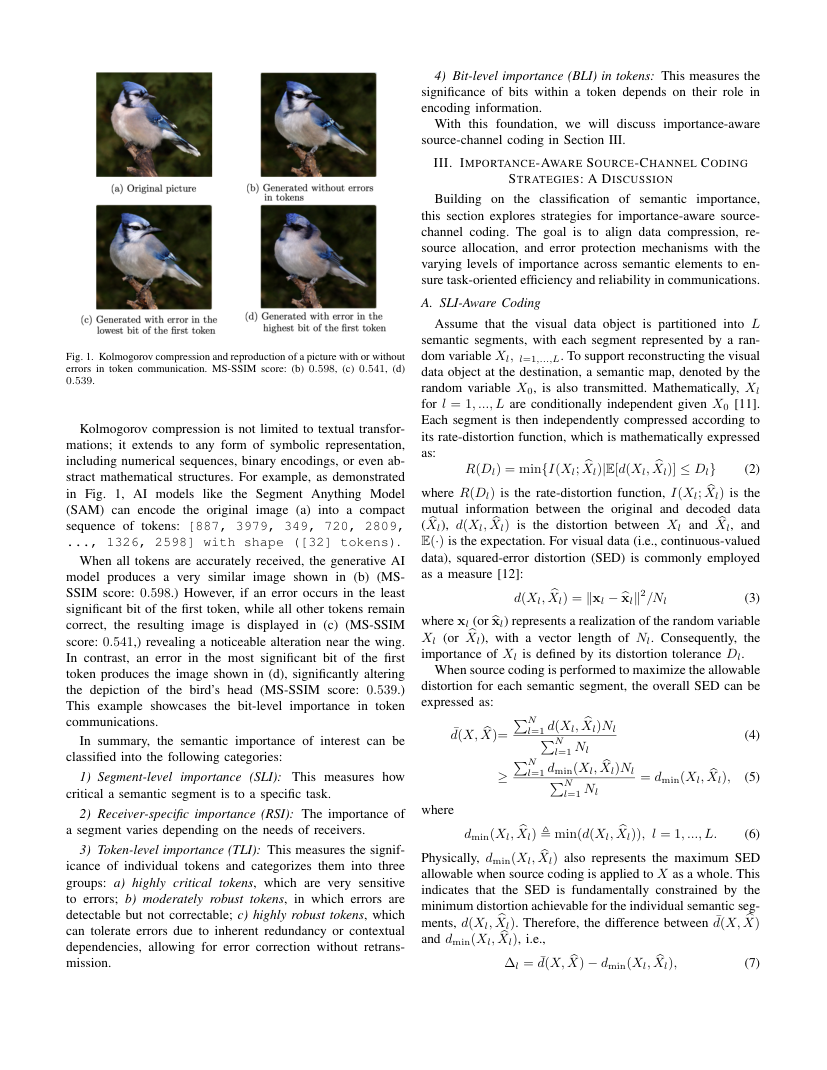
For example, instead of reconstructing an image pixel by pixel, GenAI can generate a lower-dimensional sketch, semantic attributes, or task-specific latent representations that are sufficient for downstream goals such as object recognition or classification. PDF p.1
These techniques, while robust, rely on predefined codebooks and operate independently of the content being transmitted. PDF p.1
For example, if ’a’ were mistakenly altered to ’b’, the semantic decoder would fail to execute the program, prompting a retransmission request. PDF p.2
These segments are subsequently encoded into tokens, enabling precise and adaptive transmission control. PDF p.1
Building on this frame- work, we present importance-aware source and channel coding strategies that dynamically adjust to varying levels of significance at the segment, token, and bit levels. PDF p.1
In source coding, traditional methods aim to compress infor- mation without loss (e.g., entropy coding) or with acceptable distortion (e.g., lossy compression for audio or video). PDF p.1
These techniques, while robust, rely on predefined codebooks and operate independently of the content being transmitted. PDF p.1
These segments are then independently encoded into tokens, providing a flexible and granular approach to transmission control. PDF p.1
bit / token / channel-use / CBR 证据
论文未以可检索文本完整报告输入尺寸、latent/token 数、每个 index 的 bit 数与总开销;本报告不在缺少形状和码本参数时伪造压缩率。可按 $R=N_s b_s/N_{src}$ 或 $\rho=n/k$ 在取得参数后推导。
For channel coding, traditional systems employ determin- istic error-correction codes (e.g., Polar code) that are opti- mized to minimize bit error rates or codeword error rates. PDF p.1
For highly critical tokens, which are highly sensitive to errors, robust error correction techniques like polar codes, low-density parity- check (LDPC) codes or turbo codes are employed. PDF p.5
For highly critical tokens, grouping ensures that LDPC or Polar codes achieve their full potential in error correction while maintaining strict reliability requirements. PDF p.5
For simplicity, each stream is encoded with a rate-1/2 convo- lutional code and modulated using 16-QAM. PDF p.6
实验设置与证据
数据集:论文文本未明确命中,需查看原表格或附录
Baseline:JPEG2000、LDPC、Polar、Turbo
信道/链路:QAM
指标:SSIM、MS-SSIM、accuracy、latency、throughput
SNR 条件:10 dB、10 dB
主要实验结论(带全文页码)
Our experimental results show that X0 can add around 10% ∼30% overhead onto the compressed data, depending on the complexity of the semantic map. PDF p.4
For highly critical tokens, grouping ensures that LDPC or Polar codes achieve their full potential in error correction while maintaining strict reliability requirements. PDF p.5
By utilizing GenAI to partition visual data into task-relevant semantic segments, we have developed a flexible framework that improves both accuracy and efficiency in data transmission. PDF p.6
现有进展:As a promising alternative, the semantic communication paradigm has attracted research attention, as it utilises the knowledge of the source to transmit only semantic information at the transmitter side and recover it on the receiving side [1]. PDF p.1
仍然存在的问题:Efficient handling of real-time ultra-large-scale connec- tions to enable smart applications, considering limited network resources, introduces significant challenges for the development of 6th-generation Radio Access Network (RAN) systems. PDF p.1
本文提出的方案:In this paper, we develop a context-aware resource allocation framework for a semantic-aware regenerative AI-based Unmanned Aerial Vehicle (UAV) setup that accommodates both conventional and semantic communication users. PDF p.1
方案起作用的机制:In this work, the basic MDP consists of an agent/s (UAVs) that Authorized licensed use limited to: Peng Cheng Laboratory. PDF p.3
作者希望证明的结论:Second, with the help of the dynamic reward strategy, the proposed MARL outperforms conventional resource allocation schemes. PDF p.6
More specifically, we propose an agent-independent method where all agents execute a decision algorithm independently while sharing a common structure based on Q-learning. PDF p.1
Then we propose the Q-learning based resource assignment algorithm for maximizing the long- term expected reward of the considered multi-UAV based semantic RAN. PDF p.3
In this work, the basic MDP consists of an agent/s (UAVs) that Authorized licensed use limited to: Peng Cheng Laboratory. PDF p.3
An MDP consists of a tuple of N, S, A, R(.), E and f(.) , where N is the number of agent(s) (BS, GF clients), S is the set of states, actions are denoted by A, and R(.) is the reward function. PDF p.4
中间语义表示是什么
Specifically, we define a semantic feature pooling mechanism, upon which a novel Quality of Experience (QoE) model is proposed. PDF p.1
The relay can dynamically adjust to the network traffic settings and regenerate the live- streaming contents for resource constrained users while trans- mits the regenerated streaming content features to users which are capable to process semantic features locally. PDF p.2
Semantic communication users receive only the semantic features from UAVs necessary for regenerating the content, rather than the entire raw data (such as object positions, gestures, or key points, which can be used to reconstruct the content at the receiver’s end). PDF p.2
Semantic Features and QoE Modelling We assume a BS has multiple live-streaming contents C = {1, 2, · · · , C} to deliver to multiple users via UAVs. PDF p.2
The transmission rate based on the receiving signal-to-noise ratio (SINR/SNR) for the UAV v at subchannel s is defined in (3) and for downlink transmissions, the throughput for the UAV-based relay is calculated using the function (4) defined as follows [9, 10]: Ro,v = B log2(1 + po,vho,v N0 ), (3) where po,v is the received power of the v −th UAV from BS with channel gain ho,v and N0 is Additive white Gaussian noise (AWGN). PDF p.2
Rs u,v = B log2(1 + pu,vhu,vcs v P i∈V \v cs u,ipu,ihu,i + N0 ) (5) where pu,v is the received power of the u−th user from v−th UAV with channel gain hu,v, P i∈V \v cs u,ipu,ihu,i is inter-UAV interference and N0 is AWGN. PDF p.2
实验设置与证据
数据集:论文文本未明确命中,需查看原表格或附录
Baseline:论文文本未明确命中,需查看原表格或附录
信道/链路:AWGN、OFDM
指标:latency、throughput
SNR 条件:174 dB
主要实验结论(带全文页码)
For each action, a reward r is offered to the agent to reward better performance or punish worse performance when compared with the previous state. PDF p.4
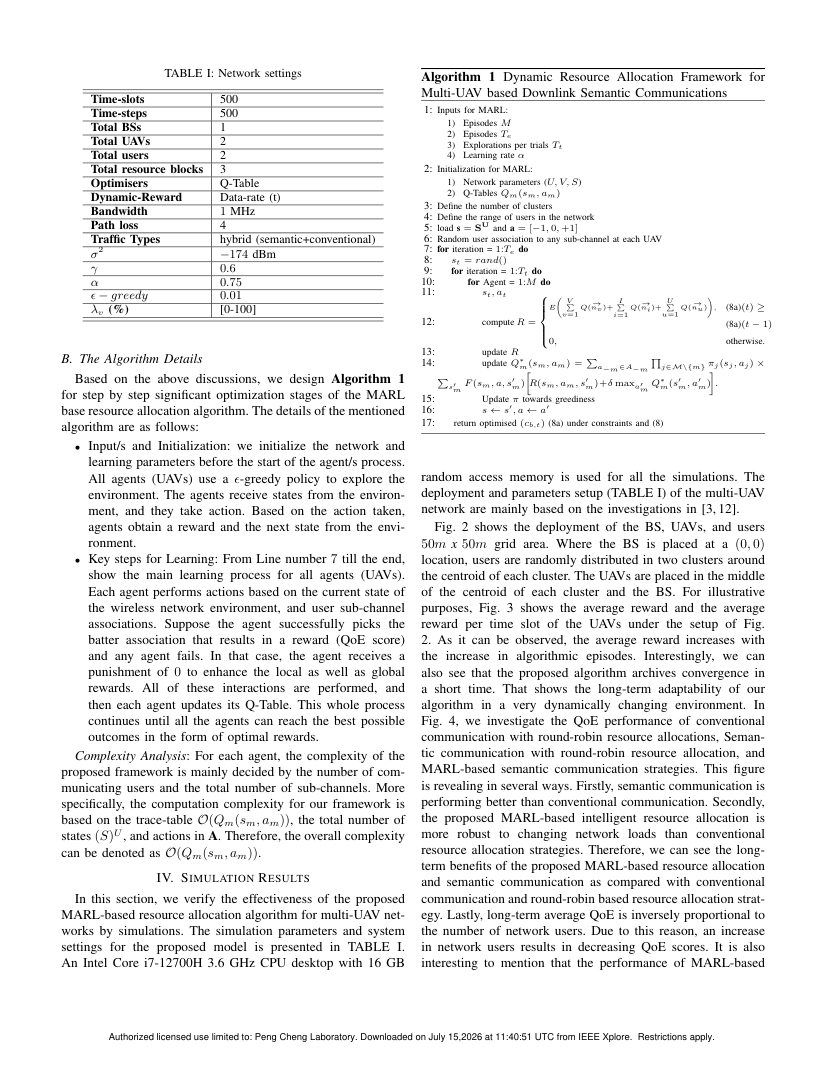
Therefore, we can see the long- term benefits of the proposed MARL-based resource allocation and semantic communication as compared with conventional communication and round-robin based resource allocation strat- egy. PDF p.5
For the improvement of long-term QoE performance in dynamic network conditions, the proposed reward function is able to converge efficiently. PDF p.6
Second, with the help of the dynamic reward strategy, the proposed MARL outperforms conventional resource allocation schemes. PDF p.6
Resource Allocation for Semantic Aware Relay Networks using Multi-Agent Reinforcement Learning,原 PDF 第 1 页(架构/方法页)。Resource Allocation for Semantic Aware Relay Networks using Multi-Agent Reinforcement Learning,原 PDF 第 5 页(关键结果页)。
Token Communications: A Large Model-Driven Framework for Cross-Modal Context-Aware Semantic Communications
2025 · IEEE Wireless Communications · 资源分配与跨层优化
作者:Qiao Li; Mahdi Boloursaz Mashhadi; Zhen Gao; Rahim Tafazolli; Mehdi Bennis; Dusit Niyato
仍然存在的问题:In this paper, we introduce the potential opportunities and challenges of leveraging context in GenSC, explore how to integrate GFM/MLLMs- based token processing into semantic communication systems to leverage cross-modal context effectively at affordable complexity, present the key principles for efficient TokCom at various layers in future wireless networks. PDF p.1
本文提出的方案:1 Token Communications: A Large Model-Driven Framework for Cross-modal Context-aware Semantic Communications Li Qiao∗, Mahdi Boloursaz Mashhadi∗, Senior Member, IEEE, Zhen Gao, Member, IEEE, Rahim Tafazolli, Fellow, IEEE, Mehdi Bennis, Fellow, IEEE, and Dusit Niyato, Fellow, IEEE Abstract—In this paper, we introduce token communications (TokCom), a large model-driven framework to leverage cross- modal context information in generative semantic communica- tions (GenSC). PDF p.1
方案起作用的机制:In a typical image semantic communication setup, we demonstrate a significant improvement of the bandwidth efficiency, achieved by TokCom by leveraging the context information among tokens. PDF p.1
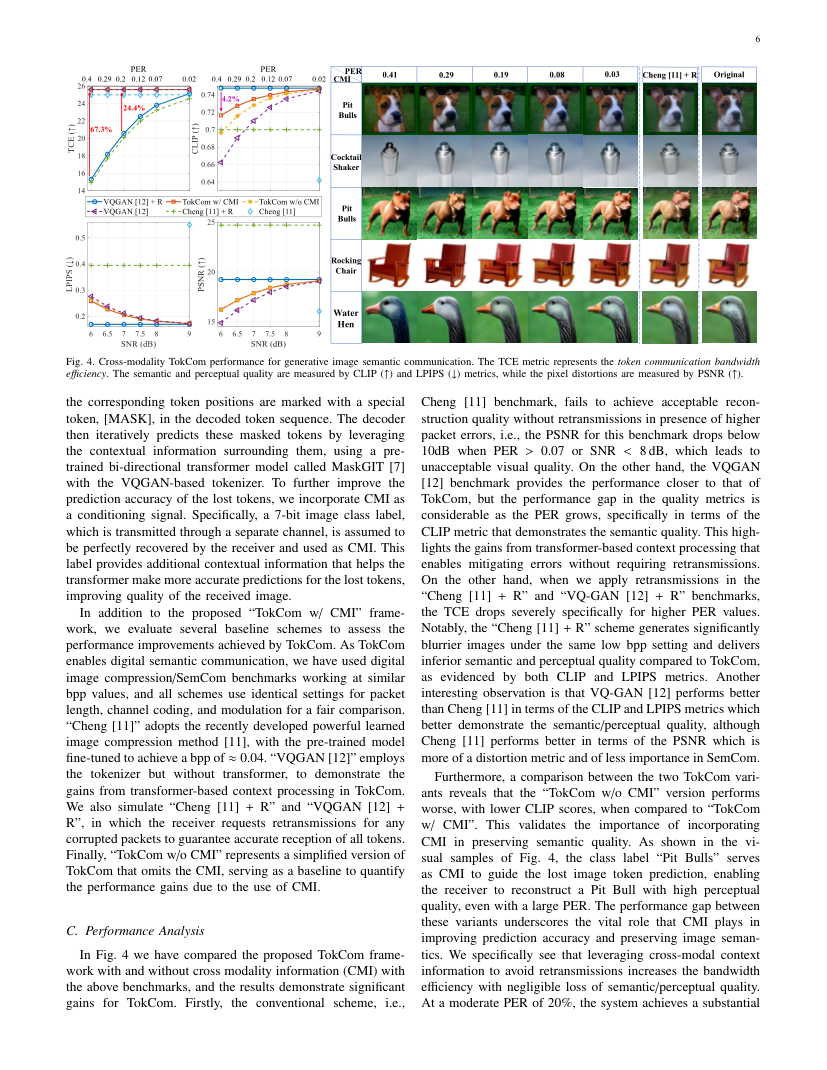
作者希望证明的结论:Performance Analysis In Fig. 4 we have compared the proposed TokCom frame- work with and without cross modality information (CMI) with the above benchmarks, and the results demonstrate significant gains for TokCom. PDF p.6
Early models like Word2Vec and GloVe used fixed embeddings, while modern transformer models such 1https://github.com/openai/CLIP 2https://github.com/LAION-AI/CLAP 3https://github.com/AndreyGuzhov/AudioCLIP as bidirectional encoder representations from transformers (BERT) and GPT learn contextual embeddings, meaning the representation of a word like “bank” varies depending on its context. PDF p.2
When co-channel mixed tokens arrive at the receiver, the GFM/MLLM architecture disentangles the over- lapping tokens through joint analysis of semantic orthogonality and predictive modeling, ultimately reconstructing both origi- nal videos. PDF p.4
On the receiver side, demodulation and decoding are performed using a Soft Viterbi decoder, resulting in different packet error rate (PER) at different signal-to-noise ratio (SNR) values. PDF p.5
Proposed Cross-Modality TokCom Scheme To enhance the TCE of TokCom under various channel conditions, we propose a “TokCom w/ CMI” scheme, which aims to reduce the overhead of retransmissions and predict lost token packets by exploiting the context and cross-modality information (CMI). PDF p.5
中间语义表示是什么
A Tok- enizer generates a large unified codebook of token embeddings that represent the whole corpus of multimodal data, e.g., colossal clean crawled corpus (C4) for text, LAION-5B for image-text pairs, and then the (pre-)trained MLLM essentially learns relations between tokens capturing the semantics and context. PDF p.2
After patchification and embedding, vector quatization is typi- cally used to achieve a discrete latent space, where each image is represented by a sequence of token indices from a codebook. PDF p.2
3 N tokens Encode with self-attention Extract embeddings Predict Masked positions Bidirectional Transformer Embeddings Token codebook … (b) (a) Token codebook … … 𝑝𝑠= ෑ𝑝𝑠𝑠ழ Unidirectional Transformer 𝑠ழ 𝑠 De-tokenizer Embeddings Token ID Fig. 2. PDF p.3
We will discuss this and other basic TokCom setups in the next sections. • In TokCom, the pre-trained token codebook is used as the shared knowledge base (KB) between the transmitter and receiver. PDF p.3
1 Token Communications: A Large Model-Driven Framework for Cross-modal Context-aware Semantic Communications Li Qiao∗, Mahdi Boloursaz Mashhadi∗, Senior Member, IEEE, Zhen Gao, Member, IEEE, Rahim Tafazolli, Fellow, IEEE, Mehdi Bennis, Fellow, IEEE, and Dusit Niyato, Fellow, IEEE Abstract—In this paper, we introduce token communications (TokCom), a large model-driven framework to leverage cross- modal context information in generative semantic communica- tions (GenSC). PDF p.1
TokCom is a new paradigm, motivated by the recent success of generative foundation models and multimodal large language models (GFM/MLLMs), where the communica- tion units are tokens, enabling efficient transformer-based token processing at the transmitter and receiver. PDF p.1
In this paper, we introduce the potential opportunities and challenges of leveraging context in GenSC, explore how to integrate GFM/MLLMs- based token processing into semantic communication systems to leverage cross-modal context effectively at affordable complexity, present the key principles for efficient TokCom at various layers in future wireless networks. PDF p.1
In a typical image semantic communication setup, we demonstrate a significant improvement of the bandwidth efficiency, achieved by TokCom by leveraging the context information among tokens. PDF p.1
The source code is publicly available at https://github.com/liqiao19/TokenCom Code. PDF p.1
bit / token / channel-use / CBR 证据
The token codebook size is Q = 1024 and each token is represented by 10 bits, achieving the ultra-low-bitrate transmission of 0.039 bit per pixel (bpp). PDF p.5
信道处理机制:decoder 实际收到什么
分类:有限星座/调制符号直接过噪声信道 接收端从有噪星座或 soft symbol 恢复语义;需区分是否有显式 bit/index 译码。
The 16-QAM modulation is used and the bandwidth is 0.05 MHz. PDF p.5
Different from many conventional deep joint source channel coding (DeepJSCC)-based SemCom schemes, TokCom achieves scalability and adaptability by alleviating the need for end-to-end training. • Tokens unify modalities and TokCom can leverages cross-modal relations to achieve ultra-low-bitrate Sem- Com. PDF p.3
TokCom and Semantic Source Compression TokCom systems can leverage GFMs/MLLMs-based con- text processing to achieve ultra-low-bitrate semantic source compression in future wireless networks. PDF p.3
Thereby, compression is achieved when models PDF p.3
As an example, the authors in [8] demonstrated that Chinchilla 70B, i.e., a language model primarily trained on text, can efficiently compress ImageNet patches to 43.4% of their original size and LibriSpeech audio samples to 16.4%, outperforming modality- specific compressors like PNG (58.5%) and FLAC (30.3%). PDF p.4
To achieve this, we introduce the concept of semantic orthog- onality in the token domain as an emerging new dimension for multiple access communications. PDF p.4
Token Communications: A Large Model-Driven Framework for Cross-Modal Context-Aware Semantic Communications,原 PDF 第 1 页(架构/方法页)。Token Communications: A Large Model-Driven Framework for Cross-Modal Context-Aware Semantic Communications,原 PDF 第 6 页(关键结果页)。
Channel-Adaptive Semantic Communication for Stereoscopic Media: Design and Prototype Implementation
2026 · IEEE Transactions on Cognitive Communications and Networking · 物理层调制、波形与 MIMO
作者:Jingxuan Men; Mahdi Boloursaz Mashhadi; Ning Wang; Yi Ma; Mike Nilsson; Rahim Tafazolli
本文提出的方案:To address this, we propose a novel dual-view deep joint source-channel coding scheme that efficiently extracts and transmits semantic features representing inter-view correlations, thereby reducing redun- dancy while improving the reconstruction quality. PDF p.1
方案起作用的机制:By leveraging the disparity between views, stereoscopic media can facilitate 3D structure construction and enhance spatial perception. PDF p.1
作者希望证明的结论:If the proposed semantic mask significantly outperforms the random mask, it provides strong validation for the effectiveness of the proposed algorithm. PDF p.9
To address this, we propose a novel dual-view deep joint source-channel coding scheme that efficiently extracts and transmits semantic features representing inter-view correlations, thereby reducing redun- dancy while improving the reconstruction quality. PDF p.1
We propose an innovative dual-view deep joint source-channel coding scheme, which eliminates the need for entropy coding, reducing computa- tional overhead. PDF p.2
To address the high-bandwidth requirements for 3D rendering, we integrate our framework with Gaussian Splatting, enabling novel view synthesis with significantly reduced communica- tion overhead. PDF p.2
Section IV details the architectures of both SSC Version 1 and SSC Version 2. PDF p.2
中间语义表示是什么
To address this, we propose a novel dual-view deep joint source-channel coding scheme that efficiently extracts and transmits semantic features representing inter-view correlations, thereby reducing redun- dancy while improving the reconstruction quality. PDF p.1
Semantic communication has recently emerged as a promis- ing solution for efficient multimedia transmission by extracting and transmitting semantic features while filtering redundant information [7], [8], [9], [10], [11], [12]. PDF p.1
Reference [35] introduced an entropy-aware rate control mechanism in which the entropy of feature maps guides adaptive bandwidth allocation. PDF p.3
The proposed semantic communication framework for stereo media transmission (SSC Version 1). yielding semantic features Fprimary and Fauxiliary, respectively, for the primary and auxiliary views. PDF p.4
数字化方案与实际传输开销
数字化判断:数字调制或混合数字-模拟链路 语义表示被映射到有限星座、编码 bit 或数字/模拟并行分支,已经触及可部署物理层接口。
We propose an innovative dual-view deep joint source-channel coding scheme, which eliminates the need for entropy coding, reducing computa- tional overhead. PDF p.2
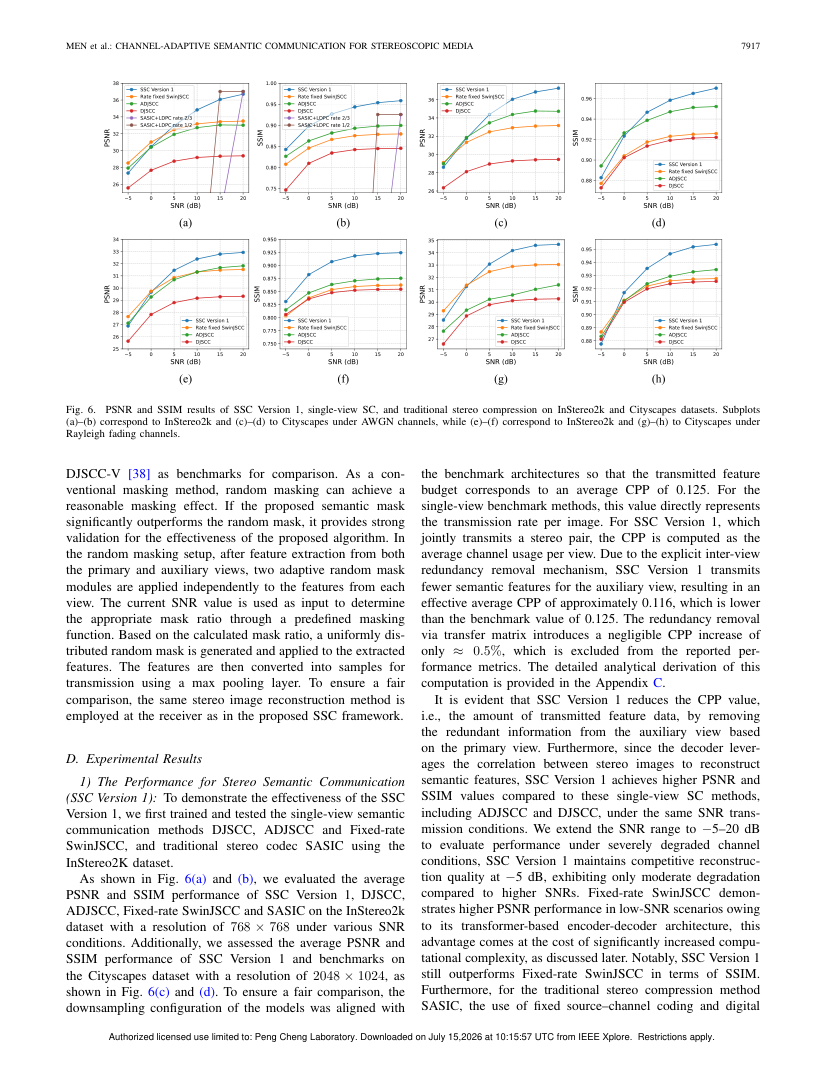
For a comprehensive evaluation, we also include a comparison with the conventional stereo compression method SASIC [4], where the compressed features are transmitted using entropy coding, 1/2 and 2/3 rate LDPC channel code. PDF p.8
As shown in Fig. 13, the training loss decreases monotonically while the validation PSNR increases and stabilizes, indicating smooth and stable convergence without oscillation or divergence. 5) Complexity Analysis: Finally, we compared the model floating-point operations (FLOP) and parameters for SSC Version 1, SSC Version 2, ADJSCC, Swin-JSCC, Dynamic JSCC, DJSCC-V and traditional stereo compression method with entropy coding SASIC on InStereo2k dataset cropped with a resolution of 768 × 768. PDF p.12
Moreover, in contrast to conventional stereo compression methods such as SASIC that rely on entropy coding for encoding and decoding, the SSC frameworks, built upon Deep JSCC, significantly reduce model complexity and computational latency, offering a more TABLE IV COMPARISON BETWEEN SINGLE-HEAD AND MULTI-HEAD SSC UNDER DIFFERENT SNR LEVELS efficient and practical solution for real-time stereo media transmission. 6) Ablation on Single-Head Versus Multi-Head Attention in SR Layers: To validate the single-head design in the stereo reconstruction (SR) layers, we conducted an ablation study comparing single-head and multi-head attention under identi- cal configurations. PDF p.12
Tafazolli, “Video TokenCom: Textual intent-guided multi-rate video token communications with UEP-based adaptive source-channel coding,” 2026, arXiv:2603.02470. [33] L. PDF p.16
bit / token / channel-use / CBR 证据
DeepJSCC-V [38] follows a different paradigm, where an oracle network predicts reconstruction quality under different compression ratios and channel conditions, and a separate optimizer selects the transmission rate to satisfy a target quality require- ment. PDF p.3
信道处理机制:decoder 实际收到什么
分类:数字语义特征 + 传统信道编码 decoder 通常看到信道译码后的 bit/index;若论文只假设译码成功,则未真正学习处理残余 index 跳变。
Its performance is comparable to the JPEG/JPEG2000 + LDPC scheme. PDF p.1
7910 IEEE TRANSACTIONS ON COGNITIVE COMMUNICATIONS AND NETWORKING, VOL. 12, 2026 TABLE I THE KEY DIFFERENCES BETWEEN THIS WORK AND THE LITERATURE 2D and 3D data requires significant bandwidth resources, while wireless channel noise and fading can lead to trans- mission errors and delays, ultimately degrading the viewing experience. PDF p.2
After the source coding operation, the real and imaginary components of the semantic features are directly mapped to the in-phase (I) and quadrature (Q) components of the baseband signal, which is transmitted over a wireless channel modeled as an untrainable Additive White Gaussian Noise (AWGN) or Rayleigh fading channel layer. PDF p.4
This approach avoids introducing imbalanced channel noise caused by using sepa- rate channels, which could adversely affect both latency and reconstruction quality. PDF p.4
Before transmission, the semantic code Z undergoes power normalization to ensure efficient transmission. 2) Stereo Source and Channel Decoder: Upon receiving the normalized semantic code Z’ with channel noise W ∼ CN(0, N0), SSC Version 1 first reconstructs the auxiliary view feature F′ auxiliary using the following relation F′ auxiliary = F′ residual-auxiliary + transfert(F′ primary). (3) Subsequently, the decoder performs multi-view semantic reconstruction, as illustrated in Fig. 3(b). PDF p.5
The SR layers are inserted at mul- tiple scales to enable cross-view semantic interaction and improve stereo consistency. PDF p.6
By leveraging inter-view correlations, the SR mechanism effectively improves reconstruction quality while maintaining low computational complexity. PDF p.6
Instead, the rate–distortion tradeoff is achieved during inference via the channel-aware adaptive semantic masking mechanism. PDF p.8
Benchmarks To evaluate the performance of our proposed SSC Version 1 framework, we first conduct a comparison with existing single- view semantic communication methods, as no prior work has achieved multi-view transmission using semantic communi- cation. PDF p.8
As a con- ventional masking method, random masking can achieve a reasonable masking effect. PDF p.9
Channel-Adaptive Semantic Communication for Stereoscopic Media: Design and Prototype Implementation,原 PDF 第 3 页(架构/方法页)。Channel-Adaptive Semantic Communication for Stereoscopic Media: Design and Prototype Implementation,原 PDF 第 9 页(关键结果页)。
Communicate Less, Synthesize the Rest: Latency-aware Intent-based Generative Semantic Multicasting with Diffusion Models
2026 · IEEE Transactions on Vehicular Technology · 资源分配与跨层优化
作者:Xinkai Liu; Mahdi Boloursaz Mashhadi; Li Qiao; Yi Ma; Rahim Tafazolli; Mehdi Bennis
本文提出的方案:In this paper, we develop an intent-aware generative semantic multicasting framework utilizing pre-trained diffusion models. PDF p.1
方案起作用的机制:The trans- mitter broadcasts the semantic map to all users over shared wireless resources, thereby utilizing orthogonal resources only to transmit the sub-signal classes intended for each user, which further saves the wireless resources. • To achieve scalability and adaptability, different from majority prior SemCom research, we follow a sep- tate source-channel coding scheme and pre-train a gen- erative diffusion model with classifier-free semantic guidance. PDF p.2
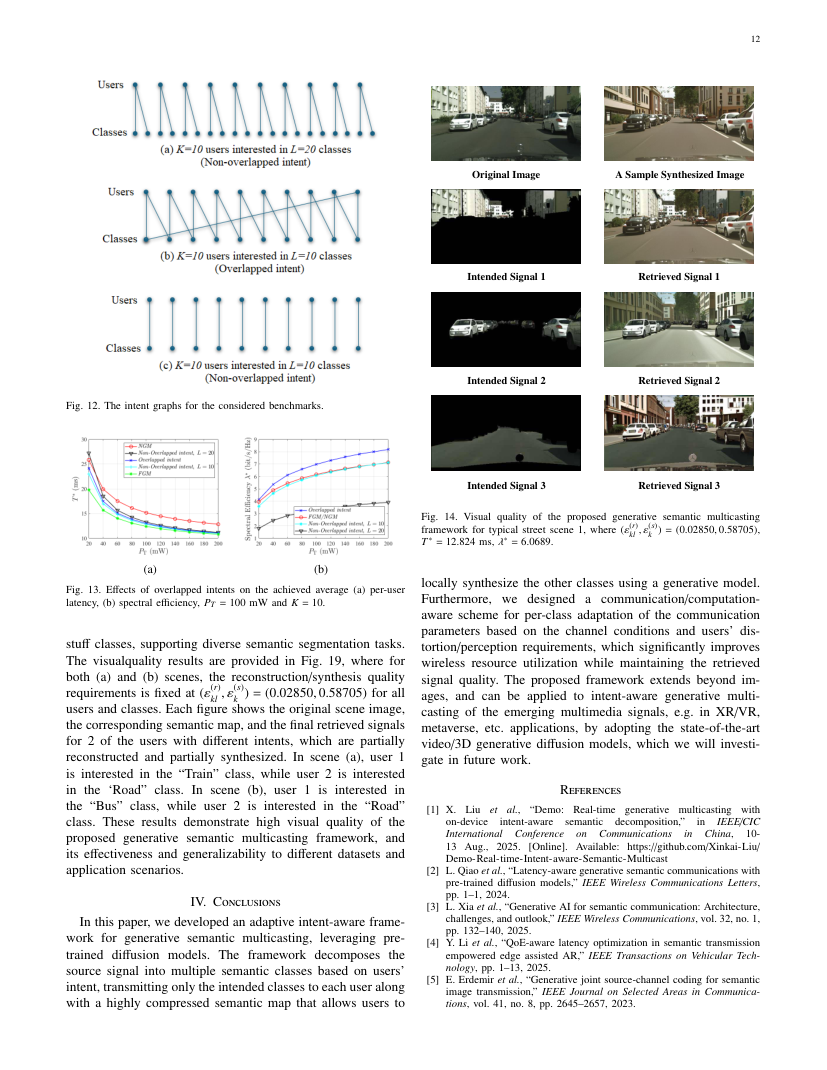
作者希望证明的结论:This shows that our proposed framework achieves a smaller compression rate for smaller K ≤3 values, thereby transmitting fewer bits over the wireless channel. PDF p.8
In this work, we propose generative semantic multicasting, where intent-aware decomposition of the source signal is carried out at the transmitter to allow communi- cating to each user only its intended part of the signal and synthesizing the rest locally with diffusion models, thereby avoiding unnecessary use of the wireless/network resources for transmission of the non-intended portions of the signal. PDF p.1
While the rate- distortion-perception function is analytically derived only for a few source distributions, it is generally estimated empirically for natural signals, e.g. images, audio/video, point cloud, etc., by training deep source encoders with a perceptual loss func- tion, e.g. PDF p.2
Secondly, the adoption of pre-trained models al- lows a source-channel separation-based Semcom architecture, thereby alleviating the need for end-to-end joint training of the transmitter and receiver, which is required in many exist- ing Semcom frameworks [24]–[27]. PDF p.2
Such a separation-based architecture offers improved adaptability to varying channel conditions, improved scalability to increase the number of users, and better compatibility with the existing design of wireless communication networks. PDF p.2
中间语义表示是什么
The generation process can be guided by multi-modal prompts and conditioning signals to produce high quality outputs with a desired semantic content. PDF p.1
In generative Semcom, the transmitter extracts the intended semantics, e.g. in form of textual prompts [13]–[15], compressed embeddings [16], [17], semantic map [18], [19], edge map [2], [7], etc., which are then transmitted over the channel. PDF p.2
Intent-aware semantic Decomposition with DDRNets for generative multicasting. branches, and a deep information extractor called Deep aggre- gation pyramid pooling module (DAPPM) to enlarge effective receptive fields and fuse multi-scale context based on low- resolution feature maps as shown in Fig. 2. PDF p.4
Information is extracted from low-resolution feature maps e.g., 1/8 denotes high-resolution branch create feature maps whose resolution is 1/8 of the input image resolution. PDF p.4
数字化方案与实际传输开销
数字化判断:数字调制或混合数字-模拟链路 语义表示被映射到有限星座、编码 bit 或数字/模拟并行分支,已经触及可部署物理层接口。
Qiao et al., “Token communications: A large model-driven framework for cross-modal context-aware semantic communications,” to appear in IEEE Wireless Commun. PDF p.13
bit / token / channel-use / CBR 证据
论文未以可检索文本完整报告输入尺寸、latent/token 数、每个 index 的 bit 数与总开销;本报告不在缺少形状和码本参数时伪造压缩率。可按 $R=N_s b_s/N_{src}$ 或 $\rho=n/k$ 在取得参数后推导。
RSMA, for the (non/)intended subsignal classes can be adopted in future work to further improve the performance of our proposed generative multicasting framework. PDF p.5
Also define E(r) l = min {︂ ε(r) kl⃓⃓⃓[I]kl ≠0, k ∈[K] }︂ , ∀l ∈[L] and E(s) = 3It is assumed that a smaller value of the metric represents improved reconstruction/synthesis quality. PDF p.6
The C/I/R adaptation is achieved by running the proposed Algorithm 1 during the “Online Deployment” phase without requiring end-to-end retraining. PDF p.7
K 1 2 3 5 10 15 r∗ 0.51698 0.58279 0.64859 0.7802 1.10922 1.43823 |b| 67762 76387 85012 102262 145387 188512 the achieved curve fitting results, which shows that the fitted exponential functions, i.e., Φr (r) = 0.199e(−3.454r) + 0.008 and Φs (r) = 0.214e(−5.14r) + 0.566, very well approximate both metrics with high accuracy. PDF p.8
Comparing these values with the compression rate achieved by our proposed frame- work as reported in TABLE III, we see that r∗< rNGM for K ≤3, while for K > 3 we have r∗> rNGM. PDF p.8
仍然存在的问题:The aim is to examine whether interference, channel state infor- mation (CSI) accuracy, and scalability limitations in conventional MIMO systems remain critical. PDF p.1
方案起作用的机制:These results confirm the powerful inference capabilities of the semantic MIMO by leveraging generative AI, and indicate that semantic MIMO is inherently more tolerant to interference. PDF p.5
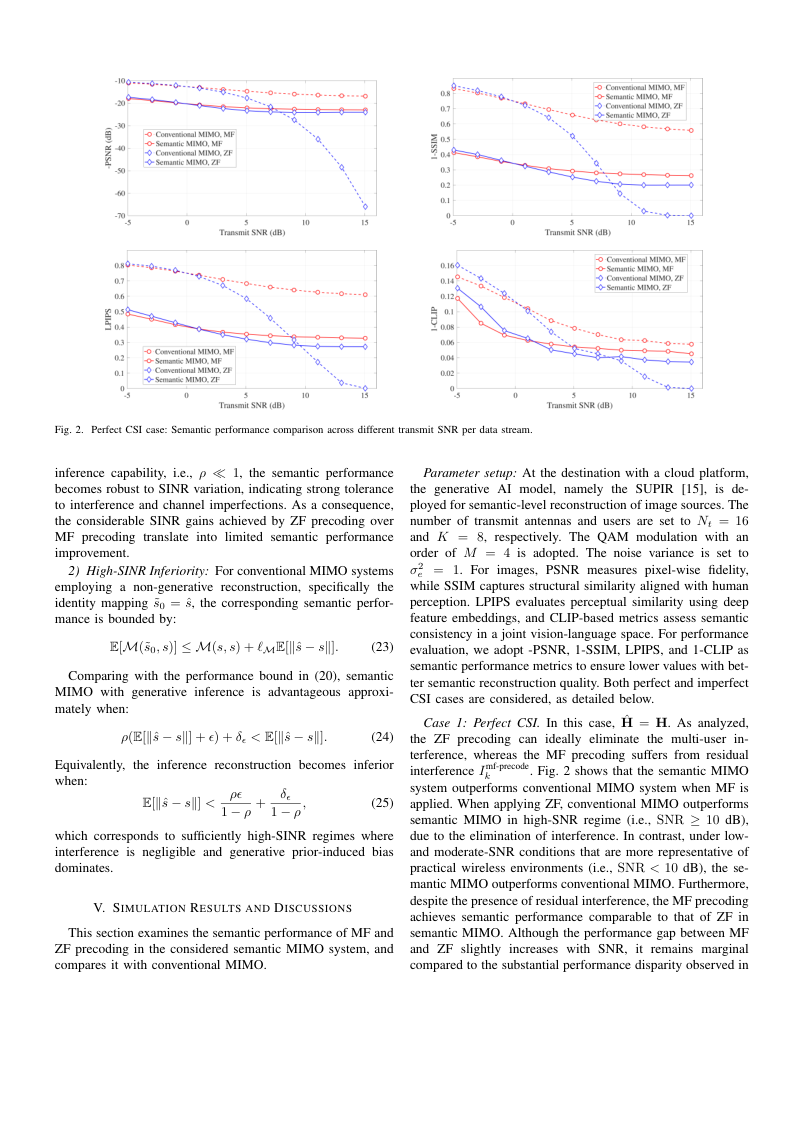
作者希望证明的结论:Fig. 2 shows that the semantic MIMO system outperforms conventional MIMO system when MF is applied. PDF p.4
Zhu, “Inference-driven uplink for 6G: Architecture, principles, and challenges,” 2026. [Online]. PDF p.6
中间语义表示是什么
Moreover, a more prac- tical codebook-based beamforming technique can achieve competitive semantic performance while significantly re- ducing implementation complexity. PDF p.6
Obtaining perfect CSI is difficult due to practical factors such as estimation errors, feedback quantization and delays. PDF p.2
Assume the metric M(˜s, s) is ℓM-Lipschitz continuous with respect to its first argument, satisfying the contraction property: M(u, s) −M(v, s) ≤ℓM∥u −v∥. (18) Using the triangle inequality, we obtain the following based on the contraction property in (10): ∥˜sG −s∥≤∥P(ˆs) −P(ˆsϵ)∥+ ∥P(ˆsϵ) −s∥ ≤ρ∥ˆs −ˆsϵ∥+ δϵ ≤ρ (∥ˆs −s∥+ ϵ) + δϵ. (19) Under Assumption 2, the semantic performance bound can be yielded: E[M(˜sG, s)] ≤M(s, s)+ρℓM(E[∥ˆs−s∥]+ϵ)+ℓMδϵ, (20) where E[∥ˆs −s∥] under channel-uncoded transmission can be approximated by E[∥ˆs −s∥] ≈ X k 2k−1BERk, (21) by assuming that at most one bit per pixel is incorrectly received. PDF p.3
Moreover, a more prac- tical codebook-based beamforming technique can achieve competitive semantic performance while significantly re- ducing implementation complexity. PDF p.6
bit / token / channel-use / CBR 证据
Assume the metric M(˜s, s) is ℓM-Lipschitz continuous with respect to its first argument, satisfying the contraction property: M(u, s) −M(v, s) ≤ℓM∥u −v∥. (18) Using the triangle inequality, we obtain the following based on the contraction property in (10): ∥˜sG −s∥≤∥P(ˆs) −P(ˆsϵ)∥+ ∥P(ˆsϵ) −s∥ ≤ρ∥ˆs −ˆsϵ∥+ δϵ ≤ρ (∥ˆs −s∥+ ϵ) + δϵ. (19) Under Assumption 2, the semantic performance bound can be yielded: E[M(˜sG, s)] ≤M(s, s)+ρℓM(E[∥ˆs−s∥]+ϵ)+ℓMδϵ, (20) where E[∥ˆs −s∥] under channel-uncoded transmission can be approximated by E[∥ˆs −s∥] ≈ X k 2k−1BERk, (21) by assuming that at most one bit per pixel is incorrectly received. PDF p.3
At the transmitter, the source s is partitioned into K bit sequences based on bit-level importance [12] and then directly modulated using M-QAM into K data streams {xk}K k=1 [2], with each transmitted to one user. arXiv:2604.01409v1 [eess.SP] 1 Apr 2026 PDF p.1
Denoting P precode k = p|ˆhH k fj|2, the average SINR of the k-th user can be expressed by: γk = E[Pk] E[Ik] + σ2n = P precode k + pσ2 e Iprecode k + Ierror k + σ2n . (7) The bit error rate (BER), which is the key performance indicator of conventional bit-centric MIMO system, of the k- th data stream can be approximately derived as: BERk = αQ (β√γk) , (8) where Q(x) = 1 √ 2π ´ ∞ x exp( −t2 2 )dt is the Gaussian Q- function. PDF p.2
For M-QAM modulation, the parameters α and β are given by α = 4 log2 M (1 − 1 √ M ) and β = q 3 M−1, respectively. PDF p.2
The QAM modulation with an order of M = 4 is adopted. PDF p.4
实验设置与证据
数据集:论文文本未明确命中,需查看原表格或附录
Baseline:论文文本未明确命中,需查看原表格或附录
信道/链路:MIMO、QAM
指标:PSNR、SSIM、LPIPS、accuracy、BER、CLIP
SNR 条件:10 dB、10 dB、15 dB、6 dB
主要实验结论(带全文页码)
Consequently, MF slightly outperforms ZF at low SNRs due to higher desired power, whereas its performance degrades severely at high SNRs due to higher precoder-induced interference. PDF p.3
Fig. 2 shows that the semantic MIMO system outperforms conventional MIMO system when MF is applied. PDF p.4
When applying ZF, conventional MIMO outperforms semantic MIMO in high-SNR regime (i.e., SNR ≥10 dB), due to the elimination of interference. PDF p.4
In contrast, under low- and moderate-SNR conditions that are more representative of practical wireless environments (i.e., SNR < 10 dB), the se- mantic MIMO outperforms conventional MIMO. PDF p.4
Furthermore, despite the presence of residual interference, the MF precoding achieves semantic performance comparable to that of ZF in semantic MIMO. PDF p.4
通信审稿价值与 Codex 判断
价值在于把语义质量转化为可优化的网络效用,并回答有限功率、带宽、时延应分给谁。
局限:证据主要来自数据集与仿真信道,缺少真实射频链路/原型验证。
Semantic MIMO: Revisiting Linear Precoding in the Generative AI Era,原 PDF 第 1 页(架构/方法页)。Semantic MIMO: Revisiting Linear Precoding in the Generative AI Era,原 PDF 第 4 页(关键结果页)。
排除与边界记录
这些条目在检索中出现,但因预印本、综述/愿景、MDPI、主题边界或被期刊扩展版取代而未进入核心表。
年份
标题
原因
2024
Communicate Less, Synthesize the Rest: Latency-aware Intent-based Generative Semantic Multicasting with Diffusion Models
非正式期刊/会议技术论文类型:preprint
2024
Generative Semantic Communication via Textual Prompts: Latency Performance Tradeoffs
非正式期刊/会议技术论文类型:preprint
2024
Generative Semantic Communications with Foundation Models: Perception-Error Analysis and Semantic-Aware Power Allocation
非正式期刊/会议技术论文类型:preprint
2024
Latency-Aware Generative Semantic Communications with Pre-Trained Diffusion Models
非正式期刊/会议技术论文类型:preprint
2024
Semantic-Aware Power Allocation for Generative Semantic Communications with Foundation Models
非正式期刊/会议技术论文类型:preprint
2025
ToDMA: Large Model-Driven Massive Token Communications for Semantic Multiple Access
非正式期刊/会议技术论文类型:preprint
2025
Token Communications: A Large Model-Driven Framework for Cross-modal Context-aware Semantic Communications
非正式期刊/会议技术论文类型:preprint
2025
Token-Domain Multiple Access: Exploiting Semantic Orthogonality for Collision Mitigation
非正式期刊/会议技术论文类型:preprint
2026
Video TokenCom: Textual Intent-Guided Multi-Rate Video Token Communications with UEP-Based Adaptive Source-Channel Coding
非正式期刊/会议技术论文类型:preprint
2026
Video TokenCom: Textual Intent-Guided Multi-Rate Video Token Communications with UEP-Based Adaptive Source-Channel Coding
非正式期刊/会议技术论文类型:preprint
2026
Wireless TokenCom: RL-Based Tokenizer Agreement for Multi-User Wireless Token Communications
非正式期刊/会议技术论文类型:preprint
2026
Wireless TokenCom: RL-Based Tokenizer Agreement for Multi-User Wireless Token Communications
非正式期刊/会议技术论文类型:preprint
2024
Semantic-Aware Power Allocation for Generative Semantic Communications with Foundation Models
存在同团队、同方法家族且作者高度重合的正式期刊扩展版;按既定口径由期刊版取代:Generative Semantic Communications With Foundation Models: Perception-Error Analysis and Semantic-Aware Power Allocation (IEEE JSAC, 2025)
2025
Adaptive Semantic Communication for Gaze-guided Stereo Media Transmission
存在同团队、同方法家族且作者高度重合的正式期刊扩展版;按既定口径由期刊版取代:Channel-Adaptive Semantic Communication for Stereoscopic Media: Design and Prototype Implementation (IEEE TCCN, 2026)
2026
Channel-adaptive Semantic Communication for Stereoscopic Media:Design and Prototype Implementation
同一正式论文的机构仓储/书目重复记录;保留 DOI 对应的出版社记录
2025
A Physical Layer Security Framework for Integrated Sensing and Semantic Communication Systems
会议版本被 IEEE TCCN 期刊扩展版 A Physical Layer Security Framework for IRS-Assisted Integrated Sensing and Semantic Communication Systems 取代
2021
Mixed High-Order Attention Network for Weakly- Supervised Semantic Segmentation
计算机视觉语义分割,非语义通信
2022
Real-Time Semantic Segmentation via an Efficient Multi-Column Network
计算机视觉语义分割,非语义通信
2021
A Hybrid Semantic Segmentation Based on Level-Set Evolution Driven by Fully Convolutional Networks
计算机视觉语义分割,非语义通信
方法与责任说明
书目元数据通过 OpenAlex、DOI 和出版页面核验;逐篇技术结论以本地 PDF 页码证据为准。自动定位不到可靠证据时明确标为待人工核查,不用摘要填充“阅读全文”结论。
AI Disclosure:本报告使用 AI 辅助完成检索、全文定位、结构化提取和网页生成;所有可核验论断均保留 DOI 或 PDF 页码入口。